

In earlier publications (Silver 2022a; 2022b; 2025) it was argued that adult basic education in Manitoba is a “buried treasure”—extremely effective but largely unknown and seriously underfunded. It was claimed that the benefits of adult basic education were such that funding ought to be doubled. This has not happened to date. However, the cost-benefit analysis described below confirms that adult basic education produces important fiscal benefits, more than sufficient to justify increased investment.
Adult basic education includes adult learning centres (ALCs) that offer the mature high school diploma to adults who had not previously finished high school, and adult literacy programs (ALPs) that bring adults up to high school entry level. As of the start of the 2025/26 academic year, according to information provided by the Province of Manitoba’s Adult Learning and Literacy Branch, there were 34 registered ALCs and 25 certified ALPs in all parts of Manitoba.
For the cost-benefit analysis described in this paper we wanted to determine if graduating from an adult learning centre with the mature high school diploma produces benefits that can be measured in monetary terms, and how those benefits relate to the costs of running Manitoba’s adult basic education program. We conducted a survey of graduates at five adult learning centres in different parts of the province. To measure the benefits, we first examined savings that arise when graduates leave Employment and Income Assistance (EIA). Savings were calculated by identifying the numbers who left EIA upon graduation with their mature high school diploma, and applying to those graduates the provincially determined payment levels that are based on family size. We also identified the increase in numbers employed full time upon graduation and estimated the increase in provincial tax revenue that would arise, making cautious assumptions about hours worked and rates of pay, and using provincial taxation rates. We identified the costs of the provincial adult basic education program from the 2023/24 Annual Report of the provincial Department of Advanced Education and Training, the latest available at the time of writing. The method and calculations are described below.
Previous studies of Manitoba’s adult basic education system
Four previous studies (Silver 2022a; 2022b; 2025; Silver, Klyne & Simard 2006) and a fifth that will appear next year (Silver 2026) have found that adult basic education in Manitoba is highly effective. It transforms the lives of adult learners, many of whom had been struggling with poverty and related problems. The earlier study (Silver, Klyne & Simard 2006), based on interviews with 74 Indigenous adult learners in five ALCs—three in Winnipeg, one in Portage la Prairie and one at Long Plain First Nation—found a very high level of satisfaction at each of these ALCs, with adult learners describing how their lives were benefiting. Those results were confirmed in interviews with Indigenous and non-Indigenous adult learners conducted by Kevin Nikkel in 2024/25, which can be seen in his film Live and Learn. Comments made by graduates who completed the survey that is the basis of this study exemplify the positive impact of adult basic education on people’s lives. Selected examples of these comments are included below.
The impact of adult basic education
I can honestly say that the Seven Oaks ALC saved my life. I was ready to give up for the final time, but the teachers there pulled me out of my shell and helped me see that I do, in fact, have a future. I’m now in college and no longer suicidal.
I had a wonderful experience with Kelsey Adult Learning. I was well supported. It opened a whole new world of opportunities.
Urban Circle has profoundly changed my life, how I look at the world, how I see myself. They built me up for success and brought culture into my life. The healing work that they do for the community and for myself was amazing.
I can’t possibly say enough positive things about the learning centre in Killarney. Katherine helped me when everybody else wouldn’t…. She went out of her way to make me feel I was part of something and that I mattered! I will forever be grateful to Katherine and the Adult Ed Program.
The people here have educated me not only in the academic area but in my personal life as well. They truly had a profound impact on me [adult learner at the Regional Alternative Education Centre in Altona].
The four more recent studies (Silver 2022a; 2022b; 2025; 2026) were based on multiple interviews conducted over four years with more than 35 adult educators in all parts of Manitoba. Those studies also found that adult basic education in Manitoba is highly effective, improving the lives of large number of adults, many of whom had been struggling with various problems prior to enrollment. Adult basic education in Manitoba is transformative—it changes the lives of adult learners and their families for the better.
A disproportionate number of adult learners are people who have grown up in and/or are living with poverty. The studies concluded that adult basic education can accurately be seen as a particularly effective anti-poverty initiative, in at least two important ways: first, adults who earn a mature high school diploma are likely, in the process, to develop the skills and aptitudes that will enable them to find the kind of employment that will pull them and their families out of poverty; and second, evidence shows that when mom and/or dad are attending an ALC, their children are likely to do better in school and thus are less likely to end up in poverty. In this way, adult basic education can contribute to breaking the intergenerational cycle of poverty.
This is especially important given the very high rates of poverty in Manitoba. In 2022, based on tax filer data, Manitoba was the province with the highest rate of children growing up in poverty—27.1 percent, or more than one in four. The federal constituency of Winnipeg Centre had the highest child poverty rate, 41.1 percent, of any urban centre in Canada. Three of the ten federal constituencies in Canada with the highest rates of child poverty were in Manitoba—Churchill-Keewatinook Aski, Winnipeg Centre, and Dauphin-Swan River-Neepawa (Campaign 2000: 2024). Child poverty, which really means children growing up in families living in poverty, can produce lasting, negative effects, including difficulties at school (Brownell Roos and Fransoo 2006: 4; Gaskell and Levin 2012: 12).
Adult basic education is also an important part of the process of reconciliation. Indigenous people, on average, experience less success in high school than their non-Indigenous counterparts. This is attributable in large part to the long-lasting effects of the residential school experience, and the continued impact of colonialism, racism and complex poverty. Indigenous high school graduation rates are, on average, lower than those of non-Indigenous youth. However, many Indigenous adults return to school later, via adult basic education, where they are represented at a rate between two, and two and a half times their share of the population. Adult basic education is, for them, a response to the damage caused by the residential schools and colonialism. As Justice Murray Sinclair has said on numerous occasions, “education got us into this mess, and education will get us out of it.” To the extent that this is the case, it is especially adult basic education that will serve this purpose. As an adult educator in northern Manitoba said, “we are reconciliation in action … the boots on the ground for reconciliation” (Silver 2022a: 14).
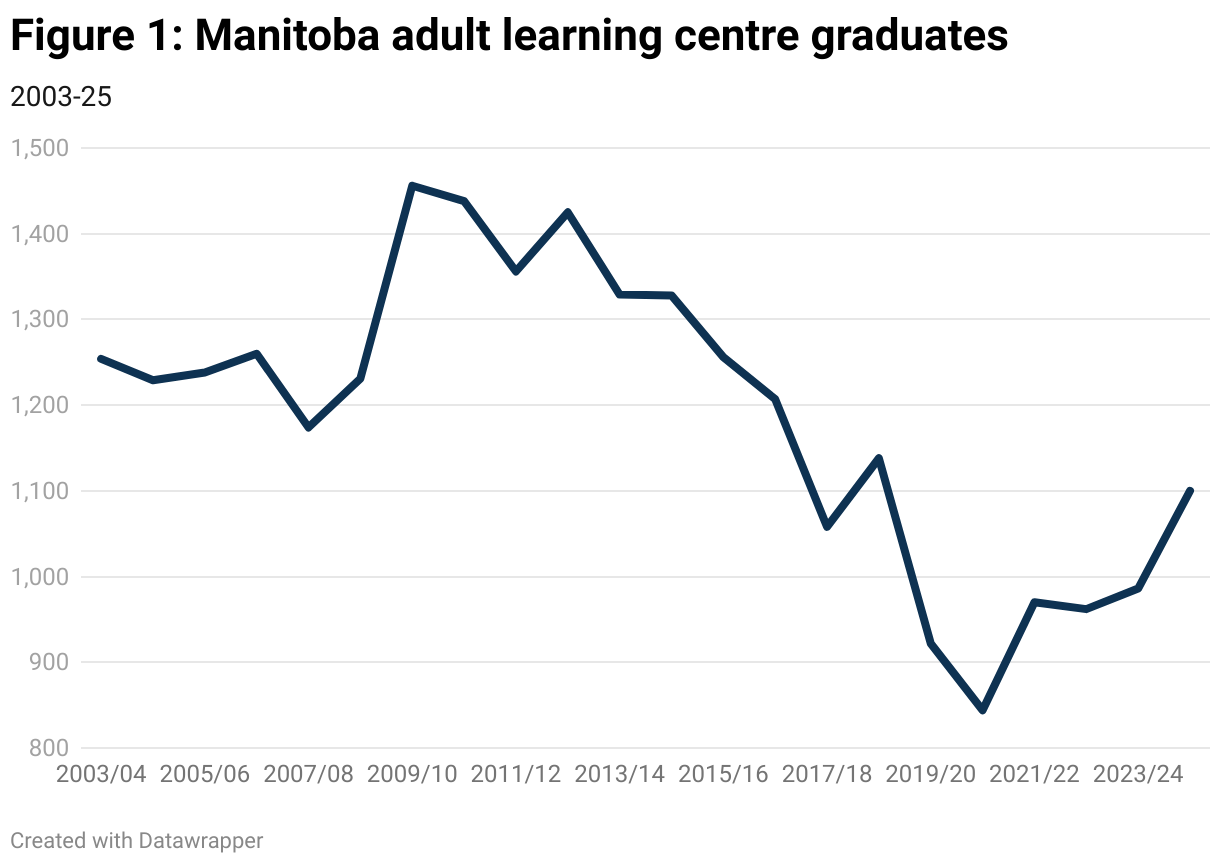
As valuable as adult basic education is in reducing poverty and promoting reconciliation and in improving the lives of adults and their families, these previous studies also found that it has been severely underfunded for years, with the result that numbers of graduates have declined until very recently (Figure 1).
The earlier studies confirmed that returning to school as an adult is a difficult challenge, especially when many have previously had negative experiences with school. To maximize their chances of educational success, it was argued that adult learners need more supports than are currently available, including access to childcare and counselling services. Various other reforms were recommended (Silver 2022b). These included: doubling the annual investment in adult basic education; ensuring that all adult educators are paid at the same rate as teachers in the K-12 system with the same qualifications; requiring school divisions to be more supportive, financially and otherwise; and using a “hub model”—combining in one physical space or in close proximity an ALC, an ALP, a dedicated childcare centre and connections with employers.
These reforms have not yet been implemented. However, the Adult Literacy Act that had been eliminated by the previous government was reinstated by the current provincial government in 2024, and the Social Assistance Amendment Act was introduced in 2024, enabling those on EIA to continue to receive their benefits if they choose to pursue the mature high school diploma via Manitoba’s adult basic education system.
More gains might be made if it can be shown that adult basic education leading to the mature high school diploma produces fiscal benefits that offset its costs. It is the purpose of this paper to determine if that is the case.
Earlier studies of the fiscal benefits of a high school diploma and the costs of low levels of education
Previous studies have identified the fiscal benefits of a high school diploma. For example, the Conference Board of Canada (2019: 20) found that “Each additional high school graduate saves the Ontario government (on average) $2767 each year on social assistance, health care and criminal justice, while each additional high school non-completer costs the province $3128 each year.” Economist Robert Allen (1999) found that the fiscal benefits of completing high school are so high—i.e., benefits exceed costs by so much—that it would make financial sense for governments to borrow money and invest it to increase the numbers of high school graduates.
Low levels of literacy are costly, not only to individuals but to the country. A study by Sonya Gulati (2013:4), a senior economist with the Toronto-Dominion Bank, calculated that “poor educational outcomes are costing the country hundreds of billions of dollars in lost opportunity.” Craig Alexander (2012: 14), then a TD Bank Vice-President and senior economist, estimated that raising all those with level two literacy scores, roughly equivalent to a grade three/four level in reading, to level three would produce an estimated $80 billion boost to the Canadian economy. Gulati (2013: 14) and Alexander (2012: 12) found that higher levels of literacy correlate strongly with higher levels of employment and income.
Serge Coulombe and Jean-Francois Tremblay (2006) estimated that a one percent increase in Canada’s average score on the international test for adult literacy would produce a 1.5 percent increase in GNP, and the greatest fiscal benefits would flow from increasing the educational levels of the least educated Canadians. Karen Myers and Patrice de Brougher (2006: iii) argued, “Better educated individuals will earn higher wages, have greater earnings growth over their lifetimes, and experience less unemployment. Better educated nations have higher long run economic growth and higher standards of living.” Brigid Hayes (2024: iii), long-time adult literacy analyst wrote, “Over 30 years of evidence demonstrates the positive relationship between literacy skills and education and employment outcomes [and] national economic performance.” She added that improvements in “social cohesion and civic participation” also follow from improved education levels.
These are all estimates based upon a variety of assumptions, and the precise dollar value of improved literacy and a high school diploma is difficult to quantify. But there is unanimity that improving literacy levels and increasing the numbers of high school graduates produces fiscal benefits—higher levels of employment and income and thus higher tax revenues; lower costs of social assistance and health care, and lower costs associated with criminal activity.
Method
To test the large body of academic evidence suggesting that investment in adult basic education produces fiscal and other economic benefits, we conducted our own cost-benefit analysis. A survey was conducted at five adult learning centres in Manitoba—Seven Oaks Adult Learning Centre and Urban Circle Training Centre in Winnipeg, the Kelsey Learning Centre in The Pas in northern Manitoba, the Regional Alternative Education Centre in Altona in southern Manitoba, and the Turtle Mountain Adult Education Centre in Killarney and Boissevain in south-western Manitoba.
The survey was prepared in consultation with Fran Taylor, Director of the Seven Oaks Adult Learning Centre and long-time adult educator, Mary Agnes Welch, partner at Probe Research, a professional market and public opinion research firm in Winnipeg, and Niall Harney, senior economist and Errol Black Chair in Labour Issues at the Canadian Centre for Policy Alternatives-Manitoba. The survey was scripted into Probe’s software and piloted at the Seven Oaks Adult Learning Centre. Each adult learning centre was then provided with its own sharable link to the survey. The survey was in the field from January 20 to April 28, 2025. It can be viewed in the Appendix.
A funding application to the SSHRC-funded Manitoba Research Alliance was successful in securing the funds to pay Probe Research to administer the survey. The project was approved in December 2024 by the University of Winnipeg Ethics Committee.
At each of the five adult learning centres, the survey was sent by the Director of the ALC to those adults who had graduated two, three, four and five years ago. A total of 1005 individual surveys were sent to graduates. Potential respondents at each of the five ALCs were told that completion and submission of the survey would make them eligible for a $100 prize awarded at each of the five ALCs. Also, at each ALC the Director contacted—by telephone, text and even social media—all those who did not initially respond to the emailed request, urging them to complete and submit the survey. Those who chose to respond signed a consent form attached to the survey questions, and submitted their responses to Probe Research, which assembled and categorized the data and did a preliminary analysis, both for each of the five ALCs and for the five in total. CCPA-MB economist Niall Harney contributed to the further analysis of the survey data and preparation of the tables and figures.
In total, 292 graduates responded to the survey, a response rate for all five together, rounded off to the nearest full percentage point, of 29 percent. A response rate of 29 percent carries a margin of error of plus or minus 4.83 percentage points, 19 times out of 20. This was a census-style survey, for which every graduate had an equal opportunity to participate. The profile of those who responded is largely consistent with that of the total population of adult learners. Just under half (45 percent) of those graduates who responded to the survey were Indigenous, just under one-third (30 percent) were born outside of Canada, and almost five in six respondents (84 percent) were between 18 and 45 years of age. Each of these is consistent with the total population of adult learners. The only exception was that approximately 67 percent of respondents to our survey were women, whereas women typically constitute 55-57 percent of the total population of adult learners.
Estimates of costs and benefits in this study are based on assumptions that are conservative, and every effort has been made to be transparent about the method, assumptions and calculations.
Some broader benefits of the mature high school diploma
In addition to the economic analysis of the costs and the benefits of adult basic education, we asked the 292 graduates from the five ALCs, “Do you agree or disagree with the following statements?”
- “I’m happier now than I was when I started classes at the adult learning centre;”
- “My kids benefited from me getting my high school diploma;”
- “I feel like I’m well on my way to a good life.”
The results, with “not applicable/no response” removed, were especially positive. For each of the three questions, almost all the graduates strongly or somewhat agreed, as shown in Table 1.
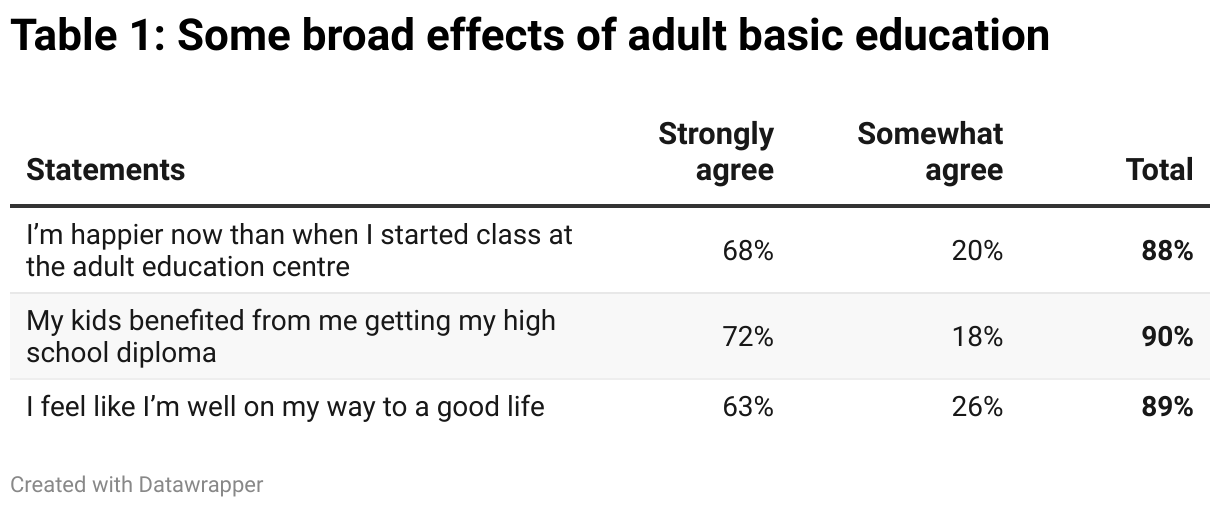
To find that 88 percent of respondents are happier now than they were when they started at their ALC is important. Families are likely to be healthier, and relationships are likely to be more stable when a parent or parents are happier, and many individual and societal benefits are likely to flow from this, not least the positive effects for the children of adult learners.
That 90 percent of respondents reported that their children benefited from the parent attending and graduating from an ALC has important implications. Children being raised in happier homes where parents see the importance of education are more likely themselves to graduate from high school, with the economic (and other) benefits that follow. This is a case of adult basic education disrupting the cycle by which poverty produces poor educational outcomes that in turn produce still more poverty.
Eighty-nine percent of respondents said they believe, “I am well on my way to a good life.” This suggests both a strong sense of optimism about the future, and a growth in self-confidence and self-esteem, the absence of which is common among those just starting in adult basic education. A good life can mean many things. An Indigenous graduate of Urban Circle Training Centre who appeared in Kevin Nikkel’s film Live and Learn (Nikkel 2024) described the effects attending Urban Circle Training Centre has had on her and her family—it “totally changed our relationship and our life and taught us a lot about ourselves and our family and what we want in life and how to get it.” A non-Indigenous graduate of the ALC in Altona said, “I’m very proud of myself…. It’s like, life changing. I never thought I’d be able to pursue my actual dream of becoming a nurse, but I’m actually only a few months away from applying and I didn’t ever think I would get here” (Nikkel 2024). In short, being well on the way to a good life can mean much more than just being better off financially.
Nevertheless, the evidence from this study is that graduation from an adult learning centre produces financial and fiscal benefits.
Fiscal benefits arising from reduced costs of employment and income assistance following graduation
A major finding of this study is that significant numbers of adult learners who had been on Employment and Income Assistance (EIA) when they started at one of the five ALCs, were no longer on EIA following graduation.
Before starting classes 63 respondents were on EIA; at the time of the survey this number was reduced to 24—39 fewer were on EIA after graduation than before, which is a 62 percent reduction.
These results mean that the cost of adult basic education will be lowered by savings in EIA expenditures. Table Two provides an estimate of the annual gross EIA claims amongst our survey cohort of 292 adult learners, both before enrollment in an adult learning centre, and after graduation from an adult learning centre. Annual EIA claims were estimated both for single individuals, and for parents with children, using publicly available EIA rates. Annual EIA entitlements for a single person were taken directly from a Government of Manitoba site.1https://www.gov.mb.ca/fs/eia/mcb_table.html Annual EIA entitlement estimates for a person with children are based on a family with two children (EIA entitlements increase based on family size beginning with one child, up to four children).
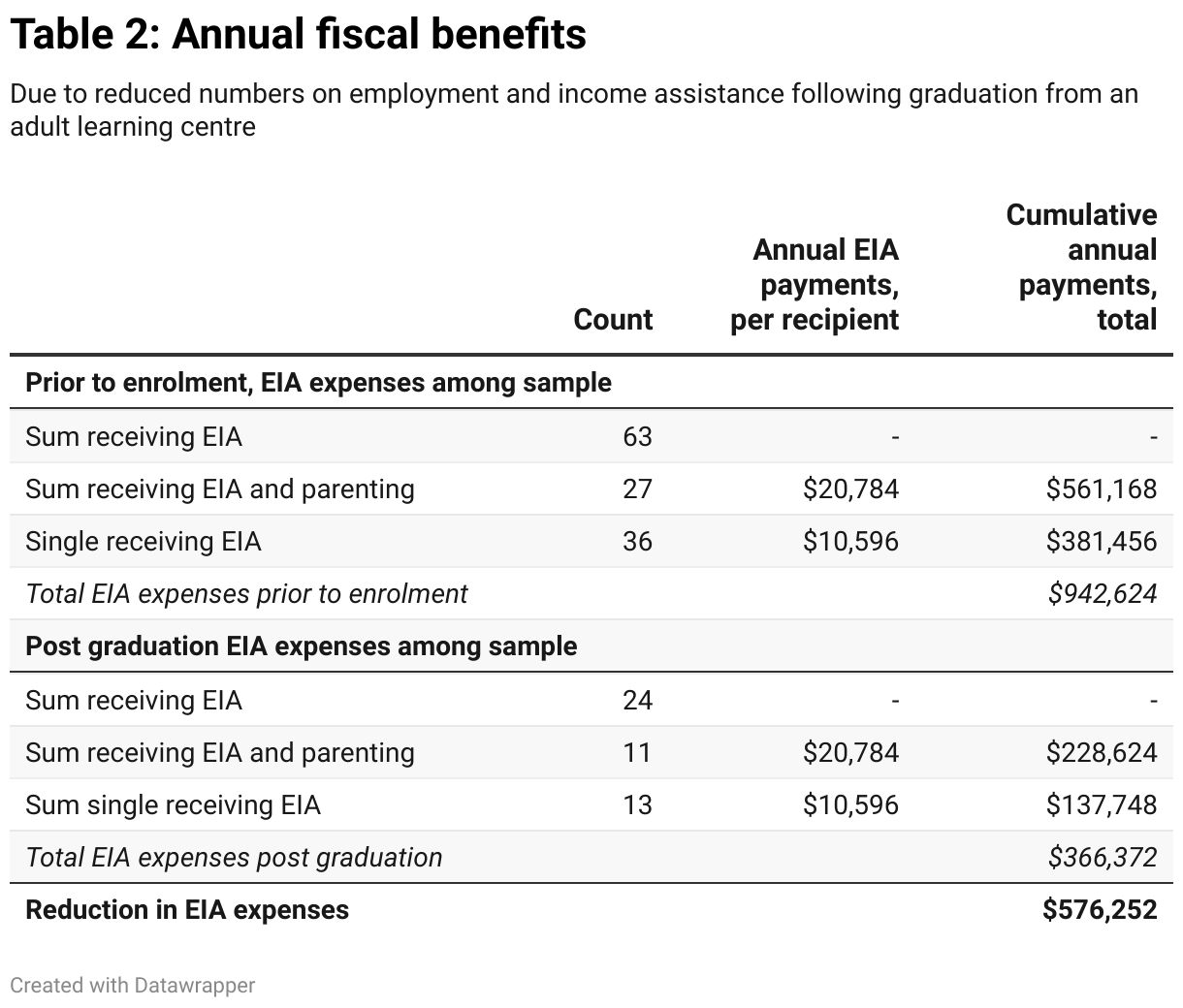
Annual EIA claims after graduation were reduced by $576,252. However, some of these people would have left EIA anyway, without the benefit of the mature high school diploma, and so all of these savings cannot be attributed to graduating with the mature high school diploma. Data provided by the Executive Director of Employment, Income and Health Supports Policy, a division of the Department of Family Services, show that for each of the last four years, four percent, five percent, four percent and three percent of all those on EIA left EIA without the a mature high school diploma. This is an average of four percent over that period. Therefore, the fiscal benefit to Manitoba is reduced by four percent of $576,252, or $23,050, making it $553,202.
Fiscal benefits arising from increased employment following graduation
Employment improved following graduation. Before they started classes at their ALC, 93 respondents were employed full-time; at the time of the survey, 161 were employed full-time—the number employed full-time grew by 68, or 73 percent. While 70 respondents had neither been employed nor looking for work before attending their ALC, that number had declined to 30 upon graduation, meaning 40 fewer respondents were neither employed nor looking for work.
At the time of the survey, in addition to the 161 graduates who were employed full-time, 40 were employed part-time, and an additional 42 graduates were taking further education that will lead to employment—a total of 243 graduates either working or taking further courses. That number is 83 percent of the 292 graduates in the sample, or five in every six. This is a remarkable number, especially given that many of these graduates will have returned to high school after a long absence and with added family and/or work responsibilities, demonstrating clearly the transformative power of adult basic education.
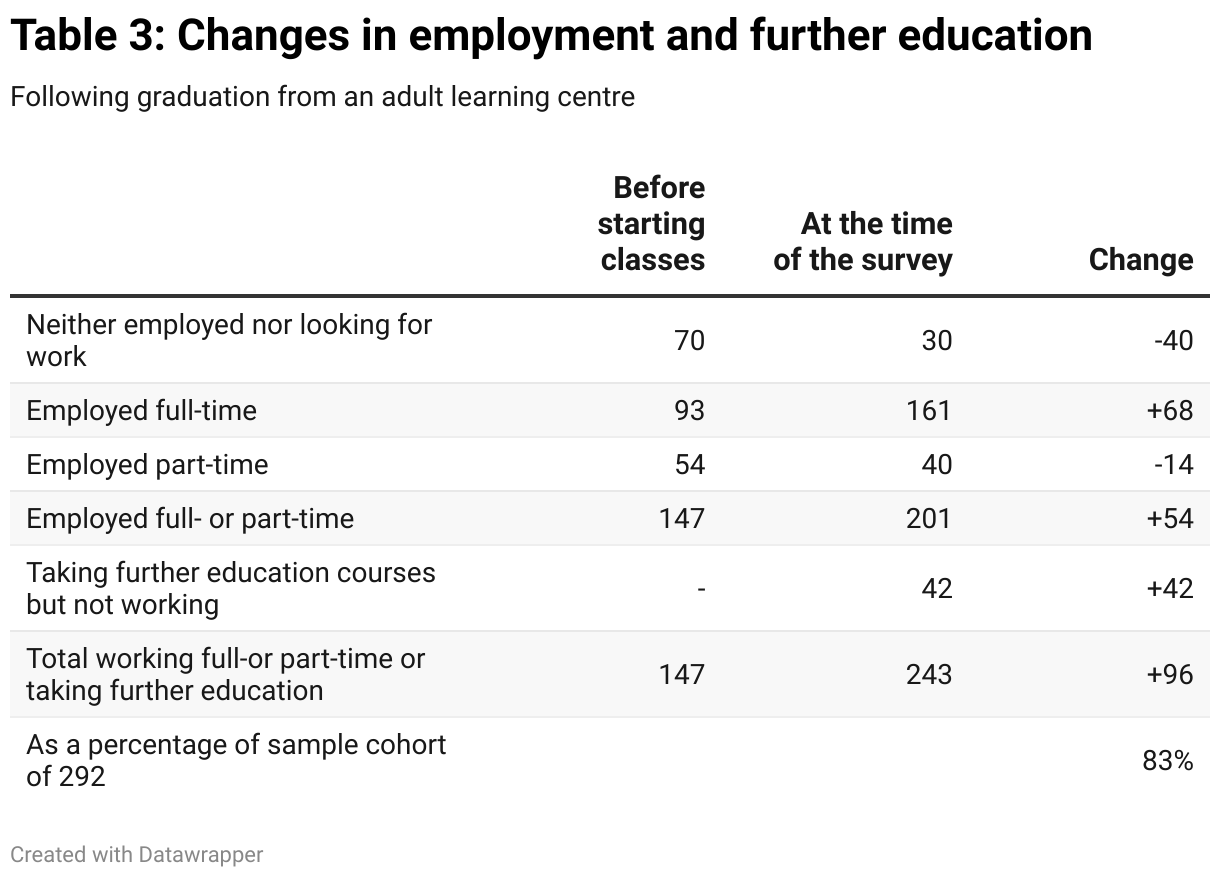
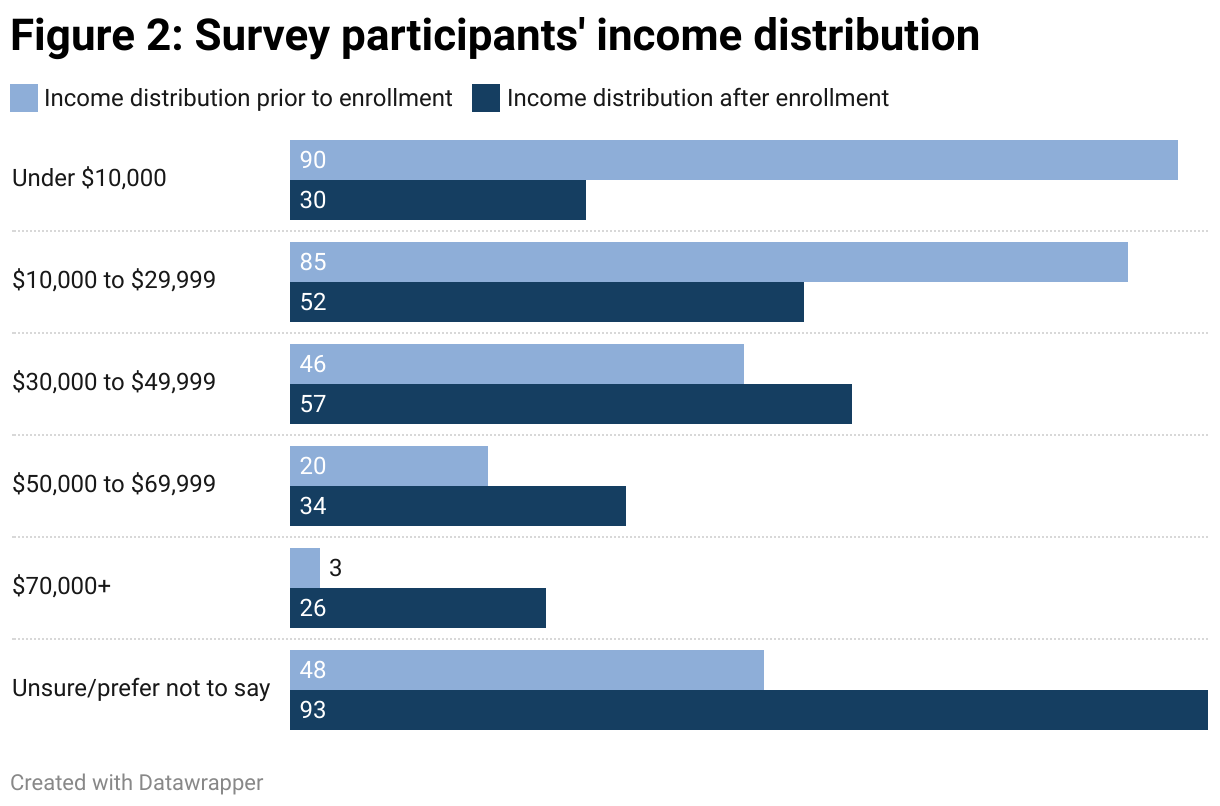
Increased employment will produce increased tax revenue. Consider those 68 additional adults who were working full-time following graduation. If we assume that full-time employment is 35 hours per week, and we conservatively estimate that the wage being earned is $20 per hour, then each of these full-time employees would have gross earnings of $700 per week, or $36,400 per year. Manitobans pay taxes on gross earnings over $15,780 per year, and for those earning less than $47,564, the provincial rate of taxation is 10.8 percent. Each of the 68 full-time employees would pay annual provincial income taxes of 10.8 percent of $20,620 ($36,400-$15,780), or $2,227. Total annual provincial tax revenue arising from the 68 additional full-time employees would then be 68×$2,227, or $151,436.2This figure does not account for various tax credits/deductions that are available to many workers earning lower incomes. Each individual/household has a different situation, making it impossible to arrive at a figure that is 100 percent accurate. However, $151,436 is likely a conservative estimate given how much incomes increased among the cohort, as shown in Figure 2. It needs to be noted, therefore, that this is an estimate, though likely a conservative estimate.
The annual savings from reduced EIA expenditures is $553,202 and the increased provincial tax revenue is $151,436, a total of $704,638.
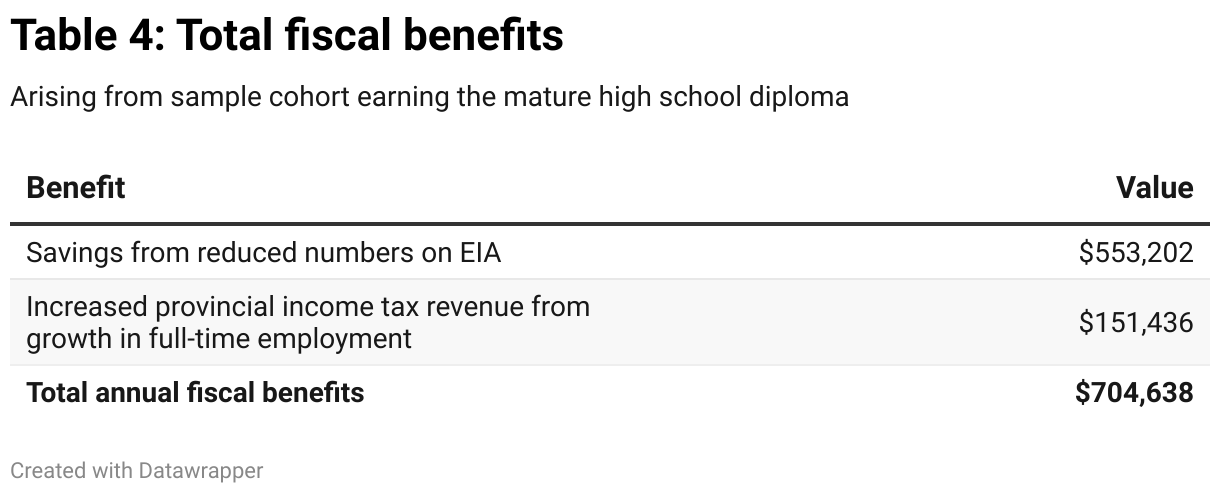
These calculations underestimate the fiscal benefit, because they do not take into account the increased tax revenue that will accrue to the Province when the 42 graduates pursuing post-secondary education enter the labour force. The calculations also do not take into account that the higher incomes earned as a result of employment would ripple through the local economies where the graduates will live and work as that money is spent, producing additional multiplier effects (See Table 6 below). Nor do they take into account the savings that would accrue to the provincial government because of reduced costs of health and criminal justice. As cited above, the Conference Board of Canada (2019: 20) found that “Each additional high school graduate saves the Ontario government (on average) $2,767 each year on social assistance, health care and criminal justice.” The 292 graduates in our sample cohort could be expected to produce savings in health and criminal justice costs, over and above the savings on social assistance described above.
Table 4 shows that the 292 graduates who responded to our survey produced an annual fiscal benefit of $704,638. The total number of adult learning centre graduates in 2024/25 was 1100, according to a September 2, 2025 communication from the Director of Adult Learning and Literacy. Let us assume that program costs remain at approximately $21 million per year, as per the 2023/24 Annual Report of the Department of Advanced Education and Training, and the number graduating remains steady at 1100 (the average number of graduates per year from 2003/04 to 2024/25 was 1189). If 292 graduates produce a net fiscal benefit of $704,638 as per Table 4, then 1100 graduates would produce an annual net fiscal benefit of approximately $2.65 million (1100 divided by 292=3.77×$704,638). However, that annual net fiscal benefit would be cumulative. In the first year the net fiscal benefit would be $2.65 million, and in the second year it would be $5.3 million, because in the second year another 1100 graduates would produce the net fiscal benefit that those who graduated in the first year would continue to produce. Thus, each successive year would produce an additional $2.65 million net fiscal benefit. Some of the benefit would be lost because some people would revert to EIA, and some would cease to be employed full-time. Let us assume that there is a 20 percent attrition over time.3There are no data from which to estimate the numbers who would leave employment and/or return to EIA. However, the fact that 88 percent of graduates who responded to the survey said they are happier now than when they started at their ALC, and that 89 percent said, “I am well on my way to a good life,” suggests that relatively few will abandon employment and/or return to EIA. If that is the case, 20 percent likely overstates the number returning to EIA and/or leaving employment, and thus may be underestimating the benefits arising from graduating with the mature high school diploma. Table 5 below shows the estimated cumulative results.
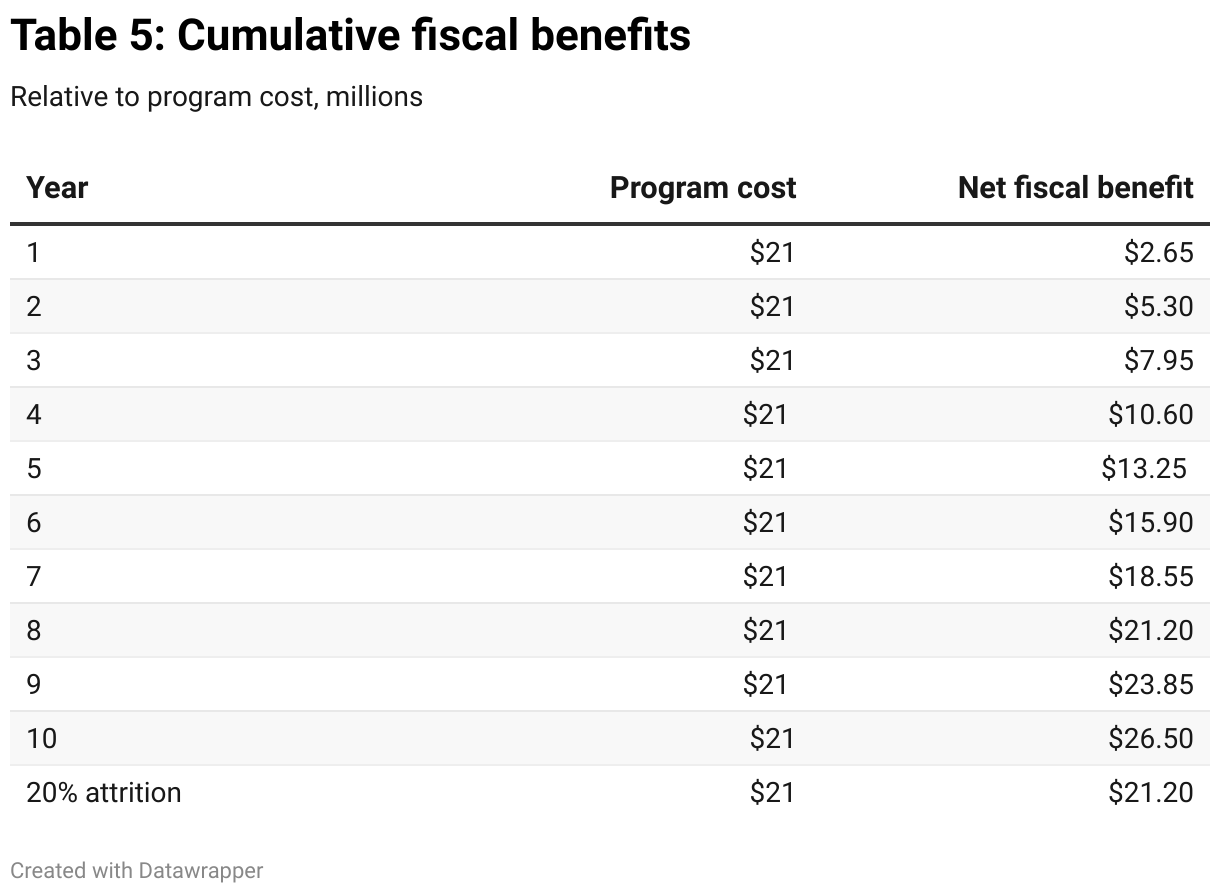
By year ten, allowing for a 20 percent attrition—i.e., 20 percent of graduates either return to EIA or no longer work full time, or both—the cumulative net fiscal benefits are equivalent to the annual program costs. By this time adult basic education is paying for itself; in future years benefits exceed costs.
Assumptions regarding program costs and numbers of graduates per year may change, but what does not change and what is of central importance is that because the net fiscal benefits are cumulative, they will ultimately equal program costs, so that at some not very distant time in the future adult basic education is not only paying for itself but producing a net fiscal benefit to the Province.
Increased incomes following completion of the mature high school diploma
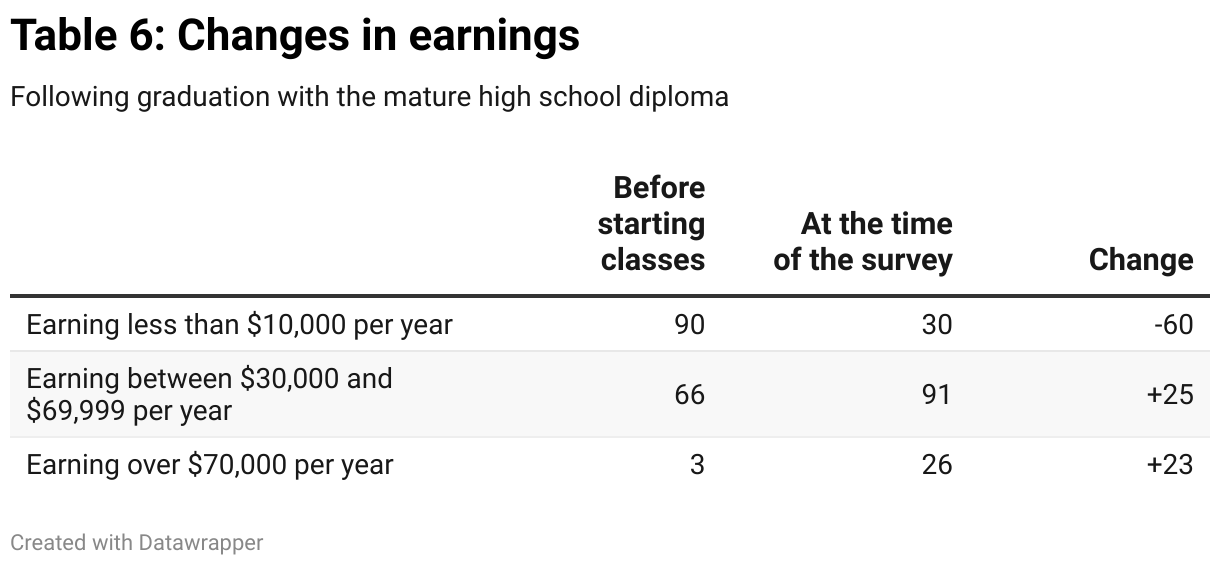
Our study also reveals that the incomes of those who earned the mature high school diploma improved, the result no doubt of employment gains. Before starting classes, 90 respondents earned less than $10,000 per year. At the time of the survey the number earning less than $10,000 per year had dropped to 30.
Before starting classes, 66 respondents earned between $30,000 and $69,999. At the time of the survey, 91 graduates, an additional 25, earned between $30,000 and $69,999. The number of respondents earning more than $70,000 increased from 3 to 26.
These increased earnings would ripple through the communities where these graduates are living and working, creating important multiplier effects that are in addition to the benefits calculated above.
These changes in income are visually represented in Figure 2.
Conclusions
Analysis of the results of the survey conducted in 2025 at five adult learning centres in different parts of Manitoba has shown that graduation from an adult learning centre with the mature high school diploma produces not only personal and family benefits, but also fiscal benefits accruing to the Province of Manitoba, because of reduced numbers on Employment and Income Assistance and increased numbers in full-time employment who then pay provincial income tax. These fiscal benefits are sufficient that, given the conservative assumptions used in this study, in ten years the fiscal benefits arising from investments in adult basic education will have grown to an amount equivalent to the costs of adult basic education. After ten years those fiscal benefits exceed the costs of adult basic education. This is evidence that increased investments by the provincial government in adult basic education are fiscally justifiable—indeed, advantageous.
References
Alexander, Craig. 2012. Literacy Matters: A Call to Action. Toronto: TD Financial Group.
Allen, Robert. 1999. The Education Dividend: Why Education Spending is a Good Investment for BC. Vancouver: Canadian Centre for Policy Alternatives—BC.
Brownell, Marni, Noralou Roos and Randy Fransoo. 2006. “Is the Glass Half Empty? A Population-Based Perspective on Socioeconomic Status and Educational Outcomes.” Choices. Montreal: Institute for Research on Public Policy.
Campaign 2000. 2024. 35 Years In: Manitoba Needs an Anti-Poverty Strategy that Works. Winnipeg: The Social Planning Council of Winnipeg.
Conference Board of Canada. 2019. The Economic Case for Investing in Education. Ottawa: Conference Board of Canada.
Coulombe, Serge and Jean-Francois Tremblay. 2006. “Literacy and Growth.” B.E. Journals in Macroeconomics. Vol. 6, #2.
Gaskell, Jane and Benjamin Levin. 2012. Making a Difference in Urban Schools: Ideas, Politics and Pedagogy. Toronto: University of Toronto Press.
Gulati, Sonya. 2013. Literacy Matters: Unlocking the Literacy Potential of Aboriginal Peoples in Canada. Toronto: TD Economics.
Hayes, Brigid. 2024. Let’s Rebuild the Foundation: Reinstating Canada’s Adult Literacy Knowledge Infrastructure Requires Federal Leadership. Ottawa: IRPP Insight, May, No. 53.
Manitoba. 2023/23. Department of Advanced Education and Training Annual Report.
Myers, Karen and Patrice de Broughton. 2006. Too Many Left Behind: Canada’s Adult Education and Training System. Research Report W/34. Ottawa: Canadian Policy Research Networks.
Nikkel, Kevin. 2024. Live and Learn. https://www.youtube.com/watch?v=LADntYGX4GQ
Silver, Jim. 2026. The Transformative Power of Adult Education. Winnipeg: Fernwood Publishing.
Silver, Jim. 2025. “Austerity and Adult Basic Education,” in Jesse Hajer, Ian Hudson and Jennifer Keith (eds.). Public Service in Rough Times: Working Under Austerity in Manitoba, 2016 to 2022. Winnipeg: University of Manitoba Press.
Silver, Jim. 2022a. Unearth This Buried Treasure: Adult Education in Manitoba. Winnipeg: Canadian Centre for Policy Alternatives-Manitoba.
Silver, Jim. 2022b. Building the Best Adult Education System in Canada: A Roadmap and Action Plan for Manitoba. Winnipeg: Canadian Centre for Policy Alternatives-Manitoba.
Silver, Jim, Darlene Klyne and Freeman Simard. 2006. “The Tools You Need to Discover Who You Are: Aboriginal Learners in Selected Adult Learning Centres in Winnipeg,” in Jim Silver. In Their Own Voices: Building Urban Aboriginal Communities. Halifax: Fernwood Publishing.
Acknowledgements
I am happy to acknowledge the particularly valuable contributions to this study made by Fran Taylor, Mary Agnes Welch, Niall Harney and Molly McCracken. Thanks also to the Directors and other staff at the five adult learning centres that conducted the survey of graduates that forms the basis of this study. Monika Idzikowski and Jennifer Mussell kindly provided valuable data. Thank you to two anonymous reviewers who made very useful suggestions. Thanks to Susan Purtell, Jess Klassen, and Karen Schlichting who assisted with publication.
I am pleased to acknowledge the generous financial support of the Social Sciences and Humanities Research Council through the “Community-Driven Solutions to Poverty: Challenges and Possibilities” grant held by the Manitoba Research Alliance.