

By the numbers
The Liberal campaign platform promised big public sector “productivity” savings, but if you compare it to federal data, a concerning picture emerges. Some key highlights:
– The Liberal platform promised $13 billion in “savings” by the 2028-29 fiscal year—that’s a 10 per cent cut of the entire federal operating expenses.
– The operating expense line is already dead flat for the next five years—there is no spending growth to cap.
– Recent increases in the National Defence spending likely exempts this department from cuts, even though it makes up 28 per cent of operational spending.
– Cutting contracting out would likely only result in $1.2 billion in savings
– This means the $13 billion cut will mostly be in personnel expenditures in non-defence departments. It would amount to a cut of 24 per cent—dramatically worse than Stephen Harper’s 10 per cent cuts on some departments and rivaling Paul Martin’s 1995 cuts of 18.9 per cent.
– If the prime minister follows through on his election promise, Canada’s federal public service will undergo the worst spending cuts in modern history. That will inevitably diminish the quality of public services.
During the 2025 election campaign, the Liberal party had quite a detailed and costed platform for most of its policies. It provided the most costed items of any of the three big party platforms, clocking in at 112 costed items. The Conservatives had only half of that, at 55, and NDP had 33 costed proposals.
What’s telling about the Liberal plan is that, although detail abounded, the single largest item on their list was “savings from increased government productivity,” which was valued at a stunning $28 billion over three years. This was much larger than their promised military spend of $16.1 billion or their middle/upper class tax cut worth $17.8 billion over three years. The “savings from increased government productivity” are roughly double the value of the next two items on their list. (Although the military spending would almost certainly be on top now.)
The platform itself refers to several ways to achieve $28 billion in savings and, specifically, that it would come from Direct Program Expenses. The platform suggested this might include:
- “Capping, not cutting, public service employment”
- “Reducing reliance on external consultants”
- “Automation of routine tasks and inquiries from the public”
- “Amalgamating service delivery”
- “Consolidating grants and contributions”
- “Better managing litigation”
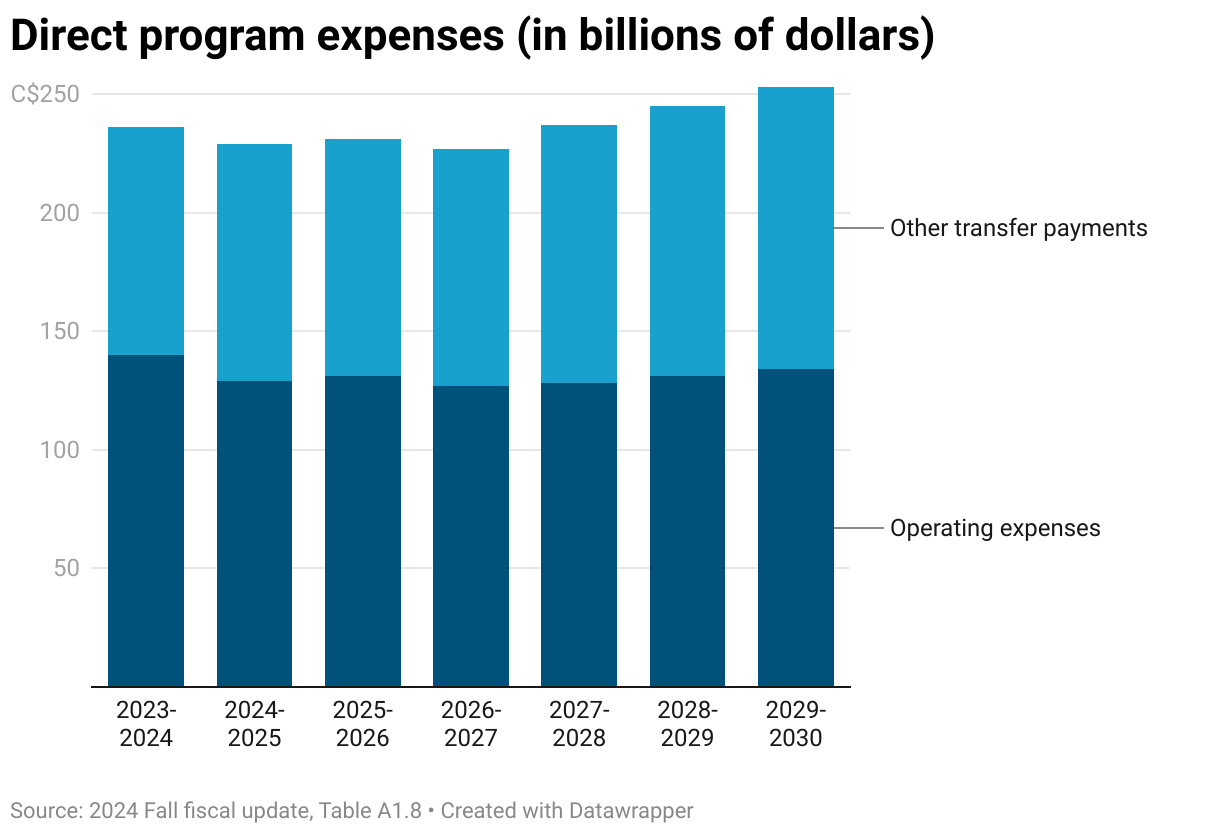
It is worth looking at the actual projections for “direct program expenses” from the 2024 fall fiscal update (the last update of the federal government’s books). That list is made up of two parts: “other transfer payments” and “operating expenses.” These are both graphed in Figure 1. “Other transfer payments” are for programs like the Canada Dental Plan, various investment tax credits and the like. These are likely not the targets of the cuts. Basically, all the examples of “savings” above are contained in “operating Expenses” line.
What’s notable is that, if we look back to the 2023-24 fiscal year until the projected 2028-29 fiscal year, “program expenses” are already flat at roughly $130 billion every year. The line isn’t growing with population or the economy. It means this budget line is already capped at zero growth. To get big savings going this route will require deep cuts.
From the operating expenditures projections, we can determine the likely source of the costing for the “savings from increased government productivity.” The basic approach here is likely a 10 per cent cut to operating expenses by 2028-29. In the two previous years, you steadily ramp up to that 10 per cent. In 2028-29, according to the fiscal update, the feds expect to spend $131 billion on operational expenditures. The Liberal platform proposes to “save” $13 billion that year, almost exactly a 10 per cent cut to operational expenditures compared to the projection.
Contrast this with the Harper era cuts, where departments might have been hit with a cut of either five per cent or 10 per cent. As we’ll see, this time around the choices would have to be even more severe.
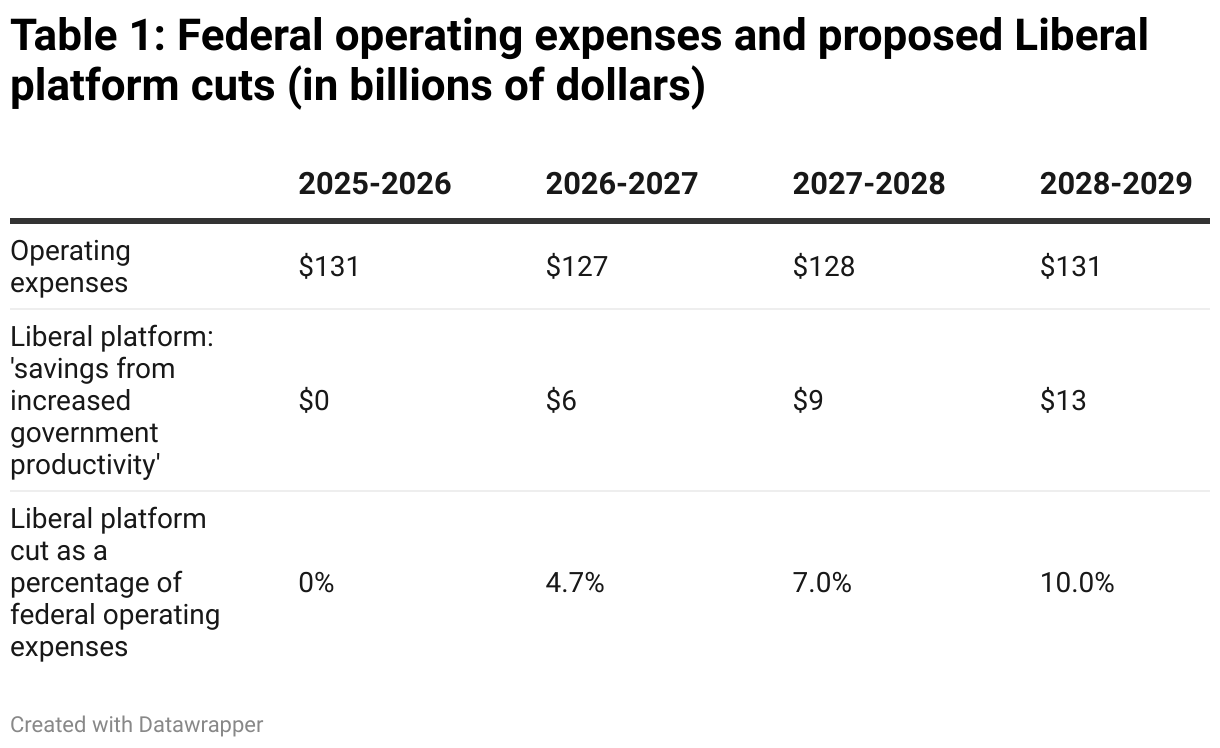
This promised $13 billion spending cut will be more than 10 per cent, as we look at what might actually be “on the block.”
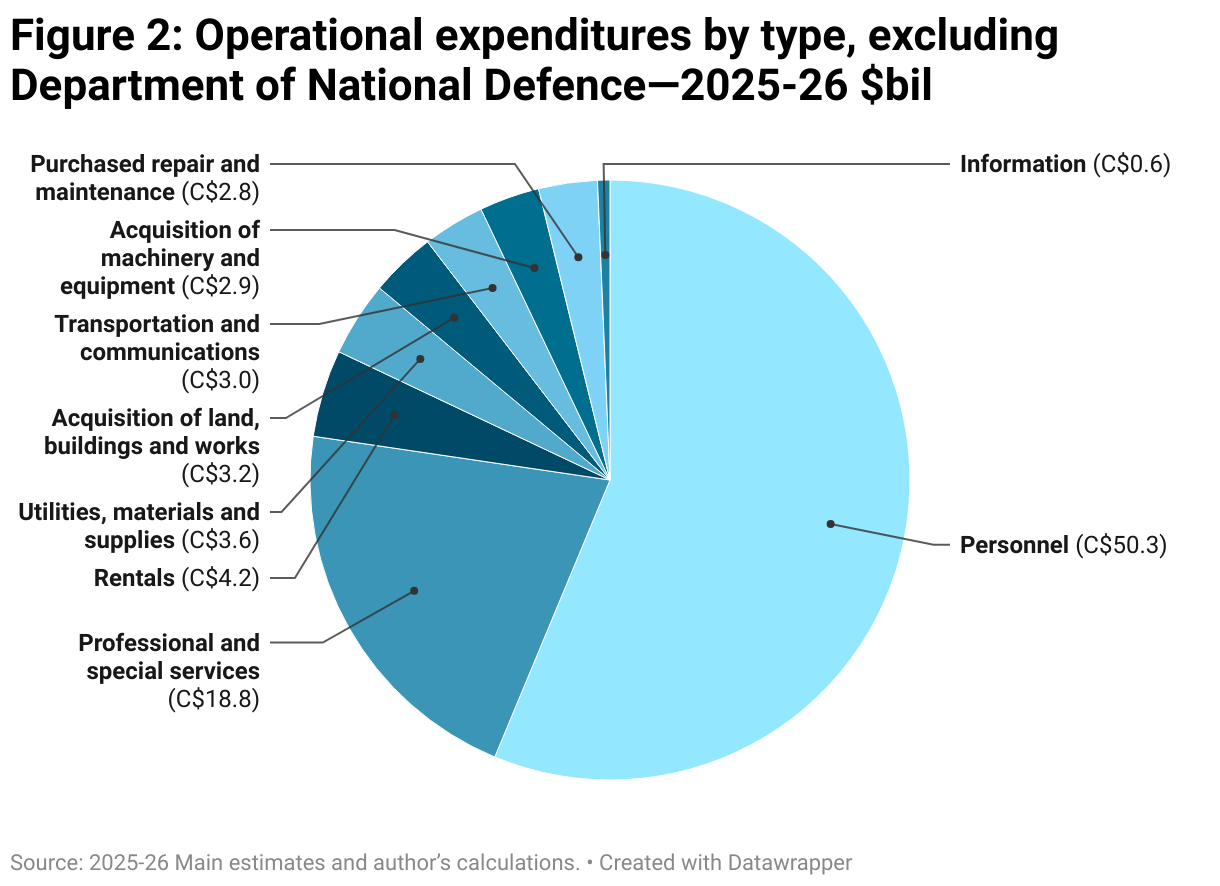
The Department of National Defence (DND) takes up 28 per cent of federal operating expenditures. If the cuts are proportional by department, we would expect to cut $3.5 billion in defence spending. But that department will likely be safe from cuts: the government is planning an immediate and dramatic increase in funding of $8.57 billion.
What’s left amounts to $89 billion in operating expenditures. To cut $13 billion out of that, the government would be looking at a 15 per cent cut in remaining departments, not the original 10 per cent.
Even here, many of these operating expenditure types aren’t in play. Figure 2 breaks down the types of operating expenditures that are left and their amounts once we exclude DND. The Liberal platform didn’t signal that they would cut the acquisition of building or machinery, repairs/maintenance, rentals, or utilities/supplies. That leaves us with professional services, personnel costs, transportation and communication along with information (largely government advertising).
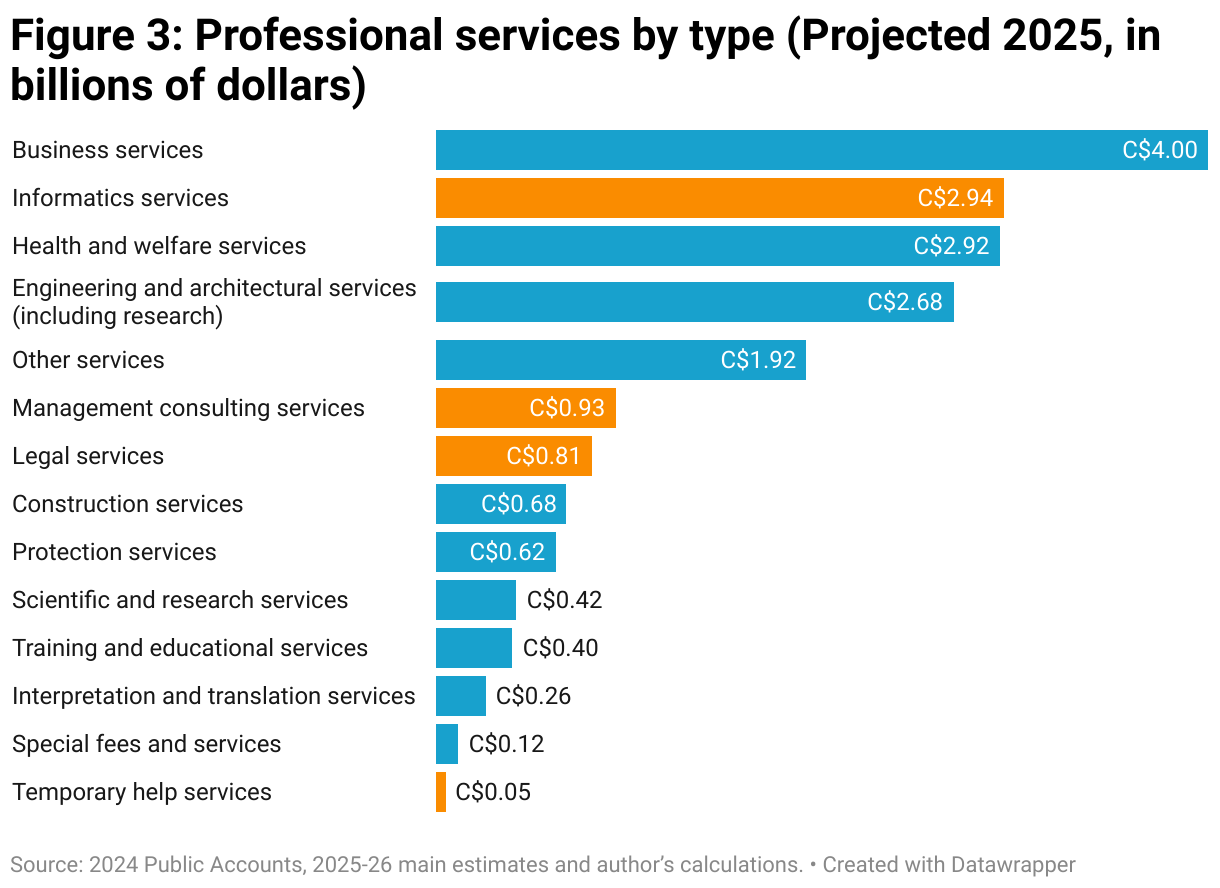
One might presume that professional and special services, or contracting out, would be a promising target, given that it’s worth almost $18.8 billion. Figure 3 projects how much will be spent on each part of professional services.
Many of the main professional services categories are not areas that would be targeted for cuts. Engineering services or health and welfare (for military and RCMP) would be foolish to target. The areas that might be targeted are those highlighted in red, and they amount to $4.7 billion, including: IT, management consulting, legal bills and temporary help.
In a recent study, the Parliamentary Budget Office (PBO) determined that outsourcing costs between 22 per cent and 25.7 per cent more than having the work done in house. Let’s assume the maximum savings of bringing these $4.7 billion in services back in house would amount to $1.2 billion of the $13 billion target.
If we move back to operational expenditures generally, excluding DND and operational expenditures that aren’t likely to be cut but include the maximum savings from moving outsourced services in house, we arrive at Figure 4. Now the cuts needed to get to $13 billion aren’t 10 per cent, they’re 24 per cent—and that would mean almost all cuts would fall on the personnel line.
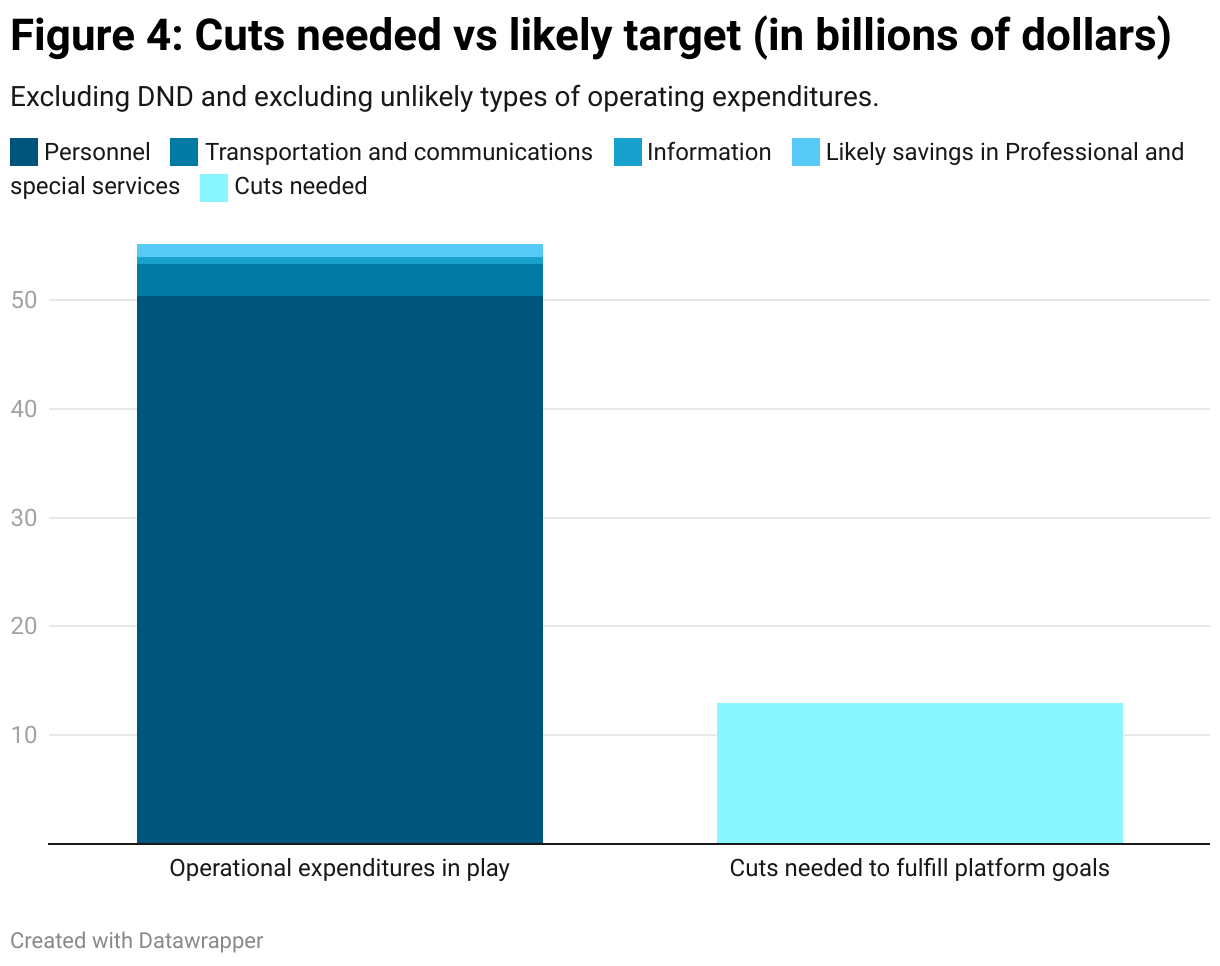
Cuts at this level wouldn’t be “capping hiring”, “finding efficiencies using AI” or “not replacing retiring workers”. For cuts this is deep, it would require across-the-board job losses and major service reductions. In other words, if it proceeded it would represent a major disruption to federal public services and would rival the 18.9 per cent cut in operation expenditures of Paul Martin’s 1995 budget as the most extreme budget slashing in Canadian history.
In their election platform, the Liberals needed an easy way to pay for their pricy tax cuts and defence spending. They settled on operational cuts with no plan for meeting this target without massive job losses and service cuts.
Cuts of this size, and restricted in these ways, are clearly not feasible. Hopefully, this is one campaign promise they don’t follow through on.