

Summary
This, our tenth annual child care survey, is likely to be the last of its kind as Canada moves rapidly toward much lower, set child care fees. With the Canada-wide Early Learning and Child Care plan’s next fee reduction milestone—average $10-a-day fees for all children aged 0 to 5—coming up in April 2026, we wanted to take stock of how close (or far) parent fees are from meeting that target.
As in previous years, our survey has assessed progress in achieving the affordability goals for full-time, licensed centres and regulated family child care for infants, toddlers and preschool-aged children up to the beginning of kindergarten. Our phone survey gathered data on child care fees in 37 cities across Canada, together with other variables, including how fees have changed since the federal government introduced Canada-wide Early Learning and Child Care (CWELCC, or the “$10-a-day plan”) in 2021.
Most jurisdictions have set fees, but we’re not at $10 a day yet
Child care fee reductions for parents are now well under way in all provinces and territories. However, by April of 2026 many parents with children in CWELCC-supported spaces will still be paying more than the $10-a-day target.
However, the federal objective of “an average of $10 a day” is quite different than a maximum parent fee of $10 a day. “Average” does not provide the transparency provided by a set or capped fee. This means some parents may continue to pay higher fees.
We are most concerned by the lack of details on the final stepdown in April 2026 to even “an average of $10 a day” in Alberta, Nova Scotia, and British Columbia. At the time of publishing, there were no additional details of how or if fees in these provinces will change further from where they stood as of April 2025.
Key findings
- Six provinces/territories have already met or exceeded the CWELCC final target of $10-a-day child care in advance of the April 2026 target: Nunavut, Saskatchewan, Manitoba, Quebec, Prince Edward Island, and Newfoundland and Labrador.
- Nine Provinces/territories already have set fees. These include the six $10-a-day jurisdictions above but also New Brunswick, Alberta and Ontario whose set fees are more than $10 a day. Additionally, British Columbia has a minority of spaces at $10 a day.
- Provinces and territories still using market fees but reducing them by a set amount are Yukon, Northwest Territories, Nova Scotia and British Columbia (most BC spaces continue to use market fees).
- In the Ontario cities, for example, infant fees are $22 a day—twice the 2026 target.
- Alberta has moved to set fees, but at $326.25 a month (or $15.03 a day), these are still well above the $10-a-day goal.
- Cities still using market fees have the highest median fees for infants. For example, Richmond, B.C., tops the list at $46 a day for infants with Surrey, B.C., a close second at $39 a day roughly four times the $10-a-day target.
- Preschool-age fees in 11 cities are already at or below the $10-a-day target. But the cities in B.C. are again still well above the target. Richmond stands out with a median preschool-age fee of $39 a day. Although the Vancouver median of $29 a day for preschool-age children is lower due to it benefiting from $10-a-day program.
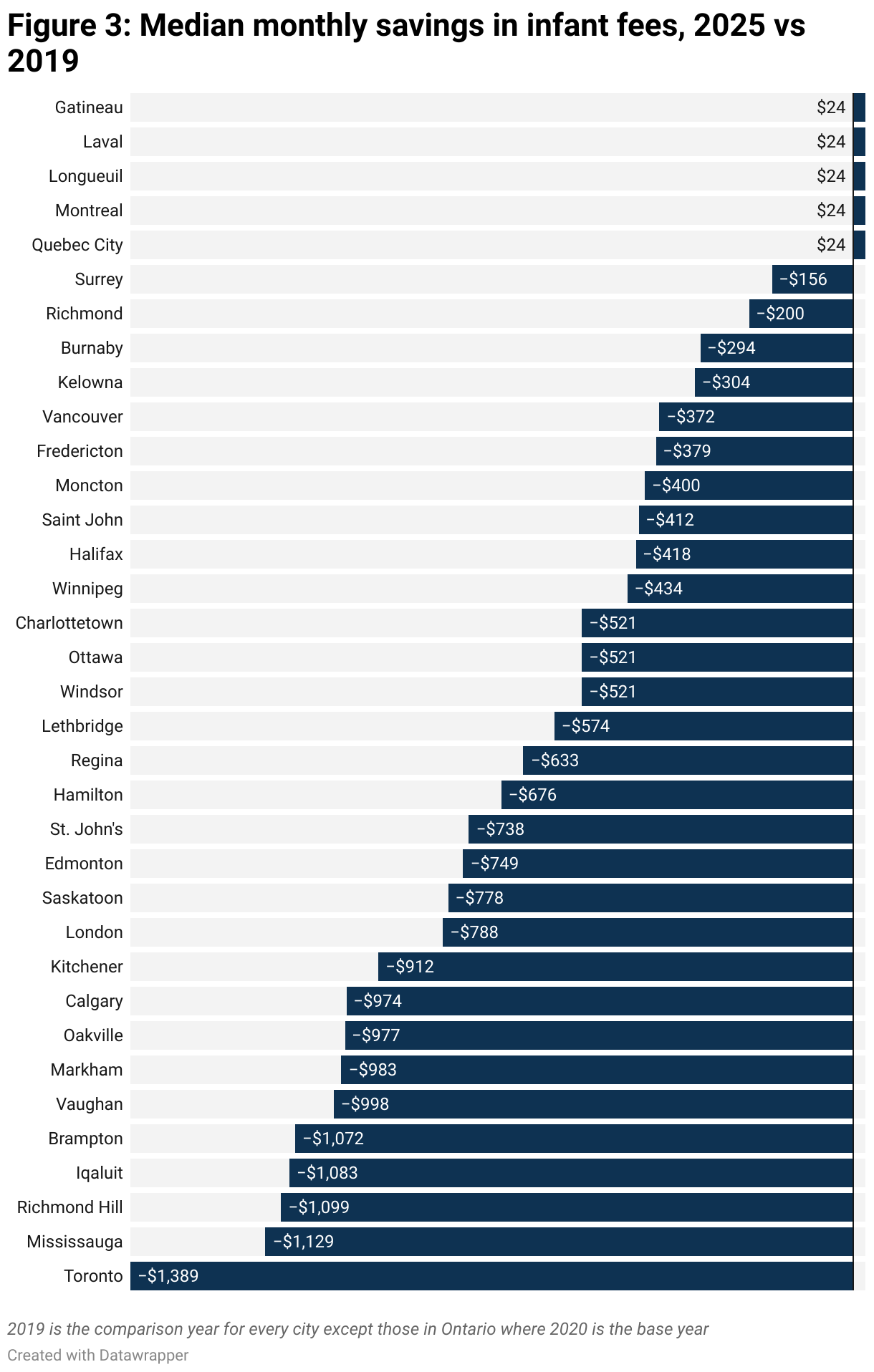
- Parents in all cities saw some savings for infant spaces in 2025 compared to 2019/20. Savings were lowest (less than $200/month) in the B.C. cities of Richmond and Surrey. They were highest for infants in Toronto and Greater Toronto Area cities, and in Iqaluit (more than $1,000/month).
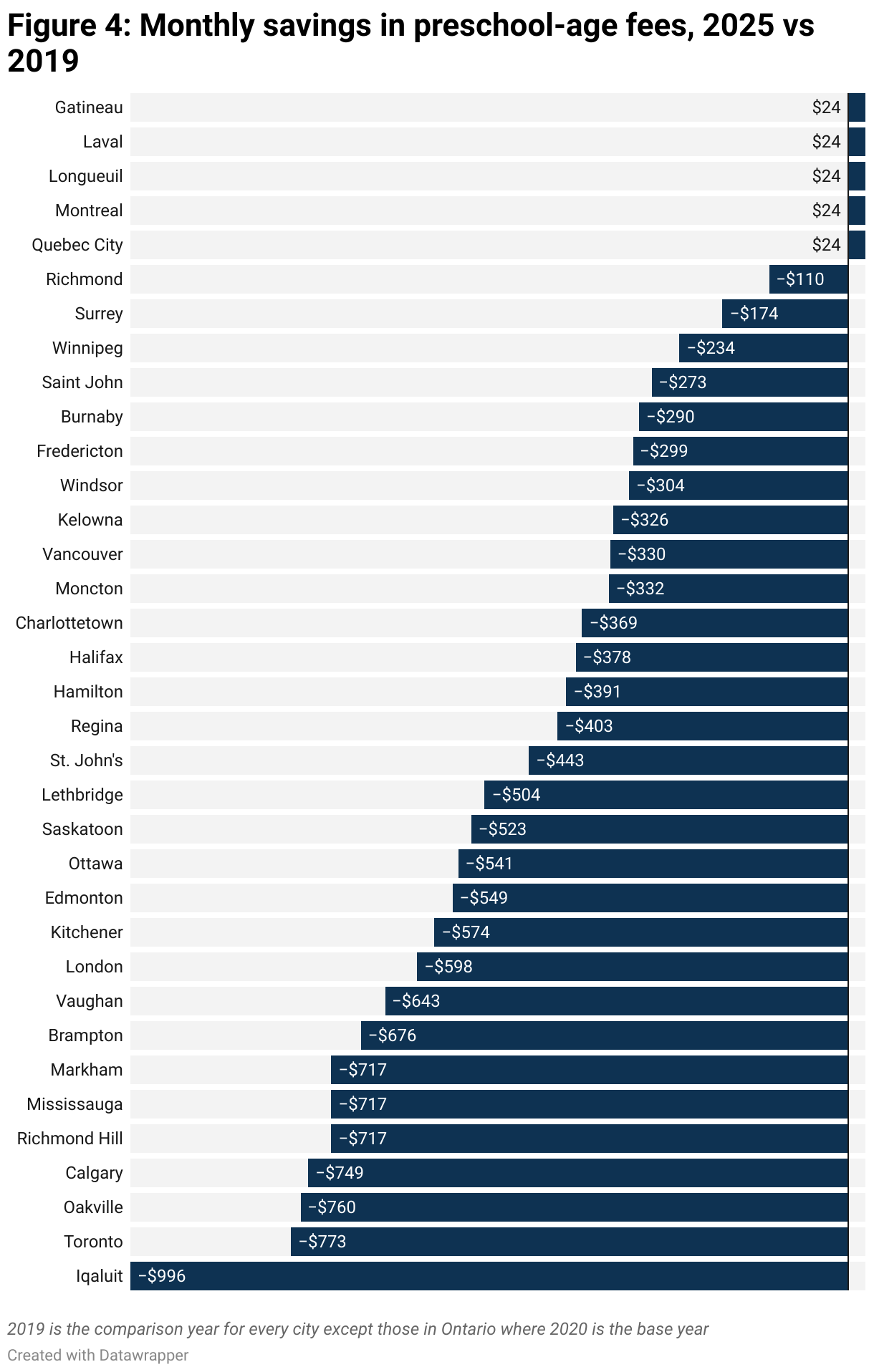
- In the preschool-age category, the biggest savings between 2019/20 and 2025 by far were for parents in Iqaluit, with savings per child just under $1,000. Parents in Toronto and the GTA cities are saving about $700 a month compared to 2020, and Calgarians with preschool-aged children are saving just over $700 a month compared to 2019.
- Preschooler parents in Richmond and Surrey in British Columbia again saw the lowest savings—just over $100 and about $200 a month, respectively.
- While most cities have seen additional fee reductions since December 2022, cities in British Columbia and Nova Scotia have actually seen fees rise. Their fee reductions haven’t changed since then. Meanwhile, underlying market fees have continued to rise eroded the parental savings.
Generally, the higher child care fees were to begin with, the larger the savings for parents brought about by the CWELCC fee reduction. Smaller savings generally meant the jurisdiction had a better public program before CWELCC began.
In its final phase, CWELCC is going to have to work on a second, more difficult to solve challenge: meeting much higher demand for lower fees. This necessitates the rapid creation of more child care spaces, but with equity in mind—to provide better access in what we call child care deserts. This requires a publicly led and funded expansion, much like we see in the K–12 school and health care systems. Recruitment of early child care educators is part of the picture, but so is the retention of current employees. Set fees are the answer to lower fees, but set wages, via wage grids, is likely the key to staffing the expansion.
Introduction: How we got here
Five years ago this spring, most public places were shut down as Canada was plunged into the global COVID-19 pandemic. It quickly became obvious that smooth distribution of food and basics, functioning transportation, and access to health care were essential to basic well-being, public health, and the economy. And, as most child care services were shut down by public health authorities, it also became obvious that child care to support parents who provide these goods and services was another essential.
It took a pandemic to put the paradox of child care in 21st-century Canada in sharp relief, showing both the fragility of our child care provision and how critical reliable child care is to our economic activity. This period powerfully demonstrated that child care is not merely “nice to have”—parents working at essential jobs and those working from home both struggled to work at all without it. The pandemic years also highlighted pitfalls in Canada’s long-time failure to tackle child care problems by developing a public system, as many other OECD countries have done over the past 30 years.
Five years later, Canadian child care has changed dramatically and substantively. The experience of the pandemic generated broad recognition that prosperity requires reliable, affordable child care. This paved the way for the federal government’s decision to back an ambitious child care plan—the first Canada-wide child care initiative to move past intentions to implementation.
The $10-a-day child care plan and parent fees
In its 2021 budget, the federal government announced the historic Canada-wide Early Learning and Child Care (CWELCC, or the $10-a-day plan), which would be backed by substantial multi-year funding. Over the next year, all the provinces and territories came on board, agreeing to collaborate (albeit with some variation in enthusiasm) with the federal government to transform Canada’s child care market into an early learning and child care system. Every jurisdiction had signed an agreement by March 2022, accompanied by a first round of action plans agreed to between the two levels of government.
CWELCC was initiated by the federal government, and the responsibility for it is shared with provinces/territories/Indigenous governing bodies.1Based on constitutional roles and responsibilities for social programs and commitments under the United Nations Declaration on the Rights of Indigenous Peoples. Provinces, territories and Indigenous governing bodies have the main responsibility for implementing CWELCC, with the federal government providing much of the funding and high-level policy considerations as it does with Medicare, housing, and other social programs under provincial or territorial jurisdiction.
The 2021 budget promised no less than a transformation of Canadian child care, setting out a vision and commitment to put a universal system “for all” in place based on the principles of affordability, accessibility, quality, flexibility, and inclusivity. These principles were integrated into the first Canada-wide child care legislation, which was passed into law in March 2024.
The federal government’s overarching goal is “to ensure that all families have access to high-quality, affordable, and inclusive early learning and child care no matter where they live.” It is “a plan to drive economic growth, secure women’s place in the workforce, and give every Canadian child the same head start.”2Department of Finance Canada. “Budget 2021: A recovery plan for jobs, growth, and resilience.” Government of Canada, 19 Apr. 2021, p. 101 https://www.budget.canada.ca/2021/report-rapport/p2-en.html?#chap3
Parent fees were the first barrier to be tackled under the CWELCC plan, with two initial fee targets. For the first target, the federal government required the provinces and territories to lower fees by 50 per cent (on average) by December 2022, using 2019 as the baseline year (with the exception of Ontario, which did not sign on to the plan until 2022; therefore 2020 was Ontario’s baseline). For the second target, provinces/territories would reduce parental fees to an “average of” $10 a day by April 2026.
Where are we at in 2025? Parent fees have dropped radically everywhere, and federal funds have replaced them as the main revenue constituting child care centres’ budgets. Services have expanded, with an increase of about 150,000 licensed child care spaces since 2019. The low wages and poor working conditions of the child care workforce—a mainstay of Canada’s traditional approach to child care operation—have finally been acknowledged as barriers to quality and expansion. Addressing these workforce issues has begun, although they are still far from solved.
About the annual fee survey reports
The Canadian Centre for Policy Alternatives has been conducting annual child care fee surveys for a more than a decade now, covering the years 2014 to 2025. When we began in 2014, Canada was ranked at the bottom of OECD countries on child care, and the idea of an affordable, accessible child care system here was merely a dream. We wrote in our 2014 survey report that “[d]espite the high concentration of mothers who work, all reports show that Canada is a very low spender on early childhood education and care (ECEC) compared to other OECD countries. Canada’s public spending on ECEC is somewhat between 0.2 per cent and 0.34 per cent of GDP—extremely low even in the best case. At best, Canada spends half the OECD average and one-third of the recommended minimum one per cent of GDP for children 0-5.” 3
We conduct our child care survey every year, providing the only Canada-wide data on child care fees available. Although we collect fee data for only large cities, they represent roughly half of the child care spaces Canada-wide. We also use the survey to collect and analyze limited related data on the following: child care fees in rural communities; wait lists at child care centres; extra-billing (for wait list fees); and expansion possibilities.
After our 2019 survey,3David Macdonald and Martha Friendly, In Progress: Child Care Fees in Canada in 2019 (Ottawa: Canadian Centre for Policy Alternatives, 2020), carried out shortly before the pandemic began, we noted in our report that “a strength of the surveys has been that the data have been collected using a consistent method, so year-to-year comparisons are possible.” Thus, we were able to show local increases in child care parent fees, which were usually higher than the rate of inflation.
The cities included in the 2019 research had grown from the original 20 largest cities (by population) to 37 cities, with at least one in every province and territory. Our 2019 survey also included questions to establish each respondent’s auspice (i.e., whether a non-profit or for-profit entity runs it) for the first time. This data showed that auspice made a difference in affordability, with for-profit child care providers almost always charging higher median fees. Sometimes this was by a small margin, and sometimes it was substantial.
We concluded in our report for that year that “the lower child care fees that we see in some Canadian jurisdictions are due to public policy, not market pressures. [This] also illustrates how a variety of policy elements, such as fee regulation, auspice and levels of public funding, play a role in determining child care fees.”
Fast-forwarding a few years, the 2022 fee survey4David Macdonald and Martha Friendly, Measuring Matters: Assessing Canada’s Progress Toward $10-a-Day Child Care for All (Ottawa: Canadian Centre for Policy Alternatives, 2023), https://www.policyalternatives.ca/news-research/measuring-matters/ was the first in which the impact of the new $10-a-day program on parent fees was clearly evident. In our report for that year we assessed progress in achieving CWELCC’s 50% fee reduction goals for child care for infants, toddlers and preschool-aged children up to the beginning of kindergarten. We also examined how parent fees had changed since CWELCC was introduced, finding that “our data this year shows that Canada is well on its way to more affordable child care,” with half the cities outside Quebec meeting or exceeding the initial 50 per cent reduction target. At that time, seven of the provinces/territories had set fees, and five (including Quebec) had already reached or bested the 2026 $10-a-day fee target.
As the implementation of the new program had now begun, analysis of the fee data provided insights into best policy practices. Thus, in our 2023 fee survey report, based on data and analysis from our fee surveys back to 2014, we recommended the following:5Ibid
1. Rapidly moving to a set-fee model in all provinces and territories, then reducing those set fees to a maximum fee of $10 a day by 2025–26 to make fees more transparent, efficient, administratively simple, and equitable. This should also include geared-to-income mechanisms up to the maximum set fee, thereby replacing existing fee subsidy systems.
2. Developing concrete expansion strategies in each province and territory to ensure that agreed-upon space targets for affordable public and non-profit child care are met.
3. Expanding in a manner that is exclusively public and non-profit, with governments putting clear public accountability into place to support this.
4. Using public funding to replace parent fees as the predominant source of revenue for child care programs. The operational funding models needed to create workable and high-quality early learning and child care systems are not yet in place. Funding to ensure improved compensation for the workforce must be part of new operational funding formulas.
What this report is about
This is our tenth annual child care fee survey, and likely our last, as Canada is moving rapidly to set fees.
With the next fee reduction milestone coming in April 2026, about a year from this report’s publication date, we need to take stock of how close (or far) parent fees are from the second target: average $10-a-day fees for all children aged 0–6.
It’s important to note that the federal objective of “an average of $10 a day”6For instance see: Canada–Ontario Canada-wide Early Learning and Child Care Agreement—2021 to 2026, Section 1.1, https://www.canada.ca/en/early-learning-child-care-agreement/agreements-provinces-territories/ontario-canada-wide-2021.html is quite different than a target of a set or maximum parent fee of $10 a day. In our 2022 report, we observed that an “average” fee target was an imprecise and problematic concept:
It may connote an average fee across the whole province or territory, but an average fee could also be determined regionally. It could also signify different parent fees by the child’s age group, so infant fees could still be higher than preschool-age fees. Or it could signify different parent fees by family income, meaning that low-income parents could pay lower fees than high-income parents. These all have various merits and challenges, and all will, of course, have different impacts on fee reduction from the perspective of meeting both federal targets and families’ needs.7David Macdonald and Martha Friendly, Game changer: The impacts of the Canada-Wide Early Learning and Child Care system on child care fees in Canada. (Ottawa, Canadian Centre for Policy Alternatives, 2002) 44, https://policyalternatives.ca/wp-content/uploads/attachments/Game%20changer.pdf
What does this mean in practical terms? “Average” does not provide the transparency provided by a set or capped fee and may continue to present some parents with higher fees, depending on where they live or the age of their child. As we discuss below, some provinces/territories are taking the “average” approach, while others are setting the child care fee to $10 a day for all. Most of the $10-a-day jurisdictions also provide an additional fee subsidy for lower income parents who qualify.
In our 2023 annual fee survey report we identified four approaches being taken by the provinces and territories to lower child care fees.8David Macdonald and Martha Friendly, Measuring Matters: Assessing Canada’s Progress Toward $10-a-Day Child Care for All (Ottawa, Canadian Centre for Policy Alternatives, 2023), 20, Table 1, https://www.policyalternatives.ca/news-research/measuring-matters/ Now, in 2025, these have become two approaches:
1. Moving from market fees to fees set by provincial/territorial government
Setting fees or setting a maximum fee is the most transparent approach, and the easiest for parents to understand. No matter which service provider they use, the fee is the same. Nine of 13 provinces and territories use this approach, as shown in Table 1. British Columbia uses both this approach and the second approach.
A provincially/territorially set parent fee works well for providers if it is introduced hand-in-hand with public operational funds based on the costs of providing a high-quality child care program. An effective funding formula ensures that costs of delivering high-quality child care are fairly covered.
Provincially set fees can make programs more affordable, but only if the fee maximums are low and there are additional measures in place to ensure that low-income households pay less than the maximum, or no fee.
2. Reducing market fees by a set amount
In this second approach, the province or territory simply pays a flat dollar amount towards the existing market fee. This means that parents pay different fees depending on the provider, although those fees are all lowered by the same set amount. For some provincial/territorial governments, this approach may have been an intermediate step to rapidly reducing fees on the way to a set fee system. However, it leaves parents paying varying amounts that are not $10 a day.
Three of the 13 provinces and territories are currently using this approach, as shown in Table 2. British Columbia uses both this and the first approach.
Neither approach is necessarily more affordable
Fees may be set by the province or territory, but set at a higher level (as are Ontario’s $22-a-day fees). Or they may be set variably by age or region (as are New Brunswick’s fees). Or existing market fees could be reduced by a large set value (as Yukon’s fees are). In 2019, provinces/territories were at very different starting places in terms of fee reduction systems and their market fees. What that can mean, as we will see below, is that even if their fees are not $10 a day in 2025, their reductions since 2019 may well have been considerable.
Tables 1 and 2 illustrate the fee systems by province and territory as they were in 2019 and as they are in April 2025.
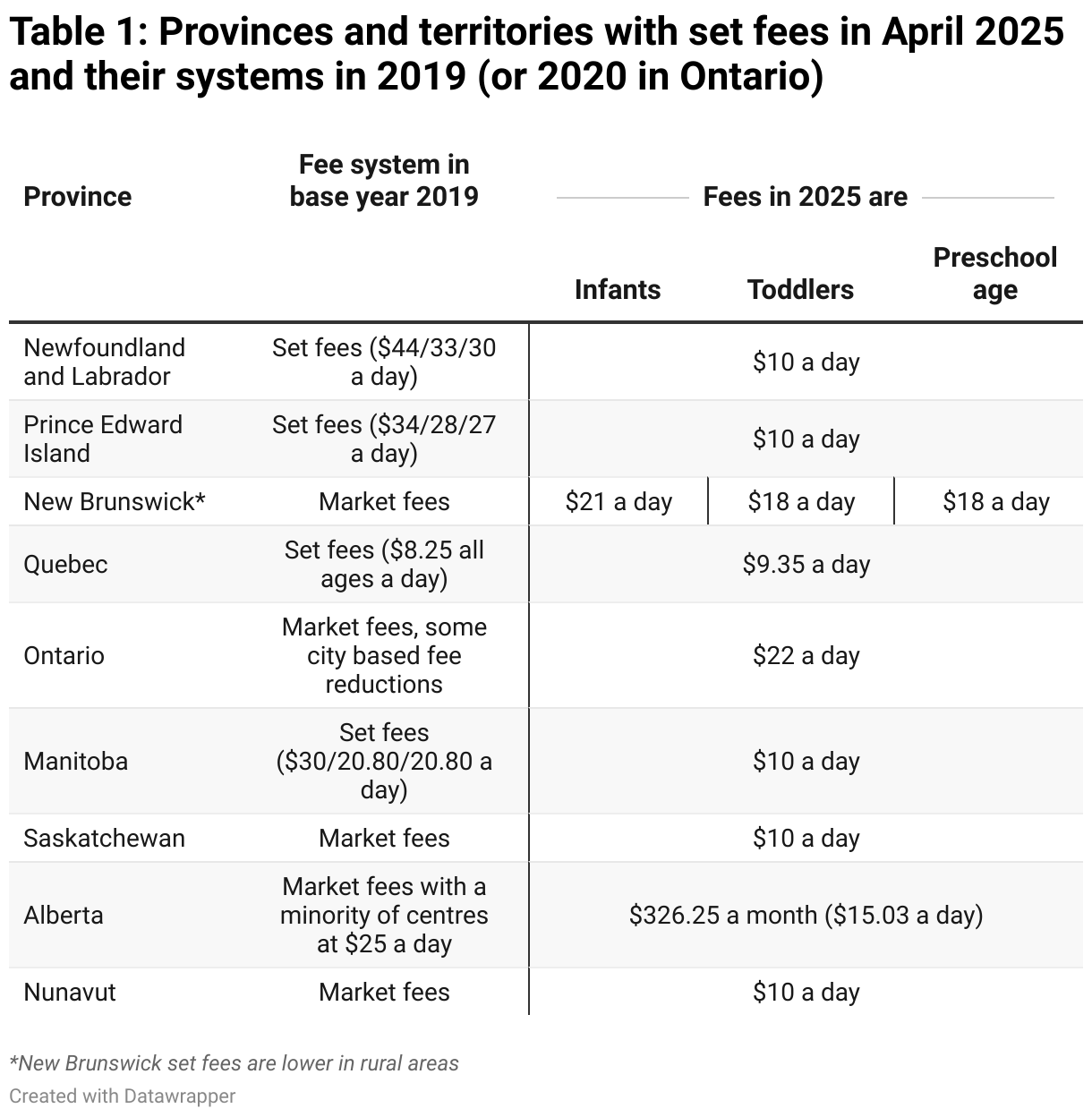
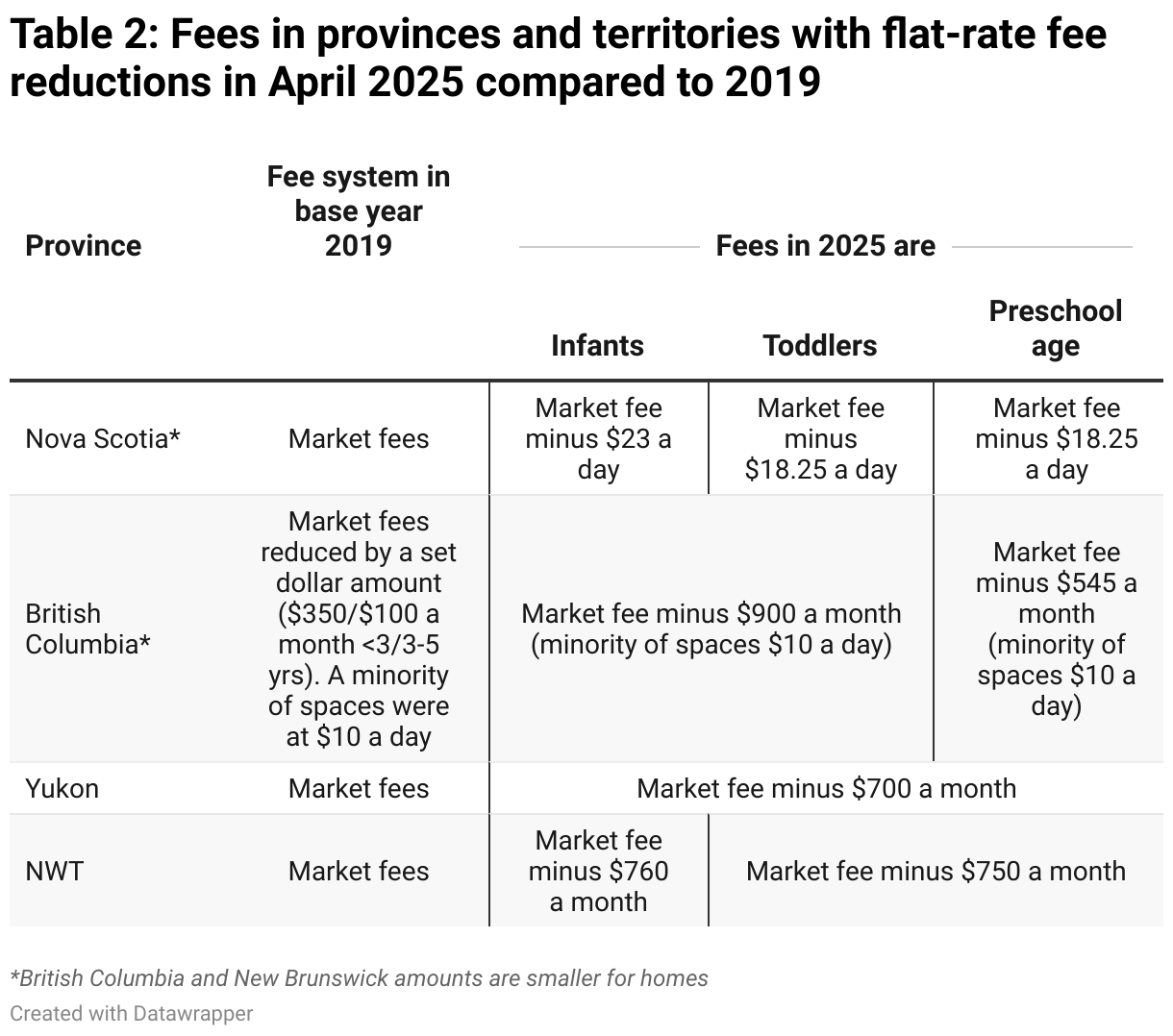
In this year’s survey we focused on cities in provinces/territories that are still primarily using market fees. To determine the median fee in these cities, we conducted a phone and internet survey of all licensed providers in them (at both centres and family child care homes). The phone survey was conducted from November to December 2024.
In the data that follows, we assume that few changes occurred to the market fees between the time of our survey and April 2025. We moved the target date to April 2025 because we wanted to include the move to set fees in Ontario and Alberta, which occurred in January 2025 and April 2025, respectively. All fees presented here are for full-time, full-day spaces in centres and family child care homes. The fees for part-day nursery school/preschool spaces are not included, nor are before-school and after-school fees.
Median fees by age group in April 2025
There are two measures of central tendency: the average (or mean) and the median. When we think about how to best represent the fee that parents pay in a city, either could be used. To find the average, you add up all the fees for every single space and divide that amount by the number of spaces. This requires that you know all the fees, and the average can be pushed around a lot by very high fees.
To find the median fee, you sort all the child care spaces in a city by their fees and move to the single space that sits exactly in the middle—the fee for that space is the median fee. The median fee can’t be pushed around by very high fees in the same way that the average can. You also don’t have to know all the fees in a city to get the median, you only have to know the bottom 50% of the fees. In cities with provincially set fees, we know that those set fees are going to be the lowest fees, even if some centres aren’t part of the system and charge whatever the market will bear. So if at least half of the spaces in a city are at set fees, then the fee for that space that is exactly in the middle is also charging the set fee. In other words, the set fee is also the median fee.
In the case of British Columbia, only about 10 per cent of spaces provincially are part of its $10-a-day program. Thus, the median fee there is not $10 a day, although the more spaces in a given city that are part of the $10-a-day program, the lower the median fee generally will be.
In Quebec, they have most providers with set fees of $9.35 a day but also some centres that charge whatever the market will bear. In some cities, the market fee centres make up a sizeable minority of licensed spaces. In Laval, for example, 37 per cent of spaces are at market fees. However, these market fee centres never make up more than half of the spaces, therefore the set fee remains the median fee.
For cities in the market fee reduction jurisdictions, in which the province or territory pays a set dollar amount towards the fee, the median fee has been calculated by first determining the full market fee, then subtracting the provincial contribution and creating a new weighted median.
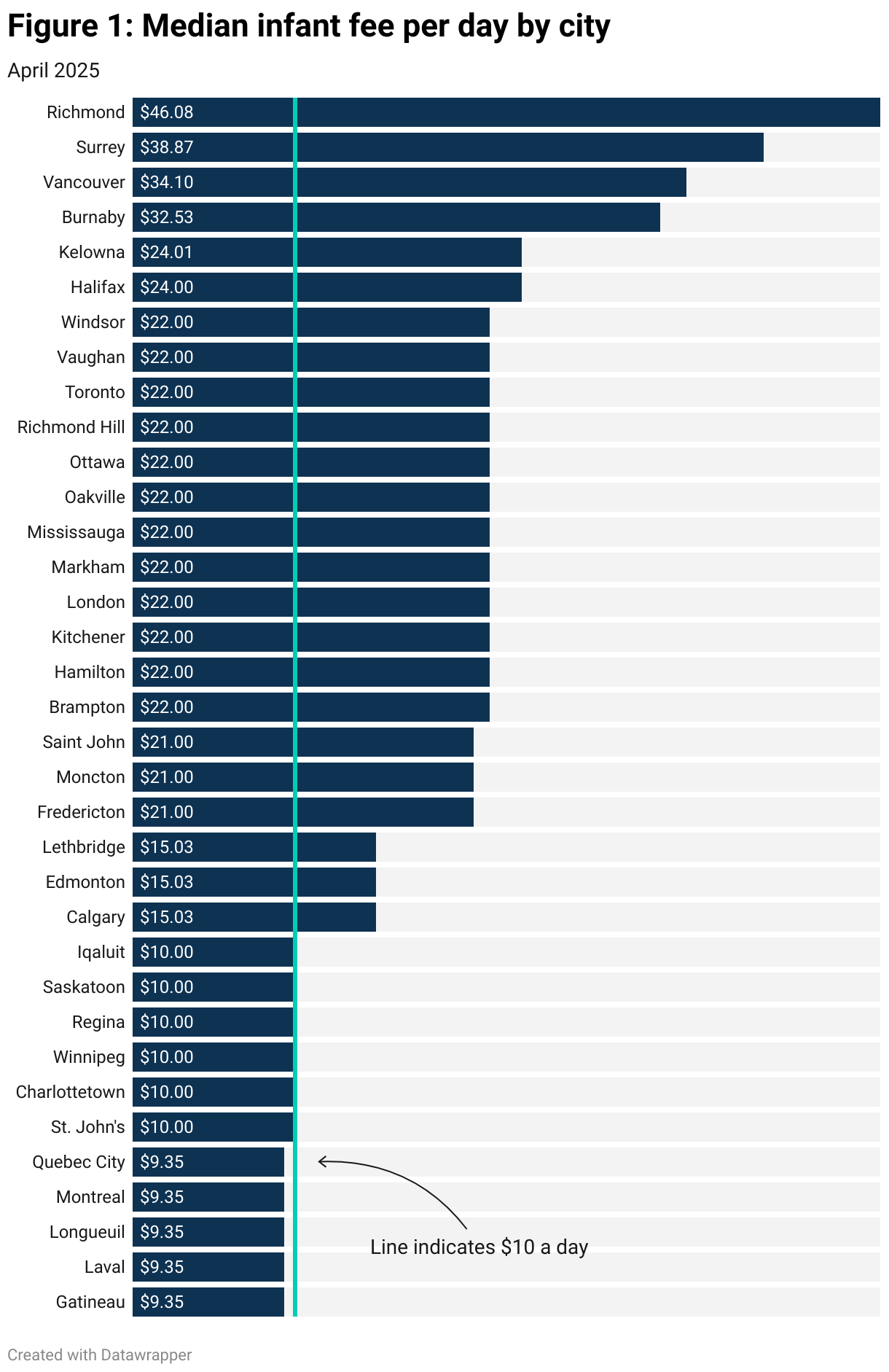
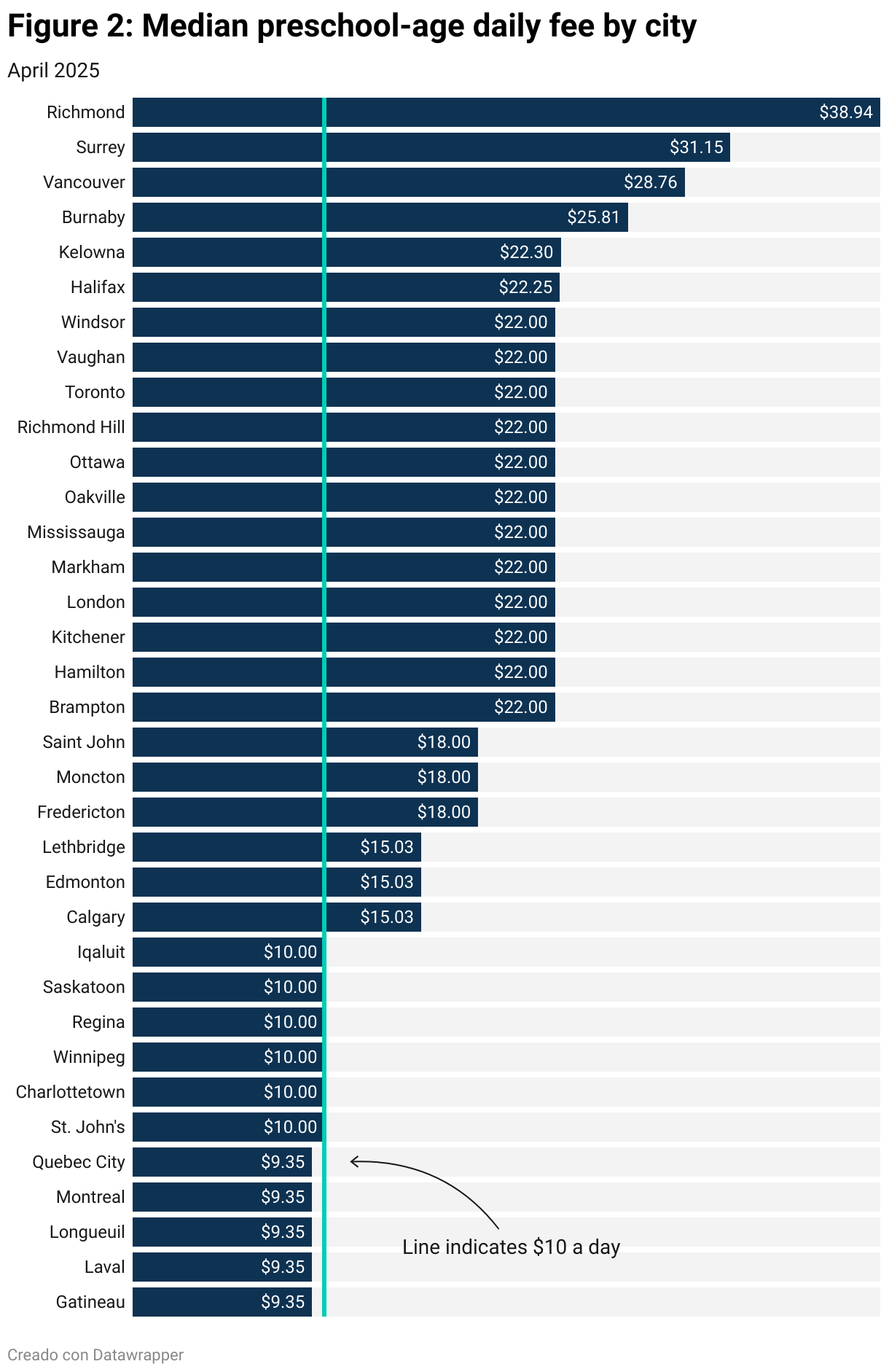
Taking into account the information in Table 1, Figures 1 and 2 show how close each city is to reaching a median fee of $10 a day in April 2025.
In a market system, the highest fees are charged for infants, who are generally under two years old (the specific definitions change somewhat by jurisdiction). Infant care is more costly to provide as more staff are required, so in a market model this increases the operating costs for providers.
However, in set fee systems, infant fees are usually the same as the fees for other age groups (several set fee provinces have moved from age-related set fees to one set fee across age groups). One result of this shift is that it has made the savings for parents of infants quite substantial, as we’ll see below for Ontario. Unfortunately, there are generally few infant spaces compared to the actual population of infants, resulting in a coverage rate that is much lower for infants than for older children.
In April 2025, eleven of the cities in our report were already at or below $10 a day for infants. These included all five cities in Quebec (at $9.359Note that Quebec child care fees are indexed; increased every January 1. a day) as well as Charlottetown, Winnipeg, St. John’s, Saskatoon, Regina, and Iqaluit.
It is noteworthy that all the cities that already had set fees in 2019 now had fees at $10 a day in April 2025. We infer that having administered set fees made the province’s or territory’s transition to the lower set fees of $10 a day easier and faster.
Set fees now exist for infants in almost all cities surveyed but some of those set fees are higher than $10 a day. In the Ontario cities, for example, infant fees are $22 a day—twice the federal government’s 2026 target. Alberta has moved to set fees of $326.25 a month (or $15.03 a day) and New Brunswick has set fees that vary by age group and region.
The cities still using market fees have the highest median fees for infants, despite contributions from provinces/territories of fee reduction dollars on behalf of parents. Richmond, B.C., tops the list at $46 a day for infants—more than four times the final target of $10 a day for the CWELCC plan. Surrey, B.C., is only slightly less expensive, at $39 a day. Among B.C. cities, the provincial $10-a-day program includes a relatively high proportion of Vancouver’s spaces, reducing its median somewhat. Kelowna rounds out B.C. cities at $24 a day for infants. This is similar to Halifax, which is also in a market fee province.
In previous years, we have also calculated published the fees for the toddler-age category (children who are aged roughly 1.5 to 2–3 years). However, this year it is less relevant, as a majority of jurisdictions have moved to one set fee across all age groups as noted above. As such, we move directly to preschool-age fees for children aged roughly two to three years through school-age.
In market fee systems, which predominated prior to the CWELCC, fees for preschool-aged children were lower than infant fees, as their care requires fewer staff compared to infants. Although most set fee systems now erase this difference and set all the fees the same irrespective of age.
Spaces were also most plentiful in this category. Many parents stay home with a child for some portion of their first year, up to 18 months (under parental leave policy) and then return to work. This means that child care centres are more likely to specialize in types of spaces for which there are lower costs and higher demand. Also parents are more likely to want the socialization experiences that child care provides for preschool-aged children than infants.
Looking at Figure 2, we find that preschool-age fees in 11 cities are already at or below the $10-a-day target. The cities in Quebec are actually slightly below target—at $9.35 a day. The cities in B.C. are again well above the target. Richmond stands out with a median preschool-age fee of $39 a day, almost four times the $10-a-day target. Vancouver benefits from a large portion of its preschool-age spaces being in B.C.’s $10-a-day program, bringing down the city’s median fee. However, that median is still $29 a day, almost three times the 2026 target.
Parental savings in 2025 compared to 2019
Broadly speaking, the higher child care fees were to begin with, the larger the savings brought about by the CWELCC fee reduction. In jurisdictions where fees were already more under control due to government interventions, savings were obviously smaller. Smaller savings generally meant the jurisdiction had a better public program before CWELCC began.
As Table 1 shows, the provinces and territories started in very different places when it comes to affordable child care. In 2019, four provinces (Newfoundland and Labrador, Prince Edward Island, Quebec, and Manitoba) had already implemented set fees, although all except Quebec still had fees that were well above $10 a day. However, compared to the market fees found in most cities, the set fees in those provinces were still much lower. Therefore, CWELCC fee reduction in the cities already using set fees meant smaller savings for families in those cities after 2019 compared to cities in other provinces.
In contrast, large cities in Ontario and Alberta, as well the city of Iqaluit, had very high market fees in 2019 and 2020, particularly for younger age groups. Their moving to set fees in early 2025 therefore represented much larger savings for parents, even if their fees are still at the high end today, as shown in Figures 2 and 3.
Figure 3 illustrates the change in median monthly fees between the CWELCC baseline point of 2019 (or 2020 for Ontario) and as of April 2025. In 2020, infant fees in the City of Toronto’s market system were the highest in the country by a fair margin. The suburban cities in the Greater Toronto Area and the city of Iqaluit followed closely behind before CWELCC’s start. With Ontario’s move to $22-a-day child care in January 2025, Toronto parents saw considerable savings, even if fees haven’t yet moved to $10 a day. Compared to the 2020 median fee for an infant space, Toronto parents were saving $1,389 a month in 2025. In the GTA suburban cities of Mississauga, Richmond Hill, Brampton, and Vaughan, the 2019/2025 savings were approximately $1,000 a month for an infant space. Parents in Iqaluit also saw $1,000/month savings, as fees there have been reduced to $10 a day.
At the other end of the spectrum, in the cities in Quebec, set parent fees have increased by $24/month for infants since 2019 (as they are annually indexed by the province), but they are still less than $10 a day. Again, note that Quebec’s asymmetrical CWELCC agreement did not oblige it to reduce fees, which were already lower there than in any other jurisdiction.
Otherwise, parents in all cities saw some savings for infant spaces in 2025 compared to 2019/20, although those savings were less than $200 a month in both Richmond and Surrey in British Columbia.
Changes in preschool-age fees affect more parents than changes in infant or toddler fees, as there are many more spaces for this age group. Additionally, preschool-age spaces had lower fees to begin with in the pre-2019 provincial/territorial systems, which were predominantly market-models. As a result, when we compare parents’ 2019/20 and 2025 savings for preschool-age fees, they tend to be somewhat smaller than for infant fees.
In the preschool-age category, the biggest savings between 2019/20 and 2025 by far were for parents in Iqaluit, with savings per child just under $1,000. Iqaluit had the highest median fees for preschool-aged children for several years prior to and including 2019. In 2025 parents with preschool-aged children in Toronto and its suburban cities (Oakville, Markham, Mississauga, and Richmond Hill) are saving about $700 a month compared to 2020, and Calgarians with preschool-aged children are saving just over $700 a month.
Parents in Richmond and Surrey in British Columbia have seen savings of just over $100 and about $200 a month, respectively. Winnipeg parents are saving about $200 a month in 2025 compared to 2019; Winnipeg fees were already set at a fairly low rate in 2019 and are now $10 a day for all ages.
Parents in the cities in Quebec are the only ones that have not seen any savings, as the median set preschool-age fees there are $24 a month more expensive now than in 2019 (set fees in Quebec are annually indexed to inflation). These fees are still the lowest in the country, just as they were before CWELCC began.
In summary, the fee survey data show that the amounts parents save each month under the $10-a-day plan vary considerably depending on several factors. These include each province’s or territory’s fee policies in both 2019 and 2025, how fees are set for different age groups, and the original fee levels prior to implementation. Overall, parents in jurisdictions with set fees pay less than parents in jurisdictions that still use market-based fees.
Market fees in British Columbia and Nova Scotia
British Columbia and Nova Scotia are the only two provinces10The Yukon and Northwest Territories also retain market fees. This year’s report was not able to include these two territories, however, which is why they are not discussed here. to retain market fees. There, the provincial government pays a flat amount toward lowering parental fees. The large cities in these provinces now have the highest child care fees in the country. As we saw in the previous section, parents in B.C. cities have also experienced some of the smallest savings compared to 2019 in both the infant and preschool-age categories.
In both Nova Scotia and British Columbia, the provinces increased the flat dollar amounts they provided in December 2022 to meet the 50 per cent reduction in fees that was the CWELCC goal for that year. Since then, these two provinces have not increased the portion they will pay for child care.
In Nova Scotia, market fees have been fixed at their July 2021 level. There is no mechanism to increase them and new spaces must charge the regional average fee or less.
In British Columbia, underlying market fees have continued to rise although the province does place limits on fee growth and facilities require special approval to exceed those limits. In Richmond centres, we’re seeing market fee increases of $50–$170 a month since 2023, a worst-case scenario of how this has played out.
While most other cities have benefited from a second step in fee reductions since December 2022, cities in British Columbia and Nova Scotia have not, because there haven’t been any provincial changes since then. Consequently, fee inflation has eroded the savings parents in those cities had been benefiting from since December 2022.
British Columbia actually uses two parallel fee reduction mechanisms: a flat amount fee reduction against market fees in most cases, and then set fees of $10 a day in a slowly growing minority of spaces. The proportions of programs being converted to $10 a day vary dramatically by city. This is because the province is now converting primarily not-for-profit programs, which are very unevenly available by city. That makes this conversion much more prevalent in Vancouver, where there is a local policy to support non-profit child care.
As more services are converted to $10 a day, the median fee will fall until it reaches $10 a day, the point at which at least half of all spaces charge that amount or less. This phenomenon is actually quite close to happening in Vancouver, as almost half its spaces have been converted to $10-a-day programs. For infant/toddler spaces in Vancouver child care centres, the median fee is now $10 a day. However, because there are very few licensed family child care providers with $10-a-day spaces, when we include licensed family child care homes with infant/toddler spaces in the calculations, the median jumps from $10 a day to $34 a day (the value published in Figure 1). This $24 jump illustrates the tremendous gap between the market system, minus the flat provincial contribution of $900 a month, and a set fee of $10 a day.
For preschool-aged children, 44 per cent of Vancouver’s spaces are at $10 a day, with the remainder at market fees minus the flat-rate fee reduction of $545 a month.
No other B.C. city included in this analysis was even close to having half its spaces in the $10-a-day system. After Vancouver’s almost 50 per cent of spaces at $10 a day, Burnaby was next-closest with 15 per cent of its spaces at $10 a day. In Kelowna, 13 per cent of preschool-age spaces and 9 per cent of infant/toddler spaces were at $10 a day. In Richmond and Surrey, the remaining B.C. cities in this analysis, well under 10 per cent of spaces were at $10 a day. We note that our annual fee surveys have consistently found that cities dominated by for-profit child care provision show higher median fees than those with predominantly non-profit provision. This was especially evident in British Columbia and Ontario.
Enrolment and additional fee questions
Our decade-long child care fee survey has always been a phone survey where we call providers and ask them about their fees, with a few add-on questions. However, as surveying providers by phone has become increasingly difficult, this year we have supplemented phone calls with electronic communications. We are now using multiple data sources, including provincial datasets and online lookups where necessary. This hasn’t always proven successful; we had to leave Yellowknife and Whitehorse out of our analysis this year due to low response rates and a lack of good alternative data.
In past surveys, ancillary questions in addition to those about fees were included, and this year was no different. This year, we asked if centres were fully enrolled. If they weren’t, we asked why not. We also asked whether additional or supplementary fees were charged for things like food, field trips, or other activities, over and above the base fee (whether set or market fees).
Unfortunately, the response rates were particularly low for these ancillary questions, making only indications of answers possible rather than solid data comparing cities on each question. We nevertheless provide it here in summary form to provide some indication, if not definitive data.
Overall, when it comes to being fully enrolled, centres for which we have this data rarely said they were at their licensed capacity. Many said they would be able to enroll another child in the next week in all age categories. Unfortunately, our survey was conducted during the transition from higher market fees to lower set fees in several provinces and so those results may no longer be valid.
The most common reason given for not being at full capacity was a lack of demand, which encompassed multiple reasons: other centres had lower fees, parents didn’t want to pay high fees, or parents had decided to keep children at home. These were the case primarily in jurisdictions or facilities that were still charging market fees.
However, this situation is changing rapidly as Ontario and Alberta were moving to lower set fees while our survey was still taking place. Trouble finding staff played a secondary role to insufficient demand, although staffing issues took on more primary importance at facilities whose fees had already dropped due to CWELCC and/or provincial policies.
Another operational constraint on “full” enrolment is that centres commonly keep spaces open for children aging up from younger rooms. Without some looseness in capacity, centres could have a child age into a new category but not have a space available for them.
Providers might have been reluctant to answer our question about whether they charge additional fees over and above their base fees. However, we did find a minority of centres charging additional fees in a manner that largely matched provincial policies. For example, Ontario banned wait list fees and requires providers to serve a hot meal (included in the base fee). We did not find additional fees of that type in Ontario. Although clearly self-reporting an illegal activity is unlikely.
In provinces like British Columbia, Alberta, and New Brunswick, which do not forbid charging an additional fee for a meal, a minority of centres appear to be billing for this (there also is no requirement for facilities in those provinces to provide meals, as there is in Ontario11For more details see table 20 of Martha Friendly, Jane Beach, Gayaththiri Aruran, Alexie Cossette, Jade Lillace, and Barry Forer “Early Childhood Education and Care in Canada 2023.” Childcare Resource and Research Unit, 2023, https://childcarecanada.org/sites/default/files/ECEC-2023-Full-publication_0.pdf .). Charging extra fees for outings and field trips happens as well, although again at a minority of centres. This practice seems to be relatively common in Quebec, at both non-profit and for-profit centres.
Across Canada, administrative fees, like registration fees for example, are also showing up in a minority of cases.
Discussion
Two pillars are emerging as the two lessons for the successful rollout of CWELCC across Canada: set fees and set wages.
Child care fee reductions for parents are now well under way in all the provinces and territories. However, by April of 2026 many parents with children in CWELCC-supported spaces will still be paying more than the $10-a-day target that should have been reached by then.
By that time, parents in six provinces and territories will be paying a maximum of $10 a day, while in others they’ll almost certainly be paying more as those jurisdictions leverage the “average of $10 a day” wording in their CWELCC agreements. For example, Ontario’s plan is for parents to be paying a maximum of $12 a day.12“Canada-Ontario early years and child care agreement”, March 26, 2025, Government of Ontario, https://www.ontario.ca/page/canada-ontario-early-years-and-child-care-agreement
What most concerns us at this point is the lack of details on the final stepdown in April 2026 to even “an average of $10 a day” in Alberta, Nova Scotia, and British Columbia. At the time of publishing, there were no additional details of how or if fees will change further from where they stood as of April 2025.
Alberta for its part now has set fees—a big change in 2025. Those fees are $15.03 a day ($326.25 a month), still well above the $10-a-day target.
Nova Scotia and British Columbia haven’t yet shifted to a maximum or a set fee. Both retain market fees, although reduced by a flat amount. In the set-fee provinces, all parents in the CWELCC system are paying the same monthly amount, or possibly less. But in Nova Scotia and British Columbia there remains a substantial range for fees. In B.C. cities in particular, the flat fee reduction amount has remained unchanged since December 2022 while the underlying market fees have been creeping up. This means that fees are rising in B.C., not falling as they have almost everywhere else over that period. Moving quickly to establish maximum set fees in both provinces will be an important step towards reaching $10 a day, even if those set fees start above $10 a day.
Prior to the CWELCC agreements, child care faced two main challenges for the public: high fees and long wait lists. On the first count, parents are paying a lot less than they were in 2019, even in provinces that aren’t at $10 a day yet.
Now CWELCC is going to have to work on the second—and more difficult to solve—challenge: meeting much higher demand for lower fees. This necessitates rapid space creation, but also equitable space creation that attempts to provide better access in child care deserts. This requires a publicly led and funded expansion, much like we see in the K–12 school and health care systems. Capital, public planning, and the workforce to staff new spaces will all be needed.
Recruitment of early child care educators is part of the picture, but so is the retention of current employees. Set fees are the answer to lower fees, but set wages, via wage grids, is likely the key to staffing the expansion. Adequate wage grids can eliminate retention difficulties overnight, as was recently illustrated in Prince Edward Island.13Kathleen Flanagan and Associates, “Early Learning and Child Care Recruitment and Retention: PEI’S 2024 Director and Staff Surveys: Final Report”, January 2025, https://mcusercontent.com/aff981eb17e452f90e6094988/files/50178ef2-2c85-9175-8afd-59f7f42ff215/2024_ELCC_Director_and_Staff_Survey_Final_Report.pdf
As such, it is both set fees and set wages that remain some of the key lessons of the CWELCC program.
Acknowledgements
The authors would like the thank the following reviewers for their helpful comments on an earlier draft of this paper: Lynell Anderson, Morna Ballantyne, Jane Beach and Eric Swanson.