



Share
Introduction
Indigenous, Black, and other racialized peoples continue to face historic and ongoing systemic racism in virtually every aspect of life in Canada. Over the past 12 months, data and lived experience underscored widening disparities in hate-crime victimization, economic opportunity, environmental health, and representation in decision-making spaces. Addressing these inequities1Equity is the recognition that in certain circumstances different treatment may be required to achieve fairness and justice. Equality is to treat everyone the same. is not only a moral imperative but also a strategic investment in Canada’s collective economic growth, competitiveness, innovation, and social cohesion. While the federal government announced targeted initiatives and consultations, progress remain uneven and largely piecemeal.
Overview
Canada’s obligations under the Canadian Charter of Rights and Freedoms, the Canadian Human Rights Act, and international instruments, such as the International Convention on the Elimination of All Forms of Racial Discrimination remain unchanged. The period under review saw incremental steps, most notably the passage of the National Strategy Respecting Environmental Racism and Environmental Justice Act, but no comprehensive legislative framework to dismantle systemic racism across federal institutions.
Some of the key developments/data over the past 12 months include:
- National Strategy Respecting Environmental Racism and Environmental Justice Act (S.C. 2024, c. 11) received Royal Assent on June 20, 2024, mandating a national strategy within two years.2Parliament of Canada, Bill C-226, Environmental Racism and Environmental Justice Act, retrieved June 18, 2025, from https://www.parl.ca/legisinfo/en/bill/44-1/c-226.
- The 2024 fall economic statement earmarked $77.9 million over two years (starting 2025-26) to launch Canada’s Black Justice Strategy, but implementation details remain unclear.3Department of Finance Canada, Fall Economic Statement—Safer, Healthier Communities: Black Justice Strategy Funding, December 2024. The strategy has a 10-year framework.
- Bill C-63 (Online Harms Act) was introduced February 26, 2024, but died on the Order Paper following the prorogation of parliament on January 6, 2025.4Mandy Lau, “Canada’s Online Harms Bill Is Dead (Again): Three Questions to Consider for the Next Round,” TechPolicy Press, April 28, 2025, https://www.techpolicy.press/canadas-online-harms-bill-is-dead-again-three-questions-to-consider-for-the-next-round/.
- Employment Equity Act modernization consultations ran May 3 to August 30, 2024; no bill implementing the Blackett Task Force recommendations has yet been tabled.5Employment and Social Development Canada, Consultation on the Employment Equity Act Modernization, May 3 to August 30, 2024.
- Police reported 4,777 hate-crime incidents in 2023, a 32 per cent increase over 2022; anti-Black, anti-Muslim, anti-Arab, and anti-Indigenous incidents led the rise.6Statistics Canada, Table 35-10-0191-01: Police-reported hate crime, number of incidents and rate per 100,000 population (2023), released July 25, 2024, https://www150.statcan.gc.ca/t1/tbl1/en/tv.action?pid=3510019101. Black individuals experienced the highest proportion of hate crimes, at 36 per cent, which is, on average, over 300 per cent greater than the average for all other racial/ethnic groups combined.7Statistics Canada, “Chart 5: Number of police-reported hate crimes motivated by race or ethnicity, Canada, 2019 to 2023”, Police-reported hate crime in Canada, 2023, March 25, 2025, https://www150.statcan.gc.ca/n1/daily-quotidien/250325/dq250325a-eng.htm. Preliminary data show 2,384 hate-crime incidents in the first half of 2024, 48 per cent of which targeted race or ethnicity.8Statistics Canada, “Police-reported hate crime and cybercrime, preliminary 2024,” The Daily, October 24, 2024.
- The 2023-24 Public Service Commission report confirmed Black public servants remain the least likely to be hired or promoted.9Public Service Commission of Canada, Employment Equity Promotion Rate Study—Five-Year Update, 2025, https://www.canada.ca/en/public-service-commission/services/publications/open-info/employment-equity-promotion-rate-study-five-year-update-2024.html.
- The Federal Court dismissed the $2.5 billion Black Class Action in March 2025; plaintiffs have appealed.10Eleanor A. Vaughan and Sean M. Reginio, “Federal Court Dismisses $2.5 Billion Class Action Alleging Systemic Anti-Black Racism in Federal Public Service Hiring Decisions and Promotional Opportunities,” Hicks Morley, March 24, 2025, https://hicksmorley.com/2025/03/24/federal-court-dismisses-2-5-billion-class-action-alleging-systemic-anti-black-racism-in-federal-public-service-hiring-decisions-and-promotional-opportunities/.
- The Canadian Human Rights Commission released an update to its Anti-Racism Action Plan in June 2025, outlining reforms to complaint handling and recruitment.11Canadian Human Rights Commission, Update on the Canadian Human Rights Commission’s Anti-Racism Efforts, June 2025, https://www.chrc-ccdp.gc.ca/resources/publications/update-canadian-human-rights-commissions-anti-racism-efforts.
National anti-racism legislation remains essential. A stand-alone Anti-Racism Act for Canada would embed a whole-of-government commitment to racial equity, provide statutory authority for an independent Anti-Racism Secretariat, and mandate uniform and consistent disaggregated data collection and require departments to act on disaggregated data and equity outcomes.
The Equi’Vision employment-equity dashboard and ongoing work by Statistics Canada to publish race-disaggregated census and survey data illustrate the power of good data to surface inequities. However, gaps persist in justice, immigration, and health datasets. Immigration status is sometimes incorrectly and inappropriately used as a proxy for racialization and ethnicity. Canada launched a Disaggregated Data Action Plan in 2021 with funding attached: $172 million over five years, with $36.3 million ongoing.12Statistics Canada, “Disaggregated Data Action Plan”, modified November 27, 2024. https://www.statcan.gc.ca/en/trust/modernization/disaggregated-data. The plan is almost at the end, and has not achieved uniform, consistent and comparable disaggregated data collection across government. The plan must be renewed and strengthened by giving it legislative foundation in a National Anti-Racism Act.
Racialized communities, especially Black, Indigenous, Muslim, Arab, and Palestinian peoples, continue to report disproportionate discrimination in employment, policing, housing, government funding, and online spaces. Aside from one-time grants, such as the National Black Canadians Summit funding announced in January 2025, core operational funding for Black-led social-justice organizations remains insufficient.
Trust in law enforcement and government redress mechanisms remains low, reinforcing under-reporting and cyclical harms. The 2019 General Social Survey on Canadians’ Safety showed a significant disparity between the number of police-reported hate crimes and actual hate-motivated incidents and crimes reported by Canadians.13Statistics Canada, “2019 General Social Survey—Canadians’ Safety: Technical Report”, modified July 2, 2025. https://www.statcan.gc.ca/en/statistical-programs/document/4504_D1_V1. Systemic barriers and bias in the process of recognizing and addressing hate incidents discourage Indigenous, Black and other racialized peoples from reporting racism and hate. The increase in hate incidents, including online harms, has detrimental social and economic effects on individuals and communities.
Actions
The AFB will require every budget measure to publish its Racial Equity Impact Assessment (REIA) findings.
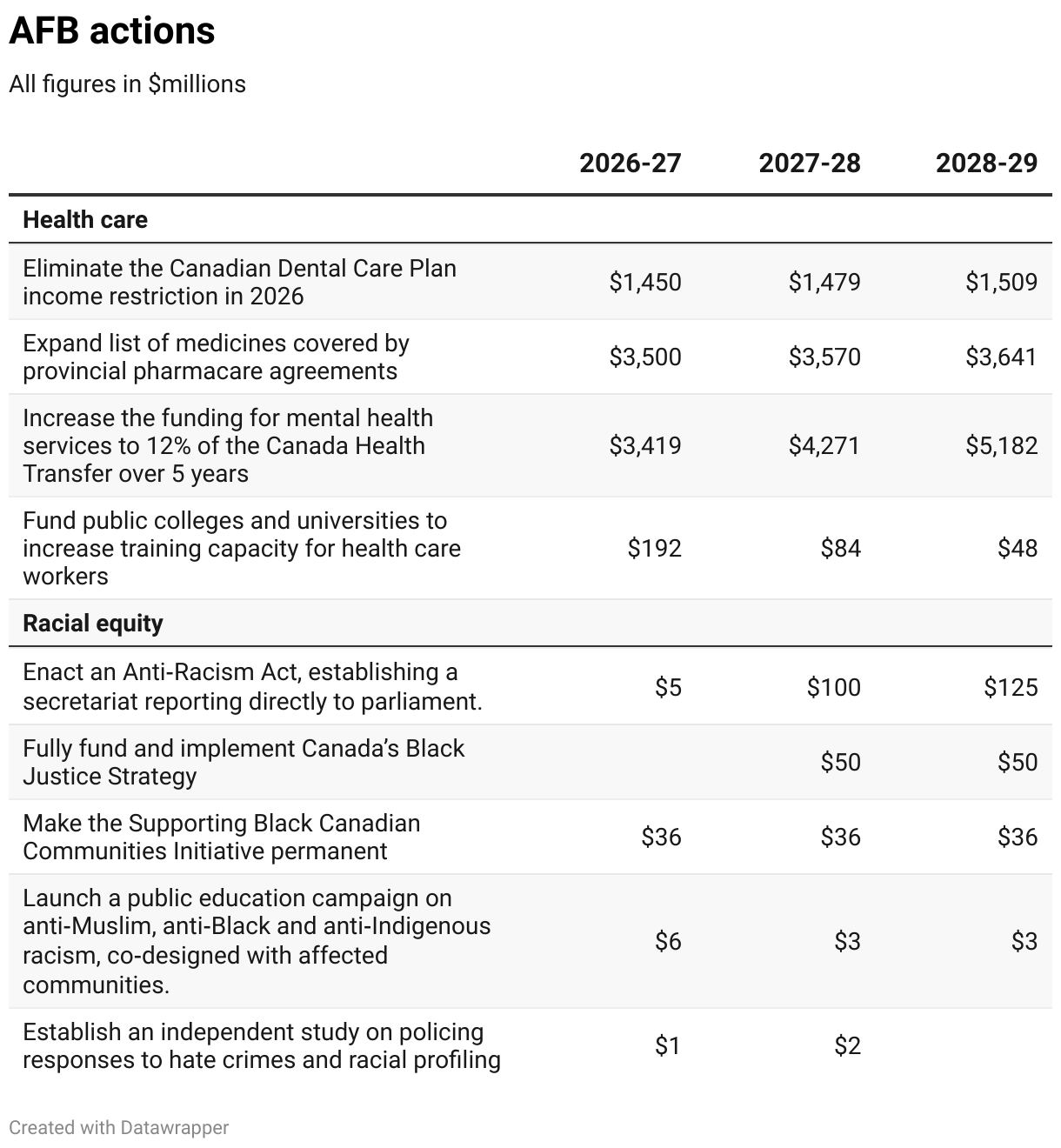
The AFB will enact an Anti-Racism Act, establishing an independent, well-resourced secretariat reporting directly to parliament.
The AFB will modernize the Employment Equity Act by 2026, adopting all Blackett Task Force recommendations and expanding designated groups.
The AFB will dedicate at least three per cent of federal program spending and procurement to Black- and other racialized-led organizations and businesses.
The AFB will alter existing government contract reporting requirements for contracts over $10,000 to report annually if that contract went to a Black or other racialized-led business or group, similar to how it presently reports on whether a business is Indigenous or not.
The AFB will fully fund and implement Canada’s Black Justice Strategy, including sustainable operational funding for Black community organizations.
The AFB will make the Supporting Black Canadian Communities Initiative permanent and expand the Black Entrepreneurship Program’s capital envelope.
The AFB will mandate uniform and consistent federal collection and public release of race-disaggregated data across all of government, and work with provincial and territorial governments to advance data transparency and equity reporting.
The AFB will amend the Canada Labour Code to explicitly recognize racism as a form of workplace violence and require employer reporting.
The AFB will attach Community Benefits Agreements with racial-equity hiring and procurement clauses to all federal investments over $10 million.
The AFB will launch a public education campaign on anti-Muslim, anti-Black and anti-Indigenous racism, co-designed with affected communities.
The AFB will establish an independent study on policing responses to hate crimes and racial profiling.
The AFB will re-introduce Bill C-63 to enact the Online Harms Act Bill, addressing online hate while protecting freedom of expression.
The AFB will mandate the Canadian Human Rights Commission to publicly report disaggregated data on anti-Black racism in its workforce and complaint handling to ensure transparency, accountability, and restored public trust.