


Share
Introduction
The Canadian Armed Forces (CAF) stand at a pivotal moment. As defence spending has now risen to two per cent of GDP—a level not seen since the end of the Second World War—Canada faces evolving security challenges that extend beyond conventional threats, increasingly shaped by the accelerating impacts of technological and climate change. Meeting this moment will not simply be addressed through major investments in defence, but through a fundamental shift in how the federal government defines and addresses security.
Put simply: the two per cent of GDP spending target for NATO members—a figure that Canada has committed to boosting to an eye-watering five per cent of GDP by 20351NATO Newsroom, “NATO Defence Ministers agree new capability targets to strengthen the Alliance,” North Atlantic Treaty Organization, June 5, 2025.—is not evidence-based policy-making. The federal government must shift from politicized defence spending targets to an evidence-based approach, determining what level of expenditures are necessary to ensure the safety and security of Canadians and then costing those into the federal budget.
Overview
Despite being labelled a “laggard” in military spending, Canada ranks as the seventh largest defence spender among NATO’s 32 member countries for 2024-25, outspending the Netherlands, Spain, Sweden and Norway.2Stephen Thorne, “Canada to meet defence spending target by March 2026: Carney,” Legion Magazine, June 18, 2025. Globally, Canada ranks 16th in the world for military expenditures,3Xiao Liang et al., “Trends in World Military Expenditure, 2024,” Stockholm International Peace Research Institute, April 2025, https://www.sipri.org/publications/2025/sipri-fact-sheets/trends-world-military-expenditure-2024. outpacing other similar or larger developed nations. While the narrative persists that Canada is falling short on defence, we spend much more on defence than many realize.
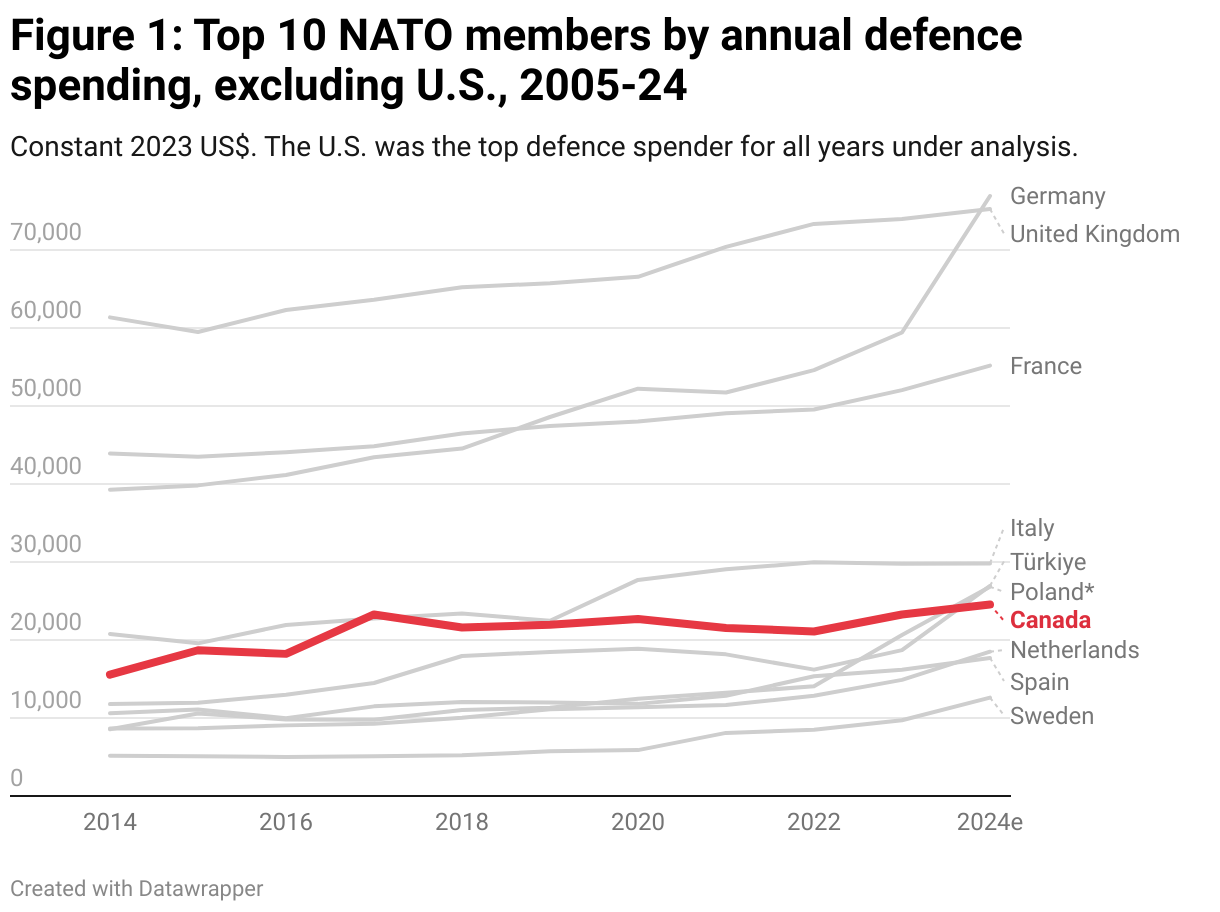
Analyzing defence spending as a percentage of a country’s GDP, the reigning benchmark for NATO members since 2014,4NATO, “Defense expenditures and NATO’s 2% guideline,” North Atlantic Treaty Organization, June 17, 2025. is not an effective measure. A more accurate approach is to examine each NATO member’s actual defence spending in real U.S. dollars.
Under the prior Liberal government, defence spending ticked up between 2016 and 2024, reaching 1.37 per cent of GDP, or $41 billion, in 2024.5NATO, “Defense expenditures of NATO countries as a percentage of gross domestic product in 2024,” North Atlantic Treaty Organization, June 18, 2024. As calls grow for NATO’s spending to increase, Canada has now committed to a national target of five per cent, with 1.5 per cent of GDP allocated for security-related infrastructure.6Murray Brewster and Peter Zimonjic, “Canada promises to spend 5 % of GDP on defence by 2035 in pact with NATO leaders,” CBC News, June 25, 2025, https://www.cbc.ca/news/politics/canada-agrees-five-percent-gdp-defence-spending-1.7570191. Such an increase in defence spending would represent a significant shift, with likely ripple effects across other areas of federal spending, possibly affecting social programs, multilateral engagement, international assistance, and actions on fighting the climate crisis—all vital elements to Canadian safety.
A credible approach requires periodic, transparent reviews of Canada’s defence policy, threat environment, and capability gaps so that spending levels align with clear strategic objectives rather than arbitrary spending targets.
The federal Treasury Board already obliges every department to track results under its 2016 Policy on Results, yet big-ticket military projects still race through cabinet, with most indicators redacted from public disclosure for security reasons. To increase transparency and public oversight, the AFB mandates that any defence project over $100 million must publish an Evidence-to-Decision Statement (EDS) before funds flow.7Treasury Board of Canada Secretariat, Policy on Results, BT22-172/2016E-PDF, July 1, 2016, https://publications.gc.ca/collections/collection_2017/sct-tbs/BT22-172-2016-eng.pdf.
An EDS is a three-page public brief that shows, in plain language, how the project scores on six pillars. A project proceeds only if the EDS shows “evidence sufficient” on at least four of the six pillars and demonstrably improves readiness. The Treasury Board’s existing Performance Measurement & Evaluation Committee would release the unclassified EDS summary on the open.canada.ca portal within 60 days, ensuring parliament and the public can judge whether new spending really buys security.
Proposed evidence-to-decision statement
- Threat relevance: Links the purchase to a named, quantified threat in the latest Strategic Threat Assessment.
- Readiness impact: States how the project will raise today’s 61 per cent force-readiness rate inside 10 years.
- Personnel sustainability: Confirms recruitment and training funds for any scarce trades the project will need.
- Whole-life cost certainty: Provides a 20-year cost track validated by the Parliamentary Budget Officer.
- Climate and community co-benefits: Measures emissions reductions and local infrastructure gains, especially in the North.
- Escalation and arms-control risk: Includes an independent review by the proposed Canadian Nuclear Risk-Reduction Centre.
Procurement
Critics have long described Canada’s procurement system as broken, inefficient, and overly politicized. Major defence acquisitions typically take much longer to procure than forecast and are generally expected to be delivered well over budget. DND faces barriers in spending its allocated budget on major capital expenditures in the time frames provided.8Eugene Lang, “Use It or Lose It: SSE and DND’s Chronic Underspending Problem,” Canadian Global Affairs Institute, May 2018. These issues would only amplify under the five per cent spending target we’ve committed to by 2035.9Cynthia Leach and Salim Zanzana, “What does greater defence spending mean for Canada’s economy?” RBC, June 13, 2025. Canada’s military procurement process must be overhauled to make the best use of resources and deliver the most economic and social benefits.
Perhaps the best example of Canada’s faltering procurement system is the Royal Canadian Air Force’s (RCAF) decade-plus-long acquisition of the Lockheed Martin F-35 Joint Strike Fighter, a platform widely criticized for its excessive costs and underperformance.10Peter Zimonjic, “F-35 program facing skyrocketing costs, pilot shortage and infrastructure deficit: AG report,” CBC News, June 10, 2025. Of particular concern to Canada’s current defence priorities are debates about its technical suitability to perform tasks in the Arctic.11Steven Staples, “Why the feds flip-flopped and bought the F-35,” Canadian Centre for Policy Alternatives, January 13, 2023. Another example is the Royal Canadian Navy’s (RCN) plan to acquire 12 new submarines under the Canadian Patrol Submarine Project.12Murray Brewster, “Canada confirms plan to replace submarine fleet at NATO summit,” CBC News, July 10, 2024. Only one in four of the RCN’s existing submarines is currently seaworthy and there is a chronic gap in trained personnel to operate them.13Richard Shimooka, “A significant boost to security: Inside Canada’s plans to replace its submarines,” Macdonald-Laurier Institute, April 17, 2023.
Canada must streamline its defence procurement system to make better use of current budgetary resources, with a focus on delivering the right capabilities, on time and within budget. Doing so requires the creation of an independent defence procurement agency that determines purchases on capability-based requirements earmarked by clear cost-benefit reviews and strategic approaches that deliver the best technology and economic benefits. In 2019, the federal government announced its intention to establish such a body, Defence Procurement Canada. However, this initiative was sidelined and later dropped from ministerial letters following the onset of COVID-19.14Standing Committee on National Defence, “A Time for Change: Reforming Defence Procurement in Canada,” House of Commons Canada, June 19, 2024.
Where possible, DND should aim to procure from Canadian industry, with an emphasis on direct engagement with private sector unions in the aerospace and defence sector to scale up industrial benefits. The federal government should continue to leverage the Industrial and Technological Benefits (ITB) policy, which requires defence manufacturers awarded DND contracts to reinvest an equivalent value into Canadian businesses. We must also build strategic partnerships that encourage Canadian innovation to meet government and DND needs instead of purchasing off-the-shelf solutions from non-Canadian suppliers that may be “good enough” but miss the opportunity to deliver better, more tailored solutions through Canadian expertise.
At the same time, the federal government must remain aware of the boom-and-bust cycle that often characterizes major defence acquisitions from domestic suppliers, a pattern that has, at times, led to export reliance to foreign states with poor human rights records.15Rhonda Ferguson, Jamal Zarlasht, “A Health-Based Case against Canadian Arms Transfers to Saudi Arabia,” Health and Human Rights,Vol. 22, 2, December 22, 2020. When Canadian military equipment is exported to governments that act counter to Canada’s values, or is used in conflicts marked by serious human rights violations, it undermines Canadian interests, Canada’s international reputation—and, most importantly, peace and security.
Climate change and Arctic security
A critical component of Canada’s current defence policy, as outlined in Our North, Strong and Free: A Renewed Vision for Canada’s Defence,16Department of National Defence, “Our North, Strong and Free: A Renewed Vision for Canada’s Defence,” Government of Canada, May 3, 2024. is shoring up Arctic security and asserting Canada’s Arctic sovereignty.
Climate change continues to reshape the Canadian landscape, most dramatically in the Arctic, which is warming four times faster than the rest of the world.17Mika Rantanen et al., “The Arctic Has Warmed Nearly Four Times Faster than the Globe since 1979,” Communications Earth & Environment, Vol. 3, 168, August 2022. Melting sea ice has opened previously unexploited regions for resource extraction in Canada’s North, driving competition and fears of potential clashes in this environmentally fragile but critically important region.
The CAF currently possesses five significant military facilities in the North, with Canadian Forces Station Alertbeing the northernmost continuously inhabited place in the world.18Ernie Regehr, Kelsey Gallagher, “Military Footprints in the Arctic,” The Simons Foundation Canada, March 2024. The Canadian military’s growing presence in the Arctic, a phenomenon matched by essentially all Arctic and near-Arctic states, should be augmented by major investments in dual-use facilities funded through the defence budget, meaning infrastructure that can be utilized by both CAF as well as civilian and commercial actors, which will increase development and economic prosperity in the North while ensuring the greatest possible stewardship over this highly sensitive region by the communities that already inhabit it.
Sovereignty is rooted not only in military presence but also thriving Northern communities.19Government of Nunavut and Nunavut Tunngavik Inc., “Roadmap to Securing Canada’s Arctic Sovereignty and Security,” Nunavut Tunngavik Incorporated, March 4, 2025. Inuit peoples have been stewards of the Northern territories since time immemorial,20Dustin Patar, “Arctic Sovereignty? Inuit Would Like a Word,” The Narwhal, April 22, 2025, https://thenarwhal.ca/arctic-sovereignty-inuit-circumpolar-council/. and Arctic communities continue to secure Canada’s sovereignty in the region.21Government of Nunavut and Nunavut Tunngavik Inc., Roadmap to Securing Canada’s Arctic Sovereignty and Securityt, March 4, 2025, https://www.tunngavik.com/news/government-of-nunavut-and-nunavut-tunngavik-inc-provide-roadmap-to-securing-canadas-arctic-sovereignty-and-security/. Paths forward must be rooted in reconciliation, ensuring equity for Northern communities and respect for Indigenous sovereignty, rights, and titles.
To meaningfully assert Arctic sovereignty, the federal government must invest significantly in Northern infrastructure in collaboration with Inuit peoples and systems of governance. This includes enhancing health and education facilities, improving roads and transportation hubs, expanding telecommunication, addressing critical housing needs, and supporting Northern food sovereignty. Such investments will strengthen local economies, attract and retain skilled workers, and reduce reliance on southern supply chains. Ultimately, it is thriving, resilient Northern communities, not military outposts alone, that form the enduring foundation of Canada’s Arctic sovereignty.
While the CAF is tasked with protecting Canada from conventional security threats and hostile actors, the DND has increasingly recognized climate change as a tangible security threat to everyday Canadians.22Jessica West, Jessica Stewart, Morgan Fox, Branka Marijan, “Climate Change, Canadian Defence, and the Arctic through a Systems Lens,” Project Ploughshares, April 2025. The Canadian government must frame the climate crisis as a national security issue within the context of a broader climate strategy.
The CAF increasingly addresses weather events through Operation LENTUS.23Department of National Defence, “Operation LENTUS,” Government of Canada, October 8, 2024. The CAF also consistently notes that responding to extreme weather events disrupts readiness—and, therefore, military response if a conventional military threat arises.
The federal government should endeavour to more comprehensively integrate climate resilience into Canada’s defence planning, spending, and operations, and include climate impacts (e.g. thawing permafrost, extreme weather events such as wildfires, etc.) in defence vulnerability assessments. The federal government should look to coordinate across the Canadian government—including, but not limited to, the DND, Environment Canada, municipal and regional stakeholders, and Indigenous communities, in partnership with the NATO Climate Change and Security Centre of Excellence (CCASCOE).
With the federal government’s recently renewed focus on recruitment,24Department of National Defence, “Canada’s new government is rebuilding, rearming, and reinvesting in the Canadian Armed Forces,” Government of Canada, June 9, 2025. Canada should also direct increased investments toward Primary Reserve forces with dedicated funding for personnel tasked specifically with responding to climate-related events under Operation LENTUS, while also building out CAF’s Canadian-procured equipment to respond to these events. This would both increase the personnel pool which can respond to climate events while alleviating some of the burden on CAF’s conventional military forces to do so.
Nuclear weapons and the “Golden Dome”
Canada has been free of nuclear weapons since 1984, yet it still shelters under NATO’s nuclear “umbrella.” This stance leaves Ottawa walking a diplomatic tightrope:25Global Affairs Canada, “Canada’s statement to the Conference on Disarmament—High-Level Segment, 2024,” Government of Canada, February 26,2024. While historically advocating for nuclear disarmament at the UN, Canada fully endorses the alliance’s nuclear deterrence doctrine, sits on the Nuclear Planning Group, and refuses to sign the Treaty on the Prohibition of Nuclear Weapons (TPNW)—even as 80 per cent of Canadians favour nuclear abolition.26“CNANW Letter to Prime Minister Carney,” Canadian Network to Abolish Nuclear Weapons (CNANW), May 22, 2025.
On missile defence, Canada’s official position has been unchanged since it rejected direct participation in the U.S. Strategic Defense Initiative in 1985 and U.S. homeland Ballistic Missile Defence (BMD) in 2005.27Mark Bourrie, “POLITICS: Canada Rejects U.S. Missile Shield,” Inter Press Service, February 25, 2005. The Trump Administration’s “Golden Dome” proposal would vastly expand the BMD system, the latter’s only role now being to intercept “rogue state” (i.e. North Korea) warheads in outer space, mid-course in their flights. The “Golden Dome” is intended to aim its deter and defend mandate to include “any foreign aerial attack on the Homeland.”
That means being able to intercept any hypothetical Russian or Chinese nuclear attacks, which virtually no expert regards as possible. The “Golden Dome” is further intended to defend against nuclear or conventionally armed shorter-range ballistic missiles, as well as hypersonic and cruise missiles, against which the current mid-course interception BMD has no capacity. NORAD’s “modernization” program is already seeking to build a capacity to detect and intercept those same shorter-range ballistic missiles and hypersonic and cruise missiles.
Canada’s 2024 defence policy update, Our North, Strong and Free, already commits Canada to supporting NORAD’s integrated air-and-missile defence efforts, including the development of effective sensors, interceptors, and command systems. The 20-year, $38.6 billion NORAD-modernization package includes, among other measures, Arctic over-the-horizon radars and satellite upgrades. None of these involvements is part of the U.S. BMD mid-course interceptor architecture28James Fergusson, “The Canadian Ballistic Missile Dilemma,” Canadian Global Affairs Institute, April 2025. that is now under the “Golden Dome.” In other words, Canada’s national and continental defence obligations are met through its Canada-U.S. NORAD agreement and there is no compelling reason to join the “Golden Dome.”
Beyond the astronomical cost of the “Golden Dome” system, of which space-based interceptors are estimated to cost up to US$542 billion,29Congressional Budget Office, “Re: Effects of Lower Launch Costs on Previous Estimates for Space-Based, Boost-Phase Missile Defense,” U.S. Congress, May 5, 2025. other risks in participating include escalation that incentivizes declared adversaries, notably Russia and China, to expand their strategic offensive forces and to deploy anti-satellite weapons. “Golden Dome” participation would undermine the credibility of Canada’s long-standing commitment to nuclear disarmament.
Actions
The AFB will move Canada’s defence budget allocation away from an arbitrary percentage of GDP target and instead determine funding targets based on a needs-based approach, considering the current threat environment and capability gaps.
The AFB will amend the Defence Production Act regulations so that, by budget 2027, every defence project greater than $100 million must table an Evidence-to-Decision Statement before Treasury Board approval.
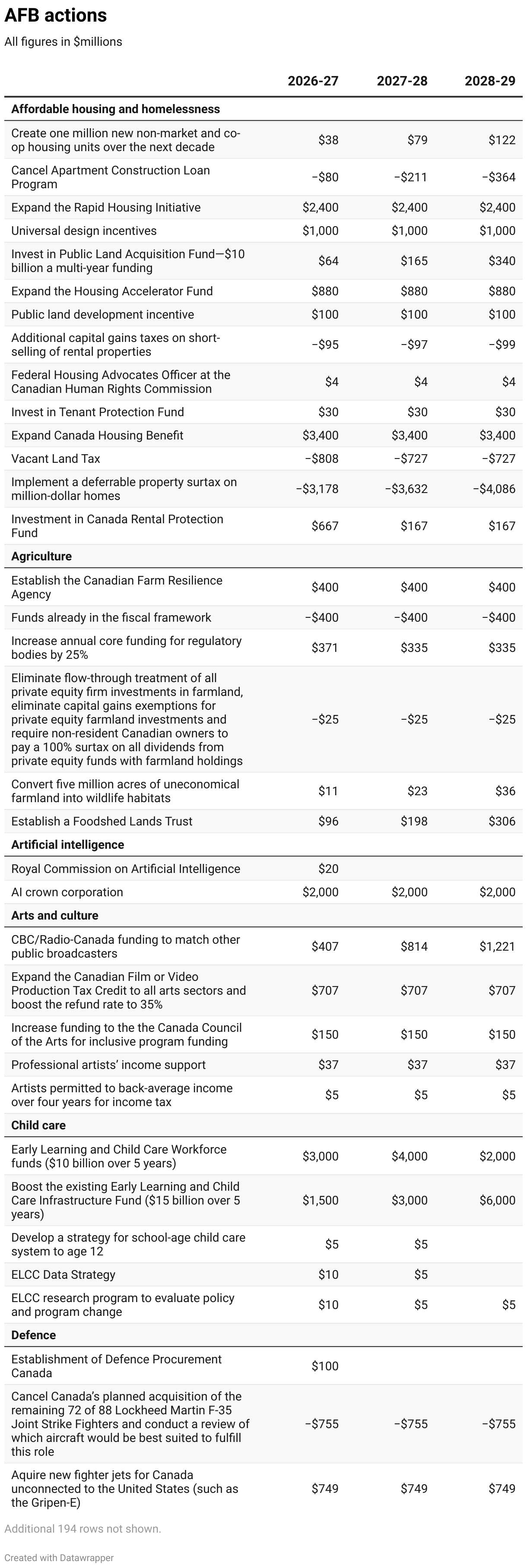
The AFB will commit $100 million toward the establishment of Defence Procurement Canada (DPC), an independent, centralized defence procurement body with clear capability-based requirements and ongoing cost-benefit reviews, delivering the best equipment to the CAF while coupling best value with domestic industrial benefits. While DPC would be an independent procurement body, it would have arms-length oversight by DND, Public Services and Procurement Canada (PSPC), and through the establishment of a permanent parliamentary subcommittee with the sole purpose of providing transparent, non-partisan oversight of defence acquisitions, ensuring accountability, fiscal responsibility, and alignment with Canada’s strategic and defence priorities.
The AFB will cancel Canada’s planned acquisition of the remaining 72 of 88 Lockheed Martin F-35 Joint Strike Fighters and conduct a review of which aircraft would be best suited to fulfil this role. The review will ensure 100 per cent Canadian-made or domestic industrial offset guarantees as part of that program.
The AFB will reduce the proposed number of submarines to be acquired through the Canadian Patrol Submarine Project from 12 to four to more realistically reflect current RCN staffing availability.
The AFB will provide $1.095 billion toward the acquisition of sixteen DHC-515 Firefighter aircraft to augment climate response efforts, to be acquired by the RCAF as the first federally owned-and-operated waterbombers.
The AFB will provide $1.5 billion toward major civilian and dual-use infrastructure programs in Canada’s Arctic, in partnership with Indigenous and Northern communities, alongside territorial and provincial governments.
- Provide investments in climate-resilient housing, transportation, and energy infrastructure for Arctic communities.
- Fund community-led permafrost adaptation projects to prevent infrastructure failure of both civil and military infrastructure in Canada’s North.
- Accelerate establishment of CAF’s Operational Support Hubs in Iqaluit, Inuvik and Yellowknife within the next 10 years, with a greater focus on civilian and dual-use infrastructure spending.30Department of National Defence, “Minister Blair announces First Northern Operational Support Hub locations” Government of Canada, March 6, 2025.
- Increase funding allocated under the Safety Equipment and Basic Marine Infrastructure in Northern Communities Initiative to increase the geographic reach of the program.31Transport Canada, “New projects funded under the Safety Equipment and Basic Marine Infrastructure in Northern Communities Initiative,” Government of Canada, March 21, 2025.
The AFB will provide $2.5-$3 billion toward dual-use domain awareness capabilities that serve both security and climate/environmental needs. This ensures cost-effectiveness and supports a whole-of-government approach toward Arctic stewardship, with prioritization of working with Canadian industry, when possible. This will include:
- Space-based sensors to monitor sea ice, shipping, and unauthorized incursions into Canadian territory.
- Investments into data integration and situational awareness with like-minded partners.
- Invest in dual-use polar sensor networks (e.g. satellites, maritime buoys) that serve defence, environmental monitoring, and community adaptation goals.
- Accelerate procurement of the Defence Enhanced Surveillance from Space—Project (DESSP), as part of broader NORAD modernization.
The AFB will allocate $1 billion over five years to scale up Canada’s peace operations, with targeted support for personnel, training, and deployment readiness. This investment will strengthen Canada’s capacity to contribute meaningfully to United Nations peacekeeping missions and other multilateral operations, with an emphasis on conflict prevention, protection of civilians, and gender-responsive approaches. Funding will support increased staffing levels, specialized training, and enhanced capabilities under the Peace and Stabilization Operations Program (PSOPs) while reinforcing Canada’s broader foreign policy objectives in fragile and conflict-affected states.
The AFB will provide $80 million toward the recruitment of an additional 6,000 Primary Reserve personnel to act as climate-event first responders. This contingent of reservists will occupy a new, separate sub-component of the Primary Reserve named the “Climate Reserve,” with the potential for rotating postings to the Canadian Rangers.
The AFB will commit $50 million towards the establishment of a National Climate-Security Task Force, a centralized body to coordinate climate-security efforts across DND, Public Safety Canada, ECCC, Indigenous governance bodies, and local governments.
The AFB will initiate a study into shifting climate disaster response leadership to civilian agencies (e.g., Public Safety Canada, emergency management offices, local authorities, etc.) in the mid-term to alleviate the climate first-response burden from CAF.
The AFB will keep Canadian defence dollars focused on real safety by capping the NORAD modernization program and refuse any spending on the “Golden Dome” and its unrealistic ambitions, especially its proposed space-based missile interceptors.