


Introduction
Housing affordability was a top issue during the 2025 federal election and there is strong support for Canada to commit to eliminating homelessness as an urgent human rights priority. A recent Abacus poll showed that “67 per cent of Canadians recognize homelessness as a housing issue needing immediate attention.”1Eddie Shepard, “67% of Canadians Recognize Homelessness as a Housing Issue Needing Immediate Action,” Abacus Data, January 31, 2025, https://abacusdata.ca/canadians-recognize-homelessness-as-a-housing-issue-needing-immediate-action/
Based on the 2021 national census data, there are at least three million households in core housing need—defined by the Canada Mortgage and Housing Corporation (CMHC) as living in an unsuitable, inadequate, or unaffordable dwelling. Notably, the 2022 Canadian Housing Survey found that 22.1 per cent of renters are in core housing need, more than triple the rate of homeowners at 6.1 per cent.
Access to affordable housing is a problem for first-time buyers and renters. Weak regulations and tight rental markets have exacerbated housing precarity. Major centres across Canada have seen an explosion of homelessness and a rise in housing encampments. The financialization of housing—treating housing as a financial asset and tool for maximizing profit—is exacerbating the problem.2United Nations Office of the High Commissioner for Human Rights, The Financialization of Housing, n.d., https://www.ohchr.org/en/special-procedures/sr-housing/financialization-housing. Governments must address these structural problems that have been building for decades instead of scapegoating migrants, refugees, and international students.
The Liberals promised to create Build Canada Homes (BCH), an agency to “get the federal government back into the business of home building” by “acting as a developer to build affordable housing at scale, including on public lands.” During the 2025 leadership debate, Mark Carney noted that affordable housing extends beyond homeownership and promised to invest in “deeply affordable” housing. The Liberal government describes its housing plan as “Canada’s most ambitious housing plan since the Second World War.”
Overview of what is needed
Solving housing affordability requires a comprehensive approach to both supply and demand, beginning with developing rental housing for those in core housing need. The 2024 federal budget committed $15 million over five years to a Tenant Protection Fund. In the 2024 budget the previous Liberal government announced a Renter Bill of Rights with conditional infrastructure funding for provinces and territories who commit to annual reporting on “how they are advancing the rights of renters in their jurisdictions as an element of broader efforts to fulfill the right to adequate housing for all.”
Protections against excessive rent increases (including rent and vacancy control) is an important part of ensuring rental housing is affordable (not exceeding 30 per cent of income) to low- and moderate-income households.
The 2024 Tenant Protection Fund supports tenant advocacy organizations and legal clinics. The federal government distributed those, and the program had a high subscription rate. The federal government needs to make a new investment in this program to further support research and advocacy for tenants.
The federal government must expand the $1.5 billion investment it made in the Rental Protection Fund to enable non-market housing providers to buy and preserve affordable homes. The Canada Housing Benefit (CHB) has helped many households with their rent, but it is not nearly robust enough—and in the absence of strong rent protections, landlords are able to increase their rents. A central pillar of any effective government plan to address housing precarity and homelessness must also be investment in social housing—non-market housing, including public and non-profit owned with rents geared to income (RGI).
A strong social housing program will require federal collaboration with other levels of government to align with the CMHC definition of affordability (households not paying more than 30 per cent of income on rent). Quebec has set a higher bar of 25 per cent, which Canada should aspire to. CMHC programs have moved away from this definition of affordability, but they must return to the use of the standard income-based measure across all of its funding programs to ensure that it is funding the most urgent segments of housing.
Social housing and OECD
Canada lags in social housing investment compared to Organization for Economic Co-operation and Development (OECD) states with far lower rates of homelessness and less housing precarity. Only four per cent of Canada’s housing stock is dedicated to social housing, compared with the OECD average of seven per cent.
Although all Canadian jurisdictions reduced social housing funding after the 1980s, it remains an integral part of the housing systems in many European countries. Finland has triple the social rental housing as Canada, contributing to the near elimination of homelessness in that country. The Netherlands continues to lead the OECD, with 34 per cent of its total housing stock being social rental supply. Housing advocates have called on the government of Canada to double the supply of social housing to bring it closer to the OECD average.
Housing as an infrastructure investment
Strong federal investment in infrastructure is needed to stimulate the Canadian economy. Policymakers may not consider social housing as infrastructure, but it offers a dual solution by creating housing for those in greatest need, while also stimulating the economy. Bringing Canada’s social housing stock to the OECD average by 2030 would create an economic boost of $67 billion, according to a recent report commissioned by the Canada Housing and Renewal Association and Housing Partnership Canada. The report found that investments in social housing would boost economic productivity by 5.7 per cent—a needed boon when our economy is facing U.S. tariffs.
Public land for housing
In 2017, the government of Canada estimated thathalf of federal owned office space was not being used to full capacity. In 2019-20 it began planning for the disposal of properties, including for housing. A 2025 Office of the Auditor General report found that while CMHC, supported by Housing, Infrastructure and Communities Canada, was on track to meet the Federal Lands Initiative’s initial target to secure commitments by 2027–28 to build 4,000 new housing units, the number of housing units built lacked clarity and the initiative “did not maximize access to affordable housing for those in greatest need.”
The auditors found that vulnerable populations were not benefiting from the Federal Lands Initiative because although land prices are discounted, the Federal Lands Initiative does not provide the continued financial support needed to accommodate projects that benefit low-income renters. Affordable housing advocates have been clear that public lands must not be sold but rather offered on long term renewable leases to non-market housing developers/operators with RGI rents or First Nations housing providers.
National Housing Strategy and the National Housing Strategy Act
In 2017, the Government of Canada launched its 10-year National Housing Strategy (NHS). Two years later the government released the first ever right to housing law for Canada, the National Housing Strategy Act (NHSA), which requires the Minister of Housing and Infrastructure Canada to “develop and maintain a national housing strategy…taking into account key principles of a human rights approach.” The NHSA cites that the National Housing Strategy supports the progressive realization of the right to adequate housing as recognized in the International Covenant on Economic, Social, and Cultural Rights.
Canada’s 2017 National Housing Strategy has never been updated to reflect the requirements of the 2019 right to housing legislation. The Office of the Federal Housing Advocate and National Housing Council have called attention to the requirement for the minister to ensure the NHS is updated to align with a human rights approach, which at its core requires that housing programs and policies prioritize those in greatest need, including a commitment to ending homelessness.
While it is true that the federal government is investing more in housing than it has in decades, the emphasis has been to incentivize private for-profit developers which is mostly creating housing that is not affordable. For example, the Rapid Housing Initiative (RHI) is the only NHS program designed to produce social housing. A NHS progress report shows that only 10 per cent of funding allocated through the Strategy’s four largest programs has gone through the RHI, which has produced only four per cent of the 226,086 units.3Blueprint, Analysis of Affordable Housing Supply Created by Unilateral National Housing Strategy Programs, National Housing Council, February 2022, https://cms.nhc-cnl.ca/media/PDFs/analysis-affordable-housing-supply-created-unilateral-nhs-programs-en.pdf. Advocates for these renter households maintain that there needs to be a shift in priority toward non-market housing if we are to achieve the baseline goal of 500,000 deeply affordable units.
Actions
The AFB will invest in a comprehensive approach to ensure that the type of housing needed most is prioritized. The AFB will reconfigure the NHS to ensure that its initial goal to provide housing for the most vulnerable is met and the National Housing Strategy Act and its commitment to the human right to housing honoured. The AFB will restrict the use of federal housing funds to entities that guarantee long-term affordability, tenant protections, and non-extractive ownership models.
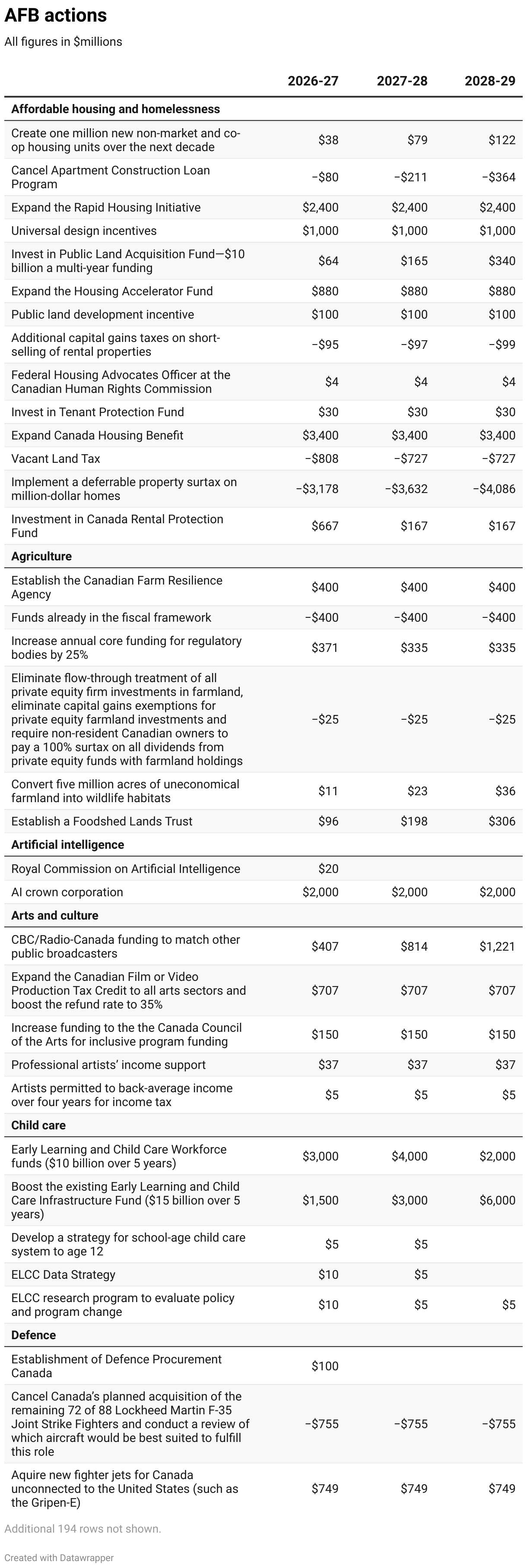
The AFB will prioritize the expansion of non-market housing, tripling the Liberal government’s proposed investment of $6 billion to $18 billion tobuild one million new non-market and co-op housing units over the next decade, with 500,000 of these units set aside as deeply affordable, non-market units for low-income households with rents set at less than 30 per cent of household income.
The AFB will focus on non-market housing for those experiencing core housing need and homelessness, upholding Canada’s commitment to the right to housing for people who are disproportionately affected by the housing crisis, including Indigenous Peoples, racialized and immigrant families, women and gender-diverse people, seniors, veterans, lone parents, and people fleeing domestic violence.
The AFB will redirect resources previously allocated to the Apartment Construction Loan Program, which has not created units affordable to low-income renters, to expand the Rapid Housing Initiative, ensuring the creation and maintenance of long-term housing for individuals and families in immediate and urgent need.
The AFB will partner with provincial and municipal governments to ensure that rents are permanently set at no more than 30 per cent of household income (25 per cent in Quebec) or aligned with social assistance housing allowances. The AFB will partner with other levels of government so that all social housing programs include ongoing operating subsidies that ensure rents are permanently set at less than 30 per cent of household income and targeted for low-income renters.
The AFB will offer financial incentives to encourage universal design to ensure accessibility to people with a range of disabilities including wheelchair users, those with vision and hearing impairment, and neurological illness and disorders. Capital subsidies will be structured to address increased construction costs as needed for larger floorplans to accommodate the creation of larger family-sized homes for intergenerational households and families and for households with disabled members. In partnership with provinces and territories, investments will ensure the creation of supportive and complex care housing that provides wraparound support for people experiencing homelessness, addictions and/or mental health challenges, as well as ensuring a range of affordable housing options are available to seniors.
The AFB will ensure that all public land remains in public hands and that includes charities, churches, and non-profits who want to expand their community commitments by providing affordable housing on their sites and will restrict the sale of government funded housing to ensure that non-market/public ownership is maintained.
The AFB will strengthen conditions on the Canada Housing Infrastructure Fund to require robust provincial implementation of a renter’s bill of rights and an end to exclusionary zoning.
The AFB will invest $10 billion in multi-year funding to redesign and expand the Public Land Acquisition Fund to include the acquisition of private land for the construction, operation, and maintenance of new and existing social housing that meets the unique and varied requirements of people experiencing core housing need and homelessness. The AFB will support tenant and community-led land acquisition strategies, including a federally backed Tenant Opportunity to Purchase (TOPA) program and right-of-first-refusal legislation.
The AFB will double the investment in the Housing Accelerator Fund (HAF) to $8.8 billion while adding criteria to ensure that 30 per cent of units will be permanently set aside as RGI. The HAF has the potential to create many more units of social housing if all levels of government collaborate to make this a priority.
The AFB will allocate $100 million annually to incentivize provincial, territorial, municipal governments and non-profit housing providers to develop and subsidize a continuum of non-market housing options on public land, to ensure that public land is used only for non-market housing development.
The AFB is committed to an approach to housing development as part of a broader industrial and economic development strategy. It will collaborate across government departments, with other levels of government, and with NGO stakeholders to ensure that employment, training and accreditation opportunities in the skilled trades are broadly accessible with an emphasis on historically excluded groups.
The AFB will eliminate preferential tax treatment for REITs and other financialized landlords, ensuring they are taxed as operating businesses, not as passive investments. The AFB will introduce a national anti-speculation tax on the flipping of multi-unit residential properties, with higher rates for institutional investors. (See taxation chapter)
The AFB will discourage investor landlords of all sizes from short-selling rental housing for profit by imposing additional capital gains inclusion rates on sales of rental properties: 100 per cent for sales under 5 years, +75 per cent for sales under 10 years, +66 per cent for sales under 15 years.
The AFB will allocate $4 million annually to the Federal Housing Advocate’s office at the Canadian Human Rights Commission. The AFB will also expand the Canada Rental Protection Fund and double investment in the Tenant Protection Fund to $30 million over 5 years to support the demand for tenant organizing, research and policy development related to tenant concerns.
The AFB will expand the existing Canada Housing Benefit to increase access and benefit levels, especially for those experiencing or at risk of homelessness.
The AFB will implement a vacant land tax, operationalizing the federal government’s commitment to explore a tax to deter landowners from sitting on developable land, hoping to profit from rising land. Vacant land needs to be used, and it is best used to build homes.
The AFB will create a deferrable property surtax on properties worth more than $1 million to ensure that those who have received windfalls from rising home prices contribute to building the next generation of affordable housing. The surtax would start at a rate of 0.2 per cent on the portion of assessed value between $1 million and $1.5 million, 0.5 per cent on value between $1.5 million and $2 million, and one per cent on assessed value above $2 million. The surtax would be fully deferrable until time of sale and purpose-built rental properties would be exempt.