
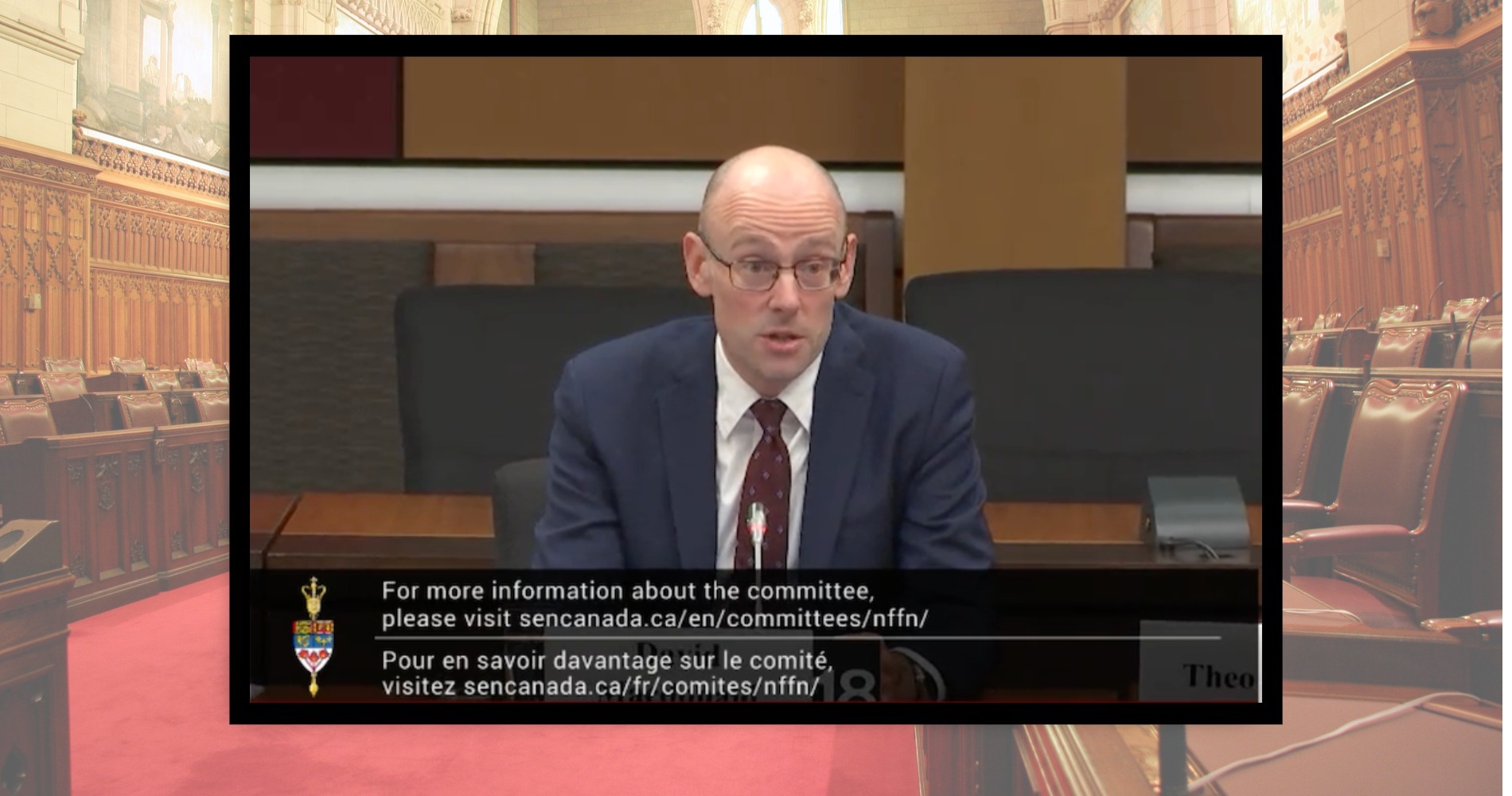
On December 2, CCPA Senior Economist David Macdonald was invited to speak to the Standing Senate Committee on National Finance about Bill C-15, the first piece of implementation legislation for the 2025 federal budget. Macdonald, who was called due to his expertise on federal finances and tax policy, spoke about two pieces of the act related to tax policy. You can watch the full session on Parliament’s website, or Macdonald’s presentation at the video below. His speaking notes are reproduced in full below the video.
I’d like to thank the Standing Senate Committee on National Finance for their invitation to speak here today. I’d like speak in favour of two measures from bill C-15: the exemptions of Canada Disability Benefit from the definition of income, and the Top-up tax credit to avoid net losers in the change in the bottom income tax bracket rate.
First of all, I’d like to support the exemption of the Canada Disability Benefit from the definition of income. This follows on recommendations from analysts like John Stapleton who pointed out the implications of having the CDB count as income. While in federal taxation CDB income isn’t taxed or clawed back against benefits, the same isn’t necessarily true in other circumstances. The federal income tax definition of income is used in the calculation of other benefits. Subsidized housing definitions have income definitions drawn from the federal calculations and if the CDB were included as income it could reduce housing subsidies. There are also potential implication for provincial benefits like the Ontario Trillium benefit. Not counting the benefit as income avoids these undesirable implications.
While not in bill C-15, it is positive to see Budget 2025 offering to cover $150 in expenses to obtain or renew a Disability Tax Credit certificate. However, forcing many Canadians with disabilities to obtain a DTC certificate at all is a time-consuming and cumbersome way to expand access. Cross recognition of existing government disability programs would be much faster a cheaper approach. For example, simply accepting provincial social assistance disability recipients and those receiving the CPP disability benefit would allow the expansion of access from 205,000 people to 800,000 people overnight with limited additional effort.
The present CDB of $2,400 a year and the low number of people with a DTC will only result in 10,000 people will be lifted out of poverty. Expanding eligibility to also include those receiving provincial social assistance through a disability stream and those receiving the CPP disability benefit would improve this to lifting 46,000 out of poverty. If the actual benefit level were raised to a reasonable level like $7,000 annually then 200,000 could be lifted out of poverty at a cost of $5.9 bil a year
I’d now like to turn now to the “Top-Up Tax Credit”. As I pointed out in my initial analysis of the lowest bracket change in March, unless addressed, there would be people made worse off by the cut in the lowest income tax bracket rate (15 to 14 per cent). Non-refundable tax credits are also evaluated at the lowest bracket rate and so they become less valuable with the rate drop. This is exactly offset in most cases by the lower tax rate, but not in all cases. However, there are instances particularly involving inter-family transfers of tuition, disability or medical expense credits where the credits exceed the upper threshold of the first bracket: $57,000 in 2025. Then the value of the tax credits is lowered by more than the tax savings.
Ensuring that the drop in this rate doesn’t make people worse is sensible policy, particularly when the cost is relatively low given the enormous expenditure on the bracket rate change.
The drop in the bottom bracket rate has been pitched as an affordability measure, but it provides effectively no benefit to those in poverty and little benefit the middle class. In fact, for those living in poverty, the lowest bracket shift provides an average benefit of only $11.
The lowest income tax filers already have enough non-refundable credits to reduce their taxable income to zero and therefore pay no income taxes. So, you can lower the tax rates, but it won’t matter as they don’t pay income taxes to begin with.
On other hand, the top third of filers will make an average of $300 a year from this change. Middle income earners will see an average benefit of $184 a year.
Incredibly, of the almost $6 billion spent annually on this measure, only three per cent of it will go to the bottom third of tax filers. This is not a measure that will have any tangible impact on affordability for those who need it most.
Incidentally the $6 billion price tag for the bottom bracket change is what it would have cost to increase the CDB to $7,000 a year and lift 200k people with disabilities out of poverty
Thank you, and I look forward to your questions.