
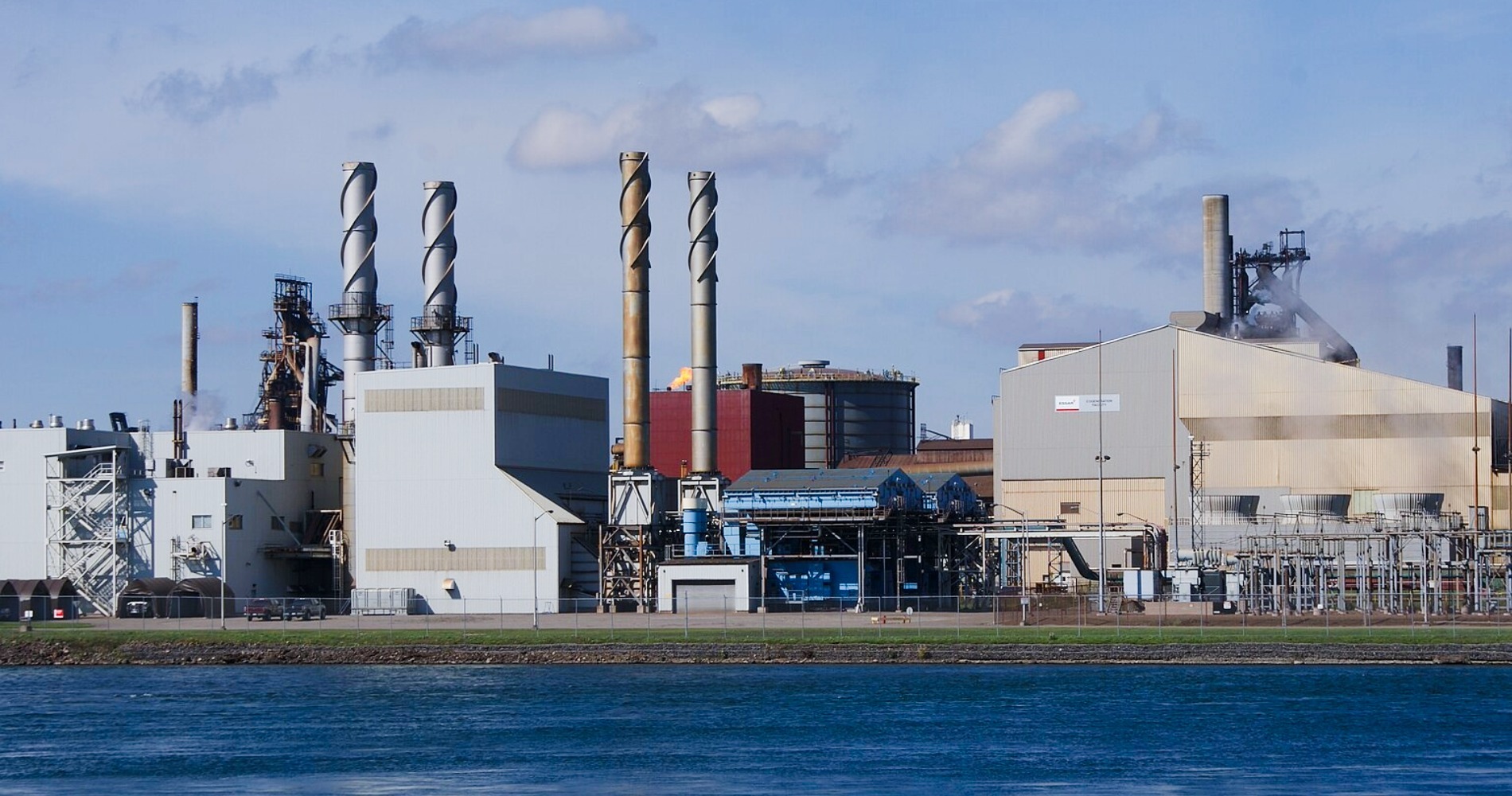
Algoma Steel’s announcement that it will lay off more than 1,000 workers in Sault Ste Marie is just the latest in a string of bad news from President Trump‘s trade war. Canada needs to respond quickly to Trump‘s attacks on Canadian value-added industries by upping its game in steel and other key sectors.
The layoffs, which take effect in March, accelerate Algoma Steel’s transition from traditional blast furnaces to cleaner electric arc furnaces. The federal government committed $420 million in 2021 to the transition, which gives the plant more flexibility in operations and will substantially reduce its carbon footprint, but ultimately supports fewer local jobs.
The timing is much worse, however, when we consider that, just two months ago, the federal and Ontario governments agreed to provide $400 million and $100 million respectively in financing for Algoma to “continue operations, transition to a business model less reliant on the United States and limit disruption to its workforce.”
Though the union representing Algoma workers knew there would be layoffs, they were not expected until much later. The company now appears to be reneging on promises to find new jobs or help train affected workers, while the federal government is in Sault Ste. Marie, assuring laid-off workers that up to 500 of them may be back to work at the upgraded plant by end of 2026.
This story has echoes of Stellantis’s October decision to move future production of its new Jeep Compass from Brampton, Ontario to Illinois. In 2022, the federal government announced $529 million for Stellantis to modernize its assembly plants in Windsor and Brampton, with $220 million of this paid out to date. The Ontario government also pledged more than half a billion dollars to Stellantis.
Industrial transformation and renewal is essential if Canada wants to weather Trump’s economic warfare. But we cannot afford to be so haphazard with public funds. Instead, we need a smarter and more collaborative industrial strategy—one that includes workers from the start.
The burden of the trade war is adding up in layoffs across the country. This is exactly what Trump intended with his 50 per cent tariffs on Canadian steel and aluminum and more surgical tariffs on Canadian automotive production. The U.S. plan for reversing America’s industrial stagnation is to simply strip jobs from Canada and Mexico.
Recent support for the steel and lumber sectors will provide relief to workers and buy time for firms. But Canada now must transition industries that were optimized for continental production and free trade. In other words, Canada needs sectoral or industrial strategies for steel and other areas.
A vision for steel (and other) industries needs to be co-created with workers, governments and the industry itself. The recently-announced Forest Sector Transformation Task Force could provide a model, as long as workers and their unions are at the table. Such a tripartite sectoral table, for example, could lay out a pathway for the steel industry in the medium term, linked to domestic sources of demand, including new major infrastructure projects.
The federal government will need to flex long-unused interventionist muscles to ensure that Canadian productive capacity can meet Canadian demand, including new domestic capacity in product lines (such as rebar) that are currently imported. The Canadian Steel Producers Association estimates domestic mills have the capacity to supply 80 per cent of Canada-wide demand.
Rather than just providing financing, governments should consider taking equity and even controlling stakes in strategically important companies. The recently-announced federal plan to subsidize 50 per cent of the cost of shipping steel by rail will substantially lower the cost of moving heavy goods long distances across Canada—the only important barrier to more interprovincial trade.
If Canada wants to have a steel industry at all, it also needs to play the tariff game to respond to cheap steel from Asia and trade threats from the United States. The federal government is moving in this direction by introducing tariff rate quotas for steel and derivative goods, with a 50 per cent tariff applying above a threshold level of import: 75 per cent of 2024 imports for countries that have a free trade agreement with Canada, and 20 per cent for those that do not.
The United Steelworkers would like quotas applied to U.S. and Mexican steel as well, to stimulate import substitution. In a recent article, the union also points out that high foreign ownership of Canada’s steel sector—currently at 80 per cent—is also a problem, as it makes Canadian facilities easy targets for idling in times of crisis.
This article originally appeared in the Toronto Star on December 5, 2025, and has been republished here with minor adjustments.