
Introduction
Canada needs vibrant arts and culture, in every sector. Artistic expressions engage, entertain and educate. They reflect us to ourselves and to the world. They are tools for social cohesion, intercultural dialogue, social change, health and more. Arts and culture are also an important industry, worth 2.3 per cent of real GDP in 2023 according to Statistics Canada.1Statistics Canada, “The Daily—Provincial and Territorial Cultural Indicators, 2023,” The Daily, June 2, 2025, https://www150.statcan.gc.ca/n1/daily-quotidien/250602/dq250602a-eng.htm. The Conference Board previously reported the sector was worth 7.4 per cent of GDP, including direct, indirect, and induced contributions.2Conference Board of Canada, Valuing Culture: Measuring and Understanding Canada’s Creative Economy, Ottawa, July 28, 2008. In 2022, Canada exported $24.5 billion of culture products3Canada Council for the Arts, Trade of Culture and Sport Products, October 9, 2024, https://canadacouncil.ca/research/research-library/2023/10/trade-of-culture-and-sport-products. and 685,000 people4Canadian Heritage, Culture Satellite Account, Government of Canada, last modified June 4, 2025, https://www.canada.ca/en/canadian-heritage/corporate/publications/general-publications/culture-satellite-account.html. worked in the sector.
But the challenges facing arts and culture in 2025 continue. Since the pandemic disruptions, every sector has been affected by rising costs, shrinking audiences, changing business models, more competition for stagnant public funding, and declining sponsorships and donations. If imposed, U.S. tariffs would have negative consequences, particularly in publishing and electronic media.
In this time of uncertainty and threats to our sovereignty, the Liberal party’s platform, Protecting Canadian Voices, said “a strong culture is forged by the history we share and the stories we tell that are uniquely our own. In a sea of American media and disinformation, we need Canadian voices more than ever.”5Liberal Party of Canada, Canada Strong: Unite. Secure. Protect. Build., April 2025, https://liberal.ca/wp-content/uploads/sites/292/2025/04/Canada-Strong.pdf. AFB 2026 brings a renewed commitment to supporting our arts, artists and culture, so we can tell our stories and hear our voices.
Overview
It is a difficult time in every sector, and across the full spectrum of arts and culture activities—artistic creation, production, distribution and exhibition. Producers, broadcasters, publishers, individual artists and others are facing rising costs and falling revenues. Since the pandemic, audiences have not returned to smaller live performance venues and theatres. Digital technologies continue to reshape business models. At the same time, philanthropic donations are falling. AI is a significant threat to performers, writers, other creatives, and to producers. The challenges are experienced differently in each sector, and particularly affect emerging artists, those from equity-deserving communities, and mature professionals who struggle to earn a living as a writer, singer, visual artist, dancer, actor, director, and other creative behind the scenes.
Last year’s AFB reported, in detail, on the challenges facing music and publishing. While a recent study6Canadian Live Music Association, Hear and Now: Understanding the Economic Power and Potential of Canada’s Live Music Industry, January 30, 2025, https://www.canadianlivemusic.ca/economic-impact-assessment. found that the live music industry generated $10.9 billion in GDP and 102,000 full-time-equivalent (FTE) jobs, it also documented the continuing struggles of smaller venues, session musicians and those trying to enter the field. Sales of books and magazines are stagnant. While growing, book sales in 2022 were still below those recorded in 2018, before the pandemic.7Statistics Canada, “The resurgence of readers: Book worms are on the rise,” The Daily, April 16, 2024, https://www.statcan.gc.ca/o1/en/plus/6060-resurgence-readers-book-worms-are-rise.
Significantly, in 2023-24 total production volume in the Canadian film and television industry decreased from the previous year by 18.5 per cent, to $9.58 billion.
The volume of Canadian television production decreased by 12.7 per cent, to $3.25 billion, and foreign location and services production decreased by 26.1 per cent, to $4.73 billion. The entire screen sector value chain (including film and television production, distribution, exhibition, broadcasting and broadcasting distribution) generated an estimated 271,195 FTE jobs (17.1 per cent decrease), $14.41 billion in labour income (13.3 per cent decrease) and $19.18 billion in GDP (14.8 per cent decrease), in both direct and spin-off impacts.8Canadian Media Producers Association, Profile 2024: An Economic Report on the Screen-Based Media Production Industry in Canada, published by Telefilm Canada, 2025, https://cmpa.ca/profile/.
The challenges facing the screen industry are numerous. As audiences embrace the largely foreign streaming services, revenues of traditional private broadcasters decline. CBC has faced cuts, declining audiences, and rising costs. The decrease also reflects the lingering effects of the 2023 strikes by U.S. scriptwriters and actors. Significantly, the streamers (Netflix, Amazon Prime, etc.) are reducing the number of productions they make, since they have now accumulated a large inventory of high-quality popular programs they can reuse. Previously, only Disney+ was able to recycle a huge inventory of popular shows, and thus adds only a small number of new films each year.
The 2024 CRTC decision to impose a requirement on foreign streamers to contribute five per cent of their gross Canadian revenues to Canadian content productions is designed to stabilize opportunities for Canadian content producers. However, the streamers have challenged the requirement in court. In an April 2025 Abacus Data poll, 83 per cent of Canadians would like to see greater investment in Canadian-made TV, film and digital content to ensure that more content with higher production values is available.9Canadian Media Producers Association, “New Poll Finds Majority of Canadians Support Political Parties That Champion Canadian Identity and Canada’s Cultural Industries,” CMPA, April 14, 2025, https://cmpa.ca/pressreleases/new-poll-finds-majority-of-canadians-support-political-parties-that-champion-canadian-identity-and-canadas-cultural-industries/.
There is uncertainty about how U.S. tariffs will apply to cultural works. A February 2025 magazine industry survey10Magazines Canada, Magazines Canada Tariff Survey Report, https://magazinescanada.ca/wp-content/uploads/2025/03/Magazines-Canada-Tariff-Survey-Report-FINAL.pdf. identified areas of concern: increased printing costs, loss of advertising revenue, reduced subscriptions, and financial strain. There is concern in the book sector. Canadian-owned publishers earn roughly 50 per cent of their revenues from U.S. sales. Canadian bookstore sales of imported works maintain a business essential for Canadian titles and authors. President Trump has threatened to apply tariffs on movies imported into the U.S. Movie production is global, with services often provided in many countries, including the U.S. For the moment, there are no tariffs on cultural goods because the president used the International Emergency Economic Powers Act (IEEPA). Regardless of how the courts deal with the use of IEEPA to impose tariffs, that Act specifically exempts “informational materials.” U.S. authorities interpret that to include cultural goods and the media.
As production slows globally, a more significant factor than tariffs for the Canadian film and television industry is that competitors are taking aggressive measures to attract producers. California is set to boost subsidies to shoot in the state to at least 35 per cent and expand the category of productions that qualify. In February 2025, the UK increased its subsidies to 34 per cent for films and high-end television, and up to 40 per cent for other productions. Canada’s current Canadian Film or Video Production Tax Credit for Canadian content provides a 25 per cent refundable tax credit for qualified labour expenditures.
Actions
AFB 2026 responds to the crisis by implementing the commitments in the Liberal platform. These include: “Support Canadian artists and creators by increasing funding to agencies … recognizing the economic importance of Canada’s creative industries and creators. The more of our perspectives that are brought to life, the better we understand Canada, and the more we can show the world what makes Canada strong.”11Liberal Party, Canada Strong.
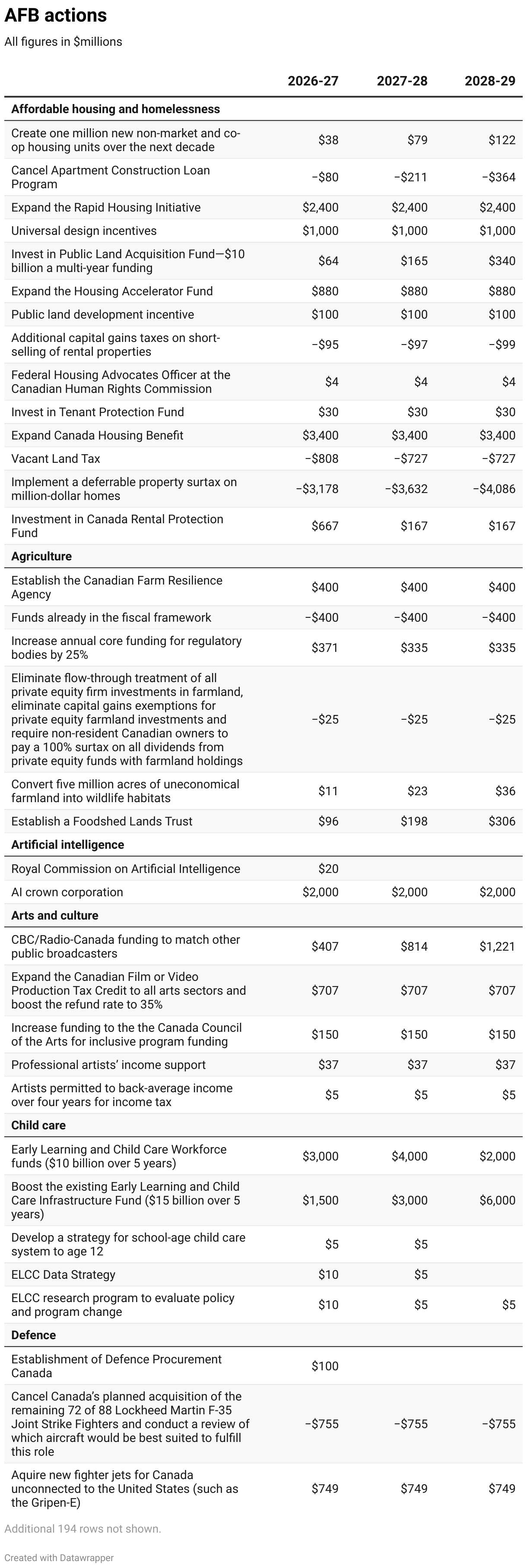
The AFB will improve CBC/Radio Canada funding so that it matches the per capita investment that other public broadcasters receive. CBC presently only receives $32 per person in federal funding. The average for all public broadcasters (based on a 19-country comparison12Geoff Bickerton, Bang For Our Buck: Comparing public service broadcasting funding in 19 countries, including Canada, Canadian Centre for Policy Alternatives, February 2025, https://www.policyalternatives.ca/news-research/public-broadcast-funding-in-canada-gives-canadians-the-best-bang-for-their-buck/.) is $79 a person in government support. Also, CBC’s total funding is presently 22 per cent advertising revenue. The AFB will eliminate advertising from CBC. The CBC/Radio Canada budget will be ramped up so that in five years’ time it will be $2 billion more than what the broadcaster receives now.
The AFB will expand the refundable tax credit programs to all sectors, to encourage private investment in the production of artistic expressions and cultural works. Canada currently provides refundable tax credits through the Canadian Film or Video Production Tax Credit and the Film or Video Production Services Tax Credit. Several provinces provide complementary credits for producers of films and television programs, and some have similar incentives for digital media and animation productions. Québec also offers refundable tax credits for producers of live performances, and Ontario provides refundable tax credits for book publishers.
The AFB will increase the federal refundable tax credit for artistic expressions to 35 per cent. Eligibility for the credit will be extended to producers of all forms of artistic expressions and cultural works, not just film and video production. The credit is based on eligible labour expenses, including salaries, wages, fees, per-diems, and other compensation. Payments to artists and other creative talent are included. The credit will be provided to eligible Canadian producers of films, television, digital media, animation, live performances, books, magazines, visual arts, crafts and other forms of artistic expressions and cultural works.
The federal government will work with the provinces to ensure the tax credit programs are complementary, effective in encouraging private sector investments in the industries, and sensitive to the needs to specialist producers/publishers creating culturally significant works.
The AFB will provide an increase of $150 million annually to the Canadian Council for the Arts to:
- Implement programs for Indigenous artists, Black artists, gender-diverse artists, artists with disabilities, older artists, as well as artists from other marginalized and equity-deserving communities.
- Support culturally significant works.
- Provide additional operating grants for arts service organizations that are essential to having a healthy and vibrant sector.
The AFB will provide targeted measures to support professional artists.
At the heart of the sector are professional artists: writers, musicians, performers, designers, visual artists, composers, dancers, editors, singers, storytellers, directors, choreographers, artisans, craftspeople and more, in every community and in every medium.
There are more than 202,000 professional artists, roughly one per cent of the labour force.13Kelly Hill, A Statistical Profile of Artists in Canada in 2016, Revised November 2019, Hill Strategies Research Inc. Mr. Hill updates some statistics based on 2021 census data, including the total number of artists. But artists are the original gig workers. Most work from contract to contract, with income that is low, fluctuating and insecure. Historically, the median individual income of professional artists is around 44 per cent lower than all Canadian workers.14Kelly Hill, 2019.
The AFB will amend the Income Tax Act to provide that professional artistic income up to $10,000 will be eligible for a refundable tax credit of 15 per cent. This credit will be reduced to 7.5 per cent for artists whose total family income exceeds the median of all artists, and will be eliminated for artists whose total family income exceeds the median of all workers.15Kelly Hill, 2019. In the 2016 census, the median family income of artists was $57,800, and the overall median family income was $86,500. This credit creates a powerful incentive for creativity for artists who are struggling to earn a living from their art. The definitions and controls are provided in Income Tax Folio—S4-F14-C1, Artists and Writers, and in the Status of the Artist Act. When the Canada Liveable Income (CLI) is fully implemented (see Poverty and Income Security chapter), the refundable tax credit will be reviewed.
The AFB will ensure tax fairness for professional artists by allowing artists to back-average their income over four years. Visual artists may prepare works for many years before these are exhibited and sold. A writer may spend many years on a script before it is made into a movie and generates income. But the income these artists receive will be taxed in the year it is received. Depending on residency and total income, they could pay up to 16 per cent more tax than if it were spread evenly over the years during which it was created.16ACTRA Submission to the Department of Finance Consultations on Tax Planning Using Private Corporations, October 2017. As necessary, regulations will address the amount artists may have received as tax credits in previous years.
Many artists and related cultural workers must work at jobs outside the sector between their artistic contracts. When they do, they and their employer will pay into the Employment Insurance (EI) program. But when they are without any work (either as an artist or the other employment), many cannot collect EI regular benefits, even if they otherwise qualify.17Garry Neil, Employment Insurance Special Benefits for Self-Employed People: The Impact on Artists and Cultural Workers, Ottawa: Cultural Human Resources Council, April 2010, https://www.culturalhrc.ca/sites/default/files/research/CHRC-EI-report-self-employed-en.pdf. The AFB will ensure the Canada Employment Insurance Commission develops regulations to bring professional artists fully and equitably into the EI system. Professional artists and engagers will pay premiums, and the artists will qualify for regular benefits according to a model based on total income earned (rather than weeks worked) in four-week periods. It is anticipated this model will be revenue neutral except in extraordinary circumstances, such as a pandemic. It may become a model for extending EI benefits to other self-employed gig workers.