

It’s almost cliche to say that the high cost of housing is at the heart of Canada’s affordability crisis. Although much media attention is placed on the home ownership market, for the one-third of households in Canada who are renters it is the soaring cost of rental housing that is top of mind. Renters are much more likely to be on the lower rungs of the income ladder, although the high cost of ownership housing has had a knock-on effect of keeping many higher income households in the rental market. Renting also means a lack of security and tenure–even if one lives in an affordable rental now, they could be displaced by a renoviction or demoviction.
The affordability of rental housing thus needs to be front and centre for all levels of government. In addition to rent itself, one’s income ultimately determines affordability. In Canada we have typically used a threshold of paying rent less than 30 per cent of gross or pre-tax income as the benchmark of affordability. For example, a person earning $50,000 per year should be spending no more than $15,000 per year (50,000 x 30 per cent), or $1,250 per month, in rent for their situation to be considered affordable. The higher one’s income, of course, the more options at higher rents are affordable.
The CCPA’s rental housing wage or rental wage is one attempt to look at affordability and how different parts of the country compare. Similar to the idea of a living wage, which is a much more detailed calculation typically based on families of four, the rental wage is a simple and intuitive tool to see how inclusive local wages, and minimum wages, are in terms of providing the most costly basic necessity, the roof over one’s head.
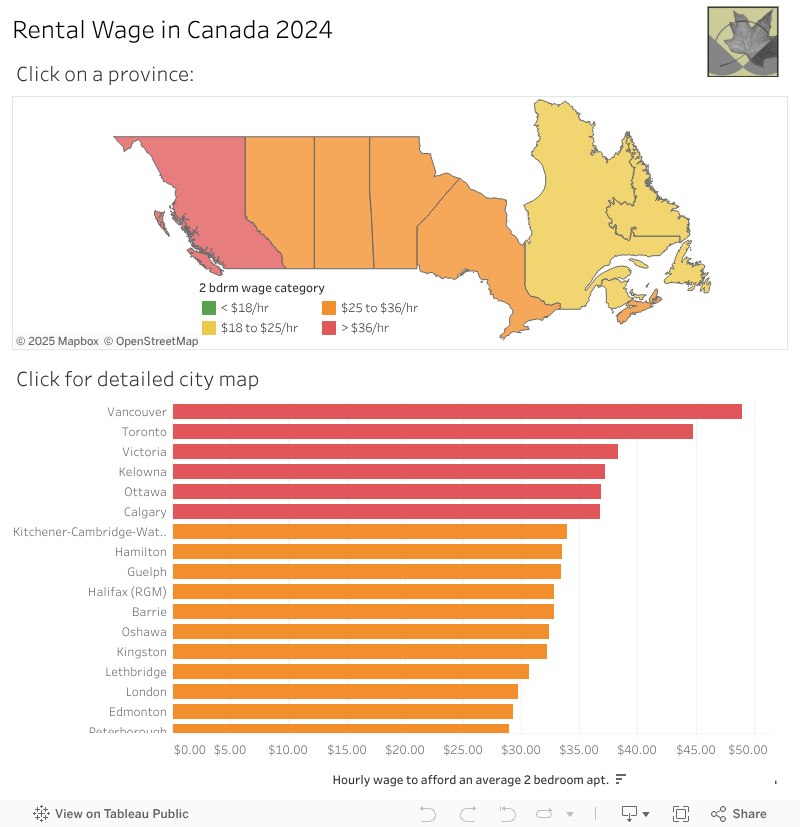
The rental wage is the hourly wage needed to afford rent while working a standard 40-hour week and spending 30 per cent of income on housing. This is the CCPA’s third update to the rental wage, and we highlight results for the largest Canadian cities (Census Metropolitan Areas or CMAs) and several other medium-sized cities. Data down to the neighborhood level is included as part of our Tableau interactive tool, which can be seen at the bottom of this post.
In this update, we focus on the rental wage for one and two bedroom units, which comprise most of the overall rental housing stock, and we use Canada Mortgage and Housing Corporation’s (CHMC‘s) rental market survey, which was last taken in October 2024. We also make some comparisons to provincial minimum wages in each city. In addition, we calculate rental wages for “asking rents”– the market rents for vacant or unoccupied housing. This is a relatively new dataset from Statistics Canada with results at the CMA level, and up to the first quarter of 2025. For the biggest cities, this provides a better sense of the actual rents someone looking for rental housing would face.
Rental wages in Canadian cities
Table 1 below compares the minimum wage and the rental wage for one- and two-bedroom apartments in Canada’s CMAs and other cities, ranked from highest rental wage to lowest. The final column shows the ratio of the one-bedroom rental wage to the minimum wage, with a ratio of one or lower meaning an apartment was affordable to someone making minimum wage.
It will surprise no one that Vancouver and Toronto top the unaffordability list, with someone working full time needing to make almost $38 an hour for a one-bedroom apartment to be affordable. This amounts to $78,699 and $78,333 per year respectively. Those making less would need to work an extra job, spend a larger share of their income on housing or get a roommate.
For those earning minimum wage, it is virtually impossible to afford housing on their own. In Vancouver, Toronto and Calgary, the rental wage for one-bedrooms is more than double the minimum wage. While this is most acute in the biggest cities, the gap between minimum wage and rental wage is a Canada-wide challenge. Of the 62 cities in Table 1, in only eight cities (six of which are in Quebec) could one affordably get a one-bedroom while working full time at minimum wage.
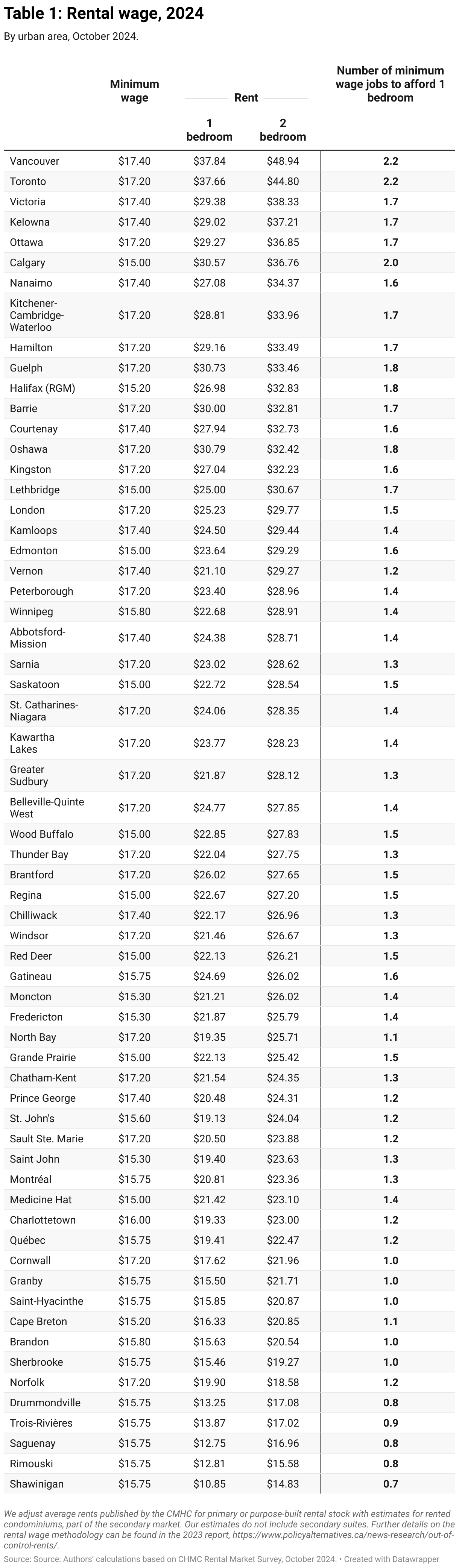
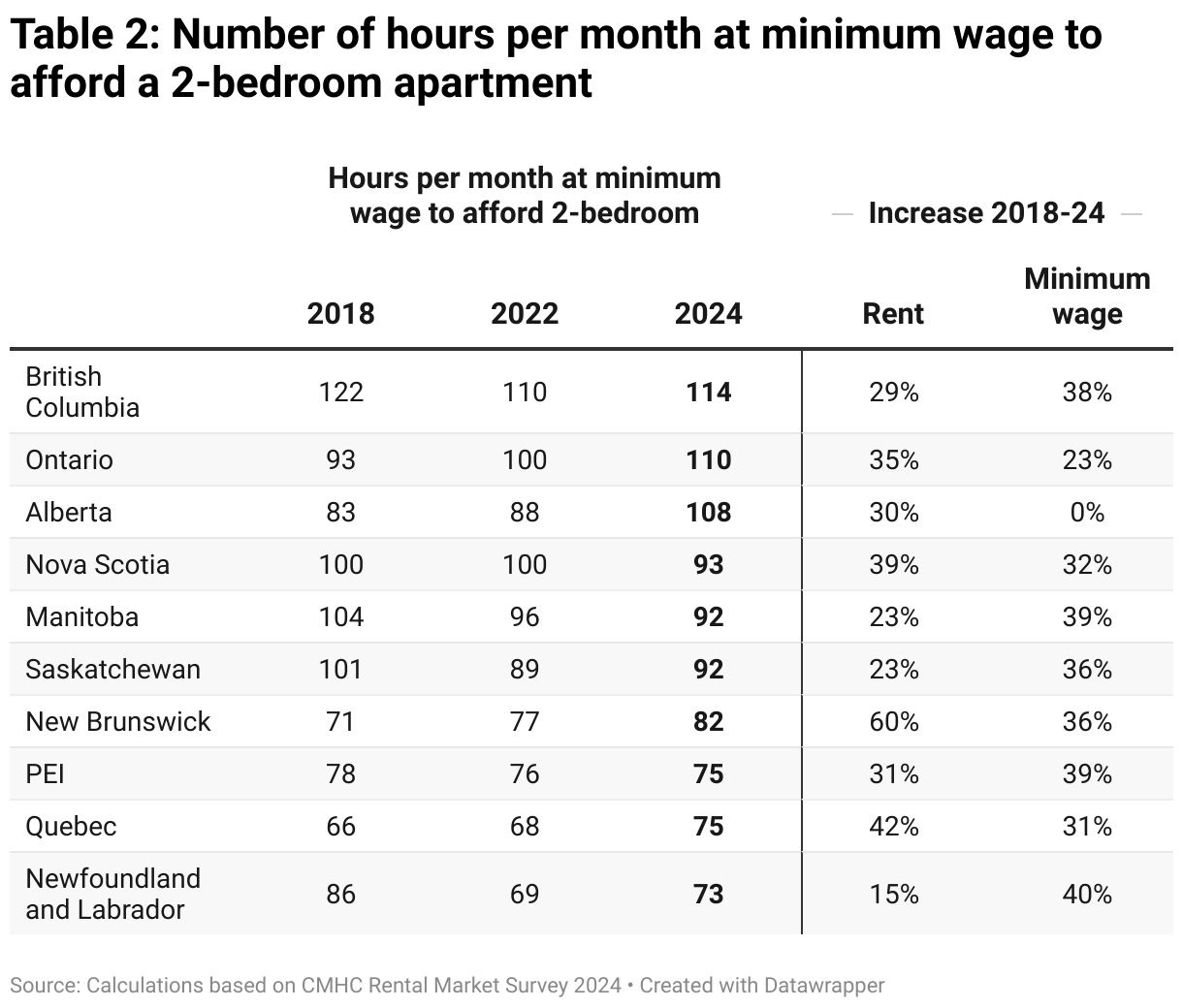
Table 2 looks at the number of working hours at minimum wage it takes to pay for a two-bedroom apartment, and how this has changed since 2018. We summarize the results at the provincial level. Note, this is the number of working hours just to pay for rent and nothing else. Even in Newfoundland and Labrador, it would take one person two full weeks of wages just to cover rent before paying for any other necessities like food.
The pattern of change over time is mixed with some provinces recording relative improvements (fewer hours at minimum wage required) and others worsening affordability. Both changes in rents and changes in minimum wages are at play. Some highlights:
- In BC, the minimum wage increased from $12.65 in October 2018 to $17.40 by October 2024, which outpaced the increase in two-bedroom rents. But even with Canada’s highest minimum wage, BC remains the most unaffordable for someone earning minimum wage, requiring three weeks of full-time work just to make rent.
- The greatest deterioration has been in Alberta, which had Canada’s highest minimum wage in October 2018, but the minimum wage has not increased since then, even as rents increased by 30 per cent.
- In Quebec and Ontario, minimum wage increases have not kept pace with two-bedroom rents, leading to worsening affordability, although Quebec remains among the most affordable provinces as of October 2024.
Rental wages for unoccupied/vacant units
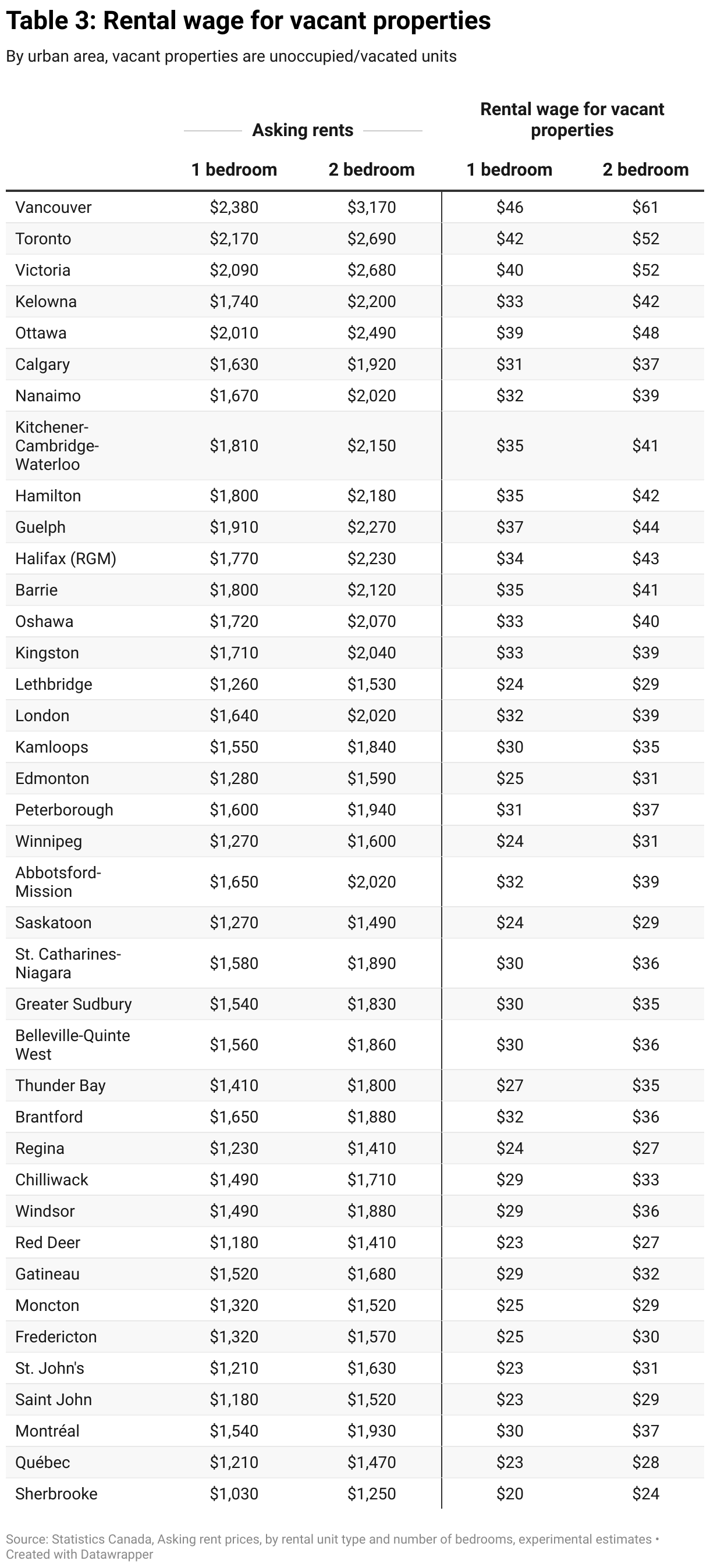
Table 3 draws on Statistics Canada for asking rents for vacated properties in CMAs during the first quarter of 2025. Note that the data above are for October 2024 so data are not perfectly comparable. As noted above, these market rents are higher, often much higher, than average rents for all renters. This “moving penalty” keeps people from seeking new accommodations and can lead to overcrowding. Keeping tenants where they are also limits job opportunities that require a move. This becomes a drag on economic growth as families can’t move to improve their fortunes and as a result economic growth more broadly.
Can we expect better affordability in 2025 and 2026?
Canadian rental markets are currently undergoing a shift, with vacancy rates rising somewhat in major cities. In part this reflects greatly diminished immigration numbers and much lower population growth. In addition, after many years of promoting new rental housing construction at federal and provincial levels, new supply is becoming more widely available.
Recent developments in the condo market in Toronto and Vancouver are also notable. While we prefer purpose-built rental apartments, condos have become an important source of secondary rental housing, because they were almost the only type of multi-unit dwellings built for many decades. In recent years, there has been a speculative boom in some markets due to low interest rates and higher demand.
That situation has reversed and many buyers of presale condos from a few years ago are walking away and not closing their condo sales, due to reduced valuations and higher interest rates. Large numbers of recently completed units will end up in the rental market in 2025 and 2026, including units currently nearing completion.
Our principal finding remains: there is an affordability gap in almost all Canadian cities, and it is particularly acute for those who earn minimum wage. Our research reinforces the conclusion that minimum wage increases are a key dimension of affordability. Because of the variation within provinces, minimum wage policies could allow for cities to have higher minimum wages better linked to the cost of housing.
Nonetheless, it would be challenging for provinces to implement $30-40 per hour minimum wages. Federal and provincial housing policies and rent housing regulations still matter, including rent controls. In BC, new protections have been introduced in certain areas for renters displaced by new developments, including temporary accommodations with rent top-ups, moving allowances and rights of first refusal to access newly constructed units at comparable rents.
Development and support of non-market housing also needs to be on the table, as these units are not subject to the same pressures to jack up market rents. This includes building new non-market and publicly-owned housing, as has been promised in a new Building Canada Homes program (see this post for how it could be done). It also includes acquisition funds for non-profit providers to purchase existing affordable rental housing and keep these units out of the hands of predatory corporate investors like real estate investment trusts (REITs).
Federal and provincial governments need to keep housing affordability on the front burner, even as trade and security take up more policy space. Too many households have to spend more than a reasonable share of their income on rent, compromising their ability to pay for food, transportation and other necessities.