

As 10,000 Ontario college support workers take to the picket line in their quest for job security, they’re also fighting for a better college system for the students they support.
Support workers do important work, such as helping students do their research in the library, helping them register for classes, and providing tech support. They’re a vital part of the college infrastructure—and their employer is taking them for granted. Ensuring that they have good jobs helps preserve the system, which acts as an important stabilizer for the Ontario economy.
Students go to college with hopes of landing a solid job—and the stakes are high. Youth unemployment in Ontario hasn’t been this bad since the 2008-09 global recession and the early 1990s Canadian recession, which hit Ontario hardest.
In August 2025, Ontario youth unemployment rates reached 16.5 per cent among those aged 15 to 24. Compare that to the last time two times youth unemployment was this high. During the 2008-09 global recession, youth unemployment in Ontario reached 17.2 per cent in August 2009. During the 1990s recession—one of the worst in the province’s history—youth unemployment reached 19.1 per cent in August 1992.
Youth unemployment reflects a perfect storm of economic pressures. U.S. tariffs are threatening key pillars of Ontario’s economy. Early evidence suggests AI is already disrupting entry-level positions. As with most periods of economic contractions, young people are among the first to lose out on jobs. Ontario isn’t even in a recession, yet, and the youth unemployment numbers are sobering.
The human cost of youth unemployment is enormous. Young people experiencing prolonged unemployment face mental health challenges, delayed financial independence, and difficulty establishing career trajectories. The ripple effects damage not only individual prospects but also undermine Ontario’s economic competitiveness when we need skilled workers most.
Yet Ontario continues to chronically underfund the very institutions that could help navigate young people through this crisis. Meanwhile, right-wing activists and politicians are trying to misdirect by blaming youth unemployment on temporary foreign workers—trying to divert our attention from the real source of the crisis: deliberate underfunding.
Instead of investing in colleges, the Ontario government has been planning even more cuts to the system. The union estimates that previous and upcoming cuts will result in 10,000 job losses in Ontario’s 24 colleges. Over 650 programs have already been cancelled.
Ontario college funding: a race to the bottom
Ontario has long had the lowest post-secondary funding level in Canada, but the situation has worsened considerably.
By the 2023-24 school year, inflation-adjusted operating revenues (in 2024 dollars) provided by the province had dropped by $358 million for colleges.
Estimates from 2022-23 show that the province’s colleges received less than 25 per cent of their operating revenue from provincial funding, a sharp contrast to other provinces, where public funding is responsible for approximately 60 per cent of colleges’ operational needs.
The provincial real operating funds per full-time student is about $6,200 per year in Ontario, while in the rest of Canada the average funding is about $19,000.
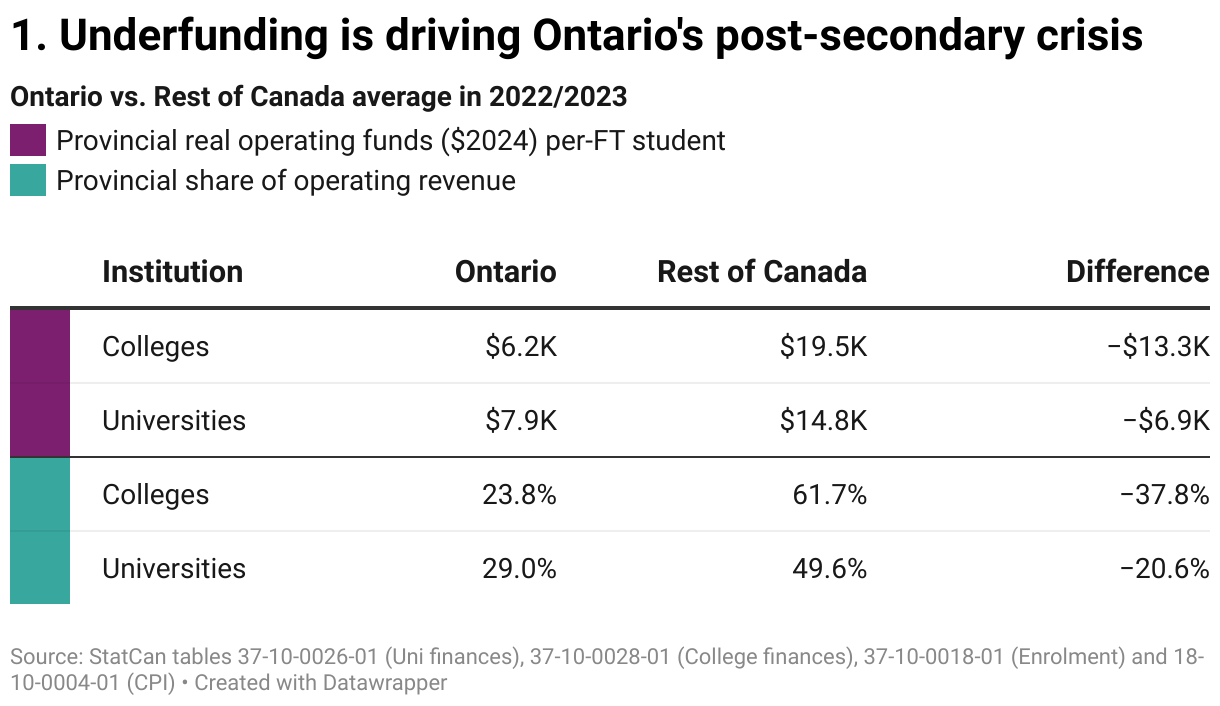
Ontario colleges are also struggling with federal restrictions on international students, and the system operates under significant fiscal constraints. Before the federal changes, international students accounted for 68 per cent of total college revenue in Ontario. Instead of stepping up with more investments to shore up the system, the provincial government keeps cutting.
Colleges have an important role to play today
The case for investing in colleges—and its workers—is strong.
Structural investments in public education institutions that have historically helped young Ontarians navigate moments of crisis.
During the 2008 financial crisis, for instance, Ontario’s colleges acted as economic stabilizers, enrolling an additional 20,000 students and helping 45,000 laid-off workers eventually re-enter the workforce. In August 2008, youth unemployment in Ontario was 12.7 per cent—lower than it is today, but it rose to 17.2 per cent in August 2009, and then began a path of recovery in 2011, at 14.2 per cent.
College programs are strategically designed to match curriculum with labour market demands. Across the province, colleges approach curriculum development to prioritize skill demand, and as such they are strategically positioned to help young people navigate a changing labour market landscape.
Today’s crisis poses a similar threat to young people. College programs are a solid policy bet to fight youth unemployment.
The choice is clear.
We can continue to underfund the institutions that support our youth, and fail to acknowledge the vital role of the college support workers forced into a strike. Or we can recognize colleges for what they are: public engines of economic opportunity and our best defence against a youth employment crisis that threatens a generation.