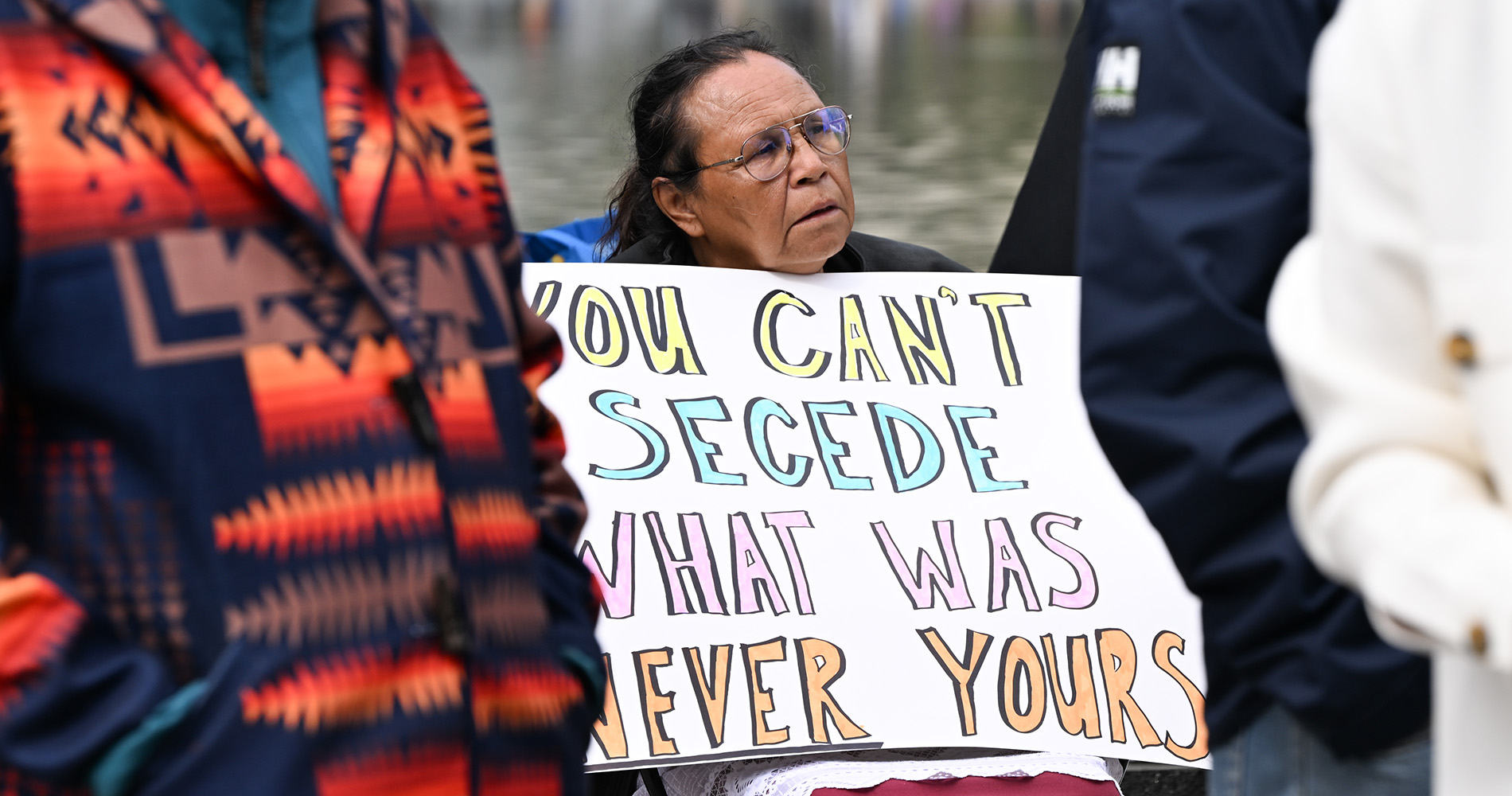
In February 1982, Gordon Kesler of the Western Canada Concept (WCC) party won a by-election in the riding of Olds-Didsbury and became the first separatist elected to the Alberta Legislative Assembly. In fact, he became the first separatist elected outside Quebec since before either Alberta or Saskatchewan became provinces. In 1986, two sitting members of Saskatchewan’s legislature, Bill Sveinson and Lloyd Hampton, became members of the WCC and began sitting as such.
Forty three years later, in June 2025, that same Gordon Kesler was actively campaigning for Cameron Davies, leader of the separatist Republican Party of Alberta, in his bid to win a by-election in the same riding (now called Olds-Didsbury-Three Hills).
Kesler failed to win re-election to the Alberta legislature in the general election that took place just nine months later. The WCC failed to win any seats in the 1986 Saskatchewan general election. And Cameron Davies failed in his bid during the recent Alberta by-election. Kesler, Sveinson, and Hampton remain the only three avowed separatists ever to sit in a legislature in Western Canada.
Many media pundits are suggesting that we are in the midst of a similar surge in separatist sentiment in Saskatchewan but the numbers just don’t bear that out. A poll from Angus Reid, held the week after the federal election, found that 19 per cent of Albertans and 15 per cent of Saskatchewanians would definitely vote for their province to leave, with another 17 per cent and 18 per cent, respectively, saying they lean in that direction.
The recent Alberta by-election results, however, paint a different story. Across the three ridings where by-elections were held, the total combined vote of the two separatist parties (the Republican Party of Alberta and the Wildrose Loyalty Party) was only 9.9 per cent. Even if you just look at the result in Olds-Didsbury-Three Hills, likely one of the most separatist-friendly ridings in the province, only 18.9 per cent of voters supported a separatist party. That’s a far cry from the 36 per cent of Albertans that Angus Reid said would support or lean towards voting to leave.
Given the longstanding tradition of voters using by-elections to send messages of discontent with the status quo and elevate radical alternative voices to office, especially when there is no actual threat of the results toppling the government, one would expect the numbers to be more reflective of the polling numbers. The fact that they weren’t suggests that all the chatter about growing separatist sentiment is overblown, and that there is no actual threat of Albertans even coming close to voting to leave in an eventual referendum.
Why then, if there has been no real growth in separatism as a threat in Alberta and Saskatchewan, has there been so much handwringing and teeth-gnashing about it since the federal election?
Part of the explanation comes down to simple sour grapes. Folks in Alberta and Saskatchewan like electing Conservatives—particularly the brand of Conservatives that came about after the Reform Party of Canada, founded by Preston Manning in the 1980s under the slogan “the West wants in”, rebranded as the Canadian Alliance and then became the Conservative Party of Canada after successfully taking over the Progressive Conservative Party.
Even at the height of Liberal popularity in the 2015 federal election, the Conservatives handily won most of the seats in Alberta and Saskatchewan—the only two provinces where that happened. In 2019 and 2021, the Conservatives added B.C. and Manitoba to the provinces they won (winning the popular vote but not the most seats). Despite those wins, the results in the rest of Canada continued to elect the Liberals to government.
Why then, if there has been no real growth in separatism as a threat in Alberta and Saskatchewan, has there been so much handwringing and teeth-gnashing about it since the federal election?
With Conservatives leading in the polls from spring 2022 onward, and being in clear majority territory through most of 2024, folks in Alberta and Saskatchewan were convinced that finally, after suffering through a decade of not just a Liberal federal government, but a Trudeau Liberal government, they would be able to return a western-friendly Conservative government to Ottawa. When that failed to materialize—Alberta, Saskatchewan and Manitoba were, once again, the only provinces where the Conservatives were able to win a majority of seats—prairie Conservatives saw it as an affront foisted on them by the rest of Canada. They saw it as reinforcing their belief that the whole system is rigged in favour of “eastern Liberals” and against Alberta and Saskatchewan.
This attitude is perhaps best demonstrated by the fact that in the same Angus Reid poll quoted above, of those who said they would vote to leave Canada, 72 per cent of Albertans and 78 per cent in Saskatchewan said they would change their mind and vote to stay had the Conservatives won the election. That’s not fundamentally about support for independence; it’s about not liking that the rest of Canada doesn’t agree with their politics. It’s about the far-right fringe not liking it on the fringe.
Beyond the separatist fringe, however, there are other dynamics fuelling anger against Ottawa in the Prairies. Finances and living conditions for working-class folks across the country have deteriorated over the last decade. Food and gasoline costs, utilities, unaffordable rents, lack of housing generally, and public education and health care in crisis were all sources of legitimate frustration for all Canadians in the lead up to the 2025 elections.
A recent report from Jim Stanford at the Centre for Future Work shows that, for people in Alberta and Saskatchewan, many of those challenges were aggravated.
The two provinces share the lowest minimum wage in the country, and since 2019, both have trailed the rest of the country in weekly earnings growth. Both have consistently seen wage growth below the national average. In fact, both Alberta and Saskatchewan saw negative growth in real hourly wages between 2019 and 2024.
This has been a particularly hard pill for Albertans, who went from consistently having the highest growth in wages and earnings in the country to having the lowest. Alberta is also no longer the highest-wage province in Canada, which was exacerbated by having the highest rate of inflation in the country and the most expensive electricity. At the same time, per student government spending on education is the lowest in the country, and surgery wait lists and emergency room wait times are some of the worst in the country after years of cuts and experimentation with privatization.
Albertans and Saskatchewanians have not hesitated to lay all of these economic and social challenges at the feet of the federal Liberal government, despite the fact that the bulk of them were either self-inflicted or the result of global economic trends like post-pandemic inflation and supply-chain issues.
And in a long-established tradition that pre-dates the birth of Saskatchewan and Alberta, premiers Scott Moe and Danielle Smith did everything they could to reinforce and encourage the blaming of the federal government for all their provinces’ woes.
Anti-Ottawa populism on the Prairies in response to these types of grievances is not new, however. The United Farmers of Alberta (UFA) and the Progressive Party were born on the Prairies out of protest against John A. Macdonald, forcing farmers to buy equipment from Eastern Canada, despite it being more expensive, and against Wilfred Laurier for denying Alberta and Saskatchewan control over their natural resources in 1905 when they joined confederation.
Albertans and Saskatchewanians have not hesitated to lay all of these economic and social challenges at the feet of the federal Liberal government, despite the fact that the bulk of them were either self-inflicted or the result of global economic trends like post-pandemic inflation and supply-chain issues.
When the Great Depression combined with the drought and dustbowl conditions to decimate rural economies on the Prairies, folks in Alberta and Saskatchewan did not hesitate to blame the federal government for their economic suffering, despite the fact that everyone across the country was also suffering the effects of the depression and the drought.
When the federal government granted Saskatchewan and Alberta rights to their natural resources in 1930, they gave the provinces control over exploration, extraction, and development, and maintained control over interprovincial trade and international exports. That split has been at the core of conflict between Prairie governments, especially Alberta’s, and the federal government ever since—a conflict neither province has ever hesitated to exploit to get its way.
As Alberta’s oil sector boomed post-1947, the province needed the feds to approve pipelines in order to prevent a glut of oil on the Prairies. In 1949, the federal Liberals approved a pipeline to Wisconsin (extended to Sarnia in 1956), and in 1950, another one to Vancouver, with extensions to Seattle. The U.S., relishing Alberta’s potential as a secure and friendly supplier of oil, began to give the province privileged access to their market, and essentially treating it, for trade purposes, as another state.
Alberta’s producers leveraged this privileged treatment by the U.S. to demand better treatment from the Canadian government, suggesting they could supply Prairie oil to refineries in Montreal for only a slightly higher price than the international oil then being imported to Canada. When the Quebec government balked at this suggestion, Alberta began to loudly complain about alienation and lean into their relationship with the U.S. With a Progressive Conservative from Saskatchewan, John Diefenbaker, as prime minister, Ottawa gave in to Alberta’s demands in 1961. Diefenbaker’s National Oil Policy forced every Canadian west of the Ottawa Valley to purchase Alberta oil at prices 33 to 50 per cent higher than imported oil. As such, Ontarians were the ones who subsidized the exponential growth of the industry in the 1960s.
When the price of oil essentially doubled in 1973 because of the Yom Kippur war and subsequent oil embargo, inflation skyrocketed in Canada. To quell inflation and rising prices, Prime Minister Pierre Trudeau put a 40-cent tax on every barrel of oil exported from Canada, using the proceeds to subsidize the cost of oil imported to Eastern Canada.
Alberta Premier Peter Lougheed riled up anger in Alberta by calling the move a serious infringement by Ottawa on Alberta’s rights. In 1979, when the Iranian revolution resulted in oil prices doubling again, Lougheed and Trudeau could not reach agreement on a path forward. In October 1980, the federal government implemented the National Energy Program (NEP). The NEP created a “made in Canada” oil price, dropped prices on natural gas, imposed a federal tax on petroleum and natural gas, and increased the federal government’s share of petroleum income while reducing the provincial share and the industry share.
The NEP resulted in a huge outcry from Alberta and the U.S., who accused Trudeau of socialist-style nationalization. Lougheed called the intrusions entirely unacceptable, challenged them in the courts, and cut provincial oil production significantly. It was at this time that the term “western alienation” first came into broad circulation, and the threat of secession was once again raised in negotiations.
In 1981, Alberta’s pressure tactics prevailed, and Trudeau agreed to significant changes in the NEP.
In 1982, the Supreme Court sided with Alberta’s jurisdictional challenge, and the feds stopped taxing the oil industry.
That same year, Gordon Kesler was elected to the Alberta legislature for the Western Canada Concept. And two years later, the prairie provinces were instrumental in helping elect Brian Mulroney as prime minister. Mulroney made a big deal of signing the Western Accord with the prairie provinces and phasing out the few remaining elements of the NEP.
The historical examples above do not just highlight causal factors shaping Ottawa’s relationship with Edmonton and Regina. They also point to what have become deeply ingrained patterns of behaviour by Alberta and Saskatchewan—patterns that elected leaders in the two provinces feel compelled to repeat ad nauseum because of their self-imposed overdependence on oil and gas revenues.
It is not history repeating itself inevitably. Because the groundwork has been laid over the decades to predispose the population to believe that the federal government is out to steal their resource wealth and mistreat their provinces, it has become an easy playbook to follow: it works, and there have been very few efforts to explore new ones.
That same playbook spurred the formation of the Reform Party in 1987 and the eventual election of Stephen Harper as prime minister. It allowed Ralph Klein to secure the Accelerated Capital Cost Allowance, essentially a tax write-off, from Prime Minister Jean Chretien’s Edmonton-based energy minister Anne McClelland to help spur the late 1990s boom in the oil sands. And it is the same strategy that Danielle Smith and Scott Moe used to secure the elimination of the federal carbon tax.
Today, they are simultaneously fomenting, amplifying, and leveraging the supposed threat of rising separatism and a potential constitutional crisis to secure a new list of demands on behalf of their friends in the oil industry. These demands include such things as eliminating the west coast tanker ban, the emissions cap, and net-zero electricity regulations, while approving pipelines to the North, East, and West coasts of the country.
None of these demands, however, is about the interests of Albertans or Alberta or the fact that, in Danielle Smith’s words, “[t]his status quo threatens our province’s economic future and way of life.”
Recent forecasts suggest that oilsands will average record annual production of 3.5 million barrels per day in 2025, and 3.9 million barrels per day by 2030. It certainly doesn’t sound like an economic future under threat.
And it is no coincidence that this renewed focus on separatism and alienation comes as Smith is battling scandals on numerous fronts, and facing health and education systems on the verge of collapse.
Nobody would deny that the Prairie provinces have had legitimate beefs with the federal government over the years, but to pretend that we have somehow reached a point where those beefs are putting the country at risk is ridiculous and disingenuous.
The perceived growth in feelings of alienation and separatist sentiment are, once again, nothing more than a new push by leaders in Alberta and Saskatchewan to secure new benefits for their rich friends. It has always been thus.