

Executive Summary
It flew under the radar during the federal election, but the newly elected federal government, led by the Liberals, is planning deep cuts to the federal public sector. Recent government directives show that those platform cuts have now doubled in size, affecting not just staffing, but departmental transfers. This analysis examines which federal transfers might now be on the chopping block—and why this should have been part of the election debates.
Cuts to staffing only makes a quarter of the cuts requested of federal Ministers. Over half of the cuts will come from federal transfers to other levels of government, non-profits and businesses. Among the transfers most likely to be cut:
Cuts to First Nations: Of the $23.7 billion in “savings” envisioned by the Feds to pay for defence and middle- and upper-income tax cuts, one in five dollars (19 per cent) might be obtained by cutting transfers for First Nations governments. The result would be a gutting of social services to Indigenous Peoples in areas like education, health care, policing and community infrastructure. An astonishing annual cut of $4.51 billion a year in transfers by 2028-29 appears to be on the table.
Cuts to veteran supports: It’s a cruel irony that cuts to transfers to veterans might be one of the important ways that the federal government pays for increased military spending. A portion of the increased military spending is to improve salaries for active military personnel. That higher pay while actively serving might be paid for by cuts in support once that active service is over. In total then, $924 million might be cut out of Veterans Affairs transfers, much of which is income supports, disability benefits and veterans’ health care benefits.
Cuts to newcomer supports: Total cuts in transfers could be $505 million a year upon full implementation. These transfers fund the non-profits providing integration services and the provision of health care for refugees.
Cuts to international aid: Military expansion could be funded by cutting international aid by almost $800 million a year, substituting one approach to international affairs for another—and moving even further away from Canada’s longstanding role as a humanitarian actor on the international stage.
Cuts to research and science: The Tri-Council funding agencies feed Canada’s research agenda for social sciences, health, and natural sciences. They successfully received an increase in funding for researchers and scholarships in budget 2024, which would ramp up to $764 million by 2028-29. However, that increase now looks like it will be undercut as these three departments could be expected to cut $597 million from their transfers.
Important cuts to provincial and municipal infrastructure programs, business diversification and sectoral development are also on the table.
These cuts are terribly ill considered. There is nothing “ambitious” in cutting social transfers to other levels of government and calling them “savings”. They simply reflect Trump’s priorities for Canada: more defence spending and border security. What should be Canada’s top priorities—reconciliation and repairs with Indigenous Peoples, quality social programs, scientists, veterans, and our standing in the world—will likely instead be on the chopping block.
There is still time for a serious rethink. The plans for how these cuts will be made have not yet been drafted. Now is the time to head them off at the pass and invest in Canada’s priorities, not Trump’s.
Introduction
The Liberal election platform proposed deep cuts to federal government spending with, concerningly, few details. On July 7, 2025, the letters instructing ministers to make those cuts were leaked and we have much more detail on their practical impact. This analysis looks at the completely new inclusion of government transfers in the cuts package, which would substantially increase their impact on key sectors.
The details of those letters initially appear vague but, the combination provides us with a good view of what to expect.
Here are the basic parameters: Three departments are whitelisted and only need to propose two per cent cuts: Department of Defence (DND), the RCMP and the Canada Border Services Agency (CBSA). All the other departments must propose 15 per cent cuts, to be achieved over the next three years, starting in 2026-27. The base (what a department multiplies by 15 per cent) includes operations and transfers but excludes capital. The transfer cuts exclude the major provincial, territorial and municipal transfers like the Canada Health Transfer or equalization payments. The total base across all departments is roughly $190 billion, with a rough-cut value of $25 billion. With these hints, a more detailed picture emerges. (See the methodology at the end for more details.)
This analysis identifies $23.69 billion in cuts by year three. This is slightly below the $25 billion figure coming from Finance Canada. As such, the estimates in this analysis are slightly conservative and/or may be missing some cuts. If the government subsequently removes certain transfers or programs from the cuts envelope, like transfers to First Nations governments, then the value of the “savings” will decrease.
One of the differences in these cut estimates compared to the proposition in the party platform, is that these cuts now include departmental transfers. Governments can reduce their spending by cutting staff or stopping outsourcing, but they can also reduce their spending by transferring less to other levels of government or cancelling contracts with non-profits to provide services. These service cuts may be less associated with the federal government because they are at least a step removed, leading to less political blowback when services disappear.
Figure 1 shows cut estimates by expenditure category. Over half of the cuts will come from transfers that are over and above the main transfers to other levels of government. The party platform made no mention of major cuts to transfers, which is clearly in play now.
As we’ll see in this analysis, many departments have as their primary role to administer transfers, grants and contributions to other levels of government, non-profits and businesses. As such, they have little choice but to focus on transfers. Even if they cut staffing and professional services by major amounts, it doesn’t matter if 90 per cent of department spending is on transfers, as it is in several bases.
It’s also worth noting that personnel would make up a quarter of these cuts. The impression so far around what’s being proposed is that we’ll not replace those who are retiring or not renew temporary contracts. That probably still wouldn’t even account for the personnel savings. Cuts to transfer are necessary over and above any staffing changes.
This round of cuts will be in addition to the previous round of cuts from budget 2024, called “refocusing government spending”, which focused on cutting staff and professional services, not transfers.
This analysis focuses on the transfers most likely to be affected by this latest announcement.

Indigenous Peoples
All told, programs delivered to Indigenous Peoples by First Nations governments, territorial governments and non-profits could suffer an astonishing annual cut of $4.51 billion a year by 2028-29.
While the provinces and territories get federal help to fund health care, social programs, education and infrastructure through large transfers, First Nations governments receive their equivalents through a hodgepodge of transfers from the Department of Indigenous Services.
The Department of Indigenous Services Canada (ISC) also provides the Non-Insured Health Benefits (NIHB) program, which appears as a health and welfare subset within professional services in the operational budget. NIHB is designed to support First Nations people in reaching an overall health status that is comparable with other Canadians. It does this through coverage of dental, prescription drugs, vision care, and so on. It is also on the block and could suffer almost $120 million in cuts to coverage.
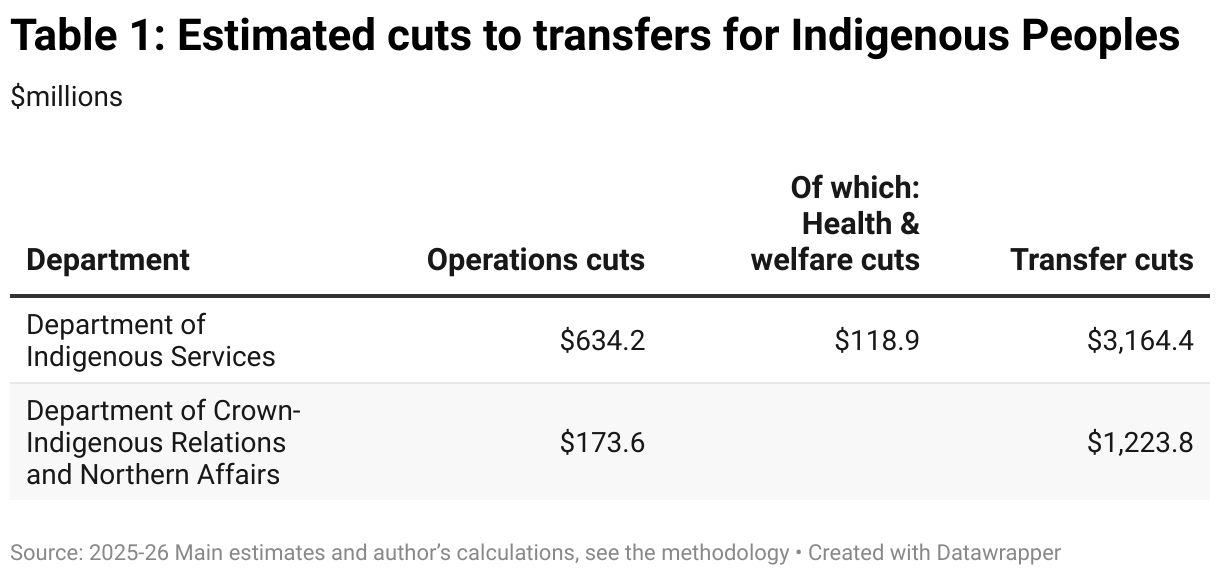
Of the $23.7 billion in “savings” envisioned by the Feds to pay for defence and middle- and upper-income tax cuts, one in five dollars (19 per cent) comes from transfers to First Nations, most of which is for basic social services like education. These cuts in transfers would be in addition to cutting 15 per cent of the staff in departments serving Indigenous Peoples. The operations cuts could amount to $807 million, $119 million of which would be simply cutting insurance for health benefits for Indigenous Peoples.
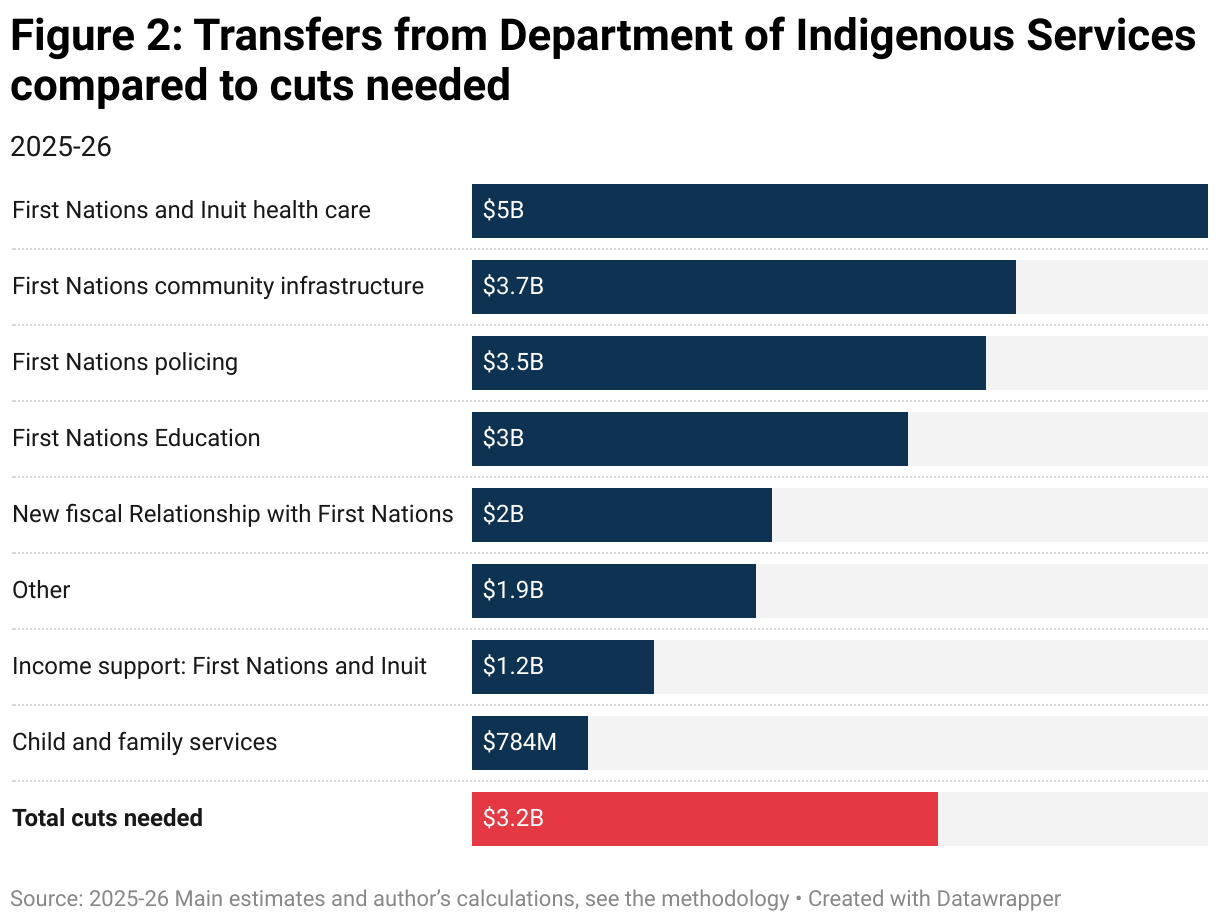
The Department of Indigenous Services is largely a transfer agency for First Nations and territorial governments. As part of these proposed cuts, the department would have to cut $3.2 billion from its transfers, as detailed below. This would be in addition to slashing health care coverage from the NIHB by $119 million a year. Those transfers are to First Nations governments for basic community infrastructure, policing, health care, education, income supports and child and family services. Unlike the provincial analogies for these supports, the First Nations versions currently don’t seem to be protected—and there are billions on the line.
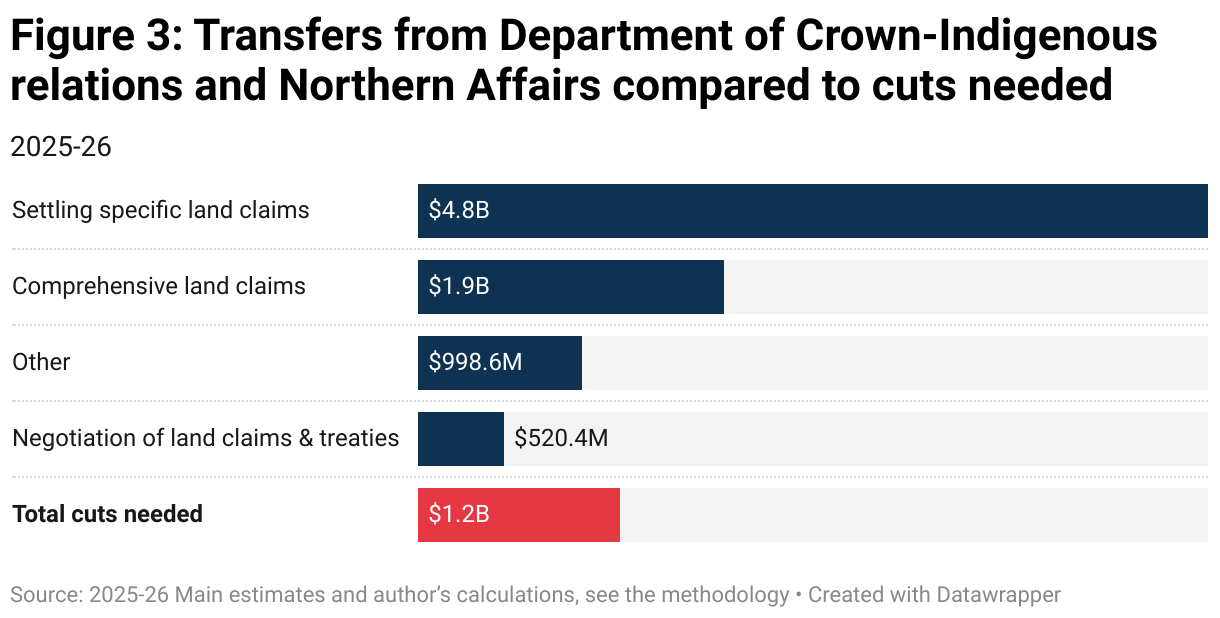
The other major department providing transfers to Indigenous Peoples, the Department of Crown-Indigenous relations and Northern Affairs, could have to cut over $1.2 billion a year in transfers. Much of what the department does is negotiate and settle specific and comprehensive land claims. As a legal process, it’s unclear how it would even be possible to cut large transfers. First Nations governments also receive capacity-building funds, so they have the capacity to properly research and negotiate claims. Both the support to First Nations governments and the actual settlement payments could be on the block in these cuts.
Estimated cuts to municipal and provincial transfers
The federal government says transfers to other levels of government will be protected from these anticipated. While that protection doesn’t appear to extend to First Nations governments, there are key ways in which provincial and municipal governments won’t be protected either.
The main transfers that will likely be protected: Canada Health and Social transfers, child care transfer, equalization and territorial equivalents, as well as municipal funding through the old gas tax transfer, now named the “Canada Community-Building Fund”.
However, there are plenty of other transfers, shared funding and joint agreements that fall outside of these major transfers. These other smaller transfers now appear to be in play across several departments. As you can see from the table below, many of these departments almost all deal with transfers, like the Department of Housing, Infrastructure and Communities Canada, and Public Safety Canada. Even if these departments want to maintain their transfers, it will likely be impossible. They can’t cut enough on the operations side to get to their 15 per cent target.
All told, there are roughly $1.9 billion in transfers a year across these departments—and that could easily impact provincial and municipal finances.
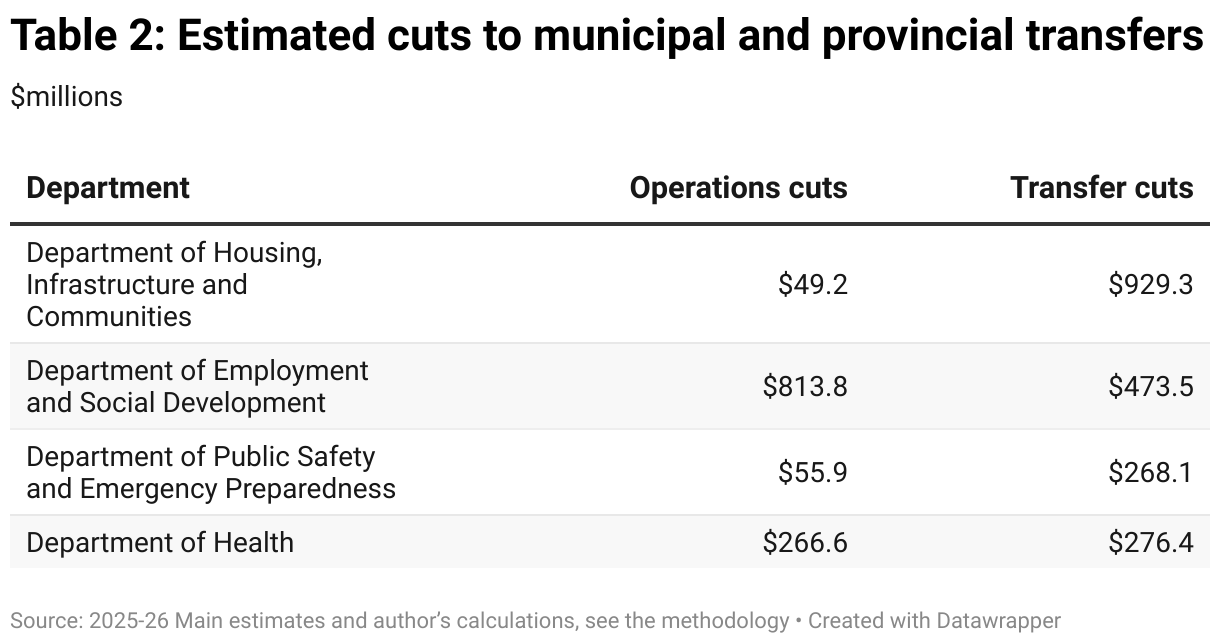
If we examine the Department of Housing, Infrastructure and Communities Canada, major portions of its transfers are cost sharing with provinces and/or cities for infrastructure or housing. These aren’t part of the major transfers that will be protected in the coming round of cuts—they could very much be on the chopping block. The department has been asked to propose just over $900 million in cuts a year from these transfers.
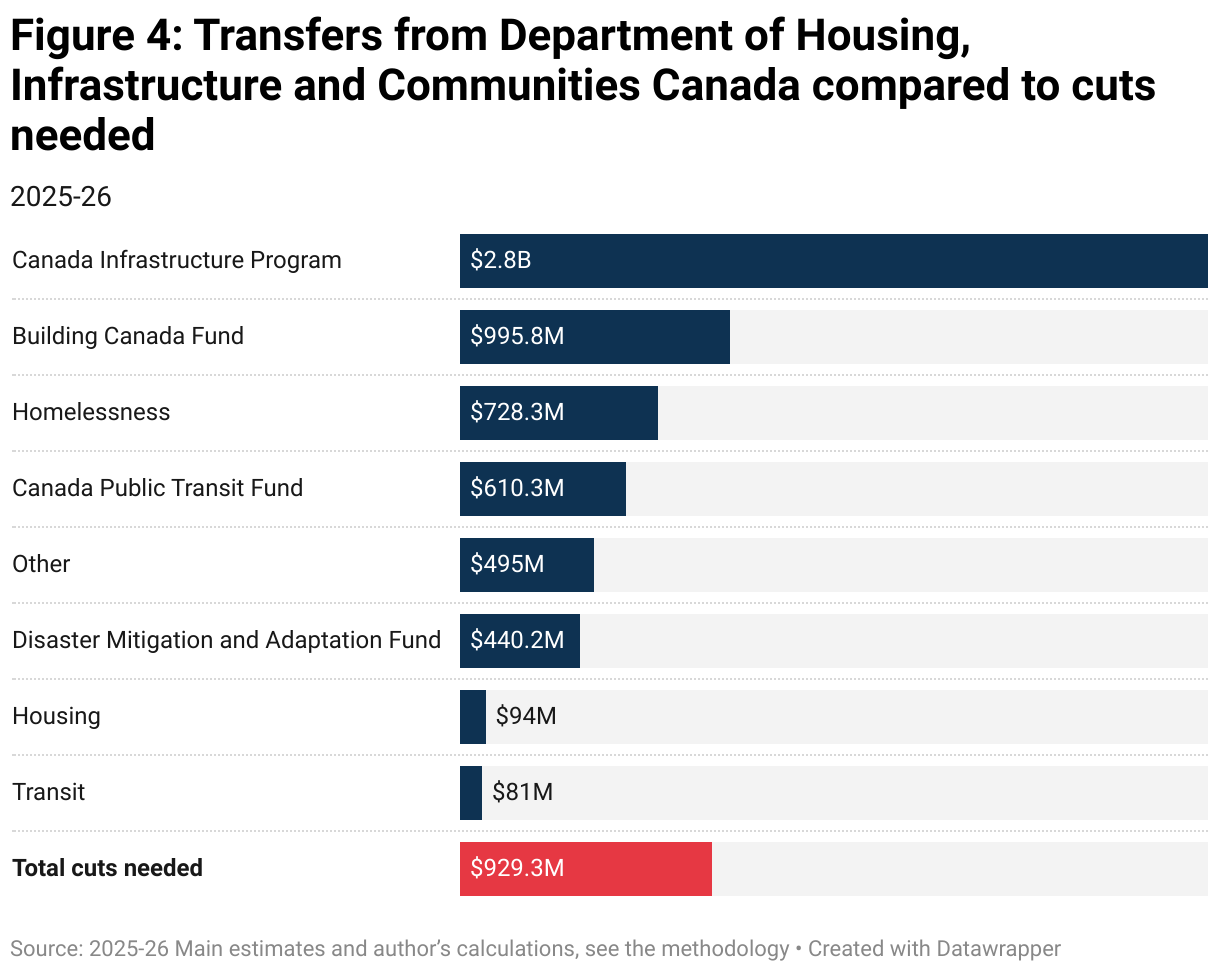
Employment and Social Development Canada (ESDC) would face $474 million in cuts to its transfers. Roughly half of ESDC’s major transfers have to do with Employment Insurance (EI) training—important portions of which are transferred to the provinces through things like the Workforce Development Agreements and other training contracts. Governments and organizations working on skills recognition and Indigenous child care comprise another quarter of the transfers.
Public Safety Canada would face $268 million in transfer cuts annually in this scenario. It has a large transfer envelope focused on two major transfer types that are roughly equal size, at half a billion dollars apiece. The first is transfers to the provinces to aid them with natural disasters, many of them now related to climate change, like forest fires. Maybe this climate change thing is just a fad. The second largest transfer goes to provincial, territorial and First Nations governments for First Nations and Inuit policing. This is another possible impact on Indigenous Peoples, in addition to cuts examined above.
The Department of Health is slated for a quarter of a billion in transfer payments a year. This department administers the transfer for “Shared Health Priorities”, but this is likely off the table and not included here. Major transfers for drugs for rare diseases are on the table—it’s the federal contribution to provincial programs for catastrophic drug coverage. The next biggest transfer is Health Care Policy and Strategies and Substance Use and addiction programs. These can be funded directly through the provinces or by providing funding to provincial health authorities to deliver programs.
Regional and sectoral business development
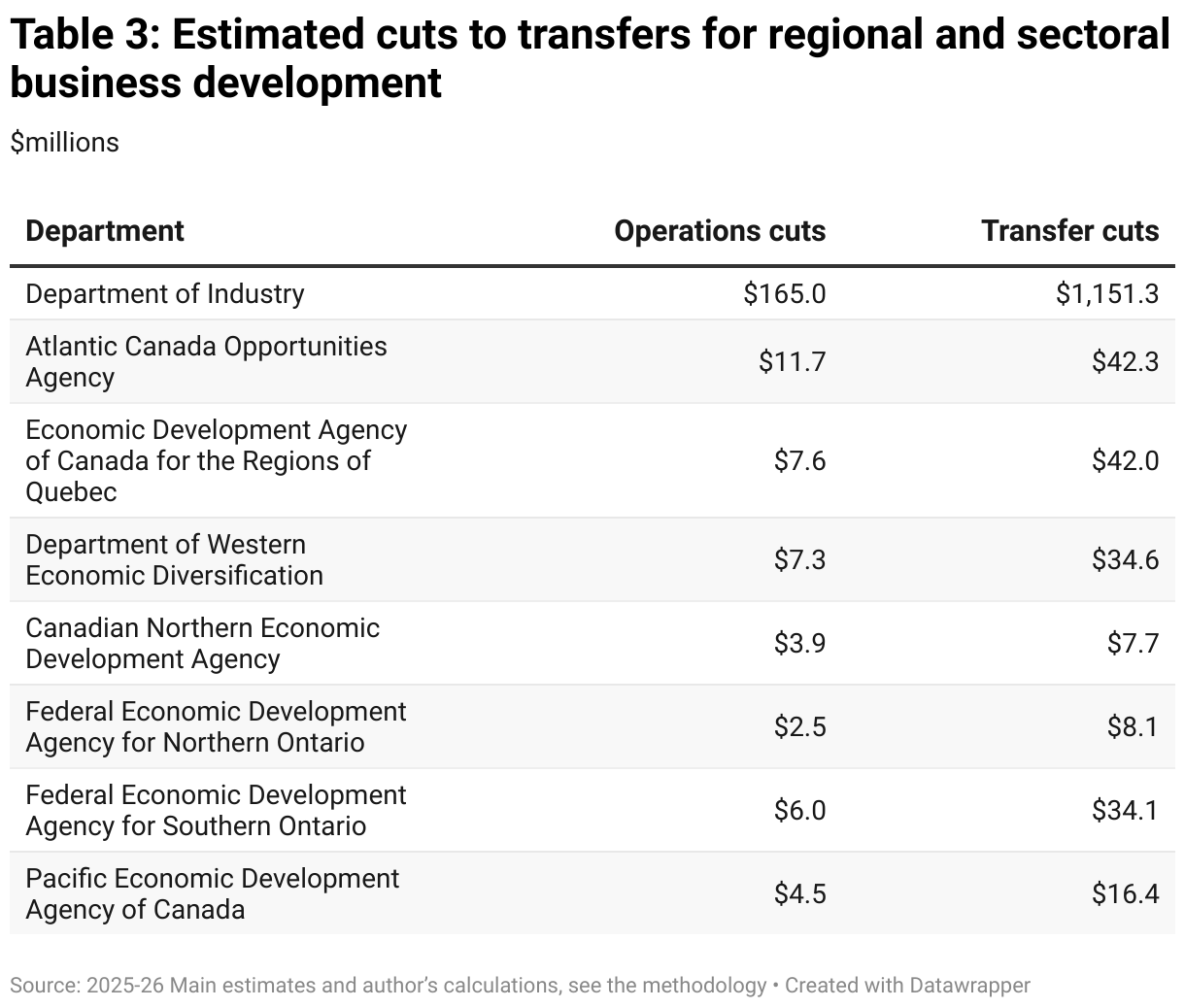
The next area at risk involves eight departments providing supports for businesses. They’ll need to provide $1.3 billion a year in cuts once fully implemented. These departments are, by and large, granting and transfer departments providing relatively few services outside of these functions. As a result, even if these departments wanted to preserve their transfers by cutting their operations more than 15 per cent, it wouldn’t matter, transfer cuts are unavoidable.
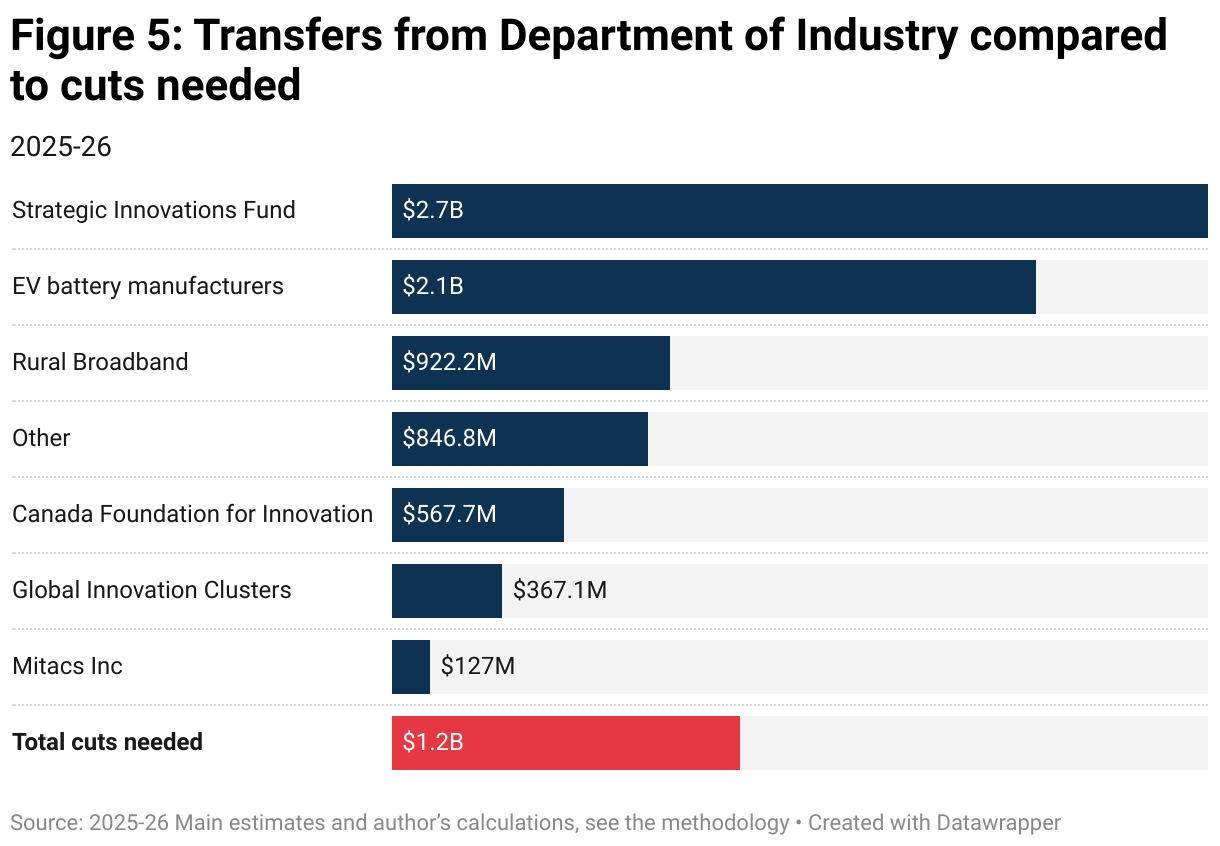
Industry Canada would face the largest cuts to its transfers, topping $1.1 billion, once fully implemented. Three major transfer types make up three quarters of all transfers from Industry Canada. The largest is the Strategic Innovations Fund, which makes major investments in companies in strategically important areas. The second largest is transfers to EV battery manufacturers to build plants in Canada. The third is subsidizing companies to provide rural broadband to better connect rural Canada to high-speed internet.
The other seven departments included above could face a combined cut of $185 million to their transfers a year, upon full implementation. Each of the departments administers smaller grants to regionally important companies to help them develop new technologies and diversify their operations.
Veterans
It’s a cruel irony that cuts to transfers to veterans might be one of the important ways that the federal government will increase military spending. An important part of the increased military spending is to increase salaries for active military personnel. That higher pay while actively serving could be paid for by cuts in support once that active service is over.
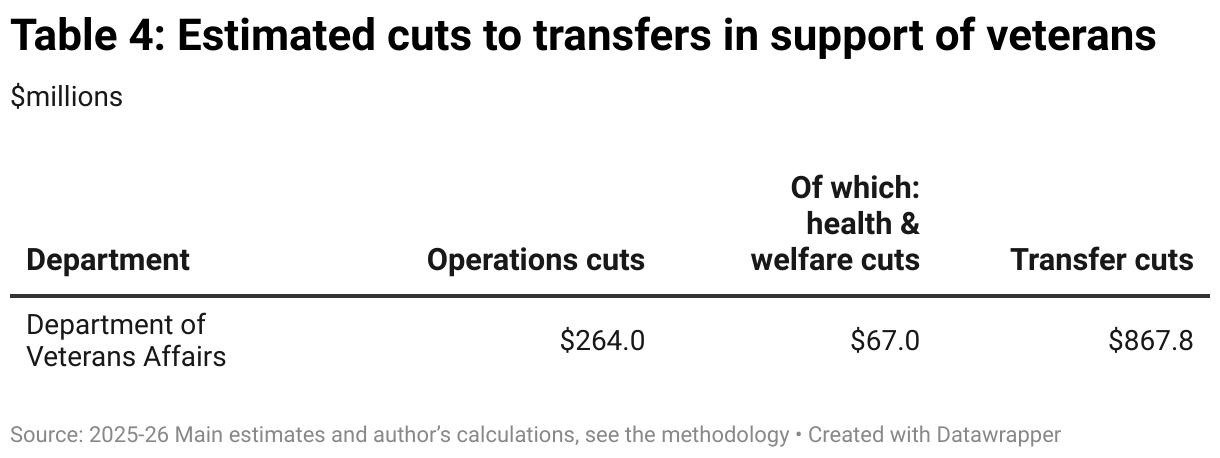
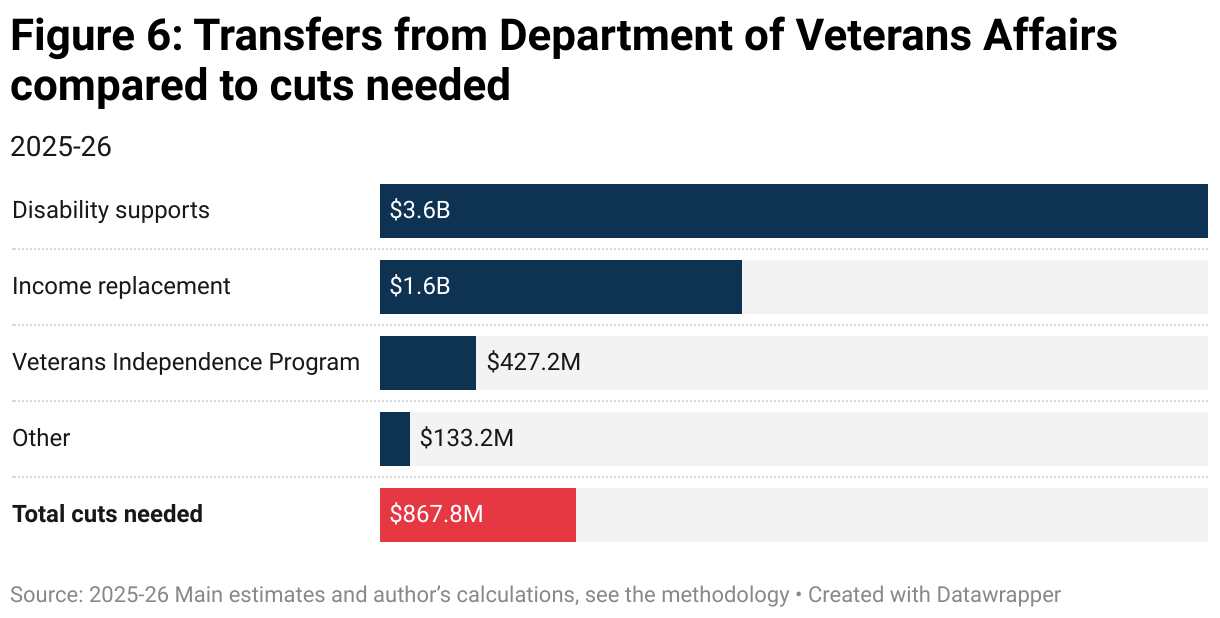
The Department of Veterans Affairs (VA) could be expected to cut almost $870 million in transfer, mostly to veterans: $67 million of veterans’ affairs operations is for the provision of health benefits for veterans, which appears as “professional services” under the operations budgets. VA could have to cut that $67 million in health benefits as well. In total then, $924 million could be cut out of veterans affairs transfers, much of which is transfers to individual veterans or their health care benefits.
In cutting 15 per cent from transfers, amounting to $870 million, there is little flexibility. Veterans affairs is mostly in the business of transferring money to veterans or providing services for their well-being. Three-quarters of transfers are to veterans for various disability support programs, the largest of which is “Pain and Suffering Compensation.” Income replacement programs make up another quarter of transfers, with another seven per cent going to help in the housekeeping and grounds maintenance of veteran’s homes through the Veterans Independence Program.
International assistance
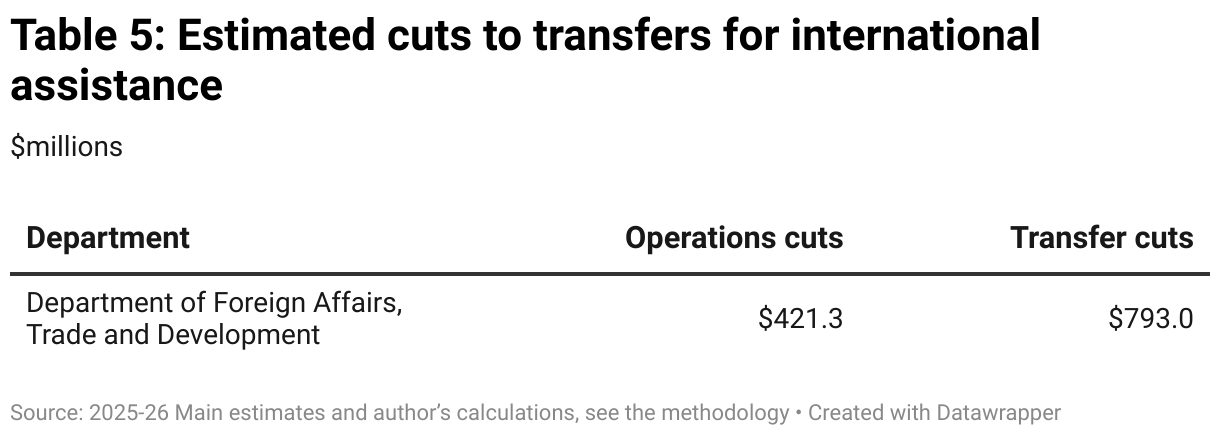
The Department of Foreign Affairs, Trade and Development (DFTAD) has an important transfer role—it administers almost all international assistance. The proposed 15 per cent cuts could result in almost $800 million being cut from transfers, once fully implemented. Most of the transfers from DFATD are forms of international assistance, which make up 80 per cent of transfers. Another 10 per cent is made up from contributions to various international organizations, like the United Nations and the World Health Organization.
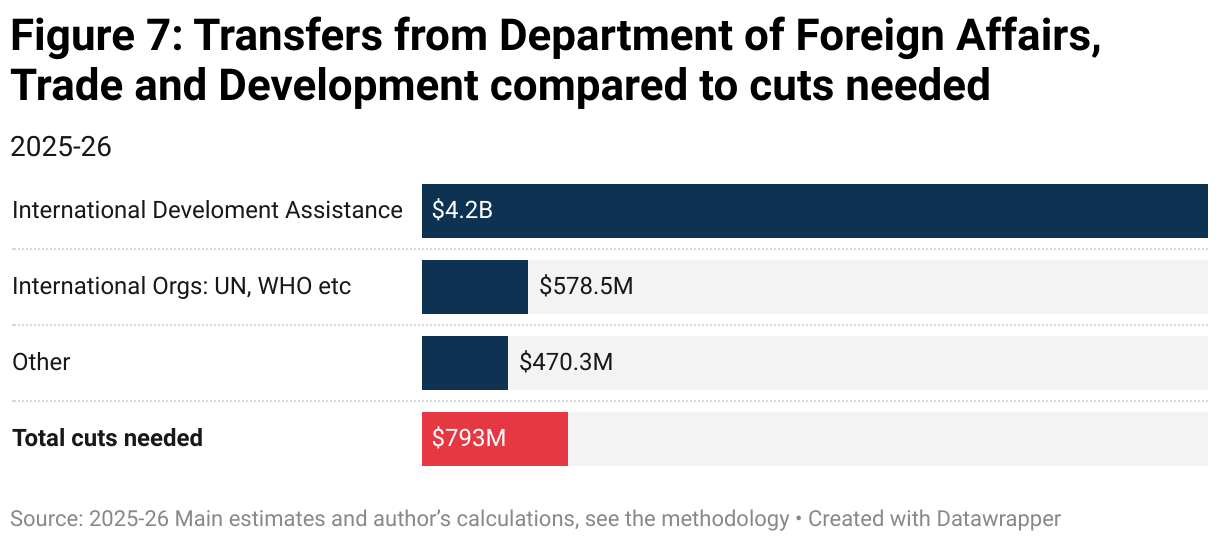
Canada has struggled to get anywhere near former Prime Minister Lester Pearson’s goal of contributing 0.7 per cent of Gross National Income (GNI) to international development. We currently contribute $10.2 billion, or 0.3 per cent of GNI, to international assistance. This is almost certain to fall under the proposed cuts plan.
Military expansion might well be funded by cutting international aid, substituting one approach to international affairs for another.
Canadian scholarships and research
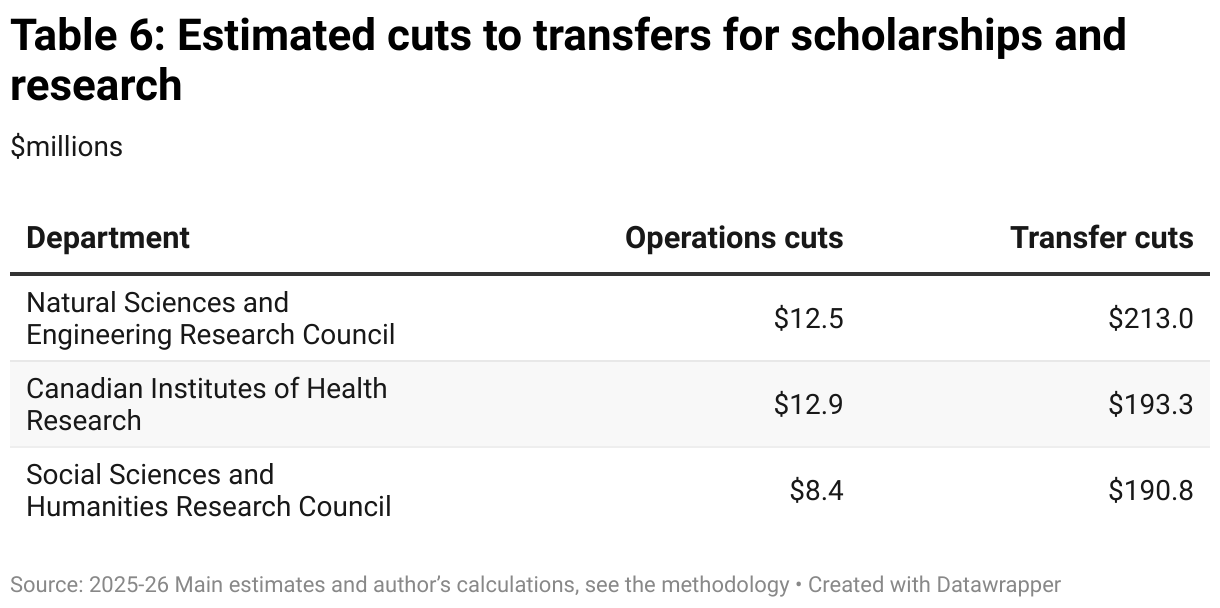
Three funding agencies, which are departments of the federal government, provide much of the granting for Canadian researchers: the Social Science and Humanities Research Council (SSHRC) for social sciences, the Canadian Institutes of Health Research (CIHR) for health care, and the Natural Sciences and Engineering Research Council (NSERC) for sciences more broadly. As implied by their function, these departments focus mostly on transfers, with relatively little spending on their operations side except for administering grants. As such, cuts here could unavoidably fall on the transfers side, which funds research in universities and colleges along with graduate scholarships.
The Tri-Council funding agencies, as they’re known, successfully received an increase in their funding envelopes in budget 2024, which would ramp up to $764 million by 2028-29. However, that increase now looks like it will be undercut as these three departments could be expected to cut $597 million in the same transfers envelope.
With a government-wide mandate to attract the best talent in the world, the Tri-Councils are well-positioned to do this and retain existing talent, but will be unable to if scholarships, fellowships, and granting programs are cut while new programs are rolled out.
Refugees and new Canadians
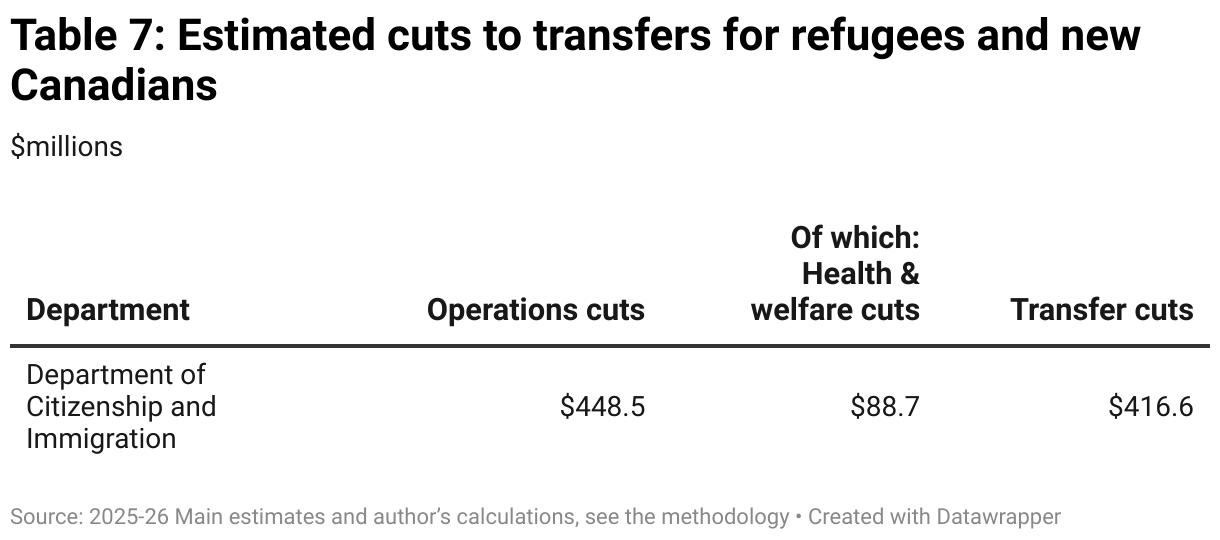
The Department of Citizenship and Immigration has a large transfer role but also plays an important role in providing health care for refugees. It also has a large operations budget that is also eligible for significant cuts. The operations budget might have to cut almost half a billion dollars a year upon full implementation, although $89 million of that cut would be for the health care of refugees, which technically falls under “professional services” in the operating budget. In addition, the department would have to cut over $400 million in transfers, almost entirely to non-profits that aid in the settlement of new Canadians and refugees.
Therefore, the total cuts in new Canadians and refugee services could be $505 million a year upon full implementation, including both cuts in transfers to non-profits providing services and cuts in health care for refugees.
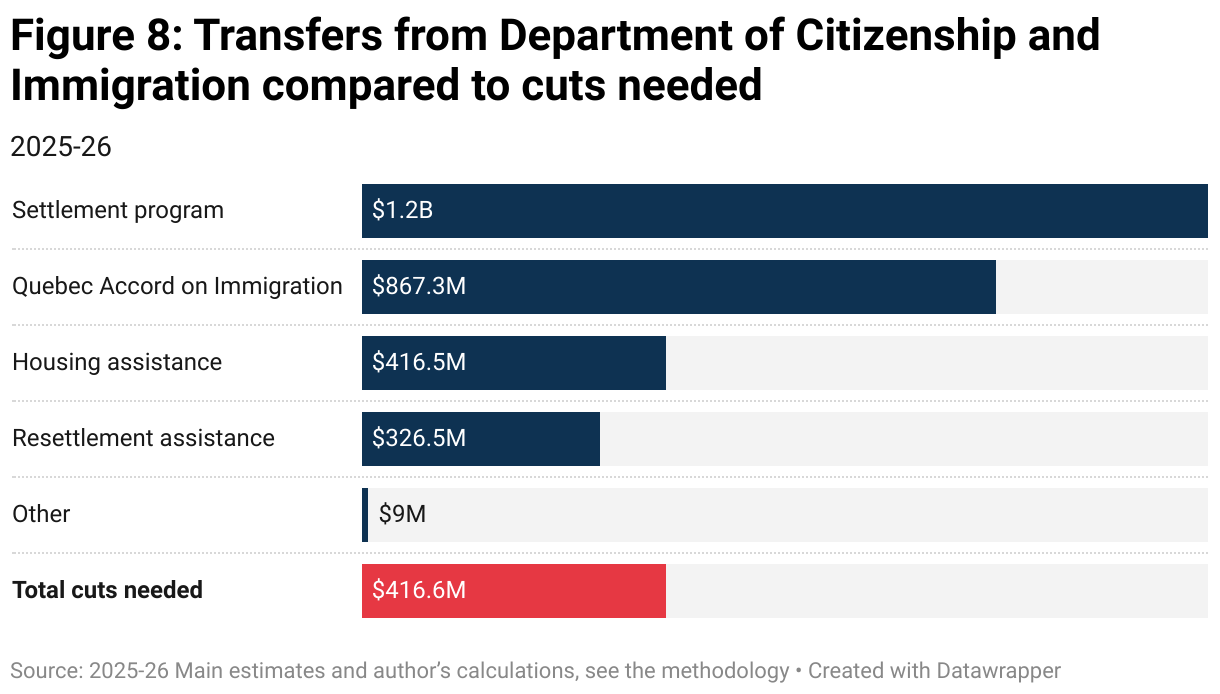
Citizenship and immigration transfers are primarily concerned with the successful resettlement of new Canadians and refugees. This goes almost entirely to non-profits, which provide these types of education, housing and employment services. A specialized transfer to Quebec amounts to a third of all Immigration, Refugees and Citizenship Canada (IRCC) transfers; this is a settlement grant and can’t be decreased, meaning that other transfers or operations will have to make up the difference.
A major part of settlement services is the language training component. IRCC had already cut the advanced language training level starting in 2025-26. These are the classes that help people find jobs consistent with their skills and experience—a counterintuitive cut, given the government’s focus on the economy.
Conclusion
There seems to be some speculation that these pending federal spending cuts can be delivered fairly painlessly by not replacing positions once someone retire or by ceasing to rehire term contracts. However, the July brief sent to ministers will have much more dramatic impacts. More than half of the “savings” will likely occur by cutting transfers—all while staffing and professional services are also cut. This subtle shift, announced in the dog days of summer, radically reshapes what seems on the table for cuts.
Deducing from the brief what might be subject to deeper cuts, all fingers point to: First Nations social programs, veteran supports, refugee and new Canadians supports, international assistance, and scientists. This was not what was proposed in the Liberal platform during an election that is just a few months behind us.
To be clear: those cuts will help pay for dramatically increased military spending and tax cuts that will benefit middle- and upper-income Canadians. It’s a bizarre trade off.
These cuts are terribly ill considered. There is nothing “ambitious” in cutting social transfers to other levels of government and calling them “savings”. They simply reflect Trump’s priorities for Canada: more defence spending and border security. What should be Canada’s top priorities—our social programs, our scientists, our veterans, and our standing in the world—will likely instead be on the chopping block.
There is still time for a serious rethink by the new federal government. These cuts have not yet been implemented, and their practical implementation plans have yet to be drafted. Now is the time to head them off at the pass and invest in Canada’s priorities, not Trump’s.
Methodology
This analysis builds from the hints already contained in the letters to ministers and additional details uncovered by journalists. Here are those hints: The base of the cuts would apply to operations and transfers, but not capital. The value of the cuts would apply to values in the 2025-26 main estimates. Transfers exclude the major transfers to persons as well as other levels of government. Therefore, in this analysis, the following transfers delivered to persons through the tax system, like elderly benefits or the Canada Child benefit, are excluded, as is Employment Insurance. On the government transfers, side I’ve excluded the Canada Health Transfer, Canada Social Transfer, equalization, health care agreements with the provinces and territories, as well as the Canada-wide early learning and child care transfers and their territorial equivalents. The Canada Community-building Fund, the old Gas Tax Fund to municipalities are also excluded. The Canada-wide Early Learning and Child Care agreement (CWELCC) and health agreements show up as departmental transfers but are excluded in this analysis.
Three departments are whitelisted and only have to present a plan for two per cent cuts, based on their 2025-26 main estimates, to be phased in over three years. Those are: the Department of National Defence, the Royal Canadian Mounted Police and the Canada Border Services Agency. All other departments face a 15 per cent cut on their 2025-26 main estimate values. Finance Canada projects a roughly $25 billion savings by 2028-29 on a roughly $190 billion base in 2025-26.
With these basic parameters, it is possible to use the main estimates to work out what’s in and what’s out, by department. This starts with the budgetary expenditures by standard object, from which I include the following categories (objects) as operational expenditures: personnel, transportation and communications, information (advertising), professional and special services, rentals, purchased repair and maintenance, utilities, materials and supplies.
Capital isn’t included in the envelope and so I exclude the categories (objects) of “acquisition of land, buildings and works” and “acquisition of machinery and equipment”.
The transfers in the budgetary expenditures table linked above isn’t the version of transfers because it includes transfers to persons and provinces (which are excluded in the cuts envelope).
Instead, the transfers are pulled from the detailed listing of transfer payments for 2025-26. This list is included in its entirety with the exclusion of:
- “Payments to provinces and territories for the purpose of Early Learning and Child Care”—Department of Employment and Social Development.
- “Contributions to Provinces and Territories for Shared Health Priorities”— – Department of Health
With these pieces in place, department-level estimates of cuts are now possible. Following the above inclusions and exclusions results in a base of $190.1 billion in 2025-26, just as released by Finance Canada; $37.1 billion of which is from the whitelisted departments: DND, RCMP and CBSA. The remainder of the $153 billion comes from all other departments.
Applying the basic two per cent or 15 per cent cut targets, the federal government would need to make cuts of $740 million from the whitelisted departments and $22.95 billion from all other departments. This would result in total cuts of $23.7 billion in year three. This is slightly below the $25 billion estimate released by the Department of Finance Canada, possibly making these estimates more conservative or possibly missing an area that would face cuts.