

- Home
- Topics
- Regions
- Magazines
-
-
-
The Monitor
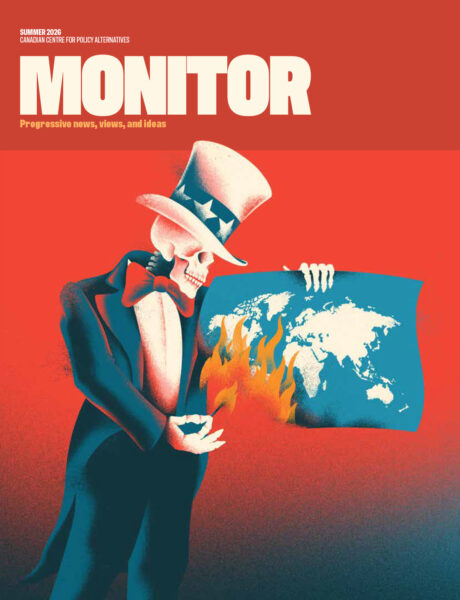
While world leaders are increasingly saying out loud that the postwar liberal world order is dead, the ruling classes in the Global North have an answer for what will come to replace it: fascism. Will they be able to implement their vision?
-
-
-
-
Our Schools/Our Selves
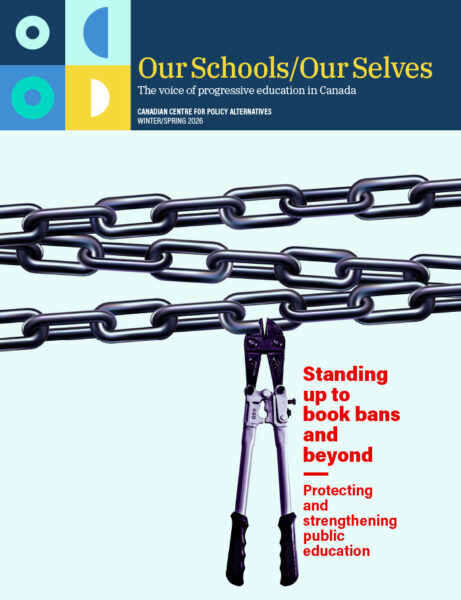
A guide to standing up to book bans and beyond, and how to protect and strengthen public education in Canada
-
-
-
-
- Media Inquiries
- Subscribe
- Legacy Gifts
- About
- Contact
- Donate Now
- Donate Now
Search results for “node/poverty”
-

Fighting energy poverty and the transition to zero-emissions housing
Today we released a new Climate Justice Project report, Fighting Energy Poverty in the Transition to Zero-Emission Housing: A Framework for BC, by yours truly, Eugene Kung (a lawyer with the BC Public Interest Advocacy Centre and a steering committee member of the CJP) and Jason Owen (who worked on this project as a student…
-

Women’s Poverty in Canada
Keynote Speech by Kate McInturff Kate McInturff, senior policy researcher at the Canadian Centre for Policy Alternatives, gave a speech about women’s poverty in Canada at an event hosted by the Canadian Women’s Foundation, on June 9, 2015. Keynote Speech: Women’s Poverty in Canada
-
Infographics: Seniors poverty and inequality
BC seniors are anything but a homogenous group. Large income and wealth inequalities exist among both seniors and working-age British Columbians—the defining problem we face isn’t about intergenerational inequality, but rather the growing gap between rich and poor across generations. Learn more: policyalternatives.ca/SeniorsInequality. Read the news release here.
-
Fast Facts: Springing to Action on Child Care
Numerous studies have demonstrated that quality child care has a positive correlation with improved childhood outcomes, notably higher social and cognitive scores upon school entry, especially with children living in poverty. On Wednesday May 13th child care advocates from across Canada are joining together to call for a universally accessible,…
-
October 2008: Poverty Amidst Plenty
Why isn’t inequality a key issue in the latest election? This column is being written in the middle of a federal election campaign, the outcome of which most readers will know by the time they see it. Not being prescient, I can only hope, as I write in ignorance of…
-
A new era for measuring poverty in Canada
Last Thursday’s Statistics Canada release of individual and household income data for 2008 marks a new era in the study of poverty in Canada. Instead of reporting only on the Low Income Cut Offs (LICO), as they used to, Statistics Canada reported on three of the most common measures of…
-
Reducing poverty and carbon emissions: lessons from Manitoba
I often get asked about alternatives to our fossil-fuelled status quo. In recent years, there have been many new projects that point to the way forward, that get beyond vague statements about reducing carbon emissions and boosting clean energy. Our CCPA-BC office held a conference last year to examine new approaches…
-
Can cooperatives humanize the economy?
Book Review of Humanizing the Economy: Cooperatives in the Age of Capital, by John Restakis, New Society Publishers, 2010. The economy is about business, right? Sure, we have a dynamic mixed economy, and most people support decent social programs and government intervention to protect the environment or to improve living…
-
What if First Nations (and their poverty) were counted?
Kudos to the Globe and Mail for their front page story on Jan 23rd highlighting the fact that the official unemployment rate does not count First Nations reserves. You heard that right: First Nations reserves, some of the poorest places in the country, are not included in the official unemployment rate. As unbelievable…
-
Further investment is needed now to end child poverty
25 years ago, Canada adopted the United Nations Convention on the Right of the Child. Among the rights enumerated in that Convention, children have a right: to learn, to play, to nutritional food, to a home.
-
Cost of Poverty in Prince Edward Island (2011)
Download 625.04 KB13 pages This report estimates that the direct cost of poverty for the PEI government is just under 100 million dollars per year — and that these costs account for 6.7% of the 2009/10 PEI government budget. When the costs to government are added to the broader costs…
-
 martinbertrand.fr / /Shutterstock” style=”border-radius:0px;–objectFit:cover;–imagePosX:50%;–imagePosY:50%” decoding=”async” srcset=”https://www.policyalternatives.ca/wp-content/uploads/2025/04/pn_sep2020_for-better-or-worse-300×133.jpg 300w, https://www.policyalternatives.ca/wp-content/uploads/2025/04/pn_sep2020_for-better-or-worse-768×341.jpg 768w, https://www.policyalternatives.ca/wp-content/uploads/2025/04/pn_sep2020_for-better-or-worse.jpg 900w” sizes=”(max-width: 300px) 100vw, 300px” />
For better or worse, it’s election time—let’s get on to the issues that matter
Since the provincial election was called last week, the focus of debate so far has been the timing. But like it or not, we’re headed to the polls in less than a month—and it’s time to shift gears to focus on the many urgent issues at stake. Top of that…


 martinbertrand.fr /