

- Home
- Topics
- Regions
- Magazines
-
-
-
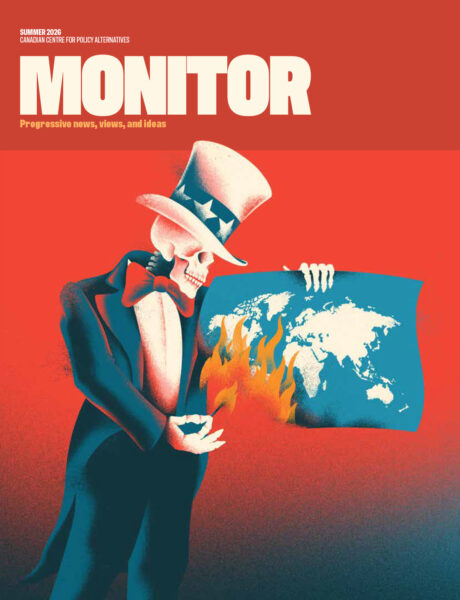
The Monitor
While world leaders are increasingly saying out loud that the postwar liberal world order is dead, the ruling classes in the Global North have an answer for what will come to replace it: fascism. Will they be able to implement their vision?
-
-
-
-
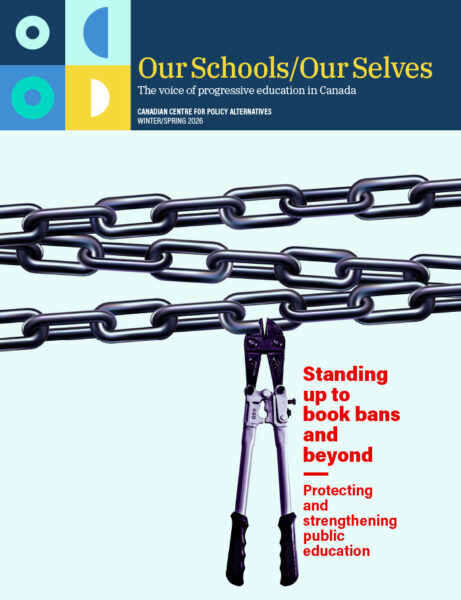
Our Schools/Our Selves
A guide to standing up to book bans and beyond, and how to protect and strengthen public education in Canada
-
-
-
-
- Media Inquiries
- Subscribe
- Legacy Gifts
- About
- Contact
- Donate Now
- Donate Now
Search results for “site/Pat Armstrong”
-

UNSPUN: Communities leading the way need provincial support
The province has invested widely in community development and “place-based” approaches to renewal and poverty reduction, with many positive results. Place-based approaches such as these are now being adopted in communities across the country as research shows that residents overwhelmed by poverty need complementary supports and resources close to home.…
-
Our Way or the Norway
One of goals in my paper, The Petro-Path Not Taken, was to compare Norway and Canada-Alberta’s record in distributing petroleum wealth amongst persons and amongst provinces. Norway has been very effective in distributing oil wealth amongst it regions and its population. Its level of income inequality is one of the lowest…
-
New study shows retirement security is colour coded in Canada
Data reveal significant inequalities in income between Indigenous, racialized and white seniors, as well as in retirement savings for adults CLICK HERE TO VIEW THE FULL REPORT (French) CLICK HERE TO VIEW THE FULL REPORT (English) Indigenous and racialized seniors have less retirement security and higher poverty rates than white…
-
Bangladeshis Victims of Corporate Exploitation
Western companies responsible for deaths of garment workers In April 2013, the Rana Plaza building collapsed in Dhaka, Bangladesh, killing 1,129 garment workers and injuring more than 2,500. The building contained four garment factories. This was the worst industrial disaster in Bangladesh’s history, and the worst in the garment sector’s…
-
Mobility Pricing: An idea whose time has come?
In a few weeks, the Mobility Pricing Independent Commission will release its final report to TransLink and the Mayors’ Council. The commission has been reviewing new options for pricing Metro Vancouver roads and bridges in order to manage congestion and support investment in the overall transportation system. This work follows…
-
Fast Facts: Regulator’s failure puts water at risk
First published in the Winnipeg Free Press May 19, 2021 CanWhite Sands Corporation (CWS) has not yet received an environment licence from the Province of Manitoba to proceed with the construction of its processing facility, nor have they submitted an Environment Act Proposal for review and approval for their unconventional…
-

Indigenous resurgence in a province like no other
After 30 years of treaty talks, the Truth and Reconciliation Commission findings, and the adoption of the United Nations Declaration of the Rights of Indigenous Peoples, First Nations still face racism on a systemic basis. Can Indigenous People ever find justice in this province? John Price and Nicholas XEMŦOLTW̱ Claxton,…
-
Faith, Hope, and Spin
Canada’s preparedness for oil spill crisis sadly lacking For Canadians wondering about our preparedness for a major oil spill, an item in The Montreal Gazette (June 6) was not reassuring. It stated that Canada was sending “half of its stock of oil containment boom – some 3,000 meters (1.8 miles)…
-
Admitting a post-Paris truth: BC’s LNG pipe dream is over
Since the signing of the new climate treaty in Paris earlier this month, there’s been plenty of debate as to whether the new global agreement is a turning point or merely more hollow promises. The answer, as the CCPA’s Marc Lee has written, will be revealed in how governments and…
-

Ten proposals from the 2018 Alternative Federal Budget
This year’s Alternative Federal Budget (AFB) has just been released. I was proud to be part of this year’s effort, coordinated by staff of the National Office of the Canadian Centre for Policy Alternatives (CCPA). Here are 10 measures proposed in this year’s AFB: Create 470,000 new (full-time equivalent) jobs.…
-
 Province of BC / Flickr.” style=”border-radius:0px;–objectFit:cover;–imagePosX:50%;–imagePosY:50%” decoding=”async” srcset=”https://www.policyalternatives.ca/wp-content/uploads/2025/04/pn_feb2018_FreshFromTheLockup-300×141.jpg 300w, https://www.policyalternatives.ca/wp-content/uploads/2025/04/pn_feb2018_FreshFromTheLockup-1024×480.jpg 1024w, https://www.policyalternatives.ca/wp-content/uploads/2025/04/pn_feb2018_FreshFromTheLockup-768×360.jpg 768w, https://www.policyalternatives.ca/wp-content/uploads/2025/04/pn_feb2018_FreshFromTheLockup.jpg 1280w” sizes=”(max-width: 300px) 100vw, 300px” />
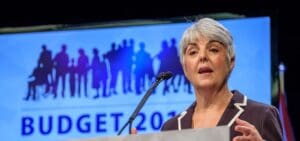
Fresh from the lockup: Highlights of BC’s action-packed budget 2018
BC Budget 2018 includes major new investments in child care, housing and infrastructure combined with significant improvements in tax fairness. This budget—the new provincial government’s first full budget—is a turning point. For too long, BC budgets have prioritized tax cuts and balancing the books over all else—preferring to sweep social,…
-
Bill 64 an organized abandonment of racialized communities
First published in the Winnipeg Free Press Friday May 7, 2021 When it comes to the problem of racism in Canada’s education system, racism is built into the very system. So, what is “new” with the government of Manitoba’s Bill 64? If passed into law, it will further entrench systemic…

 Province of BC