
- Home
- Topics
- Regions
- Magazines
-
-
-
The Monitor
While world leaders are increasingly saying out loud that the postwar liberal world order is dead, the ruling classes in the Global North have an answer for what will come to replace it: fascism. Will they be able to implement their vision?
-
-
-
-
Our Schools/Our Selves
A guide to standing up to book bans and beyond, and how to protect and strengthen public education in Canada
-
-
-
-
- Media Inquiries
- Subscribe
- Legacy Gifts
- About
- Contact
- Donate Now
- Donate Now
Search results for “site/ceta”
-

Poverty Reduction Act tabled by Opposition in the BC Leg
The following news release was issued today by the BC Poverty Reduction Coalition: Opposition proposes BC Poverty Reduction and Economic Inclusion Act: Now is the time for bi-partisan collaboration in addressing the root causes of poverty (British Columbia) Today in the BC Legislature, the Official Opposition (MLA Michelle Mungall) introduced…
-
30 Reasons for Better Pay
Watch the video below and click here to visit CCPA-Ontario’s Working For A Living website—a storytelling project to convey the value of a decent minimum wage and a living wage. 30 Reasons for Better Pay
-
In service of business
BC’s new plan for the environment When analyzing the full array of plans to cut, privatize, and deregulate environmental protection, there is one clear theme that emerges. In its bid to improve the province’s investment climate, the BC government has put the emphasis on facilitating access to BC’s natural resources,…
-
New study reveals best and worst cities to be a woman in Canada
CLICK HERE TO VIEW THE FULL REPORT OTTAWA—A new study released today by the Canadian Centre for Policy Alternatives (CCPA) reveals the best and worst cities to be a woman in Canada. According to the study, Québec City is the best city to be a woman and Edmonton is the…
-
La mondialisation, les accords commerciaux et les médicaments
CLIQUEZ ICI POUR CONSULTER LE RAPPORT. Les concessions du gouvernement canadien face aux grandes sociétés pharmaceutiques multinationales, y compris le prolongement à vingt ans de leur monopole sur les nouveaux médicaments, ont eu pour effet de faire grimper en flèche le coût des ordonnances médicales, éventuellement de bloquer la création…
-
November 2001: Exporting Destruction
Report says EDC is putting people and the environment at risk The Canadian government’s Export Development Corporation (EDC) is assisting eight environmentally and socially disastrous projects in the Third World, says a recent report. These are the Antamina mine in Peru, the Chamera I and II dams in India, the…
-
How many will vote in the November 2014 local government elections?
In BC’s last local government elections in 2011 less than 30% of people bothered to vote. CivicInfoBC has a handy list of turnout information for all of our local governments here. I was curious about how this compared to local election turnout in other provinces. I don’t have turnout information…
-
Our Schools/Our Selves: Fall 2001
DIRT(1) Cheap: Students for sale and the tilting of a scale Abstract This paper illustrates how parents, teachers and school administrators have been quietly and unknowingly enlisted as accomplices in the sale of children to commercial interests. This facet of the economic imperative is obscured by the siren call of…
-
LNG’s threat to water sustainability
By Ben Parfitt and David Hughes One glaring problem with the provincial government’s strategy to turn British Columbia into a liquefied natural gas exporting juggernaut is that it scuttles any chance B.C. has to be a climate change leader. But equally problematic is how our government’s economically dubious fixation with…
-
LNG’s threat to water sustainability
One glaring problem with the provincial government’s strategy to turn British Columbia into a liquefied natural gas exporting juggernaut is that it scuttles any chance B.C. has to be a climate change leader. But equally problematic is how our government’s economically dubious fixation with gas exports jeopardizes our irreplaceable water…
-
About that LNG Prosperity Fund
Budget 2014 contains some new information about how the province intends to pay for all of the ponies BC children have been promised from LNG riches. Alas, there is not much there – a three page text box that mostly restates the hype on LNG – and from what has…
-

Looking Back on the Vancouver-Whistler Winter Games
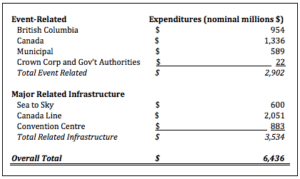
British Columbians no doubt feel thankful that the costs, security and other challenges facing the Sochi Winter Olympic Games far surpass what B.C. and Canada faced with the Vancouver-Whistler 2010 Games. But the 2010 Games were not without controversy and still raise the question of whether it was all worthwhile.…