

- Home
- Topics
- Regions
- Magazines
-
-
-
The Monitor
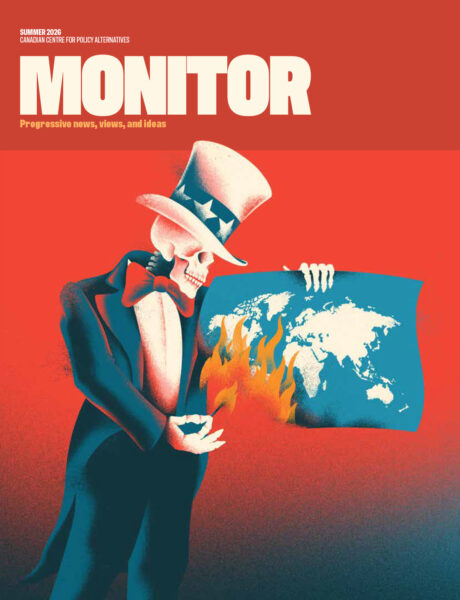
While world leaders are increasingly saying out loud that the postwar liberal world order is dead, the ruling classes in the Global North have an answer for what will come to replace it: fascism. Will they be able to implement their vision?
-
-
-
-
Our Schools/Our Selves
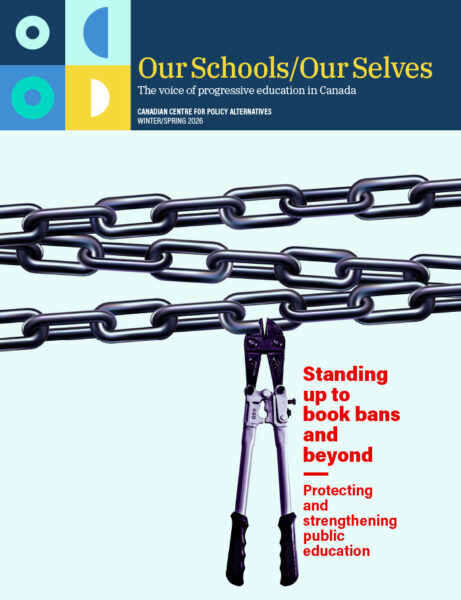
A guide to standing up to book bans and beyond, and how to protect and strengthen public education in Canada
-
-
-
-
- Media Inquiries
- Subscribe
- Legacy Gifts
- About
- Contact
- Donate Now
- Donate Now
Search results for “site/economics of childcare”
-

Fossil fuel divestment necessary in order to avoid “carbon bubble”: study
CLICK HERE TO VIEW THE FULL REPORT OTTAWA—Canada’s economy is experiencing a “carbon bubble” that could have significant consequences for Canada’s financial markets and pension funds, according to a new study released today by the Canadian Centre for Policy Alternatives. Between two-thirds and four-fifths of known fossil fuel reserves have…
-
Austerity Through Infrastructure Cuts: Budget 2013
One of the most amazing things about this budget is that one of its three focuses is actually the opposite of what it’s touting. You’ll likely hear that $14 billion will be spent on infrastructure over the next 10 years (actually, you may hear much bigger numbers, but they’re just…
-
Boom in temporary migrant workers creates a vulnerable workforce, increases workplace inequality
In 2013, for the first time in Canadian history, retirees will outnumber young people entering the workforce. Immigration is a sensible way to offset population shrinkage and economic decline and, for decades, federal programs have invited new workers to settle in Canada for precisely that reason. But now, on the…
-
New CCPA report finds tax cuts no miracle cure for BC
CLICK HERE TO VIEW THE FULL REPORT (Vancouver) The BC Office of the Canadian Centre for Policy Alternatives released a major new study today on taxes in BC. The report, by economist Marc Lee, takes a close look at BC’s tax levels (including comparisons with other jurisdictions) and examines the…
-
Think tank calls on feds to stop growth-killing austerity
Alternative Budget plan tackles Canadians’ real concerns CLICK HERE TO VIEW THE FULL REPORT OTTAWA—The Canadian Centre for Policy Alternatives (CCPA) warns more austerity measures from the federal government could further stall an already stagnant economy. With the release of its annual Alternative Federal Budget (AFB), the CCPA shows how…
-
Sweet heart, bitter pill: Rising, dancing, and costing violence against women in Canada
On Valentine’s Day this year women around the world will be dancing. One Billion Rising, a new initiative from Vagina Monologues’ author Eve Ensler, calls on women to dance their way to a future without violence. Now, I’m all for dancing, but I’d like to add a little counting into the mix. …
-
Tuition hike and the media between 2005 and 2010 in Québec
I’ve contended for the last two years that between 2005 and 2010, an intensive public relations campaign was undertaken with the aim of increasing tuition fees in Québec. I believe it was crucial when the proposal to hike fees was formally submitted in Raymond Bachand’s first budget, the Liberal government’s…
-
Our Way or the Norway
One of goals in my paper, The Petro-Path Not Taken, was to compare Norway and Canada-Alberta’s record in distributing petroleum wealth amongst persons and amongst provinces. Norway has been very effective in distributing oil wealth amongst it regions and its population. Its level of income inequality is one of the lowest…
-
Fast Facts: City no longer a player in poverty reduction
Winnipeg falls further behind other cities with proposed budget cuts The City of Winnipeg’s preliminary operating budget for 2013 cuts spending on poverty reduction, housing, and neighbourhood initiatives at a time when government leadership and resources are desperately needed to address economic and social inequality. The document indicates that the…
-
New trade treaties jeopardize fisheries regulation
CLICK HERE TO VIEW THE FULL REPORT Ottawa – The proposed Canada-EU Comprehensive Economic and Trade Agreement (CETA) and other trade and investment treaties threaten the sustainability of fisheries and fishing communities, says a new report from the Canadian Centre for Policy Alternatives (CCPA). Globalization, Trade Treaties and the Future of the…
-
Selling out our natural resources
In the beginning of December, the Harper government gave its approval to two takeover deals in the energy sector. Nexen is involved in offshore production operations around the world and in oil sands in western Canada. It will now be the property of CNOOC, a Chinese corporation. The second deal…
-
Merger mania
Hardly a day passes without an item in the business pages announcing yet another merger or takeover. The tone of coverage is typically upbeat: bigger is better, we are told, and the winners will be consumers. But even though these announcements are met with praise on Bay Street and Wall…