

- Home
- Topics
- Regions
- Magazines
-
-
-
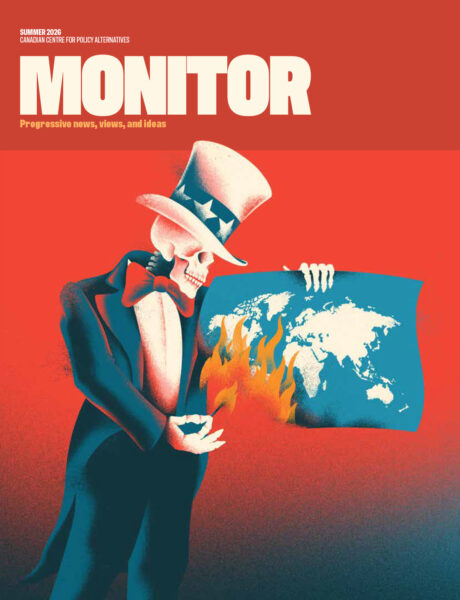
The Monitor
While world leaders are increasingly saying out loud that the postwar liberal world order is dead, the ruling classes in the Global North have an answer for what will come to replace it: fascism. Will they be able to implement their vision?
-
-
-
-
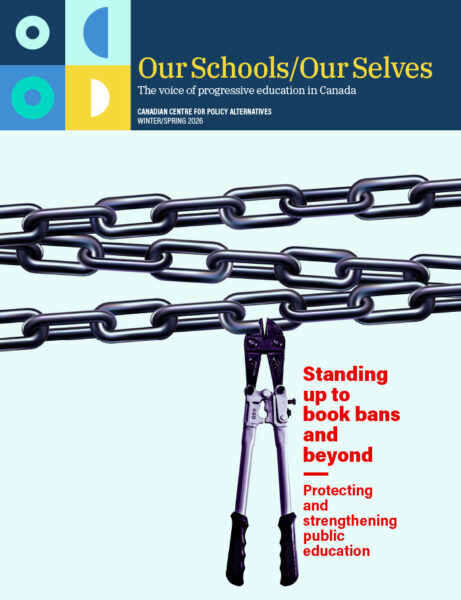
Our Schools/Our Selves
A guide to standing up to book bans and beyond, and how to protect and strengthen public education in Canada
-
-
-
-
- Media Inquiries
- Subscribe
- Legacy Gifts
- About
- Contact
- Donate Now
- Donate Now
Search results for “site/human rights”
-

Think tank calls on feds to stop growth-killing austerity
Alternative Budget plan tackles Canadians’ real concerns CLICK HERE TO VIEW THE FULL REPORT OTTAWA—The Canadian Centre for Policy Alternatives (CCPA) warns more austerity measures from the federal government could further stall an already stagnant economy. With the release of its annual Alternative Federal Budget (AFB), the CCPA shows how…
-
Low income earners in Nova Scotia need a raise
It’s time for Nova Scotians working for the minimum wage to get a big raise. A substantial increase in the wage will go some way to addressing poverty experienced by low income workers and households in Nova Scotia. It would stimulate the provincial economy and contribute to productivity growth at…
-
Tuition hike and the media between 2005 and 2010 in Québec
I’ve contended for the last two years that between 2005 and 2010, an intensive public relations campaign was undertaken with the aim of increasing tuition fees in Québec. I believe it was crucial when the proposal to hike fees was formally submitted in Raymond Bachand’s first budget, the Liberal government’s…
-
Canada and BC unprepared for climate-based migration: CCPA study
Paper explores issues that must be addressed in anticipation of climate migrants READ THE FULL REPORT HERE. Vancouver – A paper released today by the Canadian Centre for Policy Alternatives illuminates a gap in our thinking and our policies at the intersection of climate change and immigration. Preparing BC for…
-
Our Way or the Norway
One of goals in my paper, The Petro-Path Not Taken, was to compare Norway and Canada-Alberta’s record in distributing petroleum wealth amongst persons and amongst provinces. Norway has been very effective in distributing oil wealth amongst it regions and its population. Its level of income inequality is one of the lowest…
-
Fast Facts: City no longer a player in poverty reduction
Winnipeg falls further behind other cities with proposed budget cuts The City of Winnipeg’s preliminary operating budget for 2013 cuts spending on poverty reduction, housing, and neighbourhood initiatives at a time when government leadership and resources are desperately needed to address economic and social inequality. The document indicates that the…
-
Romanow report
You get what you pay for OTTAWA–The Romanow report is a clear rejection of the status quo and a pragmatic step in the right direction to secure the future of public health care, according to CCPA economist Armine Yalnizyan. Yalnizyan applauds Romanow’s recommendation that the CHST be scrapped in favour…
-
New trade treaties jeopardize fisheries regulation
CLICK HERE TO VIEW THE FULL REPORT Ottawa – The proposed Canada-EU Comprehensive Economic and Trade Agreement (CETA) and other trade and investment treaties threaten the sustainability of fisheries and fishing communities, says a new report from the Canadian Centre for Policy Alternatives (CCPA). Globalization, Trade Treaties and the Future of the…
-
Selling out our natural resources
In the beginning of December, the Harper government gave its approval to two takeover deals in the energy sector. Nexen is involved in offshore production operations around the world and in oil sands in western Canada. It will now be the property of CNOOC, a Chinese corporation. The second deal…
-
Work Life: Terminally ill professor pleads for asbestos ban
University of Manitoba professor Patricia Martens has one more mission as an epidemiologist as she confronts her final days with a terminal disease. She wants the government to stop aiding and abetting the lethal trade in asbestos. Martens is a prominent and distinguished research scientist in the university’s faculty of…
-
Mark Carney’s tenure and the state of monetary policy
Mark Carney’s tenure as Governor of the Bank of Canada overlaps some challenging economy history. Appointed in early 2008 just as the US housing bubble was popping, Carney took the helm in time for a financial crisis that brought the global economy to its knees. We are still living that…
-
Coming Down from Mount Olympus
National pride, to endure, must have a strong foundation The tidal wave of patriotism unleashed by our country’s performance in the Olympics is subsiding, but in most Canadians the euphoria lingers. Memories of our athletes’ feats at Vancouver and Whistler will be a wellspring of national pride for some time.…