
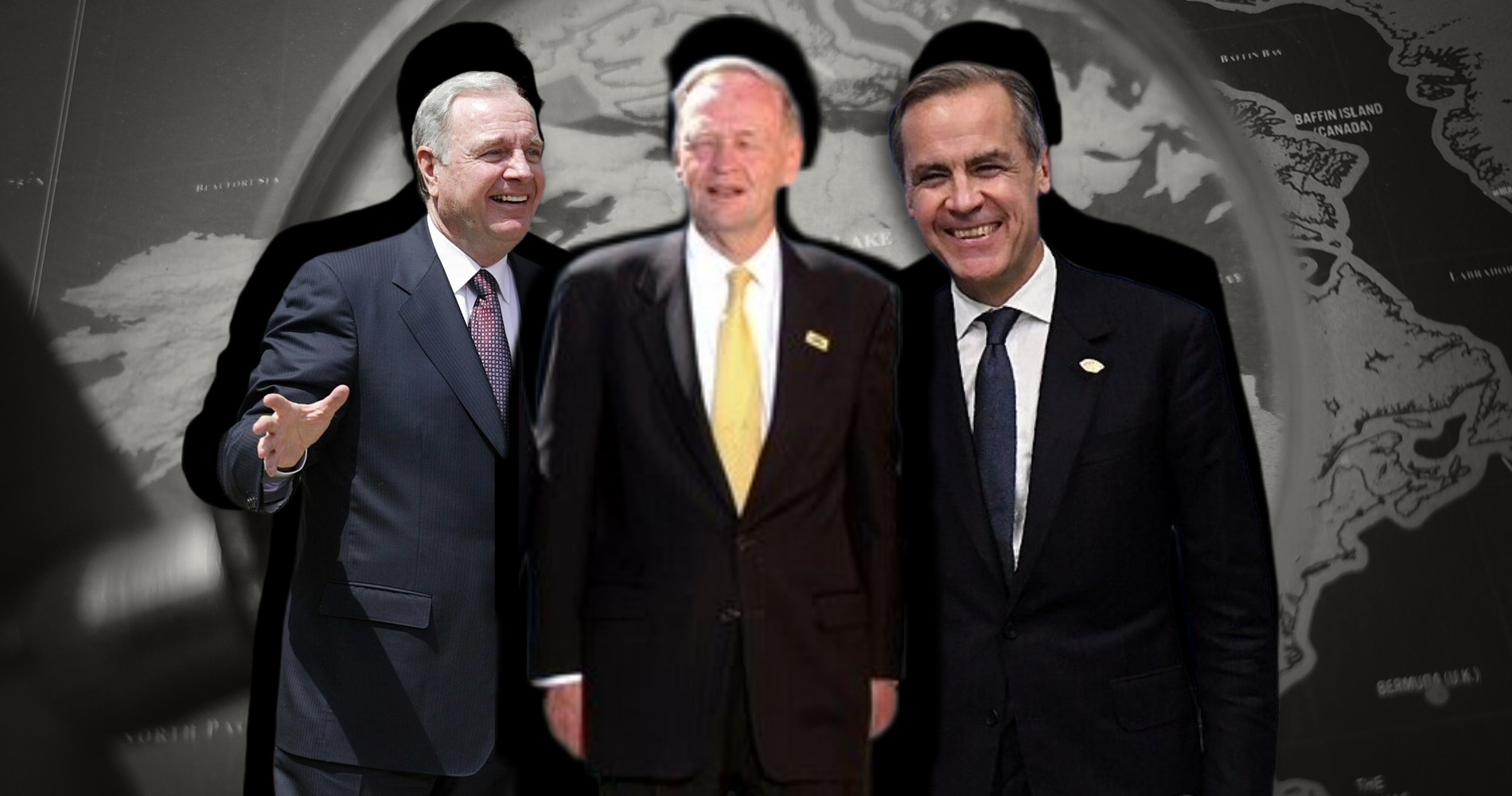
A few short years ago, we were talking about how to “build back better” from the devastation of the pandemic. Today, in the midst of a new economic crisis, the talk of prosperity and security now centres on building out Canada’s military and the tar sands.
Big business, neoliberal economists and right wing parties—including the shape-shifting federal Liberals—are using this opportunity to make the case for deep cuts to federal spending and regulatory oversight and an expanded role for private (mostly foreign-owned) business and tech platforms in the delivery of public goods and services.
Liberal governments have done it before and they can do it again, the argument goes. After all, “the extra $70 billion in spending needed to get defence and defence-related expenditure up to five per cent of GDP has to come from somewhere,” conservative economist Jack Mintz recently wrote in the National Post.
In the business press, Paul Martin’s 1995 budget has taken on an almost mythical status—described at the time as a “Maple Leaf Miracle” in BusinessWeek and now, years later, as an unparalleled public policy accomplishment.
But before Canada hurls down this road again, a reality check is in order. The millions of low and modest-income households that were hit hard by cutbacks to unemployment insurance, large reductions to social assistance, health care, education and community services, and years-long waitlists for social housing certainly don’t remember Budget 1995 as a “miracle.”
Nor do the 45,000 public servants who lost their jobs, or the municipal administrators left to do more with much much less as a result of federal downloading.
Many of the intractable public policy challenges we face today—like hallway medicine, the massive shortfall of non-market housing, financially insolvent post-secondary institution, and historically high levels of income inequality—can trace their roots to the 1995 budget, and the $100 billion in personal and corporate tax cuts introduced a few short years later.
Rather than a triumph, Martin’s failure to protect hard-won public assets and programs was a major policy failure, a failure of national vision.
The long shadow of Budget 1995
Back in the 1990s, Canada was under acute financial pressure to reduce the size of the federal debt—the result not of over-spending, but of two very deep recessions and declining tax revenues, all of which was exacerbated by the exceptionally high real interest rates inflicted by Bank of Canada governor John Crow in his pursuit of zero inflation.
At the time, Finance Minister Paul Martin argued that Canada had no choice but to massively cut federal program spending and transfers. Budget 1995 brought in direct spending cuts of $25.3 billion over three years—an average of roughly 20 per cent across government—and slashed transfers to provinces and territories for health, education and social services by $7 billion, eliminating the Canada Assistance Plan. (That’s a total of roughly $60 billion today.)
These cuts were so deep that Canada eliminated the federal deficit in two short years ahead of schedule. Program spending as a proportion of GDP fell to levels not seen in decades, assisted mightily by the booming U.S. economy, the depreciation of the Canadian dollar, and upswing in tax revenues.
The elimination of the deficit was accomplished by severely restricting access to the rebranded Employment Insurance program for “non-standard” and seasonal workers (cutting coverage rates by at least half), freezing benefit levels for a decade, and by offloading federal responsibilities and financial obligations to lower orders of government.
At the same time, “user fees and cost recovery strategies were implemented, Crown corporations were privatized, subsidies to businesses were eliminated, public operations were commercialized, departmental management operations were rationalized, and staff was reduced” by one quarter.
All of this was taking place against the backdrop of the new Canada-U.S. Free Trade Agreement—and the North American Free Trade Agreement that followed in 1994—an era that spurred huge growth in commerce between the trading partners, and in Canada, an equally massive decline in manufacturing employment, depressed economic growth and sell off of Canadian companies to U.S. investors.
It’s not surprising that between 1988 and 2001, Canada created less than half as many full-time jobs as during the previous 13 years as jobs were off-shored—nor that corporate power became increasingly concentrated in the hands of a few.
Also not surprising: persistently high poverty rates and declining median incomes over the decade, the result of downward pressure on wages, the loss of so many secure full-time jobs, and the sharp cutbacks to social transfer payments resulting from government cutbacks. For working Canadians, as Andrew Jackson writes, “the 1990s were experienced as a lost decade.”
Back to the future
Massive cuts to federal spending are on the agenda again. Deficit hawks would have us believe that cutting government and reducing taxes is key to sustained economic growth, the weight of evidence over the last four decades shows that this simply is not the case, especially in times of economic uncertainty and heightened financial stress.
Austerity policies not only exact an enormous toll on vulnerable communities, but they also do great damage to the economy—depressing demand and exacerbating unemployment, explicitly undermining the capacity of governments to effectively pursue public policies that could turn things around and build for the future. Even the International Monetary Fund has walked back their evangelical support of neoliberalism.
So why are we still talking about deregulation, privatization and fiscal austerity as strategies for strengthening Canada in this moment of existential threat from a hostile U.S. administration?
Why are we talking about $25 billion in cuts to vital services for Indigenous communities, new immigrants, science and research, housing and infrastructure, training and employment services, climate change mitigation and disaster relief? (For the sheer scale of the proposed cuts, see David Macdonald’s new analysis.)
As we learned in the 1990s, the goal of austerity politics—as Mr. Martin repeatedly stated through his tenure in government—was never just about deficit reduction. It was about permanently reducing expectations of government. It was about redefining the economy and the interests of the nation.
Mr. Carney is on a similar mission. In the hunt for defence dollars, he is doubling down on the neoliberal playbook—narrowing the remit of government, gambling that the private sector will deliver high quality services to all Canadians and drive inclusive economic growth, despite all evidence to the contrary.
Mr. Carney has been accused of being yesterday’s man—like President Trump—with his preoccupation with reviving the post-war economy. He seems to be harkening back to an age when the federal government was involved in a much smaller set of obligations—with federal spending levels to match: 11.5 per cent of GDP in 1949-50.
Fast forward to 2019, the year before the pandemic, spending was running at 15.5 per cent of GDP, delivering on a much broader range of federal responsibilities with the same ratio of federal public servants to the population (1.0 per cent) as it was through the post-war period up until the 1970s.
Is radically reducing existing government capacity the right move to confront the urgent challenges of today? How does a renewed program of austerity position the government to facilitate inclusive economic growth, provide for Canada’s security, reduce inequality, or create communities where all can thrive?
Driving a truck through federal revenues with tax cuts that favour middle and high income families as the government just did or gutting the federal public service won’t advance these goals. These decisions have only made the task all the more difficult.
Canadians are prepared to make investments to bolster their defense—understanding the seismic shift in the global order. But it’s another thing to massively exacerbate inequality and diminish opportunity through draconian cuts to vital government programs to this end. Before taking this road, there’s a debate to be had about what kind of society Canadians want and the policy alternatives on the table. Canadians deserve no less.
Canadians also deserve a strong and capable federal government—with needed resources in hand—willing and able to take action in our collective interests. The private market won’t save Canada. That’s on us.