


Share
Introduction
Canada’s industrial economy is at an inflection point. Governments at all levels, together with civil society stakeholders, must recalibrate industrial sector development to support working people, create good union jobs, and confront an increasingly volatile global economy, rapid technological change and climate crisis. Achieving this demands a bold and proactive industrial strategy that deploys public investment and oversight and fosters industry-wide collaboration to advance sustainability goals—and forge a more resilient and equitable economy.
The extensive supply chain breakdowns during the COVID-19 pandemic brought the perils of “just in time” manufacturing and decades-long deindustrialization into sharp focus. Canada’s inability to farm, process or manufacture necessary goods, especially in times of crisis, created vulnerabilities for public health, economic well-being, and national security. Over-relying on fragile supply chains comes with significant risk.
If the pandemic motivated policymakers to advance strategic sector development initiatives (e.g. investments in the electric vehicle supply chain), the U.S.-provoked trade war and threats to Canada’s sovereignty has raised the level of urgency. Trump’s tariffs on critical goods—including cars, metals, minerals and other products—illustrate the dangers of excessive export-dependence and supply chain integration. Further, Trump’s rollback of environmental regulations and job-creating clean energy investments is undoing interconnected clean tech investments here in Canada.
The Liberal government has promised to catalyze projects of national significance, create jobs, lessen U.S. trade dependence, and build “an industrial strategy that will make Canada more globally competitive, while fighting climate change.”1Speech from the Throne, delivered by His Majesty King Charles III, May 27, 2025, https://www.canada.ca/en/privy-council/campaigns/speech-throne/2025/speech-from-the-throne.html. The pertinent question is: how?
Does government form the contours of its industrial strategy around an increasingly unreliable economic and security relationship with the United States? Does Canada defer to the guidance of fleet-footed and profit-thirsty private capital? Or does Canada embark on a visionary industrial strategy that meets the needs of people and the planet?
Overview
Canada’s industrial economy is among the most advanced in the world, underpinned by a highly skilled workforce, renowned education and research institutions, a stable democracy, world-class infrastructure, strong public services, and an abundance of natural resources. Industrial innovation has advanced not because these domestic resources simply exist, or because Canada has a natural proclivity to manufacture goods better than other countries, but because governments have fostered these advantages to advance common objectives and national goals in the face of competing global interests.
Building a successful industrial sector in today’s globalized economy requires strategy—coordination by governments in collaboration with workers, industry actors, and civil society. Industrial strategies (often sector-defined, and sector-specific strategies) identify public needs and industrial goals and then marshal the necessary resources, including coordinating public policy, to execute. Some of the most enduring and defining post-war industrial programs in Canadian history, from aerospace (e.g. Canadarm, Avro Arrow) to agri-food (e.g. Canola) to energy (e.g. Alberta’s oil sands), are products of coordinated government-led industrial strategies.
The absence of goal-oriented industrial strategy, and deference to corporate tax cuts and deficit-slaying as pillars of the neo-liberal economic development ethos, rendered Canada’s response to successive major economic crises in the 1990s and 2000s totally impotent. Despite massive subsidies serving as lifelines to private financial institutions and multinational corporations after the 2008 financial crisis, hundreds of thousands of Canadian workers lost good-paying jobs in mills, forges, processing plants, refineries and factories as businesses restructured, and domestic production capacity shrunk. Employers gutted collective agreements in the industrial sector and closed pension plans, and skilled workers opted for early retirement.
The Canadian government’s response was abysmal. It enacted indiscriminate tax cuts ($60 billion worth), decommissioned industry planning councils, and brought in severe public sector austerity measures and direct attacks on trade unions. Government officials were disinterested in the effects—of hollowing out of Canada’s industrial sector. Lower corporate taxes that companies promised would go into productive investments simply led to higher profits in the pockets of shareholders. All the while investment in the real economy was anemic, inequality was rising, productivity growth stalled, and Canada was no closer to addressing its global climate commitments.2Matt Polacko, “Canada’s Failed Corporate Tax Cutting Binge,” The Monitor, Canadian Centre for Policy Alternatives, November/December 2019, https://www.policyalternatives.ca/publications/monitor/canadas-failed-corporate-tax-cutting-binge.
Canada’s economic stimulus response to COVID-19 was decidedly different. Where economic “austerity” was the watchword following the Great Recession, economic “building” was the post-pandemic frame. Governments, all over the world, embraced a modern clean tech industrial strategy, spurring productive investments and growth opportunities. The Canadian government, following the lead of the U.S., invested heavily in nascent electric vehicle programs, batteries projects, critical mineral supply chains, carbon capture and storage technologies, biofuels, and low carbon steel and building materials.
Canada’s recent embrace of the industrial strategy vernacular is a welcome change from the past, but budget 2026 must do more to operationalize industrial development. Canada can deliver better than the “defensive” or “copycat” industrial policies featured in the pandemic years and chart its own ambitious course forward. The federal government can do this by investing in both productive capacity as well as modern forms of social dialogue, by soliciting ideas and input from all civil society actors and various levels of government. Budget 2026 can reimagine Canada’s industrial sector as evolving beyond a branch-plant economy, by advancing self-sufficiency, and by holding global firms accountable for their actions.
Defending Canadian jobs and industry against U.S. threats
U.S. tariffs on Canadian goods threaten to upend decades of economic integration, leaving Canada’s trade-exposed industrial sector and industrial workers vulnerable. Donald Trump’s economic agenda also seeks to dismantle Biden-era clean technology investment supports, further delinking a shared growth strategy.
Trump has not minced words with his disdain for Canada, declaring that “[Americans] don’t need anything they have.”3Radio-Canada International, “Trump Says U.S. Doesn’t Need Canadian Cars, Lumber, or Dairy; Consumers May Not Agree,” Radio-Canada International, March 3, 2025, https://ici.radio-canada.ca/rci/en/news/2132288/trump-says-u-s-doesnt-need-canadian-cars-lumber-or-dairy-consumers-may-not-agree. The president has called for U.S. independence from Canada on car, steel, aluminum, lumber and energy production, in addition to preposterous annexation threats. Trump’s retrenchment from Biden-era green industrial subsidies, including electric vehicle rebates and infrastructure, threatens to not only undermine North America’s clean energy transition, but also slow the pace of research and development—rendering the North American industry less competitive than other global regions, including a rapidly-advancing China.
Trump’s industrial strategy pits U.S. interests against the world in a battle for scarce resources, investment and jobs. It lacks vision, ignores the plight of working people and threatens to destabilize the global economy.
Embracing a philosophical shift towards industrial strategy
How Canada formulates its industrial strategy in this highly uncertain economic context will have significant consequences for the country. Canada must not emulate Trump’s zero-sum approach. Rather, government must seize the opportunity to focus on major nation-building projects that serve a dual-purpose: make Canada’s economy more self-reliant in the immediate term, while investing in future-facing innovations, skills and productive capacity to meet domestic and global demand, while future-proofing Canadian workplaces and growing good, unionized jobs.
Self-reliance requires deeper policy integration across governments as well as ministries, departments and procurement agencies. It requires an ambitious, cross-sectoral focus on future skills identification and accessible training. Canada must also show the world it can lead on inclusive practices, by institutionalizing conversations with stakeholders and equity-deserving groups.
Industrial strategy, in this context, needs to be more than a policy of enabling private sector investments, but rather a whole-of-government, mission-driven mindset focused on resource mobilization, job creation, self-reliance, sustainability, and social dialogue.
Expanding strategic industrial sectors and supply chains
Reliance on global supply chains brings high risk in a world economy grappling with political instability, extreme weather events and climate disasters. Canada’s stated approach in defending and developing the automobile industry is to incubate an end-to-end supply chain, from ‘mines to mobility’. On the 2025 campaign trail, Prime Minister Carney pledged $2 billion to build an ‘all-in-Canada’ network for supplier parts. Although questions remain as to how this funding is used, the objective is bold: Canada must expand production capacity to build everything it is able, here at home. Project Arrow,4Project Arrow is a collaborative program to build an all-Canadian, zero emission concept car led by the Automotive Parts Manufacturers’ Association in Canada, involving hundreds of domestic suppliers. It was first unveiled at the Consumer Electronics Show in 2023. For more information, visit: https://www.projectarrow.ca/. an all-Canadian concept car, shows that Canada can be more than just a branch-plant economy for the U.S. auto industry.
This ambition must extend beyond Canada’s automotive cluster. Canada has distinct industrial advantages in the production of low-carbon steel, aluminum and metals. It maintains one of the world’s most sophisticated aerospace clusters, and is a global leader in forestry and wood product manufacturing, conventional and clean energy, critical mineral mining and value-added precursor chemical production, as well as food processing and farming. Government mobilization of resources can take many forms, from incubating, developing and commercializing new technologies, to direct public ownership of assets and intellectual property.
Participatory dialogue and decision-making
Unlike other advanced economies, notably in Europe, Canada lacks a tradition of collaborative and formal economic policy making institutions. Formulating meaningful industrial strategy requires institutionalizing deliberative social dialogue.
In 2013, the Harper government defunded dozens of federal labour market planning councils—a notable shift away from public consultation. “Inclusive growth,” a rhetorical feature of the Trudeau years, failed to deliver permanent multi-stakeholder, consultative forums, apart from select industry clusters (e.g. the Canadian Automotive Partnerships Council) and as part of the government’s broader just transition strategy, with social dialogue featuring prominently in the mandate of the new Sustainable Jobs Partnership Council. Government efforts to cultivate civil society consultation and seek guidance on industrial job transition policy is good, but not enough. Social dialogue must also drive forward-thinking industrial policy and sector planning.
Prime Minister Carney’s efforts to undertake national interest projects is welcome, but its enabling legislation, Bill C-5—which grants governments extraordinary powers to stifle dialogue and override basic human rights and environmental standards—raises serious concerns as to whether Canada is turning away from a philosophy of careful, considerate and inclusive economic development.
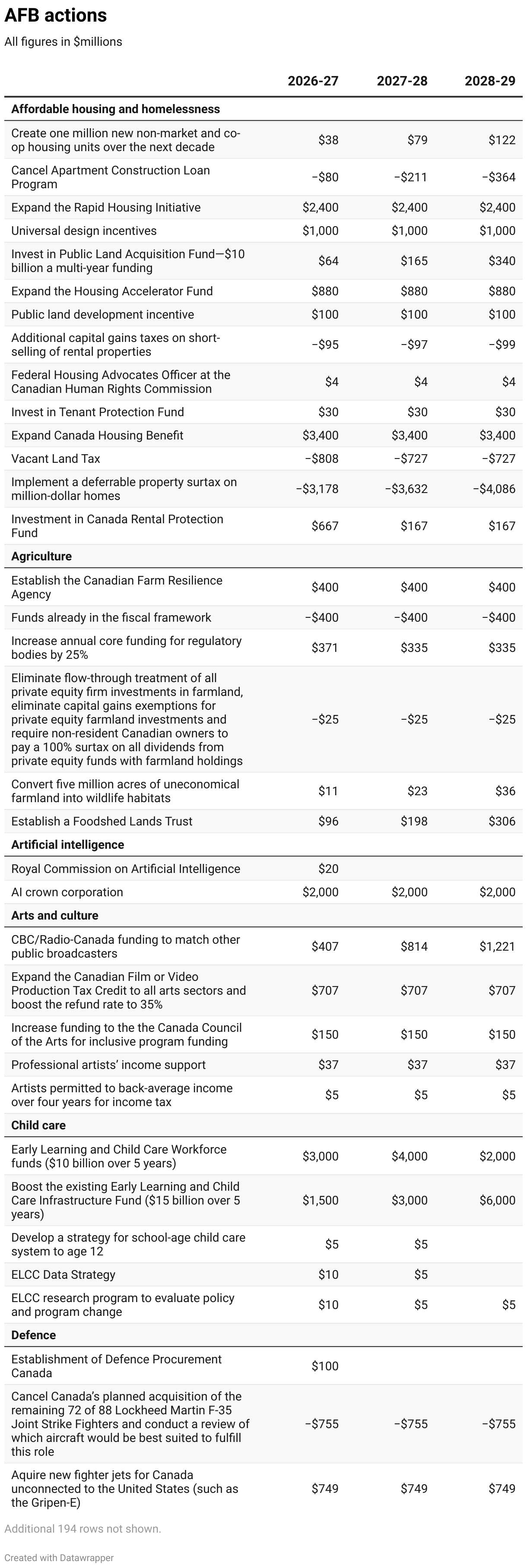
Actions
The AFB will re-invigorate Canada’s Sector Councils program model, with a broader economic forecasting and development mandate and cross-departmental support. Such councils will serve as platforms for strategic conversations between labour, industry, government and Indigenous communities across select industries and developing technology clusters, providing forward-guidance on sector development trends and strategic investments and government procurement opportunities, domestic supply chain vulnerabilities, trade and climate policy coherence, labour market skills and training needs, among other priorities.
The AFB will recapitalize the Strategic Innovation Fund (SIF) to $10 billion over five years, with half of the allocated funding directed toward large critical upstream and midstream projects tied to national interest objectives, economic diversification and tariff mitigation efforts. The SIF will coordinate on strategic investment decisions with input from Canada’s Sector Councils. The processing time for SIF applications must be streamlined, with a benchmark of three months. It will attach funding conditions to long-term domestic job and production covenants, and labour market conditions including union neutrality commitments. Preferred applications involve those tied to First Nations community development and job creation. The AFB will also relocate capital funding earmarked for the Canada Growth Fund to recapitalize SIF.
The AFB will commit $1 billion over 10 years to create a supplementary Transition Benefit for workers displaced by climate policies or tariff mitigation and trade diversification measures. The benefit is flexible by design so that it can best serve the needs of workers in different industries and regions. It can be used for income support, retraining, early retirement or other purposes, and is supplementary to Employment Insurance benefits.
The AFB will commit $5 billion over five years to create an Inclusive Workforce Development program to promote opportunities for underrepresented groups in growth industries. Previous federal initiatives in this area, such as the Community Workforce Development Program, have been well intentioned but insufficient. The Inclusive Workforce Development Program will set a target of training 100,000 workers per year for key professions in strategic industries, including at least 50,000 workers per year from equity-deserving groups.
The AFB will ensure labour and economic development conditions on nation-building projects, including, prevailing wage, union neutrality covenants, community benefit agreements. All projects will also be consistent with climate and biodiversity conditions (see Environment and Climate change chapter).
The AFB will institute an ambitious ‘made-in-Canada’ procurement directive. Among the suite of industrial policies necessary to deliver on Canada’s sector development ambitions, the federal government must reorient its philosophy toward public procurement as an enabler of domestic production and job creation, rather than simply offering state contracts to the lowest bidder. An active procurement policy will support domestic manufacturing, processing and incubate new industries and new technologies, including low-emission steel and aluminum (e.g. through ‘buy clean’ policies), advanced manufactured goods including cars, ships, planes, chemicals, and strategic goods such as biofuels (e.g. through Canadian content in renewable fuel policies). Such a procurement policy will further enable the development of strategic partnerships between governments and Canadian producers, including governments serving as “first buyers” of new technologies to help commercialize and scale Canadian-made products. The AFB’s strategic procurement policy also envisions government purchasing-to-stockpile critical resources, necessary for national and economic security.