

Introduction
Current realities portend great hardship for women and their families. The knock-on effects of a prolonged trade war with the United States will impoverish Canada and erode the public supports and services that sustain communities and the larger economy. This will intensify pressures on individual households as fiscal austerity shifts even greater responsibilities onto the private family, where women shoulder the bulk of caring labour.
In the face of these challenges, the new federal government has identified a narrow set of priorities that largely focus on re-creating the Canadian economy of the 1960s through investments in selected male-dominated industries.1Prime Minister of Canada, “First Ministers’ statement on building a strong Canadian economy and advancing major projects,” June 2, 2025, https://www.pm.gc.ca/en/news/statements/2025/06/02/first-ministers-statement-building-strong-canadian-economy-and-advancing-major-projects. This reinforces the myth that women’s labour is not essential to the economy or their families’ economic survival while also ignoring the reality that services account for 80 per cent of Canada’s GDP.
Recognizing that an economy is built not just on roads, ports and hydro dams, but also on paid and unpaid care for each other and our planet, AFB 2026 makes the investments necessary to strengthen Canada’s essential physical and social infrastructure. This will create the conditions necessary for all to thrive, positioning Canada for the future. Advancing substantive gender equality is crucial to this goal.
Overview
Recent federal budgets have delivered important gains for women and gender-diverse people, including historic investments in child care, the first-ever National Action Plan to End Gender-based Violence2Women and Gender Equality Canada, The National Action Plan to End Gender-Based Violence, Government of Canada, November 9, 2022, https://www.canada.ca/en/women-gender-equality/gender-based-violence/intergovernmental-collaboration/national-action-plan-end-gender-based-violence.html. and the Federal 2SLGBTQI+ Action Plan.3Women and Gender Equality Canada, Federal 2SLGBTQI+ Action Plan 2022, Government of Canada, August 28, 2022, https://www.canada.ca/en/women-gender-equality/free-to-be-me/federal-2slgbtqi-plus-action-plan/federal-2slgbtqi-plus-action-plan-2022.html. Important new federal programs for dental care and pharmacare are being rolled out, and additional funds were set aside in the 2024 Fall Economic Statement to support women’s sexual and reproductive health care, build capacity at national women’s organizations, and accelerate the construction of much-needed shelter spaces.4Department of Finance Canada, 2024 Fall Economic Statement, Government of Canada, November 2024, https://www.budget.canada.ca/update-miseajour/2024/report-rapport/FES-EEA-2024-en.pdf. The new Liberal government elected in April 2025 has promised to preserve these programs and make the Sexual and Reproductive Health Fund and the 2SLGBTQI+ Community Capacity Fund permanent.5Liberal Party of Canada, Canada Strong: Unite. Secure. Protect. Build., April 2025, https://liberal.ca/wp-content/uploads/sites/292/2025/04/Canada-Strong.pdf.
But these announcements and promised investments are modest in comparison to the scale of the challenges we confront. Violent crime against women is on the rise. Violence committed by intimate partners rose by 6.1 per cent between 2019 and 2023. The rate of increase in violence committed by non-intimate partners was even higher: 12.7 per cent.6Statistics Canada, “Trends in police-reported family violence and intimate partner violence in Canada, 2023,” The Daily, Statistics Canada, October 24, 2024, https://www150.statcan.gc.ca/n1/daily-quotidien/241024/dq241024b-eng.htm. In 2024 alone, 187 women and girls were killed in acts of gender-based violence—a 26 per cent increase since 2018.7Canadian Femicide Observatory for Justice and Accountability, #CallItFemicide 2024 Report, https://femicideincanada.ca/wp-content/uploads/2025/02/2024Infographic-ENG-1.pdf These are symptoms of a growing national crisis that demands urgent, co-ordinated action from all levels of government.
The federal government has played an active role in combatting gender-based violence through the 2022 National Action Plan to End Gender-Based Violence, flowing $539.5 million to the provinces and territories via bilateral agreements set to conclude in March 2027.8See Women and Gender Equality Canada, “Bilateral Agreements to End Gender-Based Violence,” Government of Canada, last modified December 10, 2024, https://www.canada.ca/en/women-gender-equality/gender-based-violence/intergovernmental-collaboration/bilateral-agreements.html 9Women and Gender Equality Canada, 2023–2024 Annual Progress Report on the National Action Plan to End Gender-Based Violence, Government of Canada, Date last modified December 10, 2024, https://www.canada.ca/en/women-gender-equality/gender-based-violence/intergovernmental-collaboration/bilateral-agreements/annual-progress-report/2023-2024.html#toc0. Available evidence suggests, however, that the plan is being implemented in a way that is replicating jurisdictional gaps and, in some cases, funding is not reaching core survivor-serving organizations like sexual assault centres.10Mariana Cueto Mendoza and Robyn Hoogendam, “Building a National Narrative: A Select Review of Gender-Based Violence Policies, Legislation, and Services Across Canada,” Women’s Shelters Canada, 2025, https://endvaw.ca/wp-content/uploads/2025/02/Building-a-National-Narrative-2025.pdf. The federal government’s own contribution to the National Action Plan is confined largely to support for research and training; there is no independent oversight, specific action items, or planned long-term investment.
The government has made little progress in responding to the 231 Calls for Justice from the National Inquiry into Missing and Murdered Indigenous Women and Girls.11National Inquiry into Missing and Murdered Indigenous Women and Girls, Reclaiming Power and Place: The Final Report of the National Inquiry into Missing and Murdered Indigenous Women and Girls, 2019, https://www.mmiwg-ffada.ca/final-report/. Budget 2021 set aside $2.2 billion to “accelerate” work on a National Action Plan.12Core Working Group, Missing and Murdered Indigenous Women, Girls, and 2SLGBTQQIA+ People National Action Plan, 2021, https://mmiwg2splus-nationalactionplan.ca/eng/1670511213459/1670511226843. Several Indigenous organizations have prepared their own plans to combat violence among Indigenous women, posted on the NAP website. The federal government’s contribution is called the Federal Pathway; its 2025 progress report can be found here: 2024–2025 Federal Pathway Annual Progress Report, https://www.rcaanc-cirnac.gc.ca/eng/1746650069874/1746650100102 Four years later, many commitments have been made but Canada has failed to deliver the transformative change it promised. The Native Women’s Association of Canada writes in its 2024-25 scorecard that “the lack of transparency, inadequate funding, and absence of Indigenous-led accountability mechanisms have undermined trust and jeopardized progress.”13Native Women’s Association of Canada, Annual Scorecard: The Federal Government’s MMIWG2S+ National Action Plan, June 3, 2025, https://nwac.ca/assets-documents/en_MMIWG2S_scorecards_MMIWG2S_V4.pdf. 14See the statements of the three national Indigenous women’s organizations on the occasion of the fifth anniversary of the MMIWG report in June 2024: Native Women’s Association of Canada, https://nwac.ca/media/nwacs-annual-scorecard-to-assess-federal-response-to-the-genocide-against-indigenous-women-finds-lack-of-urgency-and-transparency; Les Femmes Michif Otipemisiwak, https://www.newswire.ca/news-releases/les-femmes-michif-otipemisiwak-expresses-grave-concerns-regarding-the-inaction-on-missing-and-murdered-indigenous-women-girls-and-2slgbtqqia–893586611.html; and Pauktuutit, https://pauktuutit.ca/news-post/pauktuutit-inuit-women-of-canada-responds-to-federal-pathways-progress-report-on-mmiwg/.
One of the key issues in fighting gender-based violence is difficulty recruiting and retaining frontline staff,15Robyn Hoogendam and Krys Maki, Feminist Brain Drain: Labour Issues and Worker Wellness in the VAW Shelter Sector, Women’s Shelter Canada, 2023,https://endvaw.ca/wp-content/uploads/2024/03/FBD-Final-Report.pdf. a common issue across all sectors in Canada’s care economy (see Health care, Child care, and Seniors’ care chapters). Workers in these sectors have been working flat-out since the pandemic amid funding shortfalls, workforce shortages, entrenched service silos, and the steady creep of privatization. Concerns about the state of Canada’s care economy and its precarious service workers, a largely female and racialized workforce, haven’t commanded the attention they deserve. Potential public sector employment caps and job losses will also hit women workers hard.
There have been several positive steps to strengthening women’s labour market position in recent years, but new initiatives have repeatedly lacked the vision and resourcing to generate real change. For example, a new Sectoral Table on the Care Economy was struck in 2024 to develop federal strategies to improve the provision of high-quality, public, and not-for-profit care services, but no budget was attached. The new proactive pay equity legislation has come into force for 5,000 federally regulated employers, but few employers—including the federal government itself—have met the September 2024 deadline for the submission of pay equity plans.16Lori Straznicky, Paving the Way to Pay Equity: The Pay Equity Commissioner’s 2023–2024 Annual Report to Parliament, Canadian Human Rights Commission, 2024, https://www.chrc-ccdp.gc.ca/sites/default/files/documents/paving-the-way-to-pay-equity-the-pay-equity-commissioners-2023-2024-annual-report-to-parliament.pdf. On the employment equity file, there is still no government response to the Report of the Employment Equity Act Review Task Force submitted in December 202317Adelle Blackett, A Transformative Framework to Achieve and Sustain Employment Equity—Report of the Employment Equity Act Review Task Force, Employment and Social Development Canada, 2024, https://www.canada.ca/content/dam/esdc-edsc/documents/corporate/portfolio/labour/programs/employment-equity/reports/act-review-task-force/EEA-Review-Task-Force-Report-2023-v2.pdf. regarding proposed reforms or recognizing Black people and 2SLGBTQI+ people as designated groups under the Act.18See Employment and Social Development Canada, “Minister O’Regan receives Task Force report on Employment Equity Act modernization,” News Release, December 11, 2023, https://www.canada.ca/en/employment-social-development/news/2023/12/minister-oregan-receives-task-force-report-on-employment-equity-act-modernization.html. The government has agreed to include 2SLGBTQ people and Black people as recognized equity groups under the Act. In addition, the term “Aboriginal Peoples” will be replaced with “Indigenous Peoples,” the term “members of visible minorities” will be replaced with “racialized people” and the definition of “persons with disabilities” will be aligned with the Accessible Canada Act to make it more inclusive. Regulations enacting these changes have not yet been published.
The biggest gender equality win in 2024 was the introduction of legislation setting out the framework for a national pharmacare plan and a commitment of $1.5 billion over three years to provide free coverage of diabetes medication and contraception through a single-payer system, contingent on provincial and territorial agreement.19Health Canada, “Government of Canada Introduces Legislation for First Phase of National Universal Pharmacare,” Canada.ca, February 29, 2024, https://www.canada.ca/en/health-canada/news/2024/02/government-of-canada-introduces-legislation-for-first-phase-of-national-universal-pharmacar.html. To date, four agreements (British Columbia, Manitoba, Prince Edward Island, and Yukon) have been concluded.20See Health Canada, National pharmacare bilateral agreements, modified April 29, 2025, https://www.canada.ca/en/health-canada/corporate/transparency/health-agreements/national-pharmacare-bilateral-agreements.html. To date, the federal government has committed $928.5 million over four years in these four funding agreements. Based on per capita costs to cover the remaining nine provinces and territories, Budget 2026 needs to allocate an additional $5 billion to provide free contraception and diabetes treatments to everyone. The key question now is whether the new government will deliver on a truly universal and inclusive system through these agreements.
Action is also needed to uphold sexual and reproductive health and rights (SRHR) in the face of widespread disinformation campaigns and extremist attacks on gender equality and 2SLGBTQI+ rights.
This includes guaranteeing access to high-quality, scientifically accurate, and comprehensive sexuality education to all children and young people across the country.21Sex Information and Education Council of Canada, Canadian Guidelines for Sexual Health Education, 2019, https://www.sieccan.org/_files/ugd/1332d5_e3ee36e39d944009956af5b86f0a5ed6.pdf. This has become more urgent as several provinces are introducing laws that target protections for queer and trans youth in schools and restricting access to comprehensive sexuality education.22Kendall Latimer and Laura Sciarpelletti, “Critics alarmed as Sask. government scales back sexual health education,” CBC News, August 23, 2023. https://www.cbc.ca/news/canada/saskatchewan/sex-education-saskatchewan-1.6944443.
The announcement of $90 million over six years in the 2024 Fall Economic Statement, with $20 million ongoing, to expand and make permanent the Sexual and Reproductive Health Fund was an important acknowledgement that many continue to face significant barriers in accessing needed health care, including abortion and gender-affirming care. Along with new funding for permanent data collection, this will expand program’s capacity to meet heightened demand for services23Action Canada for Sexual Health and Rights, Annual Report 2023–2024. February 3, 2025, https://www.actioncanadashr.org/resources/reports-analysis/2025-02-03-annual-report-2023-2024. and Health Canada’s capacity to support essential health infrastructure.
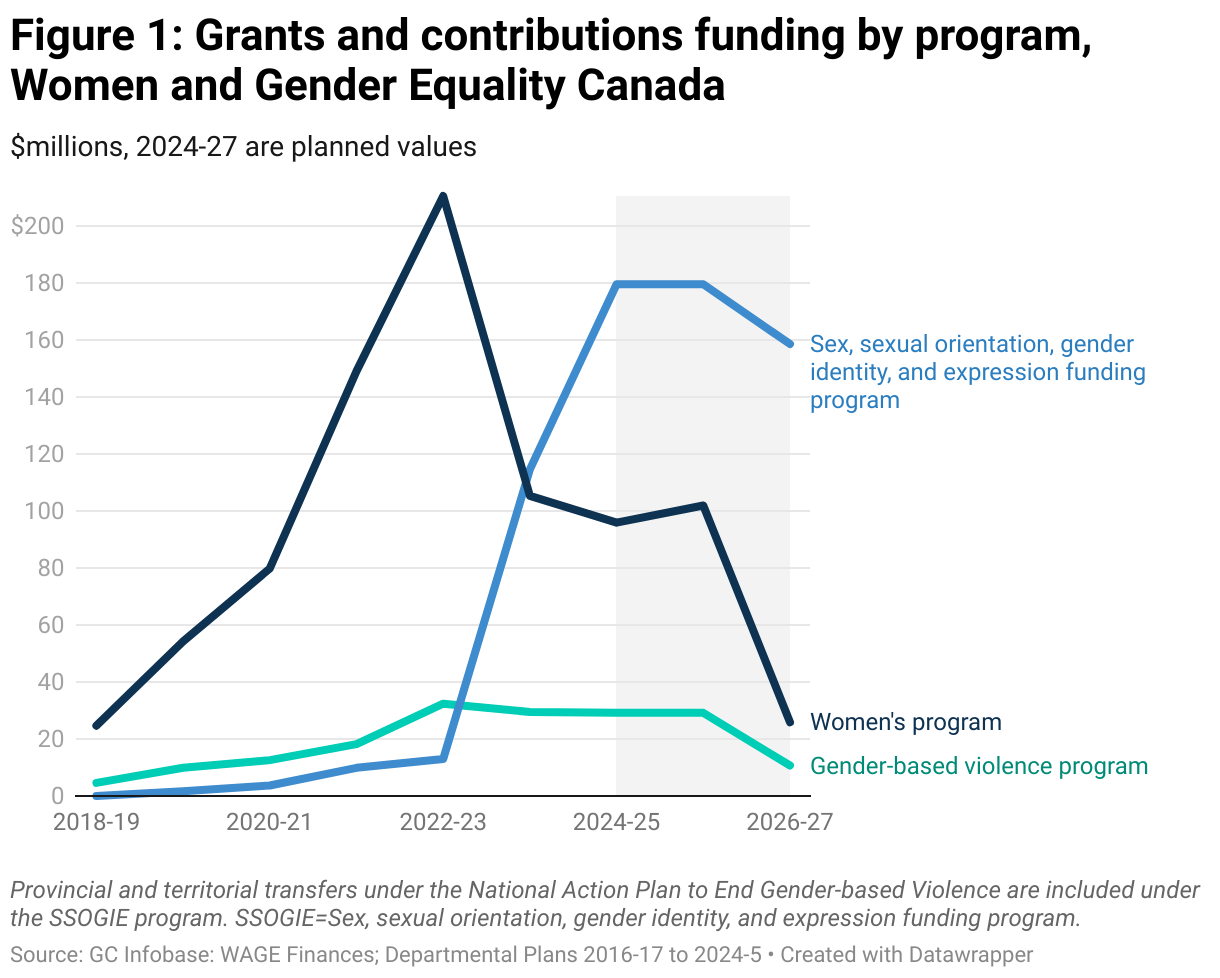
These gains are now at risk even as demand for service has continued to grow.24Ontario Nonprofit Network, 2024 State of the Sector – Policy Report, October 8, 2024. https://theonn.ca/publication/2024-survey-policy-report/. With the conclusion of current funding programs, support for gender equality organizations from Women and Gender Equality (WAGE) Canada is set to decline sharply by 2027-28, notably for organizations supported through the Women’s Program. Project funding is forecast to fall by a factor of 10, from a high of $210.7 million in 2022–23 to $18.9 million in 2027-28, a much larger cut than the 15 per cent identified in the new government’s deficit reduction plan. WAGE’s total budget is expected to fall by 79.9 per cent, from $378.6 million in 2024–25 to $76.3 million by 2027-28, at which time transfers under the Equality for Sex, Sexual Orientation, Gender Identity and Expression Program (currently the largest funding envelope) are set to expire, falling to $1.9 million. The total WAGE budget, which stands at 0.07 per cent of total federal expenditures, will fall to 0.01 per cent in 2027-28. Staffing levels are expected to decline by 35.2 per cent between 2024-25 and 2027-28, to 254 full-time equivalents.
It is imperative to secure flexible, multi-year funding for women’s rights and gender equality organizations.25Canadian Women’s Foundation and Community Foundations of Canada, Principles for Feminist Funding, April 2020, https://equalityfund.ca/wp-content/uploads/2020/11/Feminist-Philanthropy-EN.pdf. Additional resourcing is also needed to strengthen WAGE in its efforts to support the effective implementation of GBA+ across government26As per the Auditor General’s recommendations. See: Office of the Auditor General of Canada, Report 3: Reports of the Auditor General of Canada to the Parliament of Canada—Follow-up on Gender-Based Analysis Plus, 2022, https://www.oag-bvg.gc.ca/internet/English/parl_oag_202205_03_e_44035.html. and to create a comprehensive national gender equality action plan that coordinates and monitors, in collaboration with civil society partners, the implementation of gender-responsive laws and policiesacross jurisdictions.27As recommended repeatedly by the United Nations Committee on the Elimination of Discrimination against Women. See: UN Committee on the Elimination of Discrimination Against Women, Concluding Observations on the Tenth Periodic Report of Canada, United Nations, 16 October 2024, https://docs.un.org/en/CEDAW/C/CAN/CO/10. For a discussion of institutional mechanisms for the advancement of women, see: Beijing +30 Network, Missed Opportunities: A Parallel Report on Canada’s Implementation of the Beijing Declaration and Platform for Action, October 2024, https://bpfacanada.ca/wp-content/uploads/2024/10/missed-opportunities-FINAL.pdf.
Actions
AFB 2026 moves forward in four areas that are essential to the well-being of women and gender-diverse people.
1. The AFB will accelerate the launch and implementation of a new Employment Equity Act, committing $20 million over the next three years for the speedy development of a new Employment Equity regime (including the creation of two new equity groups: Black people and 2SLGBTQI+ people). An additional $20 million over three years will be invested to expedite the work of the Office of the Pay Equity Commissioner and Office of the Accessibility Commissioner. Going forward, it will ensure that these offices have the resourcing necessary to support and enforce compliance including regular independent public reviews and sustained funding for the development of the disaggregated data needed to support these initiatives (see the Racial Equity chapter).
The AFB will also commit $30 million over three years to the operation of the Sectoral Table on the Care Economy, pursuant to Canada’s obligations as a member of the Global Alliance for Care.28The Global Alliance for Care is a global multi-stakeholder initiative launched by the National Institute of Women in Mexico (INMUJERES) and UN-Women at the UN-sponsored Generation Equality Forum in 2021. See: https://www.globalallianceforcare.org/en/; https://forum.generationequality.org/home. The Sectoral Table has been tasked to develop recommendations to better support the care economy29The government of Australia has just released a draft strategy for the care economy. See: Government of Australia, Draft National Care and Support Economy Strategy 2023, Care and Support Economy Taskforce, 2023, https://www.pmc.gov.au/sites/default/files/resource/download/draft-national-care-and-support-economy-strategy-2023.pdf. and as such should embrace the ILO’s 5R framework for decent care work.30The 5R Framework calls on governments, business, labour, and civil society to “recognize, reduce, and redistribute unpaid care work, and reward and represent paid care work by promoting decent work for care workers and guaranteeing their representation, social dialogue, and collective bargaining.” See: International Labour Organization, Care work and care jobs for the future of decent work, 2018, https://www.ilo.org/sites/default/files/wcmsp5/groups/public/@dgreports/@dcomm/@publ/documents/publication/wcms_633135.pdf. See also: UN Women, A toolkit on paid and unpaid care work: from 3rs to 5rs, 2022, https://www.unwomen.org/sites/default/files/2022-06/A-toolkit-on-paid-and-unpaid-care-work-en.pdf. (see Child Care, Seniors’ Care, Health Care chapters).
To this end, the AFB will modernize and strengthen social protections for workers, such as Employment Insurance, to reflect current and future labour realities (see the Employment Insurance chapter) and ensure migrant care workers have decent work by expanding the new care worker pilot announced in 202431Immigration, Refugees and Citizenship Canada, “Canada announces new pilot programs to support caregivers and Canadian families, intends to make the caregivers program permanent,” Immigration, Refugees and Citizenship Canada News Release, June 3, 2024, https://www.canada.ca/en/immigration-refugees-citizenship/news/2024/06/canada-announces-new-pilot-programs-to-support-caregivers-and-canadian-families.html. (see Immigration chapter). The AFB will also prioritize opportunities for women, youth, and other underrepresented groups through new investments in strategic industries and physical infrastructure projects, including a new Inclusive Workforce Development program and a Youth Climate Core (see Environment and climate change chapter, Industrial strategy and sector development chapter, and Just transition chapter, and Affordable housing chapter).
2. The AFB will invest $360 million over three years to stabilize the violence against women shelter and transition-house sector and address fundamental funding gaps in the National Action Plan to End Gender-Based Violence, including the oversight of sexual assault centres and legal aid services. These funds will also support the development of an independent mechanism to monitor and publicly report on progress and lessons learned from the National Action Plan and the Federal Gender-based Violence Strategy.
The AFB will create an implementation plan to accelerate the fulfillment of the Missing and Murdered Indigenous Women and Girls Calls for Justice. It will also create independent accountability mechanisms under the oversight of Indigenous women’s organizations and grassroots groups to monitor current efforts to combat violence against First Nations, Inuit, and Métis women, girls, and Two Spirit people.
The AFB will support the development and implementation of ILO Convention C-190 on violence and harassment in the world of work with $20 million a year in funding. AFB 2026 will also expand access to domestic violence leave to a minimum of 10 paid days and 10 unpaid days in federally regulated sectors (at a cost of $5 million per year) and commit additional funds for measures to counter anti-2SLGBTQI+ hate and gendered digital hate, violence, and harassment in all its forms.32See: Momentum, “Tell the Government of Canada to #Act4QueerSafety and Tackle Rising Hate,” Momentum Canada, n.d., https://www.momentumcanada.net/act4queersafety.
3. The AFB will commit to creating a public, universal, single payer pharmacare planwith a national formulary that includes a full range of sexual and reproductive medicines and devices and other essential medications and supports (see Health care chapter).
The AFB will develop and launch a national five-year strategy in support of the standardization and equitable access to quality, evidence-based, comprehensive sexuality education across Canada and a corresponding training program for professional sexual health educators33Action Canada for Sexual Health & Rights, “Action Canada Submission for 2024 Federal Pre-Budget Consultations,”2023, https://www.actioncanadashr.org/resources/policy-briefs-submissions/2023-08-08-action-canada-submission-2024-federal-pre-budget-consultations. Submission to Standing Committee on Finance. ($4 million per year). It will also expand and make permanent the Canadian Sexual and Reproductive Health Survey.
4. The AFB will establish a fund of $7 million per year to provide core support for national gender equality organizations working on advocacy, research, education, policy analysis, and legal reform to advance the rights of women and gender-diverse people. It will also increase multi-year funding under the Women’s Program to $150 million per year for organizations working to advance equality and human rights across Canadian society. The AFB will also take action to address gaps in the new 2SLGBTQI+ Action Plan in consultation with the 2SLGBTQI+ community,including a whole-of-government implementation plan with commensurate funding.
The AFB will invest $5 million over three years to create a national gender equality plan and independent and transparent monitoring mechanism to uphold obligations under the Convention on the Elimination of All Forms of Discrimination against Women, working in harmony with other human rights bodies and processes. To this end, the AFB will establish and support a regular process for engaging gender equality groups, civil society and labour organizations, the research community, and leadership from marginalized communities in policy development and decision-making.