


Share
Introduction
We live in an increasingly destabilized world. The United States has initiated economic warfare against Canada, weaponizing tariffs. As established political and economic norms around trade and international relations are being up-ended, climate chaos is intensifying and armed conflicts are deepening.
There has been a political struggle over agriculture throughout its 10,000-year history: Should it promote prosperity and health for the wider population, or should it function to concentrate wealth and power? In Canada today, inequality caused by the concentration of wealth—including in the agriculture and food sector—is driving social unrest, fear, and alienation. But agriculture can be a source of stability, security, and resilience.
Food sovereignty—the right of peoples and nations to define their own food systems, prioritizing local production, sustainability, and community well-being—counters inequality. Food sovereignty is necessary for national sovereignty. It’s also key to resisting American territorial ambitions. No country can be strong if its food system is vulnerable. Agriculture policy that works for people, the land, and future generations provides stability to navigate multiple crises.
Overview
The AFB recognizes that diversity is the wellspring of resilience and chooses people-centred creativity and problem-solving that respects and cultivates the knowledge, ingenuity, and commitment of farmers, farm workers, Indigenous traditions, New Canadians, immigrants, and asylum-seekers of all ages and genders. This approach nurtures all diversity (equity-deserving people, agricultural diversity, and biodiversity) and counters divisive inequality.
More than any other sector, agriculture intersects with climate change. To stabilize the climate, safeguard our food supply, and provide economic dignity for farmers and farm workers, we need both economy-wide mitigation (reducing GHGs) and adaptation (dealing with impacts) designed for agriculture.
Since the 1989 Canada-U.S. Free Trade Agreement, our agriculture has become more integrated with that of the United States. Our beef and pork sectors are tightly intertwined, we’ve become more dependent on imported processed food and fresh produce from the U.S., agri-businesses are increasingly foreign-owned, and regulatory harmonization has meant adopting American regulations in many areas.1National Farmers Union, “What Impact has Free Trade had on Canadian farmers?”, Union Farmer Newsletter, October/November 2017, https://www.nfu.ca/wp-content/uploads/2017/10/2017-10-NFU-Newsletter.pdf.
Disentangling our agricultural economies is urgent. Unprecedented cuts to American regulatory bodies have implications for food safety and the spread of diseases through American dairy herds and people who work with them. The American mass deportation of immigrants and undocumented residents is not only a human rights crisis, it creates labour shortages in food processing and farm labour. Food imports from the U.S. will become less safe and less available.
The AFB recognizes that the power to regulate is an essential component of our democracy. Regulations are not “red tape” but a mechanism to put limits on self-interested behaviour to safeguard rights. Regulatory independence from the U.S. is a key trade-diversification strategy.
Rebuilding our local and regional food production, processing, storage, and distribution infrastructure is needed for reliable, long-term capacity to feed our population. This will provide more food domestically while reducing the risk of supply chain disruptions and minimizing GHG emissions from agriculture.
To strengthen supply management and maintain long-term independence from the U.S. market for dairy, chicken, eggs, and turkey, more quota must be allocated to new entrants and alternative production systems. This will promote renewal and resilience.2National Farmers Union, Strengthening Supply Management: Defending Canadian control of our market space and advancing food sovereignty, 2016, https://www.nfu.ca/wp-content/uploads/2019/10/Strengthening-Supply-Management.pdf.
Single-desk marketing for hogs and beef will safeguard these sectors from American protectionism while reducing price volatility. A central buying and selling agency in each province that provides price transparency and equal access to market and product for farmers and processors will balance supply and demand, provide fair prices to farmers, spread production out across the country, create jobs in meat-processing facilities in each province, and reduce GHG emissions.3Bijon Brown, “Price negotiating power balance hurts producers”, Canadian Hog Journal, October 2020, https://canadianhogjournal.com/2020/10/07/price-negotiating-power-balance-hurts-producers/.
Billions of dollars have been siphoned out of our rural communities every year since the Canadian Wheat Board was dismantled in 2012. Consolidated multinational grain commodity traders use their monopoly power to depress prices paid to farmers. Breaking up these giants is not feasible, nor likely to result in meaningful competition. Instead, an expanded single-desk grain authority is needed to bring fairness back to grain farmers.4Allen Oberg, “What’s at Stake”, Canadian Wheat Board Alliance, n.d., https://www.cwbafacts.ca/whats-at-stake/.
The returns from farming cannot cover the rapidly rising cost of farmland everywhere in Canada. Farmland is inaccessible to aspiring young and new farmers unless they are able to take on massive, life-long debt. If the new generation cannot take up farming, we will lose the collective knowledge of generations, our rural communities, and the culture of agriculture.
Total farm debt increased by 20 billion dollars between 2023 and 2024. Much of that is land debt. On the other side of the ledger, farmland investment companies and private equity firms seek out farmland as a safe place to put their money during turbulent times—a way to earn annual rents as real estate values go up before they eventually sell at a profit. Farmland inflation parallels housing price inflation: passive investors and financial institutions capitalize on farmers’/residents’ needs by maximizing rents and land prices. Excessive rents and mortgages take precedence over other spending, starving local businesses and putting pressure on governments to cut taxes and reduce services.5Cathy Holtslander, “Standing up to Farmland Financialization”, Union Farmer Newsletter, February 2024, https://www.nfu.ca/wp-content/uploads/2024/01/UF-NEWSLETTER-FEBRUARY-2024.pdf.
The loss of farmers in Canada is a looming economic and social crisis that cannot be solved by automation and digitalization. We need a resilient and robust Canadian food system employing a larger workforce where farm and food industry workers, whether domestic or migrant, have full labour rights. Agricultural labour strategies must recognize Canadian farming’s seasonality by providing access to livable incomes for farm workers year-round.
The weakening global free trade consensus presents an opportunity to reform Canada’s agriculture strategy framework as the dominance of export growth and the policy constraints imposed by trade agreements lessen. The current suite of Business Risk Management (BRM) programs are inadequate. They discriminate against smaller and diversified farms and are inconsistently applied by provinces. Replacing them with support designed according to an agricultural multifunctionality framework would embed the private and public benefits of environmental, knowledge-transfer, and food security while protecting farmers’ economic dignity.6European Commission, Income support explained: Overview of direct payments for farmers, n.d., https://agriculture.ec.europa.eu/common-agricultural-policy/income-support/income-support-explained_en.
Actions
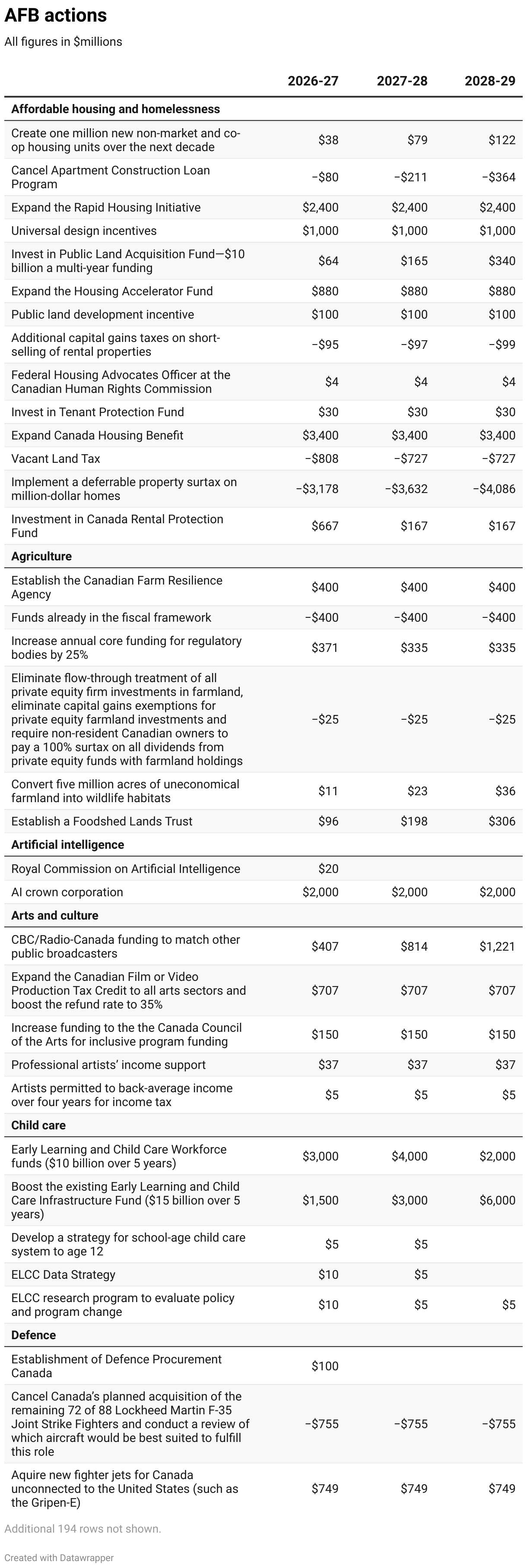
The AFB will establish the Canadian Farm Resilience Agency (CFRA), a trustworthy federal research and agricultural extension institution where farmers, scientists, and agronomists will work together to solve problems and share knowledge. The CFRA will counter the misinformation sphere undermining support for effective climate action. CFRA-supported production changes will counter losses from climate impacts significantly, reducing the annual cost of Business Risk Management (BRM) programs.
The AFB will replace the current suite of BRM programs with ones that support the multifunctionality of agriculture. The new Cultivating Food Sovereignty suite of programs will increase Canada’s capacity to produce, process, store, and distribute food for domestic consumption. These programs will aim to achieve the following: ensure a reliable supply of nutritious, high-quality food; safeguard farmers’ incomes; mitigate GHG emissions and support adaptation to climate change impacts; safeguard biodiversity and water quality conservation; promote social inclusion and diversity of farmers and food sector workers; promote successful establishment of young and new farmers; and rebuild rural community vibrancy and rural quality of life.
The AFB will implement a national agricultural workforce strategy to address labour challenges to domestic food production and support the economic dignity of both resident and migrant workers. This will include open work permits and a pathway to citizenship for migrant workers, including work permit extensions for migrant workers waiting for permanent residency applications to be processed. The AFB will provide reliable year-round income opportunities for resident seasonal farm workers through a combination of extended Employment Insurance options and counter-seasonal employment opportunities as needed.7National Farmers Union–Ontario, Reframing the Farm Labour Crisis in Ontario, 2021, https://www.nfu.ca/wp-content/uploads/2021/07/Reframing-the-Farm-Labour-Crisis-NFU-O-Farm-Labour-Study_compressed.pdf.8National Farmers Union, Towards a National Agricultural Labour Strategy that works for Farmers and Farm Workers, 2022, https://www.nfu.ca/wp-content/uploads/2022/10/2022-10-19-NFU-submission-to-AAFC-National-Agricultural-Labour-Strategy-consultation.pdf.
The AFB will create a new Canadian commodity trading institution modelled on the Canadian Wheat Board (CWB). It will be the sole selling agent of all exported grains, giving it the bargaining power to obtain the best prices possible from international buyers. The new board will have direct relationships with end-users, enabling Canada to benefit from providing grain with specific qualities buyers want. It will also provide market access balance to allow smaller grain marketing companies opportunities to purchase Canadian grain in a marketplace heavily dominated by a few giant multinationals. Like the CWB, the new board will return to farmers the full value of grain sold annually. The improved returns to farmers will create opportunities to diversify crop rotations, increasing farm resilience and helping to diversify export markets.
The AFB will provide incentives to supply management marketing boards to support expanding their capacity to allocate quota increases due to market growth and a portion of retiring farmers’ quota to increase annual new entrant numbers, and to support alternative production and processing initiatives that will enhance diversification within their sectors.
The AFB will develop a transition plan towards setting up single-desk marketing for pork and beef and a concomitant domestic local/regional abattoir sector for meat processing.
The AFB will regulate AI and the digitization of agriculture (e.g., drones for spraying, driverless tractors, etc.), taking a precautionary approach and ensuring that there are knowledgeable experts involved to assess whether digital “black box” processes result in valid outputs. The AFB recognizes that AI is not compatible with Indigenous traditional knowledge and cannot replace the complex, nuanced, and meaningful understanding Indigenous and non-Indigenous farmers develop, and that much of the practice of farming is tacit knowledge that is not available to train AI models. Technology cannot replace human observation of ecological patterns or human creativity and ingenuity in solving new and complex problems in living agro-ecosystems.
The AFB will also develop a legal framework for the governance of agricultural data that will allow farmers to benefit from the data generated by technologies on their farms and set limits on how agricultural big data for AI technologies and other digital technologies may be collected and/or used by large agribusinesses, agricultural employers, and ag-tech companies.9Sarah Hackfort, Sarah Marquis, and Kelly Bronson, “Harvesting value: Corporate strategies of data assetization in agriculture and their socio-ecological implications”, Big Data & Society, 11(1), 2024, https://doi.org/10.1177/20539517241234279.
The AFB will increase the capacity of Canadian regulatory bodies, including the Canadian Food Inspection Agency, Pest Management Regulatory Agency, Canadian Grain Commission, and Health Canada. The AFB will ensure the governance of each of these authorities is free from regulatory capture and that their personnel have the mandate, funds, and equipment to enforce public interest regulations effectively and fairly.
The AFB will create a national public registry disclosing beneficial ownership of all farmland, building on corporate public registries like the Canada Business Corporations Act, which require companies to file beneficial ownership information with Corporations Canada. The AFB will also amend the Income Tax Act to eliminate flow-through treatment of all private equity firm investments in farmland, eliminate capital gains exemptions for private equity farmland investments, and require non-resident Canadian owners to pay a 100 per cent surtax on all dividends from private equity funds with farmland holdings. By implementing disincentives for passive investment in farmland, the AFB will begin to restore the relationship between farmland prices and productive value.
The AFB will establish a set-aside program to, over 10 years, convert approximately five million acres of land currently cropped uneconomically into wildlife habitat, wetlands, and treed land to support biodiversity and carbon sequestration.
The AFB will develop a non-market farmland acquisition program in the peri-urban areas of every province to ensure Class 1 and 2 farmland is available for food production at rental/lease rates aligned with the land’s food production value. This will promote long-term food security and rural livelihoods while preventing our best farmland from becoming urban sprawl or highways. As forward-thinking municipalities protect their drinking water sources through watershed protection, the AFB will protect the long-term agricultural value of our municipalities’ “foodshed” lands. Farmers who produce food for sale in the nearby city with low-emission production methods that protect water quality and biodiversity will be provided secure tenure on these lands. Foodshed lands will also provide equitable access to farmland for Black, Indigenous, racialized, and newcomer farmers to address historical inequities in land access and to embed community governance and anti-displacement protections in agricultural land programs.
The AFB will partner with provincial and municipal governments to establish a national local food purchasing procurement framework modelled after Brazil’s Programa de Aquisição de Alimentos for schools (starting with the federal school lunch program), hospitals, prisons, and other facilities.10Global Alliance against Hunger and Poverty, Brazil: Food Purchase Program (PAA), n.d., https://policybasket.endhungerandpoverty.org/index.php/Brazil:_Food_Purchase. It will purchase food from family farmers and farmer co-operatives to increase Canada’s food production capacity, strengthen family farming, generate employment income, develop the local economy, and promote access to food, helping to reduce food and nutritional insecurity. This program will partner with the AFB’s Foodshed Land Trust to develop markets alongside production capacity to support positive long-term social, economic, and environmental outcomes.