
“You didn’t make any provisions before?” BNN Bloomberg host Andrew Bell asked Air Canada CEO Michael Rousseau, sounding somewhat dumbfounded. “To ensure the passengers, or at least some of them, would get to where they’re going?”
“Well, we thought obviously that Section 107 would be enforced,” Rousseau responded, “and they wouldn’t illegally avoid Section 107.”
“Right, so you made no provisions,” Bell said.
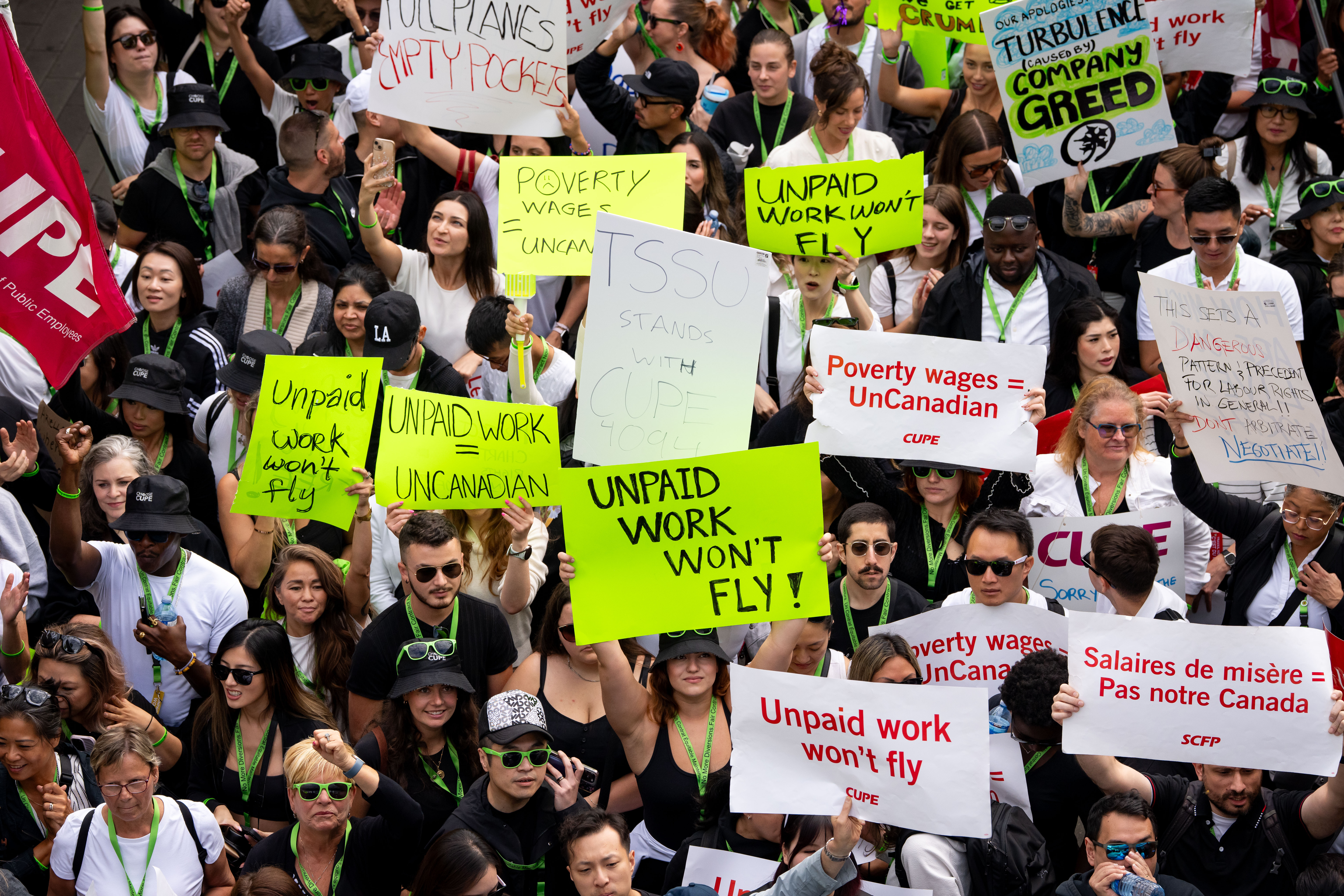
That exchange took place on August 18, shortly after it became clear that Air Canada workers were going to continue striking despite being ordered back to work by the Canadian Industrial Relations Board (CIRB), itself acting on orders from federal “Jobs and Families” Minister Patty Hadju. The workers had begun a legal strike on August 16—after a whopping 99.7 per cent of union members voted to strike—and Hadju didn’t even wait 24 hours before ordering the strike to end.
Mark Hancock, president of the Canadian Union of Public Employees (which represents cabin crew at Air Canada) stood in front of a crowd of striking workers in Toronto shortly after the CIRB issued its back-to-work order. He held the order up to the crowd, ripped it up, and threw it on the ground. The strike, he announced, was going to continue until the workers and the employer reached a deal at the bargaining table.
“If it means folks like me going to jail, then so be it,” Hancock said later to the press. “If it means our union being fined, then so be it.”
The very next day, after having negotiated for months with very little progress, the union’s negotiating committee announced it had a tentative deal.
Section 107
Rousseau’s comments on BNN Bloomberg were widely interpreted to mean that Air Canada had assumed the federal government would immediately break its workers’ strike using Section 107 of the Canada Labour Code. Indeed, it seems like the airline had built that assumption into its negotiating strategy, and was so confident in the outcome that it had failed to even consider how it would help its customers during the event of a strike. The fact that the company reached a deal almost immediately when workers defied the order certainly lends credence to that interpretation.
The assumption, on Air Canada’s part, seemed like a fairly safe one. Since June 2024, the federal government has used Section 107 eight times to end strikes and lockouts. It prevented a strike among WestJet mechanics, temporarily ended a strike/lockout of Canada Post workers, sent workers at the ports of Montreal and Vancouver back to work, and ended job actions at CN and CP rail. It has become the go-to tool in the federal government’s toolbox to put an end to worker action.
Section 107 is a relatively arcane piece of legislation—one that has been on the books since 1984, but was rarely used until the past decade and a half. It grants the federal labour minister (recently rebranded by the federal government as the “Jobs and Families” minister) the power to unilaterally end strikes or lockouts that are threats to “industrial peace.” The CIRB, once Section 107 is employed, sends both parties to binding arbitration, where a “neutral” arbitrator has the ability to impose a contract on the parties.
That term, “industrial peace,” is vague enough to allow the federal labour minister significant leeway to decide when to apply the law or not. In recent years, and particularly over the past year, labour ministers have shown unprecedented willingness to employ the rule.
The concept of “industrial peace,” though, despite being a broad and vague term, is a core concept for Canadian labour relations.
“Industrial peace”
The modern legal structure that governs labour unions in Canada was born in 1944, with Privy Council Order 1003 (PC 1003). Union recognition, under this Order, would no longer be the voluntary decision of employers—it would be required by law following a majority-support union certification election.
The government’s justification for passing PC 1003 was securing “industrial peace.” During the Second World War, the federal government first tried to secure that peace by outright banning strikes in all industries deemed essential for the war, imposing wide-ranging wage controls, and using the War Measures Act against “labour agitators.”
Despite these increased restrictions, union membership increased dramatically over this period—and so did labour militancy. In summer 1943, one in three Canadian union members were engaged in illegal strike action—in large part as “recognition strikes” attempts to force companies to recognize their unions as legitimate bargaining agents. PC 1003 made these strikes redundant by mandating employers to recognize unions after a vote.
PC 1003, then, was the direct result of masses of workers deciding to ignore and defy government strike bans in their industries.
This direction was further codified with the Rand Formula, a judicial decision by judge Ivan Rand following a militant strike at a Ford factory in Windsor, Ontario. This decision, which Rand premised on the notion that “capital must… be looked upon as occupying a dominant position” vis a vis labour, declared that “responsible” labour unions that follow Rand’s industrial peace guidelines would have access to new rights, such as automatic dues collection and “closed shops,” where the union represents all workers.
In exchange, this new labour regime banned all strikes outside of the context of contract negotiations and required unions to internally police members who acted outside of the new framework. Rand outlined strict measures to be applied to any unions that stepped out of line, ranging from massive financial penalties, decertification, and jail time for leaders. Elected union officials who oversaw illegal collective action were faced with significantly harsher penalties than members, deliberately creating an incentive for union officials to police the actions of members.
Following their implementation at the federal level, PC 1003 and the Rand Formula made their way to all of the provinces—often after militant strikes, such as the five-month strike by women workers at Fleck Manufacturing in Ontario. Together, these two elements created the foundation of the labour relations regime that continues to define Canadian industrial relations. The model—the postwar compromise— imposed significant constraints on the militancy of the labour movement, while also providing significant protections to labour unions. In exchange for maintaining “industrial peace,” labour unions could expect significant financial and institutional security in the long term.
Strikebreaking legislation
But Canadian politicians’ willingness to break strikes began rearing its head again. They soon found a new tool—so-called back-to-work legislation, or emergency laws passed by federal or provincial legislatures to end strikes and lockouts.
Federally, the first piece of back-to-work legislation was passed in 1950 against railroad workers, and the legislation would not be used again until 1958. But beginning in the mid-1960s, back-to-work legislation became a regular feature of Canadian industrial relations—being used an average of four to five times per year from that point on, counting both federal and provincial laws, with a short drop in frequency in the late 1990s.
The peak of this came during the 1982 recession and its aftermath, when 1.5 million Canadian workers were subject to “temporary” and “exceptional” strike restriction measures in the course of just over a year. In the United States, by comparison, the provisions of the Taft-Hartley Act that grant similar powers for emergency back-to-work injunctions have only been used twice since the mid-1970s.
Jean Cournoyer, a politician with Quebec’s conservative Union Nationale party and then the Liberal Party of Quebec, referred to back-to-work laws as the “miracle solution” to dealing with strikes in the 1960s—which he described, despite their then recent legalization, as a right the state “hoped that the unions would not use.”
That dynamic has shifted in the past decade, largely as a result of a 2015 Supreme Court ruling that determined the right to strike was constitutionally protected in Canada—overturning previous legal precedent which had found that striking, unionizing, and collective bargaining were not constitutional rights under the Charter of Rights and Freedoms, but were, rather, privileges governments could retract at will.
Such constitutional protections have complicated strikebreaking legislation. Some politicians chose to adapt to this reality by explicitly invoking the notwithstanding clause in strikebreaking legislation—such as when Ontario’s Progressive Conservative government passed strikebreaking legislation against education workers in 2022, explicitly suspending their constitutional rights in order to force them back to work.
Those workers, like Air Canada workers, chose to defy the law and continue striking—forcing the provincial government to withdraw it.
Defiance
The history of Canadian labour relations is one of politicians putting their thumbs on the scales in favour of bosses, and doing so under the banner of “industrial peace.” Strikebreaking legislation, during its height, was so ubiquitous that labour scholars referred to the “end of the era of free collective bargaining in Canada.” This has continued under various forms, whether through blanket strike bans, strikebreaking legislation, Section 107, or explicit suspensions of constitutional rights. Clear rulings from the Supreme Court of Canada outlining the right to strike have not been enough to prevent this behaviour—just to shift its form.
What has worked, however, has been ignoring and defying government strikebreaking. Workers went on strike during wartime strike bans, and secured major structural concessions for labour movements. Public sector workers in the 1960s ignored and defied bans on their right to unionize and won the right to strike through illegal wildcats, like the illegal 1965 strike which won bargaining rights for the Canadian Union of Postal Workers. Workers have defeated back-to-work legislation through illegal strikes, and have now defeated Section 107 for the first time.
Since the Air Canada strike, the Canadian Labour Congress has made clear that it intends to pressure federal policy-makers to strip Section 107’s strikebreaking provisions from the Canada Labour Code. If their campaign is successful, it will be the result of the bravery of Air Canada workers and union leadership who defied threats of massive fines and jail time.
The last time that Air Canada cabin crew threatened to strike was 2011. After the workers voted down two tentative agreements, then Labour Minister Lisa Raitt dusted off a rarely used provision in the Canada Labour Code to preemptively break a looming strike—Section 107. That event was the beginning of Section 107’s rise to its current status as the preferred tool for federal strikebreaking.
It seems poetic, then, that the workers who put the nail in Section 107’s coffin were at Air Canada.