
By the Numbers
The federal government generally does a better job at pay equity—ensuring equal pay between men and women, racialized groups, Indigenous peoples, and so on—than the broader labour market. However, the proposed staffing cuts amounting to 15 per cent of workers will hit those groups hard. The departments in line for staffing cuts are generally equity-leading departments, whereas the protected departments are generally equity laggards.
- 59 per cent of planned job cuts will fall on women, because three large male-majority departments are protected. 48 per cent of workers in the general labour market are women
- 5.5 per cent of the layoffs will affect Indigenous workers, outpacing both their current share in the public service (5.3 per cent) and the national labour force (4.3 per cent).
- 26 per cent of the workers cut will likely be racialized, as three large (and less diverse) departments will be protected.
-
8.3 per cent of job losses will fall on workers with disabilities—disproportionately concentrated in departments that have made the most hiring progress.
Equity-leading departments such as Employment and Social Development Canada, Indigenous Services Canada, and Citizenship and Immigration are among those facing the deepest reductions, while three major departments with weaker equity records—the Department of National Defence (DND), Canada Border Services Agency (CBSA), and Royal Canadian Mounted Police (RCMP)—are largely shielded from cuts.
Introduction
The federal government has been a source for high quality jobs for equity-seeking groups. It has been a leader in labour market reforms through the introduction of employment equity and proactive pay equity, attempting to pull the private sector and other levels of governments along, often kicking and screaming. The gender pay gap is narrower in the public sector than the private one, even taking factors like education, age, job tenure and occupation into account. And the wage penalty confronting mothers is smaller too.
However, the federal government’s plans to cut the public service threaten to throw this progress in reverse. Excluding the Department of National Defence (DND), the Royal Canadian Mounted Police (RCMP) and the Canada Border Services Agency (CBSA) from cuts will only make the situation worse.
The federal government tracks detailed administrative data on the representation of equity-seeking groups by federal department. By combining this information with staffing cuts projections, it is possible to determine how the coming cuts will likely impact historically disadvantaged groups in the core public service. In this policy note, we estimate how many women, Indigenous people, racialized people and people with disabilities will likely lose their jobs by department, and across the whole of the core federal public service, as a result of the planned 15 per cent cuts, taking into account the exclusion of three large male-majority departments.
We compare the estimated share of job cuts against each group’s share of total employees in the federal public sector and their representation in Canada’s national labour market (as measured by the Labour Market Availability (LMA) indicator used to track progress under the federal Employment Equity Act). The LMA ratios are an estimate of the workforce available to work in the federal public service, and thus exclude full-time students and those who don’t have recent work history.
Women
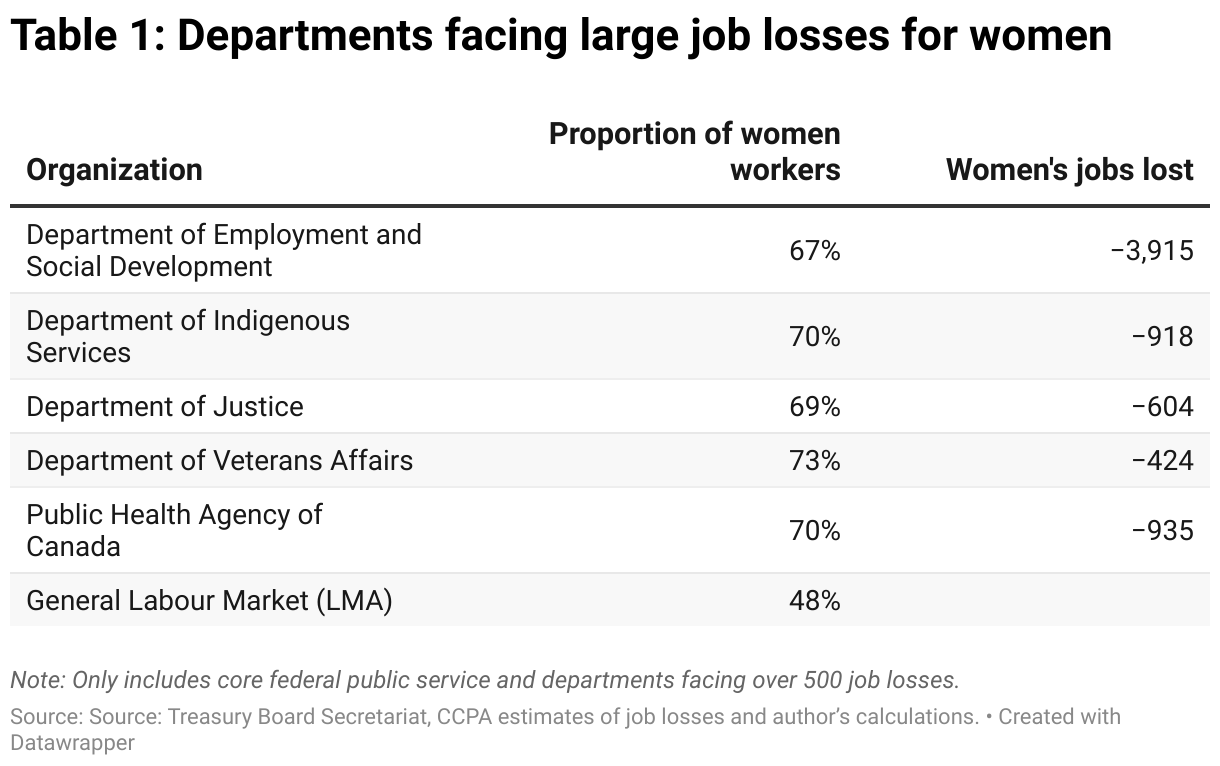
Women comprise less than half (48 per cent) of Canada’s workforce, but they will bear the brunt of the cuts. While 57 per cent of the federal public sector workers are women (including the protected departments), we estimate that 59 per cent of the cuts will fall on women because three large male-majority departments are being sheltered from program review.
Job loss among women will, predictably, be most severe in departments with the largest staff complements of women such as Employment and Social Development Canada, Public Health Agency of Canada and Indigenous Services Canada (Table 1). It will be less severe among those with comparatively smaller shares of female workers.
This includes the DND, CBSA and RCMP. The civilian side of DND is only 43 per cent women, significantly less than their share of both the Canadian labour force and the federal public sector average (57 per cent). The CBSA’s workforce is 47 per cent women, again well below the average proportion of federal departments.
The RCMP has three distinct employment categories: RCMP regular members (i.e sworn officers), RCMP civilian members and RCMP public service workers. RCMP public service workers are 71 per cent women, among the highest proportion of women of the departments with data. The bulk of the RCMP’s workforce is sworn officers (“regular members”) where only 19.6 per cent are women.
Indigenous workers
The federal government remains an important employer for Indigenous people. While 4.3 per cent of the Canadian workers are Indigenous, 5.3 per cent of the federal public service workers are. Some departments won’t see cuts, but the big employers of Indigenous workers will. We estimate that 5.5 per cent of the workers losing their jobs will likely be Indigenous.
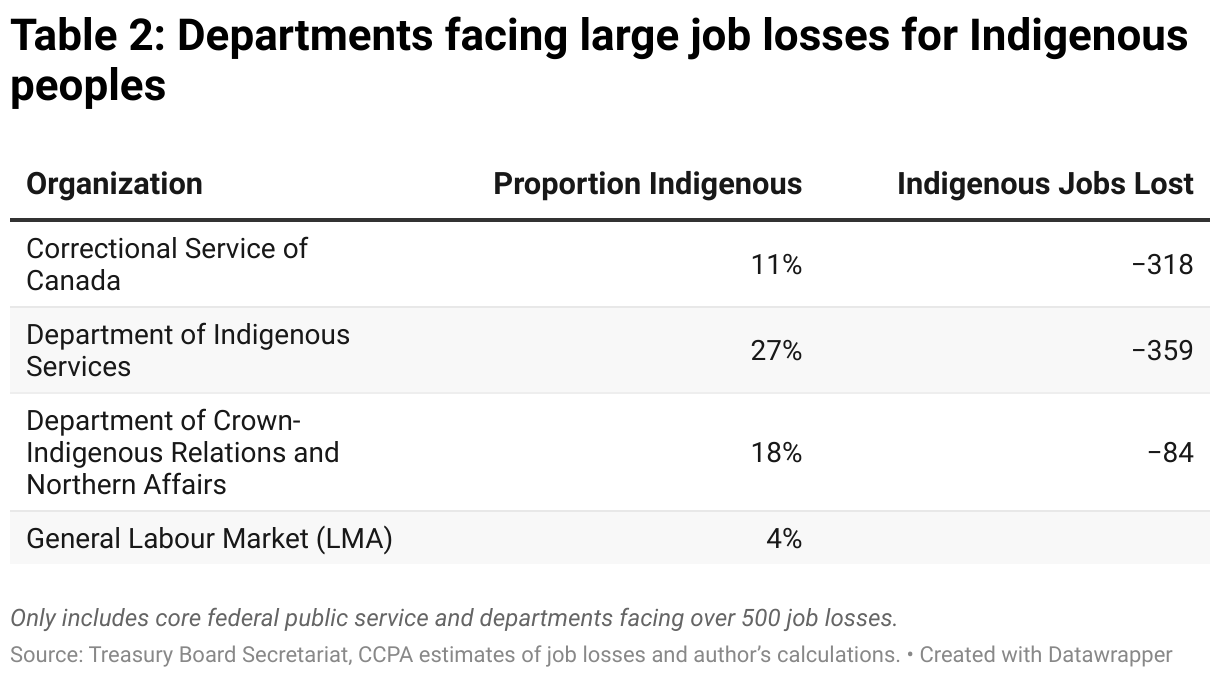
The top federal employers of Indigenous workers are listed in Table 2. One in 10 workers at the Correctional Service of Canada, for example, identify as Indigenous, nearly triple the rate of employment in the broader labour market.
Indigenous workers are also heavily involved in Indigenous Services Canada and the Department of Crown-Indigenous Relations and Northern Affairs, representing 27 per cent and 18 per cent of the workers in each department, respectively.
All three of these departments are facing large cuts as are other departments that employ Indigenous people at higher rates than in the general labour market.
Racialized populations
Strong labour standards and employment equity legislation have helped to boost the numbers of racialized workers in the federal public services, progress that is now at risk.
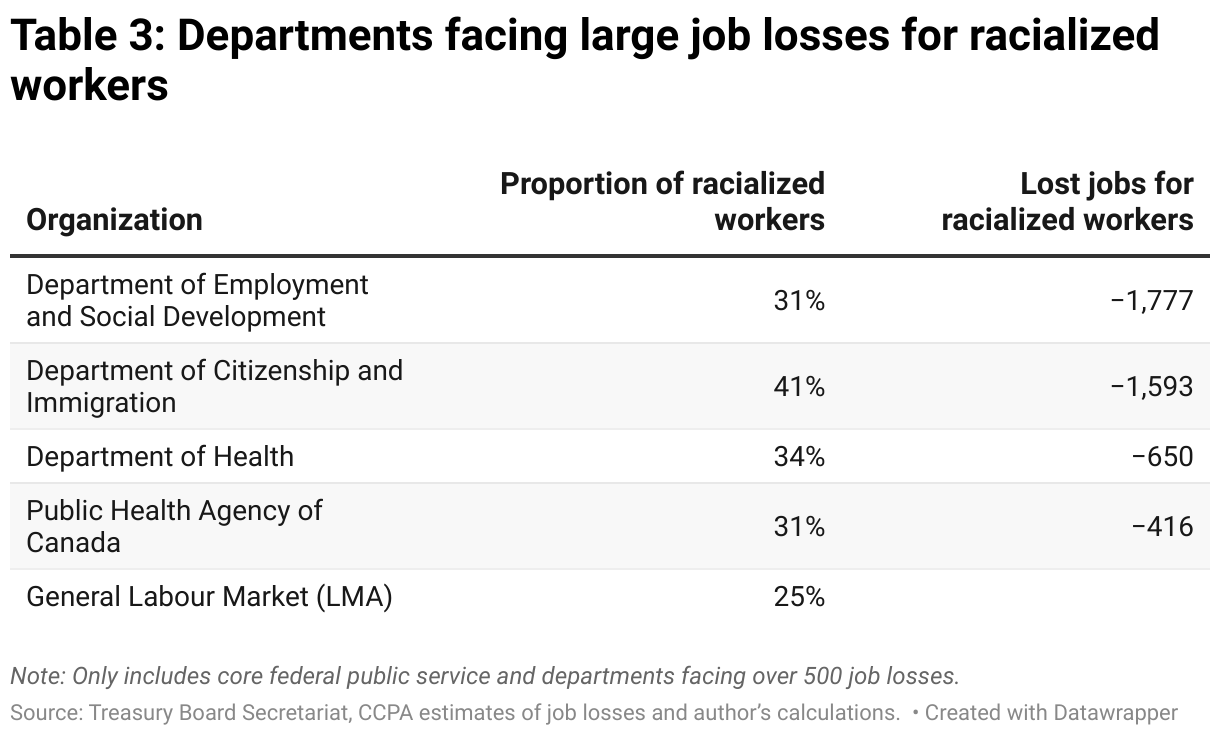
In Canada, 25 per cent of workers are racialized as reported by the Treasury Board Secretariat. Racialized workers, however, only represent 23 per cent of the federal public sector. And the federal government is poised to take another step back. We estimate that racialized workers will account for 26 per cent of the coming job cuts.
Table 3 identifies the departments that will absorb the largest losses. The Department of Employment and Social Development (ESDC) and Citizenship and Immigration Canada (CIC) will be particularly hard hit. ESDC can be expected to eliminate almost 1,800 positions currently occupied by racialized people and CIC could lose almost 1,600.
Of the departments protected from cuts, only 12 per cent of the DND workforce and 18 per cent of those in the RCMP identify as racialized, below the public sector wide average (25 per cent). The CBSA has near average representation for racialized workers.
Workers with disabilities
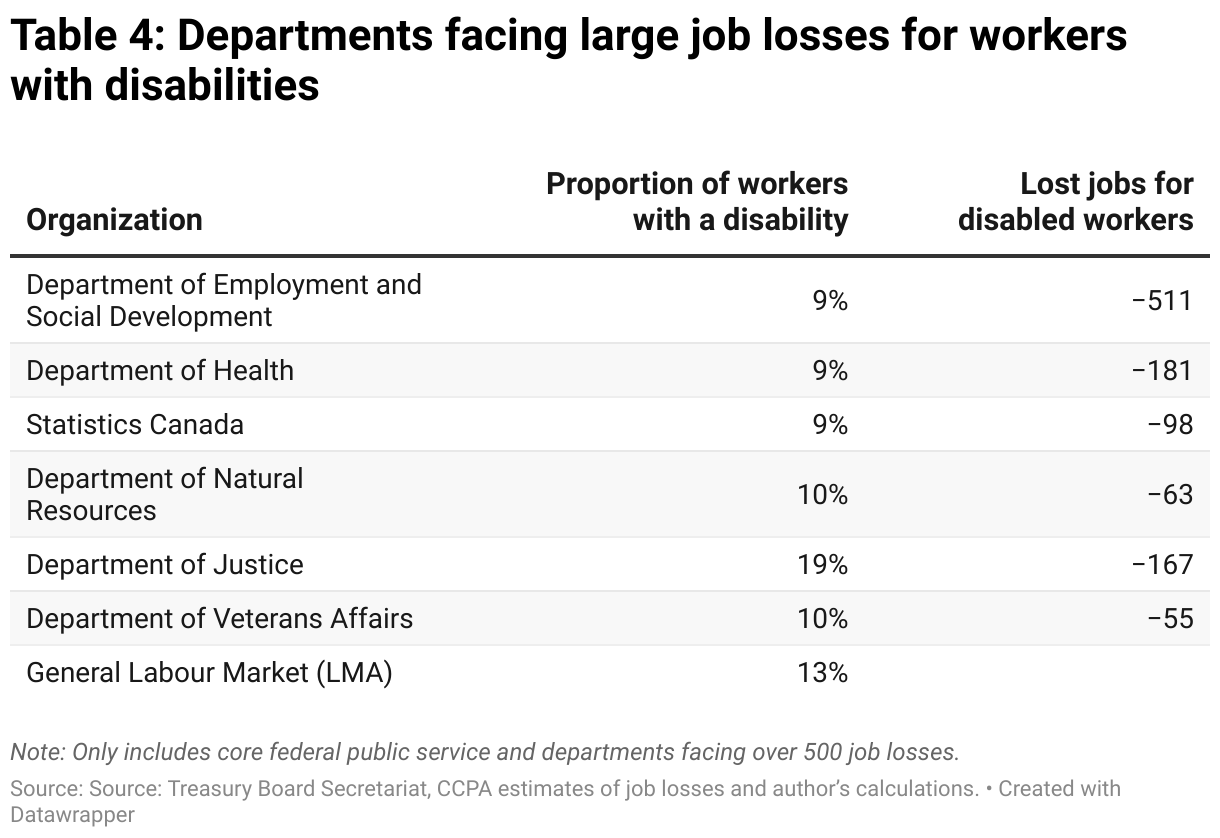
According to the Treasury Board Secretariat, 13 per cent of workers in Canada have a disability, (although Statistics Canada reports a much higher rate: 21 per cent). The federal public sector has yet to meet even the lower benchmark—currently only 7.8 per cent of its workers report having a disability. Because the protected departments have a poorer record than the departments facing big cuts, we estimate that 8.3 per cent of the workers to be let go will have a disability.
The departments that have made the most progress hiring people with disabilities will bear the brunt of the cuts—in this instance, the Department of Justice, Department of Veteran Affairs and Department of Natural Resources. The share of workers with disabilities in these departments range from 10 per cent to almost 20 per cent. At ESDC, over 500 workers with disabilities could lose their positions.
DND, RCMP and CBSA are below the federal departmental average for workers with disabilities. In the RCMP, 4.9 per cent of public sector workers have a disability. DND fares only slightly better while CBSA’s rate is similar to the public sector average.
Conclusion
The federal government is an important source of high quality, good paying jobs for those who traditionally have had a tough time breaking into the labour market.The imposition of 15 per cent cuts to staffing will hit public sector employees hard, especially those from historically disadvantaged groups. The choice of protecting some departments—which happen to be those which have relatively poor employment equity records—while cutting departments that have done relatively better, will compound the situation further.
There are still big gaps in the federal government’s approach to employment equity and hiring practices, particularly for Canadians with disabilities. Depending on how the cuts play out, we can expect wider employment gaps, wider pay gaps and the erosion of access to critical employment benefits. The Liberal government has promised to update Canada’s outdated Employment Equity Act. These cuts represent a big step back.
In the hunt for defence dollars and tax cut offsets, we’re sacrificing good public sector jobs across the country. Rather than reducing strong public services and the quality employment that comes with them, we need to invest in them to support all Canadians.