
Introduction
This year marks the end of the first five years of the federal government’s Canada-Wide Early Learning and Child Care program. By transferring funds to the provinces and territories, and pursuant to negotiated bilateral child care action plans, the federal government has turned a primarily privately funded system of early learning and child care into one that is primarily publicly funded.
Parent fees for licensed programs that are part of the program are regulated in every jurisdiction. Six provinces and territories (Newfoundland and Labrador, Prince Edward Island, Quebec, Nunavut, Manitoba and Saskatchewan) have put in place measures to limit daily fees to $10 or less for publicly funded licensed programs.1While the Government of Northwest Territories and the Government of Yukon Territory introduced mechanisms to bring down parent fees to an average of $10 a day after joining the Canada-Wide Early Learning and Child Care program in 2021, these governments allowed operators to increase the fees they charge and, as a result, parents on average pay more than $10 a day. This changed approach to financing early learning and child care has been a longstanding objective of Canada’s child care movement. It sets the stage for the development of a high-quality, inclusive, and universally accessible child care system that is also designed to respect and advance the rights of Indigenous children, families, and communities.
However, realizing this objective depends on all levels of government choosing to do the following: fund child care sufficiently and appropriately; accelerate the expansion of not-for-profit and public child care services through proper public planning and all-of-government effort and coordination; and develop and implement comprehensive strategies to expand a qualified early learning and child care workforce.
Overview
Federal commitments, 2021-25
Canada’s 2021 federal budget set the goal of ensuring “that all families have access to high-quality, affordable and flexible early learning and child care no matter where they live” through the development of a Canada-Wide Early Learning and Child Care program, now commonly known as the $10-a-day program. The federal child care commitment included implementation of Canada’s distinctions-based Indigenous Early Learning and Child Care Framework, co-developed by the Government of Canada and Indigenous partners in 2018, to ensure “progress towards an early learning and child care system that meets the needs of Indigenous families, wherever they live.”
Budget 2021 said the building of the system would begin through:
- Up to $27.2 billion in transfers to provincial and territorial governments to bring down parent fees to an average of $10 a day by March 31, 2026, for all regulated child care spaces; to finance ongoing annual growth of not-for-profit child care programs; and to properly value the work of early childhood educators and provide them with training and development opportunities.
- A federal investment in Indigenous early learning and child care of just under $2.6 billion over five years through financial agreements with Indigenous governments and governing bodies.
- A commitment to a minimum annual federal transfer for early learning and child care of $9.2 billion beyond 2025-26.
The following year, Budget 2022 added $625 million (over four years starting in 2023-24) to its transfer to the provinces and territories to support the financing of early learning and child care infrastructure, including the building of new facilities. Two years later, Budget 2024 promised an application-based Child Care Expansion Loan Program, administered by the Canada Mortgage and Housing Corporation, to provide low-cost loans and some non-repayable contributions to not-for-profit and public child care providers wanting to create more child care spaces or renovate existing child care centres. This loan program has yet to be launched.
Problems of quality, quantity, and inequitable access must be addressed
While historic, these federal investments are insufficient to meet the real and rising cost of providing high-quality early learning and child care for all children.
More public funding and government-directed human resource policies are needed to raise the wages of those who work in the Canada-Wide Early Learning and Child Care system, and to extend to them public-sector benefits and pensions. Seven provinces and territories2The Manitoba government has developed wage guidelines for licensed and government-funded early learning and child care facilities. The guidelines recommend a “target” hourly wage for each position/classification. The government provides licensed programs funding through a “wage grid supplement” that must be used to help pay staff the “target” hourly wage. have put in place a wage grid that sets out pay rates for employees in the child care sector but, with the exception of Prince Edward Island,3Kathleen Flanagan and Associates, Final Report: Early Learning and Child Care Recruitment and Retention: PEI’s 2024 Director and Staff Surveys, Early Childhood Development Association of PEI, January 2025, https://mcusercontent.com/aff981eb17e452f90e6094988/files/50178ef2-2c85-9175-8afd-59f7f42ff215/2024_ELCC_Director_and_Staff_Survey_Final_Report.pdf compensation levels are not yet sufficient to incentivize the development and retention of a more qualified workforce.
More capital funding, better government planning, and active leadership is needed to support the creation of not-for-profit and public child care. Especially now that child care is primarily publicly funded, governments have a duty to put in place child care infrastructure and programs in a way that gives children and families equitable access. Location, size, types of new programs, quality of design and construction, and staffing should be driven by public interests—not private ones. Nor should these decisions be dictated by the capacity of service providers to develop and operate new services.
Urgent action is required by the federal government to stop the growth of for-profit child care that is funded by public money. Since 2022, and the start of the Canada-Wide Early Learning and Child Care program, 57 per cent of the net new licensed child care spaces funded by the federal government are operated by for-profit business owners. The net new not-for-profit spaces represent only 30 per cent of the publicly funded growth.4David Macdonald, Cash cow: Assessing child care space creation progress, Canadian Centre for Policy Alternatives, August 2025. https://www.policyalternatives.ca/news-research/cash-cow-assessing-child-care-space-creation-progress/.
The scope of the federal government’s child care investments must be widened. Until now, federal funding has been directed exclusively to child care for children under the age of six despite the promise in Budget 2021 to expand school-age programs. Data for 2019 (the baseline year for the $10-a-day program) up to and including 2024 show that while there has been a considerable increase in before- and after-school spaces for children aged four to 12, most parents using this care continue to pay high fees and there continues to be a shortage of spaces.5Friendly, Martha et al., “Interim Space Statistics 2024: Early Childhood Education and Care in Canada,” Childcare Resource and Research Unit, July, 2025.
Further return on federal child care investments depends on further action
In his 2024 analysis of the broad economic benefits of the first years of the Canada-wide Early Learning and Child Care program, economist Jim Stanford found that since 2019, employment in the child care sector grew by 40,000 positions—making it the sixth largest source of new work in Canada. Also, the program supported a significant rise in women’s labour force participation, amounting to 110,000 additional workers. Stanford also calculated that the expansion of licensed child care services through the program added $32 billion in additional GDP.6Jim Stanford, Powering Growth: Economic Benefits from Canada’s $10-per-day Early Learning and Child Care Program, Centre For Future Work, November 2024, https://centreforfuturework.ca/wp-content/uploads/2024/11/Child-Care-Economic-Benefits-Nov2024-FINAL.pdf.
Furthering these economic benefits requires that the Canada-wide Early Learning and Child Care program continues to grow to include all children, and extend to all communities. The return on public investment will also be greater in the short and longer term if public funding is primarily directed towards not-for-profit and public child care programs that spend every dollar of revenue received on the provision of services, pay staff better, are mandated to serve all children and families, and are not permitted to close for the purpose of profiting from their publicly funded assets.
Actions
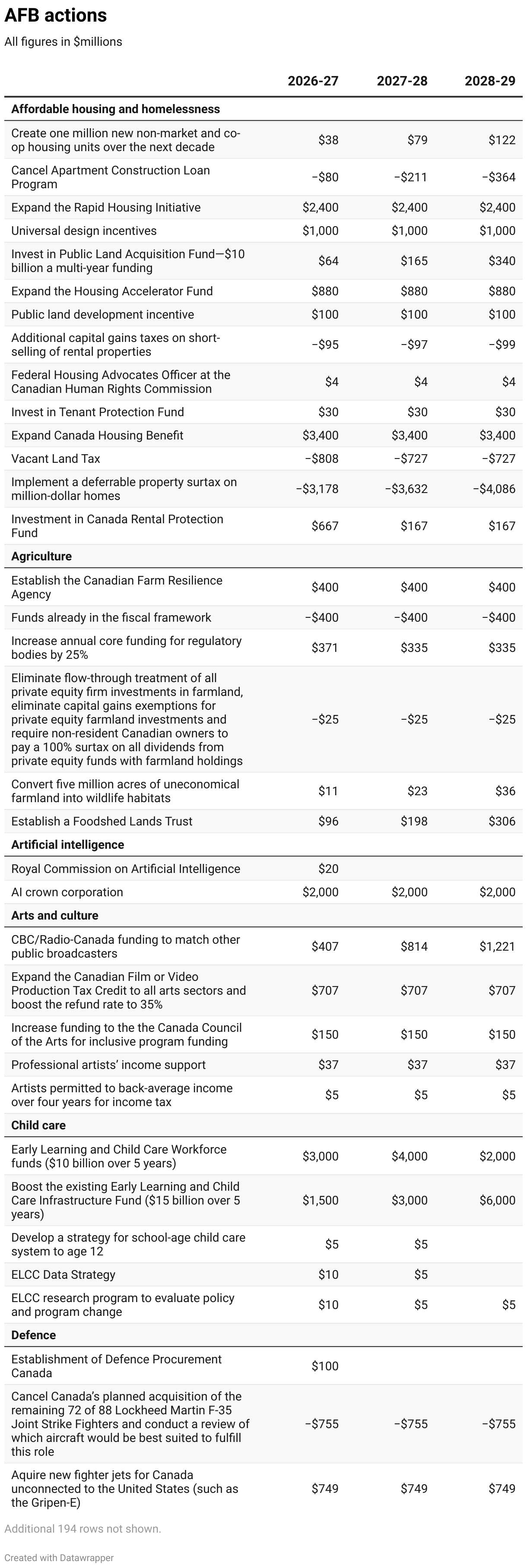
The AFB will take the following actions to increase equitable access to $10-a-day child care and improve the quality of the Canada-Wide Early Learning and Child Care program over the next five years. Additionally, the AFB will ensure adequate financial support for the implementation of the Indigenous Early Learning and Child Care framework agreement co-developed by Indigenous partners and the Government of Canada.
The AFB will support over the next five years the creation of sufficient net new full-time spaces operated by not-for-profit community child care providers, public sector entities, or Indigenous governments and organizations, with the goal of ensuring that there is sufficient licensed child care by March 31, 2031, in each province and territory for at least 65 per cent of children under the age of six.
The AFB will require that each provincial and territorial government develop a five-year government-led expansion plan with annual growth targets and specific strategies for increasing the supply of not-for-profit, public, and Indigenous child care and reaching the 65 per cent coverage target.
The AFB will require that each provincial and territorial government expand the size of the child care workforce, raise recruitment and retention rates, and increase the proportion of staff who have early childhood education post-secondary diplomas and degrees. Federal funds will be earmarked to do the following:
- Pay those who work in licensed child care in accordance with regularly improved wage scales that compensate child care employees for all hours worked, including program preparation time, commensurate with their responsibilities, qualifications, and work experience.
- Extend to the child care sector benefit and pension plans equivalent to those in place in publicly funded sectors such as public education, health care, and municipal services.
The AFB will amend the Child Care Expansion Loan Program (announced in 2024 but not yet implemented) with a comprehensive Child Care Infrastructure Program (CCIP) that will provide grants to support the efficient and effective expansion of not-for-profit, public, and Indigenous child care under the Canada-Wide Early Learning and Child Care program.
The AFB will co-locate licensed child care in federally supported housing projects.
The AFB will convene and support the development of a comprehensive strategy, by March 31, 2027, to build a public school-age child care system for children until age 12. This policy initiative will include extensive consultations with community-based early learning and child care providers, public school authorities, and municipalities.
The AFB will develop, fund, and operationalize a comprehensive Canada-wide early learning and child care data and research strategy to monitor and report publicly on progress, track and account for public spending, and support policy development.
The AFB will fund an early learning and child care research program to answer key research questions, and evaluate the effects of policy and program change.
The AFB will require every provincial and territorial government that is part of the Canada-Wide Early Learning and Child Care program to issue a comprehensive public report each year on the implementation of its expansion plan and workforce strategy.
The AFB will require the federal government to produce an annual public report on the overall progress of all elements of the Canada-Wide Early Learning and Child Care program.