
Ten years ago, 195 countries signed the Paris Agreement, which committed the world to limiting global warming to no more than 2 degrees Celsius above pre-industrial levels. Negotiations took place shortly after the Trudeau Liberals first came to power, and Canada’s then-environment minister Catherine McKenna was instrumental in pushing for an additional “aspirational” target of limiting global warming to 1.5 degrees.
In 2024, the world hit 1.5 degrees of warming for the first time, putting the Agreement’s targets in grave jeopardy.1Copernicus Climate Change Service, “2024 is the First Year to Exceed 1.5°C Above Pre-Industrial Levels,” Copernicus, January 10, 2025, https://climate.copernicus.eu/copernicus-2024-first-year-exceed-15degc-above-pre-industrial-level. It is a global shared failure—but Canada is especially culpable for allowing significant growth in oil and gas production over the past decade. In spite of progress in other areas—such as the phase-out of coal-fired electricity generation—Canada’s overall emissions have fallen only six per cent since 2015, and we remain the most polluting country per capita outside Saudi Arabia.2Environment and Climate Change Canada, Canadian Environmental Sustainability Indicators: Global Greenhouse Gas Emissions, consulted June, 2025, https://www.canada.ca/en/environment-climate-change/services/environmental-indicators/global-greenhouse-gas-emissions.html.
Another devastating summer of wildfires is a stark reminder of the stakes of inaction. We cannot afford to sit idly by as the human, environmental and economic costs of climate change continue to rise. Getting fossil fuels out of the economy is essential for meeting our climate targets and setting Canada up for success in a decarbonizing global economy. It is a monumental task that the AFB does not shy away from.
Overview
Over the past decade, the federal government has released a series of climate plans. The latest iteration is the 2030 Emissions Reduction Plan, published in 2022. Most of the plan has now been brought into force, including the long-awaited Clean Electricity Regulations, finalized in December 2024, which will limit the role of fossil fuels on Canada’s power grid.
The most important outstanding promise is an oil and gas sector emissions cap. Fossil fuel production is the largest and fastest growing source of emissions in Canada, accounting for 30 per cent of total greenhouse gas emissions in 2023. The oil and gas cap would be a powerful tool for driving down emissions in the sector, but it has been mired in opposition from industry and some provincial governments even as the federal government has repeatedly watered down the proposed regulations.
Unfortunately, even if the cap were implemented, Canada’s climate policies—those already in place and those it has promised—are wildly insufficient for meeting the urgency of the climate crisis. The latest government projections suggest Canada will blow past our domestic climate targets by a wide margin, not to mention our fair share of the global climate effort (see Figure 1). To make matters worse, the federal government recently eliminated consumer carbon pricing, which means we are on track for even higher emissions.
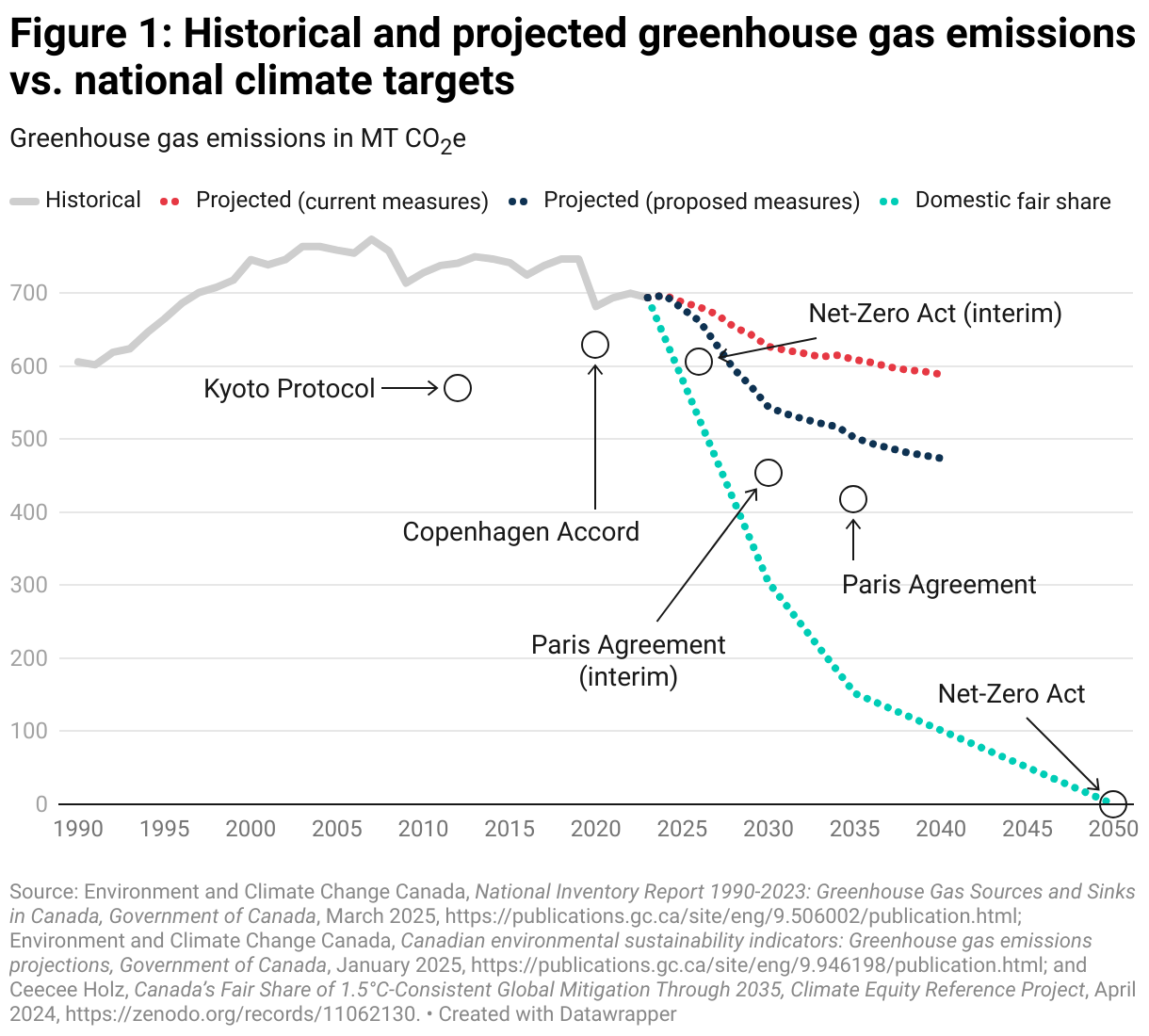
The Net-Zero Act requires the federal government to develop and report on climate plans, but whether the new Liberal government has any intention of closing the emissions gap remains to be seen. The party did not make climate action a priority during the election campaign or in the prime minister’s mandate letter. Commitments to support energy efficiency and clean transportation remain vague, as does a promise to “improve” the existing industrial carbon pricing system. The government has even entertained new oil pipelines and liquified natural gas (LNG) projects, and made clear its continued support for subsidies to the fossil fuel industry for carbon capture, utilization and storage (CCUS).
LNG and CCUS are both false climate solutions. They are technologies superficially intended to reduce greenhouse gas emissions, but which, in practice, exist to support continued production and consumption of fossil fuels. The lifetime emissions of LNG can be higher than from coal,3Robert W. Howarth, The Greenhouse Gas Footprint of Liquefied Natural Gas (LNG) Exported from the United States, Energy Science & Engineering 12, no. 11 (November 2024): https://scijournals.onlinelibrary.wiley.com/doi/10.1002/ese3.1934. and CCUS is prohibitively expensive and despite decades of publicly-subsidized development has still not been proven at scale.4Katrin Sievert, Laura Cameron and Angela Carter, Why the Cost of Carbon Capture and Storage Remains Persistently High, International Institute for Sustainable Development, September 2023, https://www.iisd.org/articles/deep-dive/why-carbon-capture-storage-cost-remains-high. Yet by promising to invest in these false solutions, the fossil fuel industry has avoided any serious government efforts to curtail its emissions.
Rather than identify fossil fuel production as the fundamental problem that it is, the federal government has instead tried to compromise with the industry and placate its political backers. For example, the grand bargain the Trudeau government struck by purchasing and building the Trans Mountain Expansion (TMX) pipeline was framed as a necessary concession to win political support for climate action in oil-captured Alberta. TMX is now pumping millions of barrels of oil to the Pacific coast, and opposition to federal climate action in Alberta is as strong as ever.
The federal government provided more than $50 billion in public subsidies to TMX alone.5Julia Levin, “Federal Government Approves New, Massive $20 Billion Loan for Trans Mountain Pipeline,” Environmental Defence, January 31, 2025, https://environmentaldefence.ca/2025/01/31/federal-government-approves-new-massive-20-billion-loan-for-trans-mountain-pipeline/ In contrast, federal investment in the clean economy is falling well short. While the government is expected to spend about $20 billion on climate initiatives this year, that only accounts for about 0.5 per cent of GDP.6Hadrian Mertins-Kirkwood, Spending What It Takes: 2024 Update, Canadian Centre for Policy Alternatives, March 13, 2024, https://www.policyalternatives.ca/news-research/spending-what-it-takes-2024-update/. To successfully decarbonize the economy, total public and private spending on the order of $100 billion per year, or about 2 per cent of GDP, is likely necessary.7Finance Canada, Budget 2022: A Plan to Grow our Economy and Make it More Affordable, Government of Canada, April 7, 2022, p. 60. Ironically, the federal government’s recent commitment to spending 2 per cent of GDP on defence illustrates just how attainable a target it is with political will (see Defence chapter).
Decarbonizing the Canadian economy by regulating fossil fuels and spending enough on climate action is not merely an environmental or moral imperative. In 2024, extreme weather caused a record-breaking $8.5 billion in insurable losses in Canada.8Insurance Bureau of Canada, 2024 Shatters Record for Costliest Year for Severe Weather-Related Losses in Canadian History at $8.5 Billion, January 13, 2025, https://www.ibc.ca/news-insights/news/2024-shatters-record-for-costliest-year-for-severe-weather-related-losses-in-canadian-history-at-8-5-billion. Indirect costs to human health, productivity and so on likely totalled closer to $20 billion.9Canadian Climate Institute, Damage Control: Reducing the Costs of Climate Impacts in Canada, September 2022, https://climateinstitute.ca/reports/damage-control/. After yet another devastating wildfire season, 2025 is shaping up to be no different. Yet these costs are just the tip of the iceberg. Canada’s economy will be cut by a third or even in half by the end of the century if climate change continues to go unchecked—economic damages on a scale that vastly exceeds the cost of achieving net-zero emissions.10Adrien Bilal and Diego R. Känzig, The Macroeconomic Impact of Climate Change: Global vs. Local Temperature, National Bureau of Economic Research Working Paper No. 32450 (May 2024; revised November 2024), https://doi.org/10.3386/w32450M. Kotz, A. Levermann, and L. Wenz, The Economic Commitment of Climate Change, Nature 628 (2024), ; University of Cambridge, Too Hot to Think Straight, Too Cold to Panic, March 10, 2025, https://www.cam.ac.uk/research/news/too-hot-to-think-straight-too-cold-to-panic.
Actions
The AFB will ensure the timely passage of two major outstanding federal climate commitments: the Oil and Gas Sector Greenhouse Gas Emissions Cap and the Climate-Aligned Finance Act. The federal government has put forward versions of both policies, but neither has been fully implemented. Capping emissions from Canada’s most polluting industry is essential for our climate commitments, as are requirements that financial institutions develop, adhere to and report on credible climate plans.11Alan Andrews, Andhra Azevedo, Tanya Jemec, Julie Segal and Adam Scott, Roadmap to a Sustainable Financial System in Canada, Environmental Defence, Ecojustice & Shift: Action, November 2022, https://environmentaldefence.ca/report/roadmap-to-a-sustainable-financial-system-in-canada.
The AFB will impose climate and biodiversity conditions, also known as “green strings,” on all federal spending, including infrastructure investment and public procurement. Not all spending needs to focus on decarbonization, but no spending should exacerbate these crises.
The AFB will create an Environmental Justice Secretariat to implement the national strategy required by the National Strategy Respecting Environmental Racism and Environmental Justice Act. The AFB will apply an equity lens to all environmental policies and programs, requiring disaggregated data, outcome tracking and community representation in decision-making to ensure climate benefits and burdens are distributed fairly.
The AFB will strengthen the national carbon pricing system by reinstating the consumer carbon pricing backstop on its previous schedule and closing loopholes in the industrial output-based pricing system (OBPS). At present, major industrial emitters, such as oil and gas producers, pay only a fraction of the headline carbon price, which amounts to a significant fossil fuel subsidy. The OBPS was always intended to be a transitory system that would gradually be wound down as the full price of carbon was phased in for industry. The AFB will accelerate that transition by subjecting all industrial emitters to the full national carbon price within three years. As it is revenue neutral for the federal government, there will be no federal revenue impact. To offset competitiveness concerns, the AFB will introduce a carbon border adjustment mechanism—as promised in the Liberal platform—that applies a tariff on goods that were produced without paying a comparable carbon price in their jurisdiction of origin.
The AFB will impose a moratorium on all new fossil fuel infrastructure, including oil sands expansions, offshore oil wells, liquified natural gas facilities, oil and gas pipelines and gas power plants. Canadian industry is already on pace to be stuck with more than $70 billion in stranded assets due to global decarbonization efforts.12Heads in the Sands; see also UK Sustainable Investment and Finance Association (UKSIF), Stranding: Modelling the UK’s Exposure to At-Risk Fossil Fuel Assets, March 6, 2025, https://uksif.org/stranding-modelling-the-uks-exposure-to-at-risk-fossil-fuel-assets/. Investing even more capital into the dying fossil fuel industry is an expensive and avoidable mistake, especially when it starves greener industries of the capital they need.
The AFB will create a new national Oil and Gas Cleanup Fund to supplement Alberta’s inadequate and underfunded Mine Financial Security Program (MFSP). The estimated cost of cleaning up old oil infrastructure in Canada is over $120 billion, with most of those costs being connected to the oil sands in Alberta.13Environmental Defence, “Past Due: Tallying the Costs of Oil and Gas Cleanup in Canada,” Environmental Defence, July 2023, https://environmentaldefence.ca/report/past-due-tallying-the-costs-of-oil-and-gas-cleanup-in-canada/. Yet only $1.7 billion has been set aside in the MFSP for cleanup.14Alberta Energy Regulator, “Mine Financial Security Program—Security and Liability,” 2024, https://www.aer.ca/regulating-development/project-closure/liability-management-programs-and-processes/mine-financial-security-program. The main weakness of the MFSP is that producers are only required to pay into it as their projects are approaching the end of their productive life. Companies often declare bankruptcy or otherwise disappear at this stage, leaving the public on the hook for cleanup costs.15Regan Boychuk, Mark Anielski, John Snow Jr. and Brad Stelfox, The Big Cleanup: How enforcing the Polluter Pay principle can unlock Alberta’s next great jobs boom, Alberta Liabilities Disclosure Project, June 2021. The new federal program will be fully funded by industry through an aggressive securities payment schedule. Industry can no longer be permitted to shirk responsibility for environmental damages.
The AFB will commit $66 billion over eight years to strengthen and accelerate the implementation of the National Adaptation Strategy (NAS) and related resilience programs. The current strategy is neither systematic nor comprehensive, and preparing for and adapting to the impacts of climate change is more important than ever.16Office of the Auditor General of Canada, Report 1—National Adaptation Strategy, 2025, Reports 1 to 4 of the Commissioner of the Environment and Sustainable Development to the Parliament of Canada, 2025, https://www.oag-bvg.gc.ca/internet/English/parl_cesd_202506_01_e_44647.html. A refocused and refunded NAS can help Canada avoid significantly greater future costs—every dollar spent now protects the economy from $13 to $15 in damages down the road.17Dave Sawyer, Ryan Ness, Caroline Lee and Sarah Miller, “Damage Control: Reducing the Costs of Climate Impacts in Canada,” Canadian Climate Institute, September 2022, https://climateinstitute.ca/reports/damage-control. As part of this funding, the AFB will develop a National Response and Recovery Strategy to help communities impacted by climate impacts. Lytton, Jasper, Fort McMurray, Slave Lake and other communities devastated by wildfires in recent years received only piecemeal responses from governments. Recognizing that climate-related disasters are now systemic, rather than isolated incidents, means the federal government needs dedicated disaster response capacity.
The AFB will commit $10 billion over five years for nature conservation and biodiversity restoration, including for Indigenous-led conservation and stewardship programs. The Liberal election platform promised $1.5 billion over four years for nature-related promises, which is a promising start, but more money will be needed to achieve our goals of protecting 30 per cent of Canada’s land and water by 2030 and implementing the Global Biodiversity Framework.
The AFB will commit $12.5 billion over five years to improve the energy efficiency—and thus the affordability—of homes and residential buildings. Of that, $7 billion will be for no-cost upgrades for low-income households, including in rental buildings, and $3.8 billion for deep retrofits in Indigenous communities. The remainder will fund skills training, research and demonstration projects.
The AFB will commit $20 billion over five years for Canada’s fair share of international climate finance. Providing funding to developing countries to mitigate and adapt to climate change is a moral duty, and reduces global greenhouse gas emissions—and, thus, climate impacts in Canada—often at a lower cost than equivalent domestic emissions reductions.
The AFB will commit $1 billion per year toward the rapid development of a Youth Climate Corps (YCC), which would train and employ young people to solve climate challenges in Canada. Budget 2024 included an unfunded promise to work toward a YCC, and the Liberal election platform included $56 million for a pilot, but far more funding is necessary to meet the need and demand for good climate jobs.18Climate Emergency Unit, “Youth Climate Corps Polling Results, 2023,” Climate Emergency Unit, accessed June 2025, https://www.climateemergencyunit.ca/youth-climate-corps-polling. Many of the spending priorities described in this chapter, such as a home retrofitting program and disaster response strategy, will require significant numbers of additional workers. The YCC is also an opportunity to bring underrepresented groups, such as women, racialized workers and immigrants, into the clean economy.
Reducing greenhouse gas emissions is an all-of-government priority with implications in a wide variety of policy areas. Additional climate-related priorities can be found in other AFB chapters.
The AFB will increase funding for a clean electricity grid, electric vehicle charging network, public transit operations, active transit infrastructure, electric buses and high-speed rail (see Infrastructure chapter).
The AFB will develop an industrial strategy consistent with climate policy priorities, and will create a Just Transition Benefit to support workers negatively impacted by climate action (see Industrial strategy and Environment and Climate Change chapters).
The AFB will eliminate all subsidies to the fossil fuel industry (see Taxation chapter).
The AFB will direct Canadian diplomats to negotiate an exception for climate action from international trade and investment rules (see International Trade chapter).