



Share
By the numbers
In this analysis, we examine 84 federal departments and agencies that might rely on sunsetting funding on programs that are due to be renewed within the next three years. Among the findings:
- Of the 88 departments and agencies with data, 52 will likely use non-renewal of programs, at least in part, to reach their 15 per cent cuts mandate.
- Of those, 32 could reduce their expenditures by 15 per cent or more by sunsetting program funding alone.
- The top five departments most likely to cut costs by sunsetting funding for programs: The Department for Women and Gender Equality, Public Safety and Emergency Preparedness, Crown-Indigenous Relations and Northern Affairs, Environment and Climate Change Canada, and Transport Canada.
- The Department for Women and Gender Equality could cut up to 81 per cent of current expenditures by allowing programs to expire within the next three years. That would turn back the clock on women’s gains in a dramatic way.
- Cuts to emergency preparedness could result in communities experiencing slower responses to disasters in the coming years.
- Cuts to First Nations programs would slow down Canada’s progress settling land claims with Indigenous Peoples.
- The hundreds of services and programs to be sunsetted could impact real people and real communities: From health care to school lunch programs to mitigating and adapting to climate change, these vital programs could quietly disappear.
It doesn’t have to be this way. The CCPA’s Alternative Federal Budget, released today, shows how the federal government could not only preserve, but improve, vital public services and supports—and how to pay for them. Instead, Canadians should brace themselves for one of the most draconian federal budgets in history; much of it done through stealth by sunsetting programs.
Introduction
In the lead up to the November 4 federal budget—a budget expected to be one for the record books in terms of program spending cuts and soaring military spending—we’ve been analyzing what the targets of those cuts will likely be.
The federal government has ordered most departments to cut 15 per cent of their budget in the next three years.
We’ve already written about what is eligible for cuts: staffing and outsourcing, as well as transfer, grant and contributions to other levels of government and non-profits.
The major transfers to other governments, like equalization and the Canada Health Transfer, are protected from cuts—as are transfers to people, like Old Age Security or Employment Insurance. But there are billions in transfers over and above those main ones, which are protected.
Three major departments are protected from cuts, including the Department of National Defence (DND), the Canada Border Services Agency (CBSA) and the Royal Canadian Mounted Police (RCMP). In fact, major hiring and new expenditures are being announced for these departments. Cutting some departments and protecting others have important equity implications.
These cuts in most departments will go to pay for historic expansions in defence as well as an expensive middle- and upper-income tax cut.
This analysis identifies over 120 individual programs that are at risk of being cut as a result of sunsetting—that’s when governments simply let a program quietly die on the vine by not renewing funding for it.
This is the first, and possibly only, list of its kind detailing what could be lost by cuts through stealth. It’s unlikely the government will provide such a list either in the upcoming budget or in the future.
Many federal programs are time-limited. They’re created but only funded for a few years and then advocates have to re-advocate for their continuance in order to be renewed for a few extra years. If renewal isn’t granted, then the programs “sunset” or end. There are other programs that are “permanent” and are, by default, in future department budgets and main estimates. Permanent programs don’t have to keep being renewed by parliamentarians.
Sunsetting programs as the road to cuts
In this analysis, we examine all programs in all departments and agencies to identify those that are decreasing over a three-year timeframe, 2025-26 to 2027-28, published in the official 2025-26 Departmental Plans. These departmental plans were published in the spring of 2025—prior to the announcement of 15 per cent cuts. Of course, just because a program has decreasing expenditures over time doesn’t mean it’s due to sunsetting, but it usually does.
Budget to budget, most sunsetting programs tend to be renewed, although there is no requirement to do so. Sometimes these renewals are included and highlighted in budget documents, like making the school food program permanent after 2029-30. But this isn’t always the case.
If departments do nothing, then a program “sunsets”, or runs to the end of its funding. If that does happen, then everything related to it ends: all staff positions end, all contracts end, all grants end, any transfer to another level of government or to a non-profit organization ends.
Many departments will likely rely on sunsetting programs as a means to get to a 15 per cent cut in expenditures. They’ll just sit on their hands, they won’t advocate for program renewals, those programs will sunset and they’ll “save” 15 per cent. This isn’t part of any bottom-up exercise of the need for those programs or how well they’re functioning. Rather, it will be an accident of timing: programs that are unlucky enough to come up for funding renewal in the next three years will likely get caught in the crosshairs.
Table 1 examines the 84 departments and agencies eligible for cuts, along with the proportion of their departmental expenditures that will sunset between 2025-26 and 2027-28. This can provide us with some idea of how likely departments are to use the sunsetting expiry approach to getting to their 15 per cent cut target.
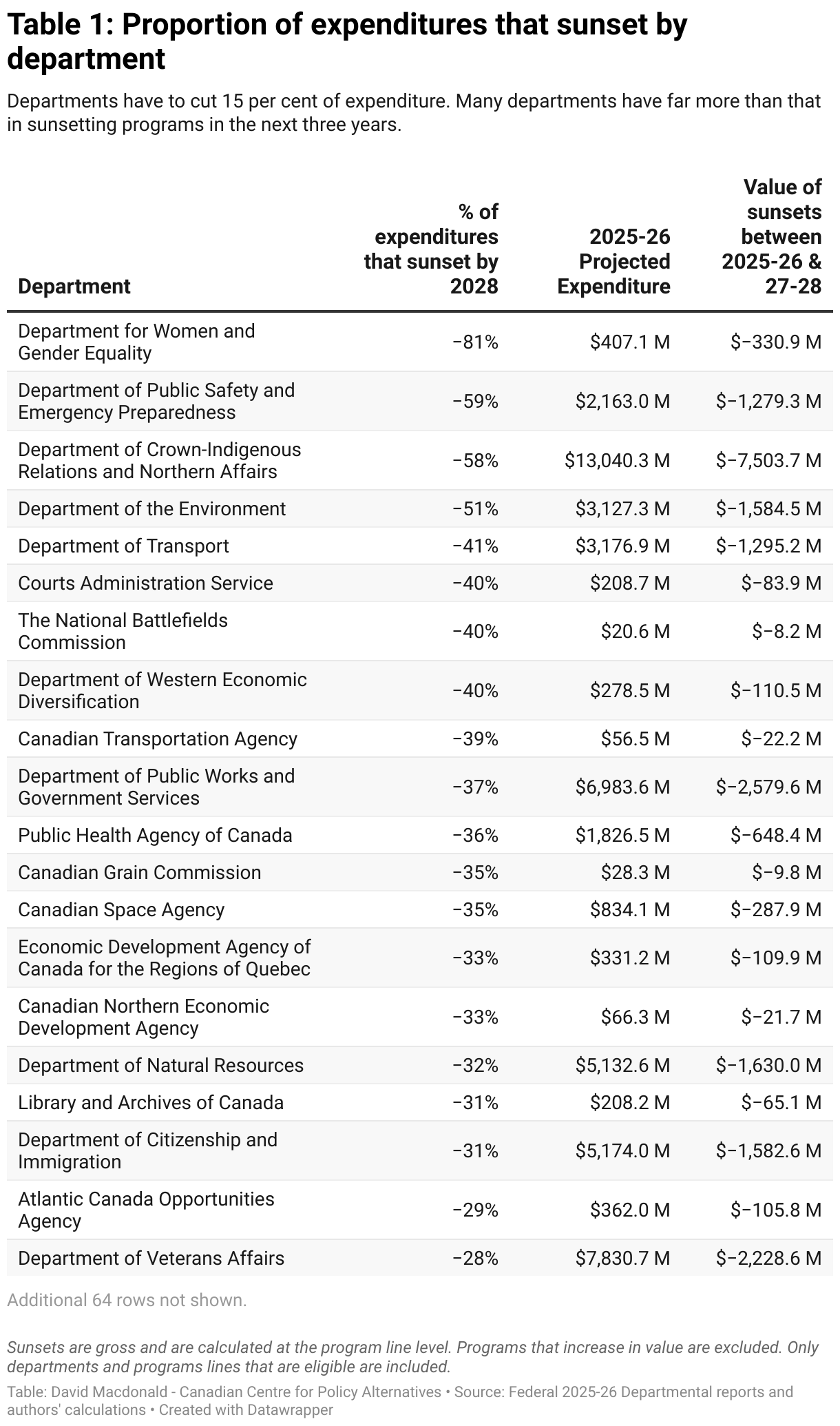
Not all departments will be able to cover their cuts only through the non-renewal of sunsetting programs, but many could. Of the 84 departments facing cuts, 32 of them could reduce their expenditures by 15 per cent or more from sunsets alone. A further 20 departments could cut over five per cent through sunsetting. The remainder of departments will have to find cuts in a more transparent way, actively cutting permanent programs instead of letting unlucky programs expire.
If we look at the top five departments facing major sunsetting:
Women’s programs: The Department for Women and Gender Equality is a relatively new department, created in 2018. Its programs are overwhelmingly short term, with most ending in the three-year timeframe we’re analyzing (and the government is targeting). Very few of its programs have attained “permanent” status that would ensure ongoing funding beyond the next three years. As a result, 81 per cent of current expenditures in that department will sunset in the next three years. This department will almost certainly be letting sunsetting programs expire. That would turn back the clock on women’s gains in a dramatic way.
Emergency preparedness: The departments of Public Safety and Emergency Preparedness, along with Crown-Indigenous Relations and Northern Affairs, have, by their nature, many unknown but significant expenses in the future. Those expenses are often known for the next year, but over a three-year timeframe. In the case of public safety, it funds natural and climate disaster aid. In the case of Crown-Indigenous relations, it funds land claims processes. As a result, large projected decreases in expenditures are shown in Table 1, even though these aren’t all sunsetting programs, per se; they are more unknown costs in future years. Those cuts will come at a cost: Limiting these budgets could easily slow down a disaster response and could slow down Canada’s progress in reconciliation with Indigenous Peoples.
Environment and Transport: The next two departments—the Environment and Climate Change Canada and Transport Canada—have substantial amounts of sunsetting programs coming up for renewal. Fifty one per cent of Environment Canada’s program expenditures expire in the next three years, as do 41 per cent of Transport Canada’s program expenditures. These departments could not renew 15 per cent of their programs to meet the cuts target. In both departments, many of the programs that will sunset are related to climate change—a crisis we can’t afford to ignore.
The stealth cuts list exposed
Let’s zero in on what types of programs could fade into the sunset. Departmental reports allow us to identify individual programs that are sunsetting and need renewal in the next three years. Table 2 lists over 120 such programs across the 32 departments we examined. These departments have large portions of their budgets that would sunset, with large dollar value.
This list is a compilation of programs that might be cut by stealth. Here are a few examples of hundreds services and supports that could be lost:
Women’s supports: Funding to organizations that advance gender equality, support victims of gender-based violence.
Veteran supports: Funding to ensure one-on-one supports for veterans, reducing disability supports processing times.
Reconciliation: Funding to support reconciliation and rights for First Nations, including for fisheries, Indigenous-designed projects for safety and well-being, construction and maintenance of First Nations community infrastructure, better quality housing and school improvements in First Nations communities.
Emergency response: Funding to the Red Cross and other emergency response NGOs, working to reduce wildfire risks.
Climate change and the environment: Funding to projects that reduce greenhouse gas emissions, zero-emissions vehicle incentives, support for clean fuel production facilities, protecting our oceans.
Health care: Funding for infectious disease prevention and control, procurement of COVID and flu vaccines, action on the social determinants of health, home care and mental health supports, substance use prevention and treatment services.
Newcomer supports: Housing and health care for asylum seekers, support for people affected by the crisis in Gaza, migrant worker supports.
Student and youth supports: Grants to students from low- and middle-income families, supporting youth’s job readiness, summer jobs, paid work experience for post-secondary students.
Connectedness and fighting misinformation: Funding for civic journalism in underserved communities, countering online disinformation, affordable internet for low-income families and seniors, connecting rural and remote communities with high-speed internet.
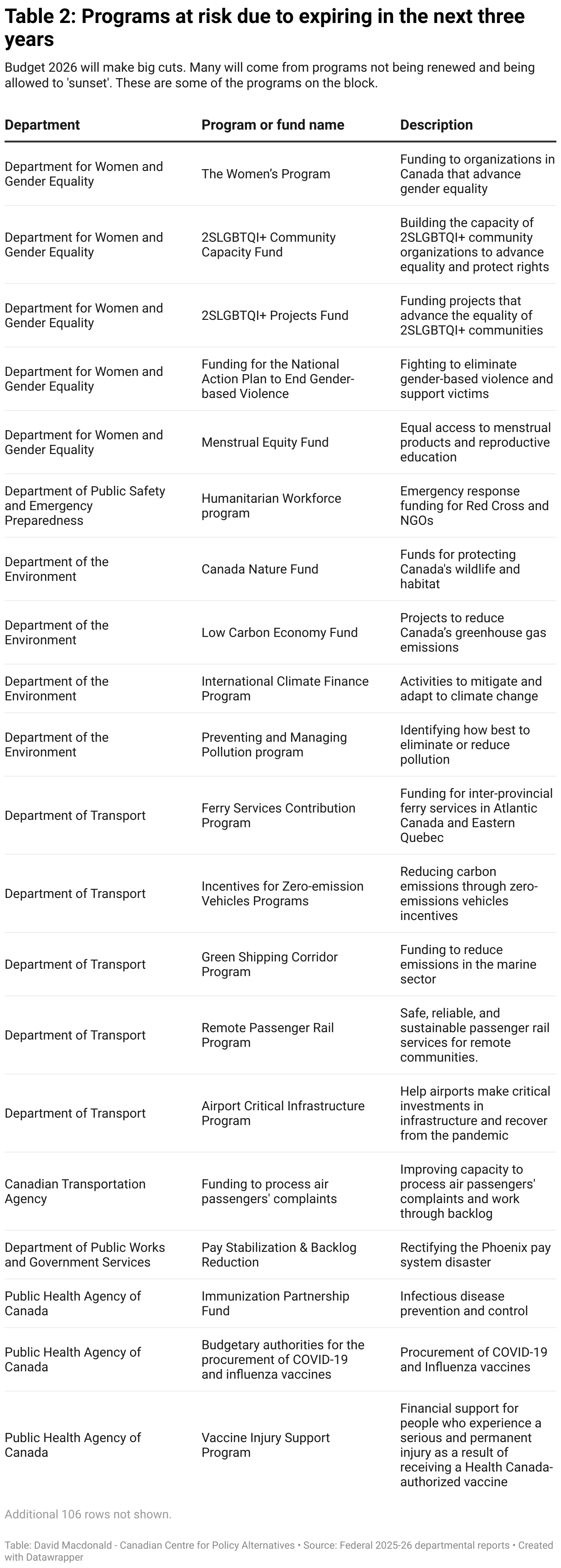
These programs, and many more like them, are simply unlucky enough to require renewal in the next three years. This isn’t based on need or performance, it’s just based on bad timing.
Budgets are about choices, this year more than ever
Major cuts in government services are coming on November 4th. The budget itself will almost certainly gloss them over to focus on its priorities and the choices the government has made. But Canadians deserve to know what they are being forced to give up in order to pay for massive increases in military spending and an incredibly expensive middle- and upper-income tax cut.
Our 2026 Alternative Federal Budget (AFB) shows that these deep cuts are unnecessary. In the Alternative Federal Budget, we like to say that budgets aren’t about economics, they are about policy choices. Instead of cutting programs to fund Trump’s priorities—the border and the military—we should be building the programs Canadians are crying out for: better health care and long-term care, reductions in income inequality, programs to address climate change and made-in-Canada solutions to the job losses from the U.S. trade war.
Instead, Canadians can expect a federal budget with cuts as deep as the Harper government’s from 2012 through 2014 and the infamous 1995 Martin budget cuts. In this case, the Carney government will likely rely on cuts through stealth—but Canadians will feel the impact. It won’t be painless.
About the authors
David Macdonald
David joined the CCPA as its Senior Ottawa Economist in 2011, although he has been a long time contributor as a research associate. Since 2008, he has coordinated the Alternative Federal Budget, which takes a fresh look at the federal budget from a progressive perspective. David has also written on a variety of topics, from child care to income inequality to federal fiscal policy. He is a regular media commentator on national policy issues, often speaking to the CBC, Globe and Mail, Toronto Star and Canadian Press. David received his BA from the University of Windsor and his MA from the University of Guelph, both in Philosophy. Follow David on Bluesky at @davidmaccdn.bsky.social

