Share
In 2024, Manitoba’s provincial NDP government brought back a fundamental right for workers when they restored single-step certification (also known as card-check certification)—making it easier for workers to form a union. Since then, more workers are choosing to join unions to raise their wages, access health benefits, and have a voice at work. Card check allows for workers to unionize immediately after a majority of workers have signed union cards, rather than having to take the second step of voting after workers signed their cards. Anti-union employers notoriously used voting periods to interfere in union drives.
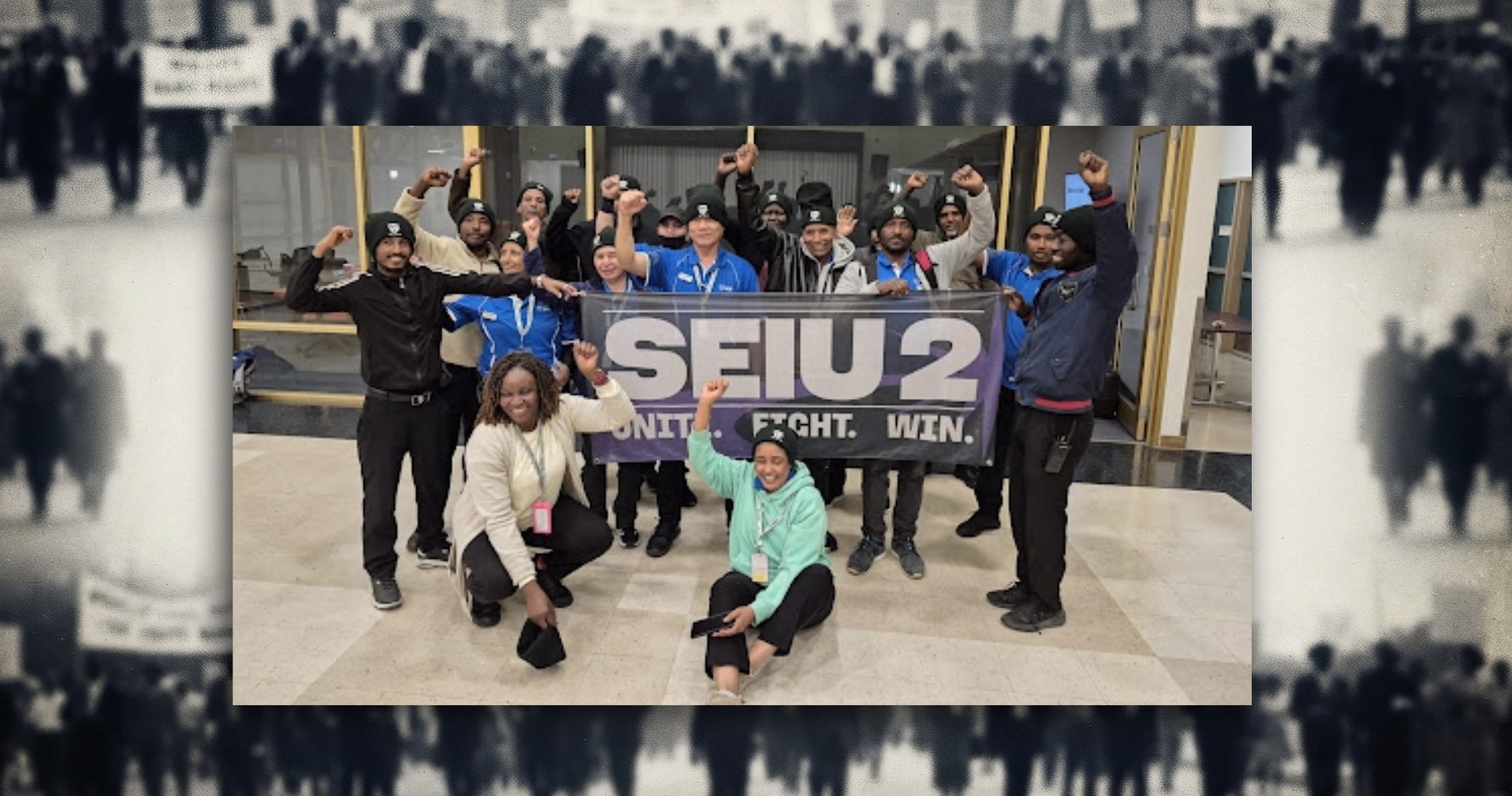
The results have been swift: hundreds of cleaners across Winnipeg are joining the Justice for Janitors movement and organizing their workplaces with SEIU Local 2, including at public institutions like University of Winnipeg and the Convention Centre, office buildings like the Richardson Building, and commercial properties like Polo Park.
These workers, and other contract for service workers, face a particular problem due to insufficient legislation: successorship rights. Contract workers’ lack of successorship rights means they can lose their union—and even their job—the moment the contractor changes, even when the work remains the same.
Let’s take a hypothetical example: workers at a university cafeteria serve food from a large multinational, and unionize to improve their working conditions. When that multinational’s contract expires at the end of its term, the university decides to take on a different food services provider for the following years. The new contractor can fire the existing staff and rip up the existing collective agreement. Some may be rehired—at minimum wage and non-union. Under existing legislation, the workers have no protection.
So while it has become easier for workers to form their union, for workers employed in the contract-for-service sector, the province must amend its legislation to make it easier for workers to keep their union.
A growing fight
Contracting out has become a core model of service delivery across Canada. Within the last decade, Manitoba’s government enacted a multi-year austerity drive that included large-scale contracting out of government infrastructure, services, and equipment operations—fully 54 per cent of workers at Manitoba Infrastructure reported some or all of their work had been privatized or contracted out between 2016-2021. At Canada’s post-secondary institutions, 84 per cent have contracted out food services, while 61 per cent have contracted out janitorial services. The majority are contracted to big multi-nationals: Dexterra, Sodexo, Aramark and Compass group. Without a union, these workers make minimum wage, have no health and dental benefits, and have little job security.
With card-check, janitorial work is transforming from precarious low wage work towards decent jobs for many workers. Cleaners employed by the contractor Dexterra at the University of Winnipeg organized a union in 2025 and ratified a 1-year collective agreement that included a 8.75 per cent wage increase, employer-paid extended health and dental benefits, fair workload language, job security, paid sick days and bereavement leave, strengthened rights to pray on breaks, and more.
After bargaining for the renewal of their collective agreement this fall, UW Dexterra cleaners voted unanimously to strike for higher pay, as they still make $1.15 below Winnipeg’s living wage.
As these workers prepare to take strike action, the University of Winnipeg could simply decide to end the cleaning contract with Dexterra and hire a non-union company to avoid a labour dispute. Without successorship legislation, the workers would lose their collective agreement, their union, and even their jobs. The practice is known as “contract flipping,” and it is very common in the contract-for-services world to keep wages low and unions out. In effect, the employer would be punishing cleaners at UW for exercising their right to join a union and their right to strike.
There is already the possibility of a Dexterra contract changing hands at the Canadian Forces Base (CFB) Shilo. The CFB Shilo cleaners employed by Dexterra organized a union with SEIU Local 2 just this summer. Last month, they voted to strike for their first collective agreement after little progress in bargaining. Since then, CFB Shilo posted an advance procurement notice for janitorial services, meaning the contract may be re-tendered, depending on the level of interest from other contractors. In the face of the possibility of losing their jobs and their union, the workers are standing up to fight for higher wages and better working conditions that a first contract brings.
Some provinces have already implemented successor rights to discourage the practice of contract flipping. In both B.C. and Ontario, provincial governments have enacted legislation which has survived through NDP, Liberal and Conservative governments. In Ontario, legislation covers contract workers “servicing the premises.” In B.C. the legislation covers “contract for service workers” in building cleaning, security, bus transportation, food services, and non-clinical services in the health sector. In places with such legislation, there is consensus across party lines that successorship protection for contract workers is good for workers and the economy. Who is covered by the legislation depends on the local context.
Canadian legal scholar Pascal McDougall highlighted how successorship rights achieve stability through maintaining continuity of the workforce, reducing union/employer conflict during a contract flip, and providing legal and economic certainty to contractors. For workers, when a contractor changes they are not forced to find new employment, to reorganize a union, and bargain a new contract. For governments, it means fewer workers are accessing unemployment benefits and social services, employment services are freed up for job-seekers who are actually without work, and there is less strain on the Labour Relations board because there are fewer disputes. Overall, there are more opportunities to build positive relationships with new employers under less contentious circumstances of union organizing and first contract negotiation.
The face of precarious work in Manitoba
Successorship can help protect vulnerable workers, particularly those from racialized and immigrant backgrounds who tend to work in contracted out jobs. In Canada, racialized and immigrant populations now make up a third of the labour force. Many of these workers are concentrated in the sectors which are still feeling the impact of the COVID-19 pandemic.
This is true in Manitoba, where the population is increasingly diverse: from 2016 to 2021, the proportion of the population coming from visible minority backgrounds in the province increased by almost five per cent. The working conditions of immigrant workers also continues to be an important issue in the province as immigration levels increased after the COVID-19 pandemic, with immigrants making up almost 20 percent of the population in Manitoba. In particular, this has been driven by the influx of temporary migrant workers brought in to fill labour shortage gaps in various industries.
Both racialized and immigrant workers are likely to take on low-wage, precarious or unstable jobs, many of which are concentrated in the service sector. Throughout Canada, precarious work became an emerging issue beginning in the 1980s when the rise of neoliberalism clawed back key labour protections and regulations in the country. This contributed to the rise of low-wage, temporary, or part-time employment with little to no access to benefits or unions. This issue of precarious work intersects with issues such as the incidence of poverty and low earnings that disproportionately affects racialized, immigrant, and Indigenous workers in Manitoba.
As precarious workers, racialized and immigrant workers already face barriers in terms of worker organizing and union participation. Research has shown that both immigrants and racialized workers are less likely to be covered by a collective agreement. While unions could improve upon the precarious conditions of these workers, there exists a catch-22 issue in that the very precarity they face serves as a barrier to union certification.
Lifting the floor
Encouraging worker organizing and protecting the right to unionize are necessary to improve the precarious conditions that racialized and immigrant workers face. Unions such as SEIU organize workers in sectors that have been historically difficult to unionize in areas such as the service sector—workers that predominantly come from immigrant and racialized backgrounds.
Pro-worker policies such as successor rights and the return of card-check legislation are important to remedy the issue of precarious work in Manitoba. While card-check legislation breaks down some barriers that hinder workers from certification, lack of successor rights allows employers to continue undermining workers’ ability to keep their unions. Successorship is therefore an imminent next step that builds on card-check legislation in protecting the rights of workers to belong in unions, especially those who face barriers to unionization in the first place. Successor rights are necessary not only to strengthen the right of workers to join a union, but for them to keep their unions in the long run.
About the authors
Kayla Hilstob
Kayla Hilstob is a researcher at SEIU Local 2 and a PhD Candidate at Simon Fraser University's School of Communication.
Angela Ciceron
Angela Ciceron (she/her) is a first-generation Filipino immigrant scholar and community organizer working and living on Treaty 1 land. Her research interests lie at the intersections of political economy, gender, and labour, with a focus on migrant work. She is the Errol Black Chair in Labour Issues for the CCPA's Manitoba office.