

- Home
- Topics
- Regions
- Magazines
-
-
-
The Monitor
A lot of AI discourse masks the fact that it is the result of a series of policy choices. Despite the government evoking Margaret Thatcher’s infamous “there is no alternative,” we do have a choice. And we should be serious about what that choice is.
-
-
-
-
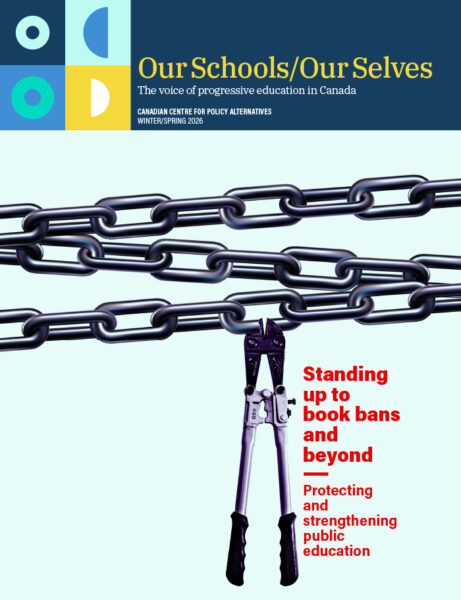
Our Schools/Our Selves
A guide to standing up to book bans and beyond, and how to protect and strengthen public education in Canada
-
-
-
-
- Media Inquiries
- Subscribe
- Legacy Gifts
- About
- Contact
- Donate Now
- Donate Now

Democracy & Politics
Our publications are available to all at no cost. Please support the CCPA and help make important research and ideas available to everyone. Make a donation today.
-

The municipal left wins in Toronto: What’s next?
Olivia Chow’s victory—along with a slate of progressive allies on council—heralds new possibilities in the municipal government of Canada’s largest city
-
A progressive’s guide to B.C.’s new Conservative government:
What does the 2026 election mean for British Columbia and the rest of Canada?
-
Where do B.C. parties stand on big health care challenges?
B.C.’s political parties offered policy ideas, but most fall short of proposing a comprehensive solution to what ails the health care system
-
The B.C. election is bringing drug policy in the wrong direction
The campaign should be a chance to rethink B.C.’s approach to the mental health and substance use crisis
-
B.C.’s snap election and DRIPA: Advancing human rights
All political parties must make an unqualified commitment that the basic human rights of every person— and every people— are sacred and non-negotiable.
-
What would happen if B.C. scrapped public auto insurance?
In British Columbia’s election, public auto insurance is in the crosshairs. How does the system work—and compare to other provinces?
-
B.C.’s fiscal choices after the provincial election
No matter which party wins, there are some difficult choices coming in the next fiscal year.
-
The Quebec election is a triumph of neoliberalism
The election feels like a referendum on social democracy. Most parties, to varying degrees, seem to be voting “No.”
-
The BC election no one wanted
The government of British Columbia is calling an election, just two years into a majority mandate and with an opposition mostly in disarray
-
Social housing in Manitoba: Examining the historical impacts of neoliberalism
30 years of neoliberalism in Manitoba social housing policy, and how to resist it
-
Weaving a Better Winnipeg: 2026 Alternative Municipal Budget
A Winnipeg budget created by the community calling for bold choices that prioritize housing, safety, transit, and climate action
-
Why is the BC government targeting Victoria’s elected school board?
Democracy, waste, and the anatomy of a completely preventable fiasco








Updates from the CCPA
Read the latest research, analysis and commentary on issues that matter to you.
CCPA Updates