



Share
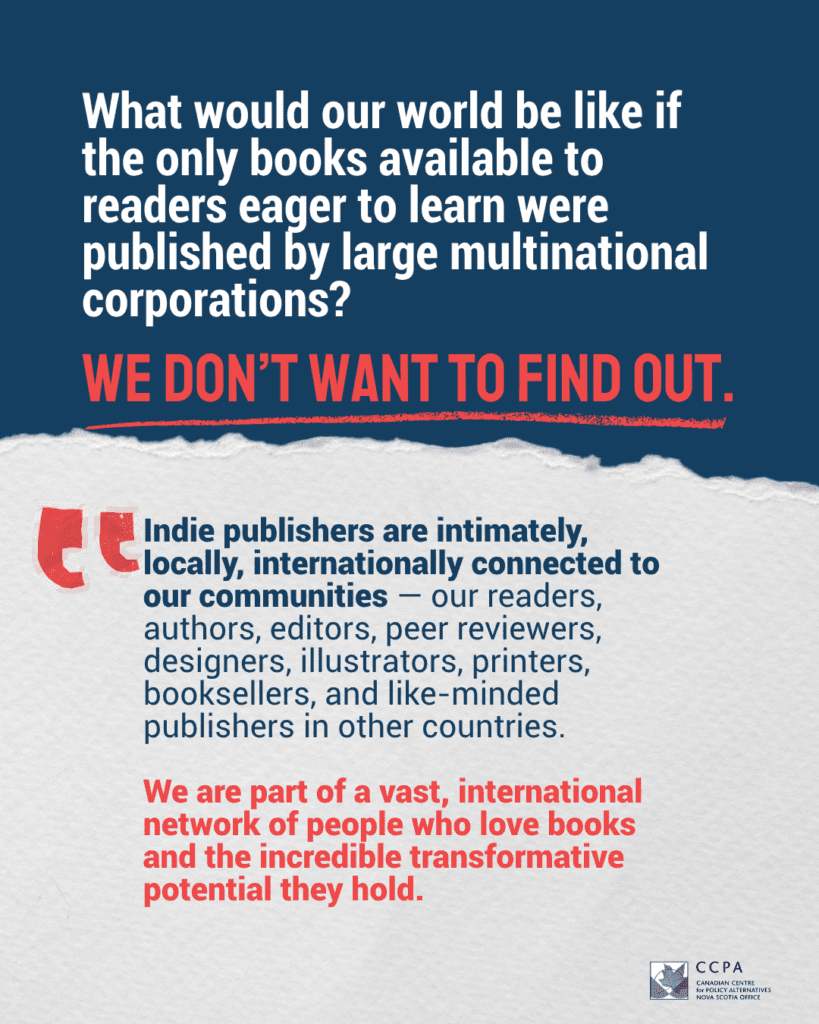
What would our world be like if the only books available to readers eager to learn were published by large multinational corporations?
Nova Scotia is now the only province in Canada that does not provide direct funding to publishers. The provincial government’s 2026-27 budget has dismantled funding for book publishing, along with other cuts to arts, education, and community infrastructure.
Operational funding for the arts in Canada has been vital for arts and culture sectors to compete against the US, a cultural whirlpool and a massive market. Federal funding for arts, culture, and heritage was prioritized after WW2 to support distinct cultural production in Canada, and each province has implemented its own support of these industries through funding streams and tax credits. It’s not that publishers are unprofitable businesses requiring “handouts” — the industry runs on seasonal sales cycles and operational funding creates stability for workers during low points, so books can continue to be developed, warehoused, distributed, and promoted. Independent presses invest months in advance for editing, design, printing, freight, storage, and marketing before a book has earned back a dollar.
Public funding does not replace commercial discipline; it provides the stability that allows publishers to survive long production and sales cycles.
With devastating cuts to provincial arts funding in Nova Scotia, including a complete gutting of the Publishers’ Assistance Fund (PAF), independent book publishers face unprecedented instability.
Substantial return on investment
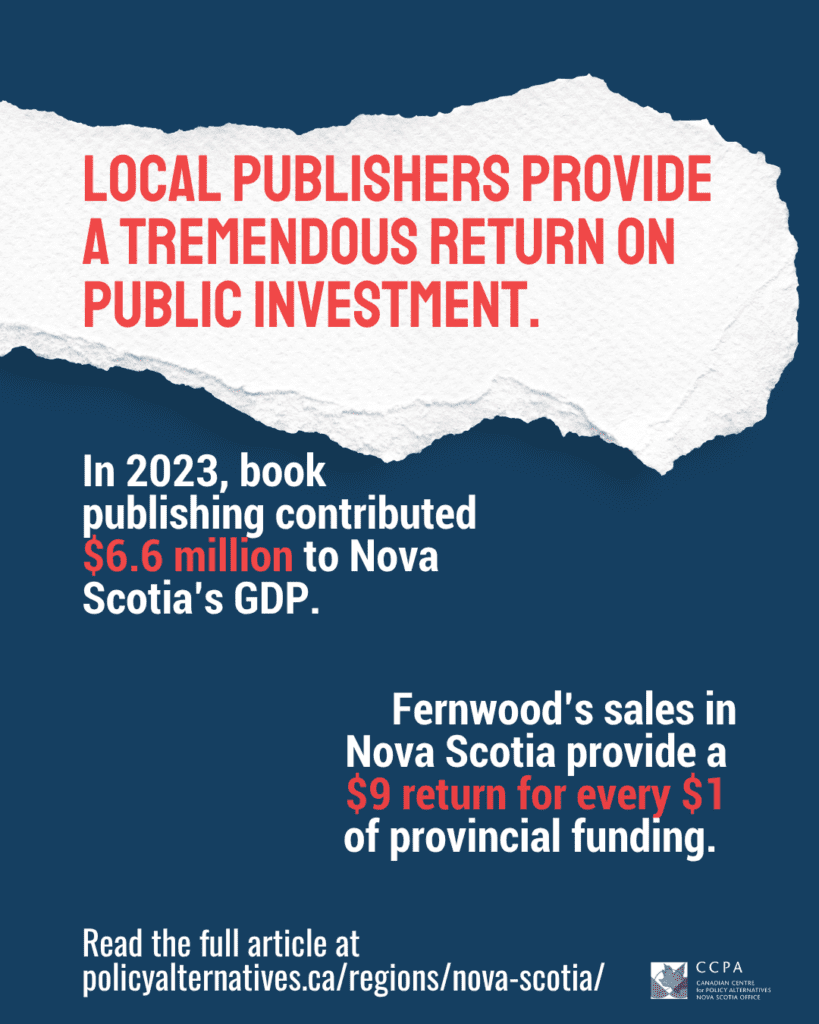
At $700,000 per year shared between all Nova Scotian publishers, the PAF represents a tiny fraction of the province’s $18.9 billion budget.The PAF was designed to increase the sustainability, export capacity, and marketplace growth of the publishing sector in Nova Scotia. PAF was a small government investment that returned exponentially more to the province’s economy through exporting local cultural production and providing stable local employment. According to Statistics Canada, book publishing contributed $6.6 million to Nova Scotia’s GDP and employed 71 people in 2023.
These cuts affect the livelihoods of so many more than just those employed “in-house.” Indie publishers are intimately, locally, internationally connected to our communities — our readers, authors, editors, peer reviewers, designers, illustrators, printers, booksellers, and like-minded publishers in other countries.
We are part of a vast, international network of people who love books and the incredible transformative potential they hold.
Cutting this funding means giving over this entire, diversified, internationally connected industry to the U.S., because books produced by multinational publishers based there already flood markets and influence culture in Canada.
Publishing is an industry that returns to the economy exponentially more than it receives in grants, whether we measure that in dollars, jobs, cultural production, or community building. For example, in 2024, Nova Scotia book publishers had an operating profit margin of 8.1 per cent — that is higher than the Canadian average (5.8) and highest in Atlantic Canada. At Fernwood specifically, over the last five years we received $746.453 from the PAF and brought $7 million in sales to Nova Scotia, which is a 938 per cent return. That means $9.28 for every $1 invested by the government goes back into our business and the many workers we employ in house or freelance. What a hefty return on investment. Everyone in the long creative chain behind a book benefits; these are tax dollars well spent.
For publishers, even modest operational support has an outsized effect. It helps maintain capacity, supports book development across the year, and allows presses to publish for long-term cultural value rather than cutting back to only the safest and most immediately commercial projects.
Valuing critical ideas and diverse cultures
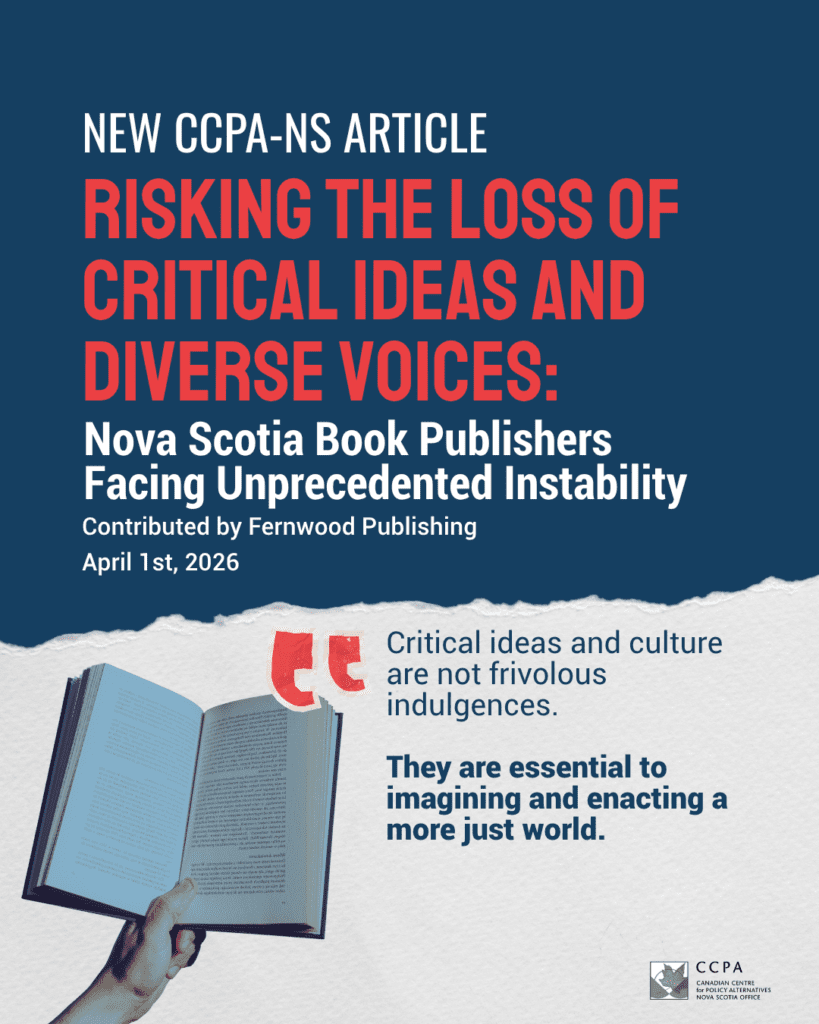
Critical ideas and culture are not frivolous indulgences. They are essential to imagining and enacting a more just world. Fernwood Publishing has recently been profiled in a few conservative media pieces that attempt to discredit the public funding of arts and culture because we are proud to be politically driven and not profit driven. What does it mean for a publisher to prioritize politics over profit?
It does not mean ignoring financial reality; it means refusing to let short-term profit alone determine which ideas deserve to be platformed.
With the aim of bolstering critical ideas and perspectives, Fernwood’s publishing program operates as a whole: our bestsellers support the books that may not break even but are crucial for smaller communities. When we operate our business this way, we can take risks on publishing the most underheard or cutting-edge thinking. That’s the role of a publisher: to document, represent, question, and imagine anew. When we choose to publish a book, it’s because we think it can move us all closer to a more humane world — not just because we can sell it.
The PAF made it more possible for us to publish books that expanded the definition of “Nova Scotian culture” by representing African Nova Scotian, Mi’kmaw, and immigrant communities in their own words. That’s crucial both for the historical record as well as imagining better ways forward. We also prioritize keeping our books accessible and affordable so everyone who needs them can access them.
Funding support helps us sustain a non-extractive business approach where profit isn’t the only marker of success and benefit to communities is equally valued.
And guess what? Readers love these books; they buy them and teach with them and give them to a friend. Fernwood exports the majority of its books (95%) outside Nova Scotia, and many of our titles circulate well beyond Canada. Provincial support for publishing does not remain confined within a small regional economy; it helps produce books that travel into classrooms, bookstores, libraries, and public conversations elsewhere, extending Nova Scotia’s cultural and economic reach.
The timing of these cuts could not be worse, because the influx of boring, inaccurate, and often harmful AI-generated “slop” has made it harder for anyone to access trustworthy information. Discerning readers around the world now increasingly look to small publishers, indie bookstores, and public librarians to help sift through the overwhelm for text that is artisanal, not artificial.
Nova Scotia’s government has diverted funds away from creative and critical thinking toward resource-extraction activities that non-profits and Indigenous groups have warned will destroy the health of the land and water we all depend on to live. Rather than supporting the social and economic benefits of thriving cultural industries, the provincial government will use that collective money to subsidize truly unsustainable businesses like fracking, fossil fuel pipelines, and AI.
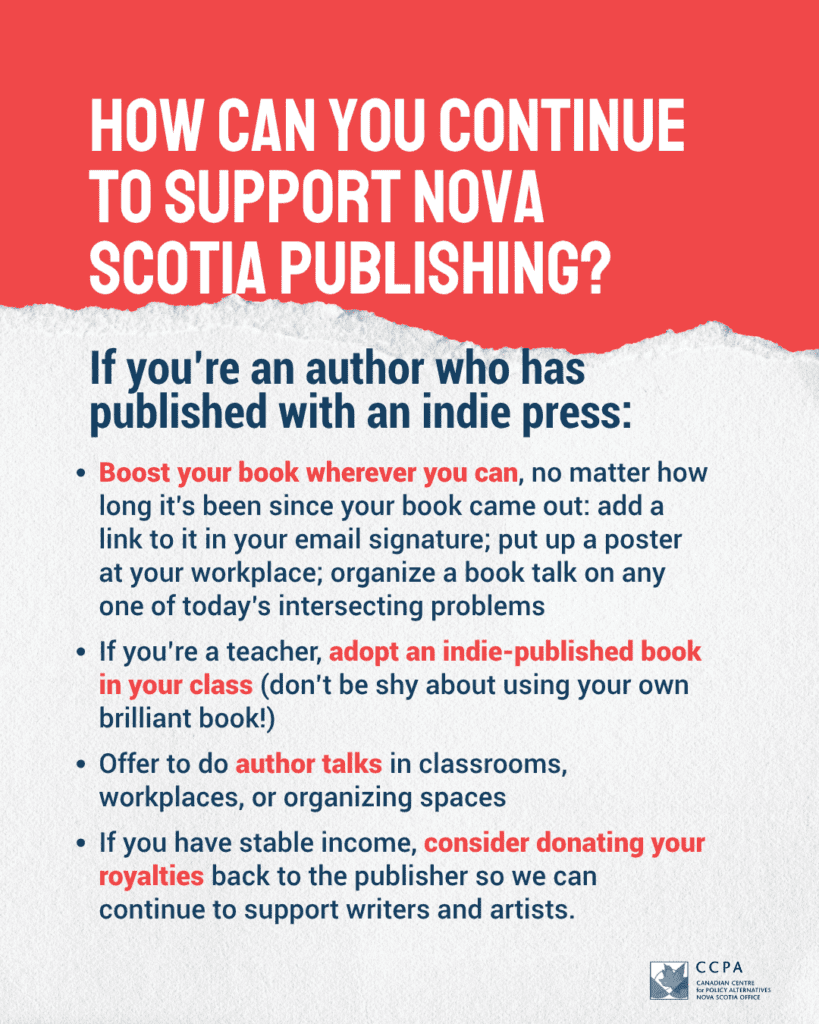
You can continue to support Nova Scotian publishing in these ways:
If you’re an author who has published with an indie press:
- Boost your book wherever you can, no matter how long it’s been since your book came out: add a link to it in your email signature; put up a poster at your workplace; organize a book talk on any one of today’s intersecting problems
- If you’re a teacher, adopt an indie-published book in your class (don’t be shy about using your own brilliant book!)
- Offer to do author talks in classrooms, workplaces, or organizing spaces
- If you have stable income, consider donating your royalties back to the publisher so we can continue to support writers and artists.
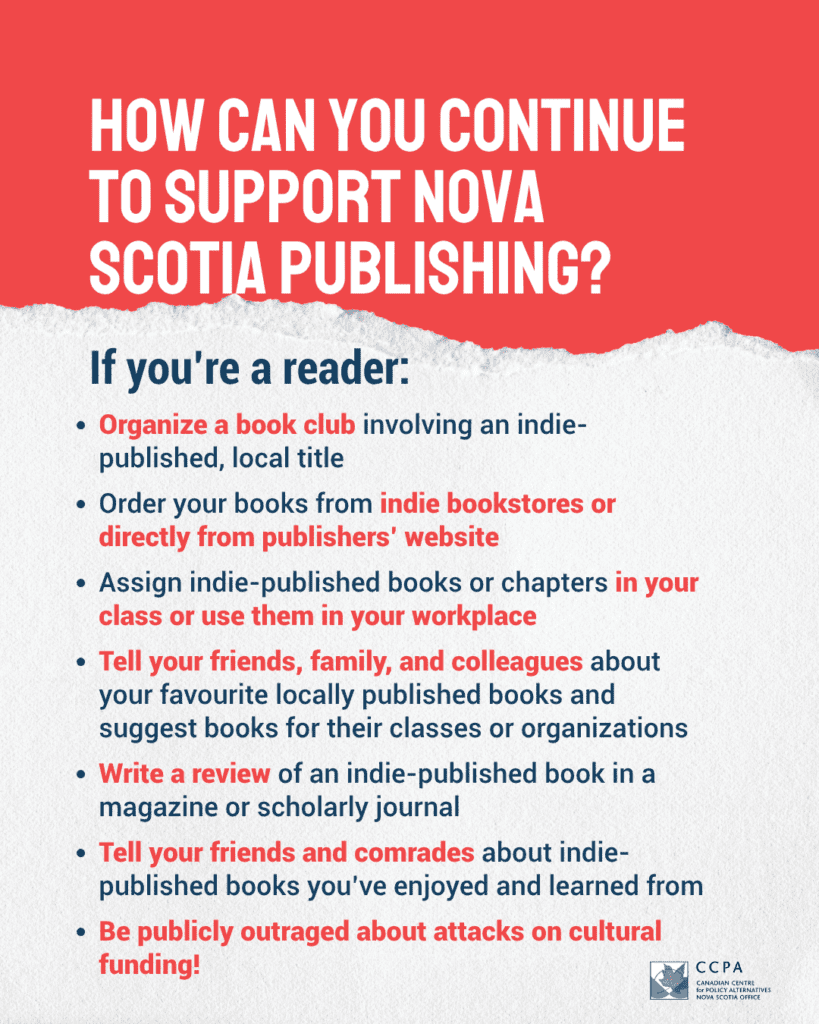
If you’re a reader:
- Organize a book club involving an indie-published, local title
- Order your books from indie bookstores or directly from the publisher’s website
- Assign indie-published books or chapters in your class or use them in your workplace
- Tell your friends, family, and colleagues about your favourite locally published books and suggest books for their classes or organizations
- Write a review of an indie-published book in a magazine or scholarly journal
- Tell your friends and comrades about indie-published books you’ve enjoyed and learned from
- Be publicly outraged about attacks on cultural funding!
Note about the author(s): Thanks to Fazeela Jiwa for taking the lead as a co-author. This article was collaboratively written by workers at Fernwood Publishing, one of the Nova Scotia publishers who was a past recipient of support from the Nova Scotia Publishers Assistance Fund. Other recipients of funding include Nimbus Publishing, Conundrum Press, Moosehouse Press, Formac Publishing, Pottersfield Press, and Macintyre Purcell Publishing.
Read the press release here.Graphics to share
About the author
Fernwood Publishing
Fernwood Publishing is dedicated to platforming critical voices and publishing books that challenge the status quo.
