

On November 20, the government of Ontario announced the Buy Ontario Act. This is a follow up to a 2022 policy—the Building Ontario Businesses Initiative Act—that favoured Ontarian suppliers within public purchases, also known as “procurement localism” in technical language. To be compliant with the Canadian Free Trade Agreement, the Act favoured Canadian suppliers—instead of Ontarian suppliers—for contracts above a set amount but below international thresholds.
Now, the Ontario government is doubling down on this same project, albeit with some minor changes. First, the new Act now includes municipalities in its scope. Given reports that the City of Toronto was dragging its feet on buying Canadian before barring American suppliers in March, this is a welcome change. Second, the Act has added enforcement language that will penalize entities failing to fulfill its mission. The press release for the act further gestures toward local sourcing within subcontracting, though the text of the law itself is ambiguous.
Still, the news is bittersweet. While the rebranded policy is a worthwhile aspiration, it continues to be dogged by execution and implementation challenges of the government’s own making.
Buying Local Makes Sense
Buying local (or procurement localism) is, all else equal, a good thing. Public procurement represents roughly a third of government expenditure. With the right priorities, this pot of money can potentially re-shape industries, redistribute wealth, strengthen unionized labour and meet other social objectives. Buy local mandates can help advance these objectives while generating downstream benefits for our communities.
This is far from the only advantage. Procurement localism simplifies purchases from the start. Rather than designing complicated formulas for evaluating bids, we can reduce administrative burden by eliminating undesirable suppliers early.
Opponents suggest policies like Buy Ontario reduce value for money by eliminating competition. This critique is misguided. First, this critique overemphasises price point while forgetting downstream and secondary benefits from local sourcing and purchasing.
Second, these opponents over-assess how competitive public procurement really is. Many suppliers cannot afford the overhead of bidding, especially if they are unsuccessful. In fact, according to federal public data, the vast majority of procurements had fewer than four bids. Paradoxically, procurement localism may introduce more quality bids by lowering the risk to smaller suppliers.
More and more countries are embracing procurement localism. While the pandemic raised concerns over extended supply chains, the Trump administration’s global withdrawal has further undermined the value of traditional procurement. If the world’s largest economy is further closing its public procurement to foreign suppliers, why not do the same? This is the conclusion Mexico, United Kingdom and Australia have reached. Canada is late to the party.
In brief, the Ontario government is justified in pursuing procurement localism, but the Buy Ontario Act is fraught with execution and implementation challenges.
Buy Ontario Changes Too Little
The Buy Ontario Act will apply to a small portion of government purchases, principally because national and international trade agreements take precedence over any consequent procurement policy.
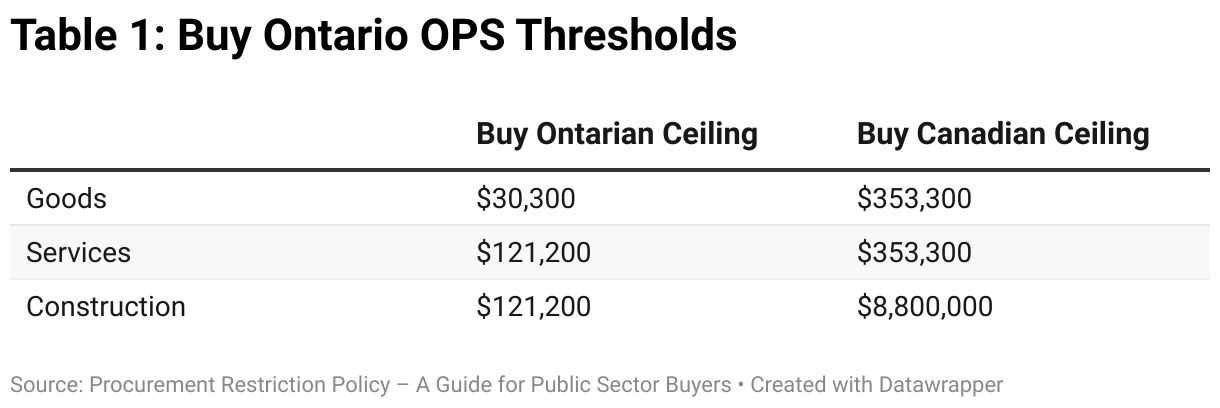
Buy Ontario still needs to be compliant with these trade obligations. Domestic agreements, namely the Canadian Free Trade Agreement and the Ontario-Quebec Agreement, limit favouring Ontarian suppliers for contracts valued above strict thresholds like those listed in Table 1. These agreements still allow favouring Canadian suppliers.
International trade agreements, however, do not. The biggest offender is the Canada-EU Comprehensive Economic and Trade Agreement (CETA), which prohibits both excluding EU suppliers and mandating discriminatory sourcing requirements. CETA broadly applies to Ontarian public entities with few exceptions—this means a great deal of Ontario’s purchases won’t be affected by Buy Ontario.
In fairness, some state agencies have relaxed international trade thresholds that leave some breathing room. That said, we do not know how much of procurement dollars are won by foreign suppliers. Ontario does not release a comprehensive dataset, and state-owned enterprises and municipalities are often less forthcoming. If we define “local” as a domestic address, the vast majority of dollars are already local. At the federal level, it is over 90 per cent.
Of course, this is a lousy measure of origin that international suppliers can manipulate by bidding on contracts using a branch entity with a domestic address, and then pushing the actual work abroad if successful. To Ontario’s credit, the provincial government has done a better job addressing this loophole than others. Ontario uses either headquarters location or employment as indicators of origin.
The gesture toward subcontracting is encouraging insofar as it addresses the origin loophole further. Subcontracting is the secondary purchase of goods or services through a contracted supplier. By managing more of these purchases, we ensure more contract value stays within local communities. Of course, we do not routinely collect subcontracting data. It is not yet clear how Ontario could sustainably implement this.
While data coverage is a consistent problem, internal expertise is a potentially more damaging one. Public entities need internal expertise to judge when policy exceptions are appropriate, what local sourcing can be done, and how to manage increasingly demanding contract conditions. Public procurement is too complicated for a one-size-fits-all approach. Recent public sector hiring freezes may deprive the provincial government of this needed expertise.
Buying local is no replacement for an internal capacity to deliver public services. While buying Ontarian is good, employing Ontarians within the public service is often more efficient, transparent and affordable. Public procurement introduces steep transaction costs that undermine value for money. It cannot be our default option.
A Missed Opportunity
The Buy Ontario Act is largely a rebranding of an existing policy. While there are a couple of improvements, it is thwarted by existing trade commitments, data gaps and public sector deficiencies. It leaves the impression the government of Ontario wanted to repackage existing initiatives for the symbolic benefit.
The province’s moves, in that regard, have been contradictory. Under an internal free trade agenda, the federal and provincial governments removed procurement exceptions that allowed targeted regional benefits. Meanwhile, the federal government is actively pursuing new trade agreements that limit procurement localism. These actions hurt our ability to strategically use our massive procurement spend.
We cannot afford to recycle the same free trade agenda. If there is any pathway to a fulsome Buy Ontario policy, it starts by swimming with global currents, not against them.