


Share
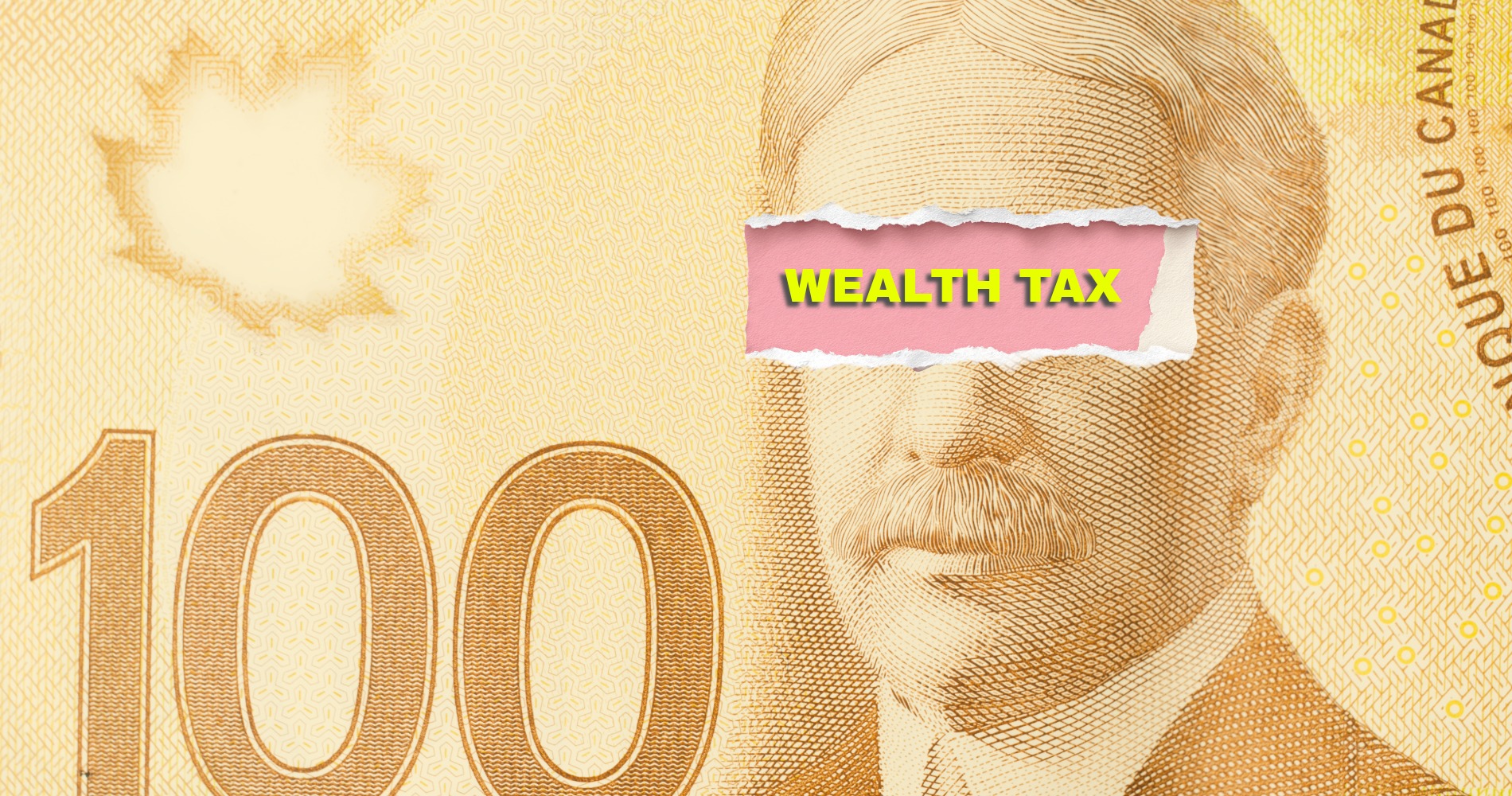
The issue of wealth inequality is one of the most pressing social and economic problems of our time. In their new book, authors Linda McQuaig & Neil Brooks make the case that extreme wealth concentration risks wrecking the economy, poisoning the environment, and destroying democratic systems of government. States must take action to rein in the power of billionaires—and one key tool for doing so would be a wealth tax.
Cancelling Billionaires Before They Cancel Us: The Urgent Case for a Wealth Tax was published by Dundurn Press in 2026. It is available at bookstores across the country.
The protestors who occupied Wall Street in the fall of 2011 managed to draw public attention to the long-ignored problem of the huge accumulation of money at the top. As they boisterously camped out in a Wall Street park, their rallying cry against “the top one per cent” quickly entered the popular lexicon and remains in common usage today. Yet this iconic phrase has become wholly inadequate — indeed almost quaint — in describing the surreal way wealth is now distributed in our society.
Before we begin the task of describing today’s wildly extreme inequality, let’s just quickly note its centrality to our lives, and yet how almost invisible it is. The amount of wealth we possess as individuals determines a great deal about our lives: how well or badly we live, what options and opportunities we have, what doors are closed or open to us, etc. Yet despite its enormous impact on our lives, public debate rarely touches directly on the issue of how unequally wealth is dispersed.
There’s an implicit acknowledgement that today’s wealth distribution is unfair. Certainly, politicians like to portray themselves as championing ordinary working people, not the rich. Even politicians who relentlessly promote the interests of the rich routinely pretend otherwise, attacking “the elite” and cloaking themselves in the mantle of “populism.” Yet politicians, including those who boast that they represent working people, rarely advocate policies that would do anything to spread the wealth more broadly, to share it even a little with the people they claim to represent.
This omission is curious, given that redistributing wealth—even by a small amount—could greatly improve the lives of millions and millions of ordinary people and also enable us to invest heavily in key societal goals. There was a much more equal distribution of income and wealth in the four decades after the Great Depression, and it produced tremendous economic growth and is often referred to as “the Golden Age of capitalism.” It’s striking, then, that the subject of wealth redistribution is barely discussed or even mentioned in mainstream debate today.
We know little about the concentration of wealth. As citizens, we have only a vague, sketchy idea of how truly lopsided Canada’s wealth distribution is. Surprisingly, almost no official statistics are kept about how much money there is at the very top. Today, governments routinely track virtually every aspect of the economy. Yet they steer clear of tracking anything about wealth above the top one per cent, thereby preventing us from knowing what’s going on way, way up there, where wealth is accumulating far more rapidly than anywhere else. This exception is striking; it means there is no official information available, or even recorded anywhere, about a vast swath of our economy. What we know about the massive holdings of the ultra-wealthy comes not from government, but from unofficial assessments by business journals (particularly Forbes magazine), private banks, and academic researchers.
Without official data, the cavernous gap between rich and poor largely disappears as a problem to be addressed. Rather, it becomes simply a gigantic, unmovable backdrop to our lives. The satirical publication The Onion captured this bizarre situation well by describing the gap between rich and poor as “the Eighth Wonder of the World … a tremendous, millennia-old expanse that fills us with both wonder and humility … the most colossal and enduring of mankind’s creations.”
To provide a thumbnail sketch of today’s colossal gap between rich and poor, we could start by noting that the bottom half of humanity, some four billion people, barely own anything at all. These four billion people live mostly in wretched poverty, even though the world is constantly generating new wealth—including a great deal of wealth that these four billion people help create through their work—but virtually none of it trickles down to them. Instead, newly-created wealth is suctioned up by those higher up the ladder, particularly by those much higher up the ladder. So, for instance, those who make up the global top one per cent of wealth-holders have managed to capture about half of all the new wealth created between 2012 to 2023. In the last few years of that period, they’ve managed to capture a still larger share: almost two-thirds of all new wealth.
But focusing on what’s been happening to this top one per cent fails to convey the truly stunning scope and pace of recent wealth concentration. If we consider the top one per cent as the “treeline” on a mountain, then the real story of the phenomenal wealth growth in the last few decades has taken place almost completely above the treeline, and the higher above the treeline we go, the bigger and faster the wealth has accumulated.
Back in 1987, Forbes, the leading U.S. business magazine, did the first serious global inventory of extreme wealth-holders, producing a list of 140 billionaires. Since then, Forbes has produced an annual list that just keeps growing. By 2025, its global list had grown to 3,028 billionaires. Hence, over that 38 year period, the number of billionaires has increased, accounting for inflation, by 10 times.
Even more interesting has been the growth in the sheer volume of their wealth. In 1987, the 140 billionaires had a total net wealth of US$295 billion. Today’s 3,028 billionaires have a total net wealth of US$16.1 trillion. The wealth of billionaires has increased, accounting for inflation, by nineteen times (or by 1,900 per cent).
However, this spectacular growth over 38 years actually fails to capture the extent to which wealth growth has sped up in the last five years.
In 2020, at the start of the pandemic, Jeff Bezos was the only centi-billionaire (someone with more than US$100 billion). Five years later, by the beginning of 2025, there were 15 centi-billionaires. Four of these centi-billionaires are now worth more than US$200 billion. Elon Musk now ranks as, by far, the world’s richest individual with US$843.5 billion. If Musk’s wealth continues to grow at its current pace, he will become the world’s first trillionaire, possibly within a year or two. Within a decade, nine others are expected to join him in the ranks of a trillionaire class.
So, at the very top, a sliver of humanity known as billionaires—3,028 of them, with a few trillionaires in sight—live in indescribable splendour, controlling more than $16.1 trillion in wealth. And they are taking over an ever-larger share of the world’s wealth at an astonishing pace. Indeed, we are on a dizzying trajectory where this ultra-tiny group could, within a few decades, capture most of the new wealth created in the world. An odd situation for us to simply accept as an unmovable backdrop to our lives.
Among Canadians, it’s common to think of the rise of billionaires as largely an American phenomenon. But that isn’t the case.
There are now about 120 billionaires in Canada. While the growth of their fortunes has been less dramatic than in the U.S., it has been relentless. And it has come at the expense of all other Canadians. According to the Global Wealth Report produced by the investment bank Credit Suisse, the wealthiest one per cent of Canadians—those with net assets above $6 million—increased their share of total Canadian wealth significantly between 2010 and 2019 from almost 18 per cent to almost 26 per cent. Credit Suisse found that, over that time period, the share of wealth owned by every other income group in Canada declined.
In Canada, as in the U.S., the most incredible wealth growth happened above the treeline, in the upper reaches of the top one per cent. In the two decades between 1999 and 2018, the number of Canadian billionaires (measured in Canadian dollars) more than quadrupled from 23 to 100, and their combined total wealth increased by almost five times, from $72 billion to $339 billion. (This growth rate was actually slightly faster than the growth rate in the number and wealth of the billionaires in the United States.) Furthermore, as in the U.S., the growth in the number of Canadian billionaires and their wealth significantly sped up in the past five years.
So, the bad news is that wealth inequality is worsening with each passing day, as a number of spectacularly wealthy people pull ever farther ahead of all other Canadians. Furthermore—and this is not widely appreciated—the members of this ultra-privileged elite are able to largely avoid paying income taxes. While Canadians at almost every income level pay a substantial portion of their incomes in tax, billionaires do not. The income tax is not an effective tool for taxing them.
The good news is that a wealth tax, which would be effective at taxing the ultra-wealthy, has been developed by some of the world’s brightest economic minds, including renowned economists Thomas Piketty, Emanuel Saez and Gabriel Zucman. The tax would be applied at the national level, and it has already won high-level support in some key G20 nations. Of course, the political obstacles in the U.S. are formidable, with Donald Trump in the White House. But a strong backlash against oligarchy could well develop—indeed already is developing—as billionaires and their political enablers overplay their hand.
Before we go any farther, let’s be clear: a wealth tax would apply only to the extremely rich. In the version we propose for Canada, the tax would only touch an individual with net assets above $25 million. Anybody with net assets of $25 million is truly wealthy, not merely at the upper end of the middle class. We’re talking about the top 0.1 per cent, which is the top one-tenth of the top one per cent. Those paying the tax would be members of an extremely exclusive club. Your chances of ever belonging are, sadly, almost nil.
Yet, even though this privileged group represents merely a microscopic slice of the country’s total population, it holds immense wealth. As a result, the amount collected through a wealth tax would be massive: in the range of $40 billion a year. That revenue would enable us to pay for a wide range of benefits, social supports, climate measures, and public infrastructure improvements that could transform the lives of millions of Canadians.
Of course, the rich would threaten to leave. Indeed, their threat to depart is regarded as the ace up their sleeves. Any suggestion that we need a wealth tax is immediately rejected on the grounds that the super-rich will leave and take their wealth with them. But not so fast. Here’s an important but little-known fact: Canada has an exit tax.
Anyone is free to depart. But, if they have significant wealth holdings, they will face a hefty exit tax on the way out. Here’s how that works: A person can accumulate wealth (typically in the form of corporate shares) and pay no tax as that wealth grows. However, the Canadian Income Tax Act stipulates that the person is obliged to pay tax whenever they cash in any of those shares, or when they die—or leave the country.
This significant requirement, which is also part of American tax law, is always left out of discussions about a wealth tax. It shouldn’t be. The ace-up-the-sleeves of the wealthy turns out to be really more of a joker.
Ultimately, a wealth tax would take a modest chunk out of the grotesquely large fortunes that Canada’s super-rich have amassed for themselves during the most unequal era in world history, and use that money to create a better-functioning democracy, with a more hopeful, well-nourished and empowered citizenry.