

- Home
- Topics
- Regions
- Magazines
-
-
-
The Monitor
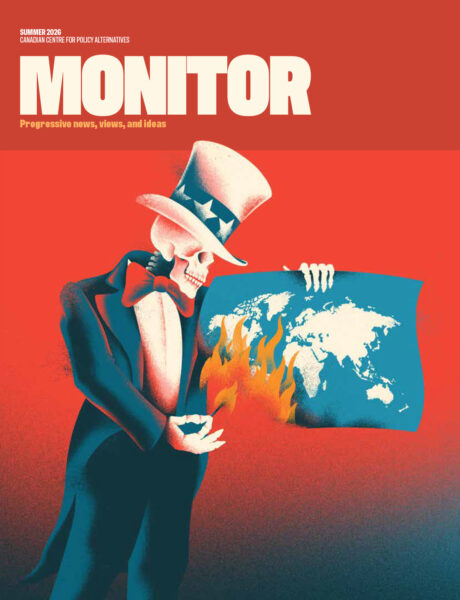
While world leaders are increasingly saying out loud that the postwar liberal world order is dead, the ruling classes in the Global North have an answer for what will come to replace it: fascism. Will they be able to implement their vision?
-
-
-
-
Our Schools/Our Selves
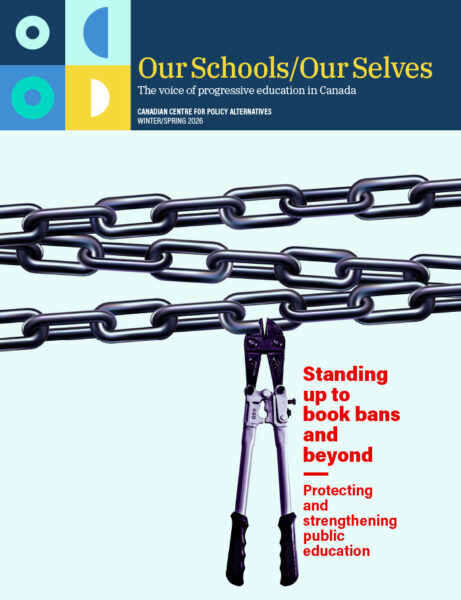
A guide to standing up to book bans and beyond, and how to protect and strengthen public education in Canada
-
-
-
-
- Media Inquiries
- Subscribe
- Legacy Gifts
- About
- Contact
- Donate Now
- Donate Now
Search results for “site/economics of childcare”
-

Skyrocketing rent pushes modest apartments out of reach for lower-income Canadians in 97% of neighbourhoods
New study maps the rental affordability crisis in Canada’s cities CLICK HERE TO VIEW THE FULL REPORT OTTAWA—In nearly every neighbourhood, in all parts of Canada, the hourly wage needed to afford an apartment rental is far above minimum wages and rising quickly, according to a new study released today…
-

New report: Canada isn’t spending what it takes to succeed in the global shift to a clean economy; Budget 2023 must include ambitious climate investment plan
CLICK HERE TO VIEW THE FULL REPORT Unceded Algonquin Anishinaabe Territories [OTTAWA], 9 February 2023 For Canada to compete in the global clean economy, the federal government must adopt an ambitious investment plan to match the scale of the climate and affordability crises, finds a new report released today by…
-
Housing advocates look to provincial budget for action
Manitobans should have access to housing but, at any given time, there are about 1,400 people experiencing homelessness in Winnipeg alone. Many others live under threat of homelessness, paying the rent with money needed for food and other basic needs. Housing advocates call on the provincial government to remember these…
-

BC Budget 2017: $600 million in tax breaks for business
Does the BC business sector need a tax cut? Not so much. But Budget 2017 promises to give business over $600 million in additional annual tax breaks nonetheless. That’s more than half a billion dollars annually that won’t be invested in creating affordable high-quality child care spaces, building affordable housing…
-
Alternative Federal Budget 2017: High stakes, clear choices
The following remarks are excerpted from the 2017 Alternative Federal Budget press conference, featuring Kate McInturff, David Macdonald and Peter Bleyer (March 9th, Parliament Hill).
-
Five things you can do right now to help women achieve economic equality
I’ve got my pussyhat. I’m ready to march. To strike. To get to work. Or I could stay home. And watch Netflix. What would happen if we all just called it a day? What if we said, ‘Meh, close enough ladies’? What price would we pay? Right now, women’s employment…
-
Precarious work a reality across employment sectors in BC
Across the world, one of the features of contemporary labour markets is the rising level of precarious employment. We know that labour markets look quite different from place to place for a variety of reasons – institutional, legal, technological, sectoral mix, education, immigration, and other factors that all contribute to…
-
Bankers and cleaners
So who is worth more to society: someone who cleans hospitals for a living or someone who runs a bank? The answer to that question might seem subjective. Someone flat on their back in a hospital room might have pretty strong opinions. But Britain’s New Economics Forum (NEF) has produced…
-
Prairie Update: Doing Austerity in Saskatchewan and Manitoba
In the Fall 2016 Monitor, Canadian Centre for Policy Alternatives (CCPA)Saskatchewan’s Simon Enoch penned Getting to Know Brad, introducing Canada’s most popular premier – Brad Wall – to the country. He ran down Wall’s list of “accomplishments”. What made Simon’s analysis so interesting (and at the same time, disheartening) was…
-
WKanadpon / Shutterstock” style=”border-radius:0px;–objectFit:cover;–imagePosX:50%;–imagePosY:50%” decoding=”async” srcset=”https://www.policyalternatives.ca/wp-content/uploads/2025/04/pn_may2019_BCLabourCode-300×133.jpg 300w, https://www.policyalternatives.ca/wp-content/uploads/2025/04/pn_may2019_BCLabourCode-768×341.jpg 768w, https://www.policyalternatives.ca/wp-content/uploads/2025/04/pn_may2019_BCLabourCode.jpg 900w” sizes=”(max-width: 300px) 100vw, 300px” />
BC Labour Code amendments: A foundation to strengthen worker rights?
The first comprehensive review of BC’s Labour Code in over a quarter of a century has resulted in changes to the law to strengthen protections and collective bargaining rights for workers. In addition to requiring a review of the Code every five years, the changes will: Strengthen successorship rights for workers…
-
Memo to northeast BC: More fracking earthquakes ahead
Of the many “unknowns” flagged in a recent science panel report, few are as disturbing as the finding that no one can say how destructive an earthquake may one day be triggered during brute-force oil and gas industry fracking operations. The panel’s report—commissioned by Michelle Mungall, BC’s Minister of Energy,…
-
BC home to Canada’s second highest poverty rate
New report: Province must stop rejecting need for poverty reduction plan READ THE FULL REPORT HERE. VANCOUVER – BC’s poverty rate is virtually unchanged from where it was a decade ago yet the province remains the only one in Canada without a poverty reduction plan. And it’s not because BC…


 WKanadpon