

- Home
- Topics
- Regions
- Magazines
-
-
-
The Monitor
While world leaders are increasingly saying out loud that the postwar liberal world order is dead, the ruling classes in the Global North have an answer for what will come to replace it: fascism. Will they be able to implement their vision?
-
-
-
-
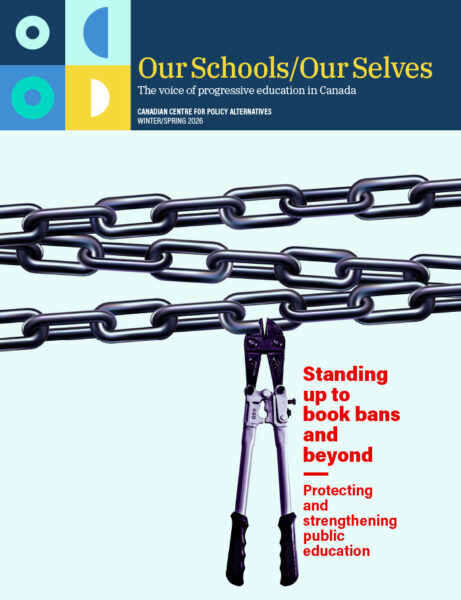
Our Schools/Our Selves
A guide to standing up to book bans and beyond, and how to protect and strengthen public education in Canada
-
-
-
-
- Media Inquiries
- Subscribe
- Legacy Gifts
- About
- Contact
- Donate Now
- Donate Now

Search results for “site/economics of childcare”
-

Nova Scotians paying more than their fair share for post-secondary education: Report
CLICK HERE TO VIEW THE FULL REPORT Halifax – The Canadian Centre for Policy Alternatives-Nova Scotia (CCPA-NS) released a new report today which shows that Nova Scotia students and their families are paying almost three times as much as the provincial government. The report, entitled Fairness, Funding and our Collective…
-
Temporary foreign workers and the election
A major issue getting scant debate An election should be a time to discuss key policy directions. One of the biggest policy transformations in the Harper era has been the enormous growth in Temporary Foreign Workers (TFWs) –– “guest” workers who come to Canada for short periods, generally tied to…
-
How Much Would Harper Cost Your Province?
As I note in the following op-ed in today’s Toronto Star, federal Conservative election promises entail significant fiscal costs for provincial governments. It is not the first time that Harper has tried to stick provinces with the tab. For example, his policy of increased incarceration imposes costs on provincial jails. For links to references supporting…
-

Housing platforms and platitudes in the 2018 Vancouver election
It should be no surprise that Vancouver’s growing housing affordability crisis is the top issue going into the election. All candidates are in favour of affordable housing, of course. Sorting out the chatter from concrete plans, however, can be difficult—not least because of the way Vancouver’s municipal politics has fractured…
-
Temporary Foreign Workers and the Election: A Major Issue Getting Scant Debate
An election should be a time to discuss key policy directions. One of the biggest policy transformations in the Harper era has been the enormous growth in Temporary Foreign Workers (TFWs) – “guest” workers who come to Canada for short periods, generally tied to specific employers, without future prospects for…
-
Can cooperatives humanize the economy?
Book Review of Humanizing the Economy: Cooperatives in the Age of Capital, by John Restakis, New Society Publishers, 2010. The economy is about business, right? Sure, we have a dynamic mixed economy, and most people support decent social programs and government intervention to protect the environment or to improve living…
-
Of the 1%, For the 1%, By the 1%
The first leg of the federal election campaign has featured much debate over who benefits from different proposals. At least indirectly, it has been a discussion about income inequality as the federal parties reveal proposals that could widen or close income disparities while growing the economy. Against this noisy foreground, two…
-
From Charity to Entitlement
Look to history for best way to end persistent poverty I recently heard a caller to a radio talk-show complain about poor people turning to government for assistance to survive. He suggested that community efforts, such as food banks and charity, should suffice. And from his grave, Dickens groaned. One…
-
Indigo’s “For the Love of Indigo” school library fundraising campaign
Did you know that parents want their children to have access to well-stocked libraries in their schools? Were you aware that they’re very concerned that provincial governments aren’t doing enough to ensure that there’s enough money to pay for these books and libraries? Or that increasingly teachers have to dig…
-
Fast Facts: Tax increment financing and True North Square
First published in the Winnipeg Free Press September 20, 2018 On Thursday September 20, Winnipeg City Council will vote on a motion to clear the way for True North Square (TNS) to receive an $8 million subsidy through the City’s Tax Increment Financing (TIF) program. Council will be asked to…
-
CCPA Review: Taking Stock of the Bipole III Debate
On July 29, 2010 Manitoba Hydro (with the approval and support of the Manitoba government) announced their preliminary preferred route selection for the Bipole III transmission line. Bipole III will bring power from planned dam developments on the Nelson River down the west side of the province to southern Manitoba,…
-
Fast Facts: Facts, Principles, and Priorities in Government Budgets
Nova Scotians are again invited to help the provincial government “return to balance”, i.e., reduce the province’s deficit and debt. We are reminded that “if we don’t want tax increases, we have to accept spending cuts” and warned that the annual interest charges paid by the government are $1 billion…