

- Home
- Topics
- Regions
- Magazines
-
-
-
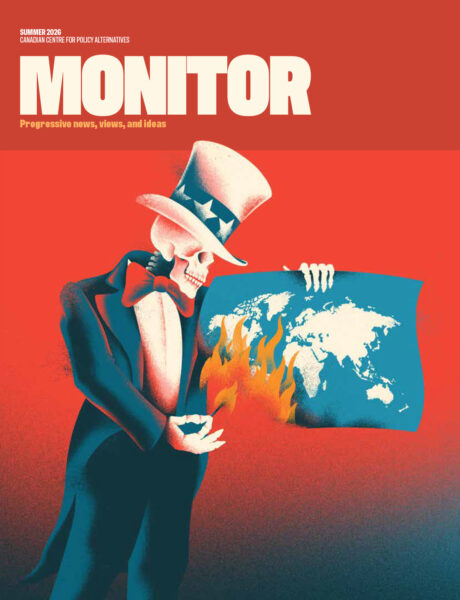
The Monitor
While world leaders are increasingly saying out loud that the postwar liberal world order is dead, the ruling classes in the Global North have an answer for what will come to replace it: fascism. Will they be able to implement their vision?
-
-
-
-
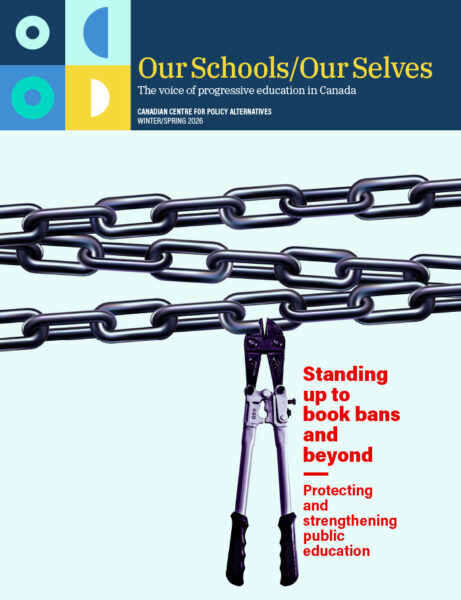
Our Schools/Our Selves
A guide to standing up to book bans and beyond, and how to protect and strengthen public education in Canada
-
-
-
-
- Media Inquiries
- Subscribe
- Legacy Gifts
- About
- Contact
- Donate Now
- Donate Now
Search results for “site/economics of childcare”
-

Au point mort
les familles manitobaines travaillent dur juste pour faire du sur place En mars 2007, le bureau national du CCPA publiait un rapport sur l’inégalité des revenus au Canada au cours des trente dernières années. Ce rapport intitulé The Rich and the Rest of Us : The Changing Face of Canada’s Growing…
-
Pipe Dreams: The risky bets behind Ottawa’s TMX purchase
The federal government’s decision, announced this morning, to purchase the existing Trans Mountain pipeline and the pipeline expansion project from Kinder Morgan for $4.5 billion is politically risky, economically perilous and, as we’ve said many times before, impossible to justify on environmental grounds. It all looks even worse when you…
-
New report disputes the economic case for nuclear power in Saskatchewan
CLICK HERE TO VIEW THE FULL REPORT Regina — The Saskatchewan office of the Canadian Centre for Policy Alternatives has released a new study on the economic costs of pursuing nuclear power in Saskatchewan. “In the Red: The Green Behind Nuclear Power,” authored by policy researcher Heath Packman, critically examines…
-
Ontario election 2018: Turning votes into seats
In Ontario’s first-past-the-post electoral system, it’s not just a matter of counting votes. Here are a few things to think about that may help determine who wins—and who loses—on June 7: Geography matters Governments change when the same people vote differently, or when different people vote the same—but in a…
-
Youth Voices: Poverty and the alternatives uses of shopping carts
Last summer, Gabrielle Giroday wrote an article for the Winnipeg Free Press called “Stores can’t stop carts vanishing: Shoppers wheeling thousands away.” This article raised concerns about shopping carts being removed from store property to be used for other purposes. Giroday’s article inspired me to look more closely at the…
-
Marc’s Summer Reading
With summer comes a lightening of my work load, so I’ve finally found some time to dive into a few interesting books. These are all related to my ongoing research interests (I do have some fiction sitting around waiting for a real holiday, with Barbara Kingsolver’s The Lacuna at the…
-
Fossil fuel peddling impedes BC’s progress toward a green future
Based primarily on the creation of a carbon tax two years ago, the BC government has been propelled into the position of North American climate action leader. While there was much to applaud as first steps on climate action in BC’s 2008 “green” budget, two years later there remain some…
-
BC’s 2009 Super-Fudge-It Budget
Under the “we told you so” category, I am filing the BC public accounts for 2009/10. The province closed the year with a deficit of $1.8 billion. As Will McMartin comments in The Tyee: … B.C.’s public accounts for the fiscal year 2009/2010 conclusively prove that the pre-election fiscal plan…
-
Invest surplus in program enhancement, not costly tax cut agenda–report
OTTAWA–Despite recently well-publicized spending commitments, the federal government will post surpluses totaling $24.1 billion over the next three years, according to the Alternative Federal Budget’s (AFB) Economic and Fiscal Update. In keeping with the Chretien-Martin Liberals’ practice of amassing significant surpluses–belying dire economic predictions from the Finance Department–the AFB forecasts…
-
The “Unsustainability Myth”
Don’t believe claims Medicare is becoming unaffordable Total health care spending in Canada has been rising in recent years, taking larger shares of government revenues and budgets. It has been accused of “crowding out” government funding of other important public services. Some economists and pundits are now predicting that, left…
-
Beware the Canadian Austerity Model
Europeans should shun Paul Martin’s deficit-cutting ways Paul Martin was Canada’s Minister of Finance from 1993 to 2003, and then served a short term as Prime Minister. He spoke on Canada’s debt reduction strategy in the 1990s to a recent Public Services Summit organized by the Guardian newspaper in the…
-
Frack Attack
New, dirty gas drilling method threatens drinking water A technology used by the oil and gas industry to obtain natural gas is raising major concerns across the United States and is equally suspect for areas being drilled in Western Canada. Called hydraulic fracturing (or “fracking” in the trade), it allows…