
- Home
- Topics
- Regions
- Magazines
-
-
-
The Monitor
While world leaders are increasingly saying out loud that the postwar liberal world order is dead, the ruling classes in the Global North have an answer for what will come to replace it: fascism. Will they be able to implement their vision?
-
-
-
-
Our Schools/Our Selves
A guide to standing up to book bans and beyond, and how to protect and strengthen public education in Canada
-
-
-
-
- Media Inquiries
- Subscribe
- Legacy Gifts
- About
- Contact
- Donate Now
- Donate Now
Search results for “site/economics of childcare”
-

The job market may be recovering but some jobs are not coming back
A recent article in The New York Times illustrates this point with the story of an unemployed administrative assistant in her 50s, who has not been able to find a job for over two years after being laid off. As the journalist explains, her difficulties are likely not the result…
-

Ontario’s high-stakes election campaign: parties going “all in”
Back in March, the Ontario Liberals put all of their chips on the table with their election-style provincial budget. They promised free child care, more support for dental care and drugs, and a reinvestment in health care—bankrolling it by deficit spending for the next six years. That left the opposition…
-

Ten things to know about the newly signed federal-provincial-territorial housing framework agreement
A federal-provincial-territorial (FPT) framework agreement on housing was signed on April 10 in Toronto. It supports the Trudeau government’s National Housing Strategy, which was released last fall.Here are 10 things to know about the just-signed agreement: Though a National Housing Strategy (NHS) was released last fall, a federal-provincial-territorial (FPT) framework agreement still…
-
Nearly 200 arrests and counting
Image: Rogue Collective (Flickr Creative Commons) The build started with a single West Coast cedar tree. In the early hours of March 10, against the backdrop of forest-covered Burnaby Mountain on the shores of B.C.’s Burrard Inlet, volunteers carried in wood planks and cement corner stones and set to work.…
-
No End To Unemployment Crisis
The recession won’t be over till people get back to work The next time someone says the “recession is over,” ask them exactly what they mean. Because it’s increasingly clear that it means different things to different people. And it’s equally clear it doesn’t usually mean that the unemployment crisis…
-
The Clean Energy Act – adding insult to injury
I don’t follow the provincial legislature closely enough to judge whether the proposed Clean Energy Act is the worst legislation the Liberals have introduced since first being elected, but it has to be a front runner. The first objective listed in the Act is the government’s misdirected requirement for BC Hydro…
-
The Temporary Recovery
Forget total employment numbers, it’s the types of jobs coming back that count There is a shadow side to this recovery that may undo it in the end. Uncertainty is fast becoming the new normal in the labour market, and that has long-term implications for aggregate demand, household indebtedness, and…
-

Five things to know about the 2018 Alberta Budget
Alberta’s 2018 budget was tabled on March 22, 2018. The official name of this year’s budget is Budget 2018: A Recovery Built to Last. Here are five things to know: This was largely a status quo budget. Total estimated provincial revenue for 2018-19 is $47.9 billion, compared with $46.9 billion in 2017-18.…
-
In defense of the stimulus
Earlier this week, the Fraser Institute published a controversial report which argued that the government stimulus did not do much for economic growth in the last two quarters of 2009, suggesting that government spending on infrastructure was useless. While their analysis suffers from serious shortcomings, which I outlined in a…
-
The role of stimulus spending in the recovery
Yesterday, the Fraser Institute published a new report, which argues that the government stimulus did not drive Canadian economic growth in the last two quarters of 2009, suggesting that government spending on infrastructure was useless for the economy. The report earned the scorn of Federal Finance Minister Jim Flaherty, who…
-
Peddling GHGs: How much does BC export?
Bill Rees, the father of the ecological footprint, likes to say that fossil fuels are a powerful hallucinogenic drug. We are all addicted to cheap and abundant fossil fuels, and so have reshaped our economy and society in fundamentally unsustainable ways. When emissions are reported for BC or Canada, there…
-

BC’s budget deficit third smallest in Canada
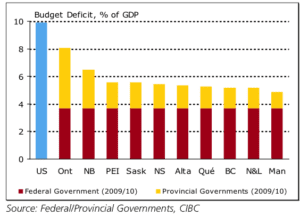
Media attention may still be firmly focused on athletes and tourists today, but we’re already starting to see hints about what will dominate BC’s post-Olympics discourse. The fear-mongering around our provincial debt and deficits is making a return