
- Home
- Topics
- Regions
- Magazines
-
-
-
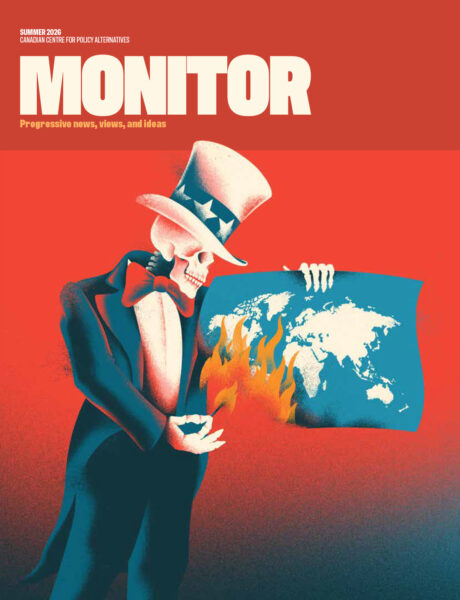
The Monitor
While world leaders are increasingly saying out loud that the postwar liberal world order is dead, the ruling classes in the Global North have an answer for what will come to replace it: fascism. Will they be able to implement their vision?
-
-
-
-
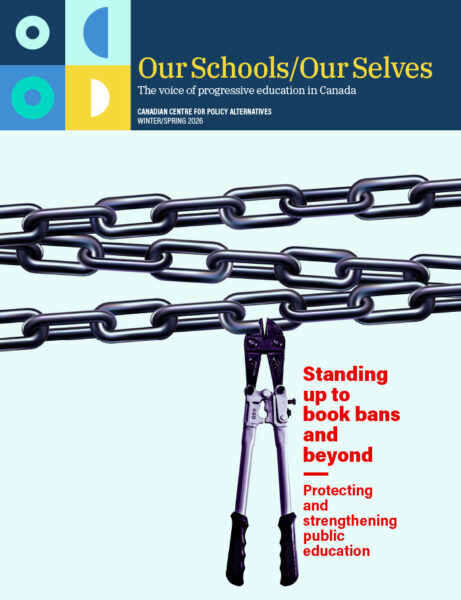
Our Schools/Our Selves
A guide to standing up to book bans and beyond, and how to protect and strengthen public education in Canada
-
-
-
-
- Media Inquiries
- Subscribe
- Legacy Gifts
- About
- Contact
- Donate Now
- Donate Now
Search results for “site/economics of childcare”
-

How clean is a BC that subsidizes accelerated fossil fuel extraction?
When the provincial government unveiled its new climate plan late last year, Environment Minister George Heyman, Green Party leader Andrew Weaver and Premier John Horgan presented a happy, united front as ceremonies got underway at Vancouver’s main library. But the biggest smiles of the day may have been on the…
-

Setting the record straight on the economics of banning fracking
READ THE FULL COMMENTARY HERE. HALIFAX – A member of the Nova Scotia Hydraulic Facturing (Fracking) Review Panel clarifies the economics of adopting a serious ban on exploration and exploitation of shale gas reserves in a new commentary released today by the Canadian Centre for Policy Alternatives-Nova Scotia (CCPA-NS). The…
-
L’insolvabilité de l’Université Laurentienne reflète une crise structurelle du système universitaire néolibéral en Ontario
Les gouvernements ontariens ont successivement réduit leurs subventions publiques envers les revenus d’exploitation des universités d’environ 80 % en 1980 à environ 50 % en 2004, et à seulement 38 % en 2017.
Les gouvernements ontariens ont successivement réduit leurs subventions publiques envers les revenus d’exploitation des universités d’environ 80 % en 1980 à environ 50 % en 2004, et à seulement 38 % en 2017.
-
Economics are for Everyone – A webinar with Jim Stanford and Lynne Fernandez
As part of CCPA-MB’S Supporter Drive, economist Jim Stanford, currently living in Australia, joined Lynne Fernandez in an interactive video platform to talk about Economics for Everyone. CCPA MB – Jim Stanford & Lynne Fernandez – Economics for Everyone take 2
-

Priming the pump
Scientist warns cumulative effect of thousands of fracked gas wells means powerful earthquakes ahead for northeast BC Massive amounts of water pumped with brute force into the earth at thousands of fracking operations is priming the pump for potentially deadly earthquakes in British Columbia’s Montney basin, warns a former top…
-

A Living Wage for Regina is $16.23/hour, Saskatoon is $16.89 per hour: Report
REGINA – The Saskatchewan Office of the Canadian Centre for Policy Alternatives calculates that a family of four would require a living wage of $16.23 per hour for Regina and $16.89 per hour for Saskatoon in order to maintain a decent standard of living in each respective city. The living…
-
Fracking in BC’s northeast
Last summer I got out of Vancouver and toured northern BC. While the trip was mostly for pleasure, my inner economist could not resist some industrial tourism and visits to resource towns and major industrial sites that are the heart and soul of BC’s resource economy. Forestry dominates near Prince…
-
After the rush: Fort Nelson needs firm government commitments to reclaim lands abandoned by fossil fuel industry
In the face of the economic fallout from COVID-19, it’s easy to forget that some communities in British Columbia were in deep fiscal distress long before the pandemic began. Fort Nelson is a good example, and a textbook case of why senior levels of government need to be mindful when…
-
Progressive Pricing
Making Childcare More Affordable in Manitoba Download 805.58 KB 36 pages In this paper, we review Manitoba’s childcare funding, the provincial parent fee model, and the costs paid by parents; assess who is using childcare, as well as the share of family income spent on childcare for families in different…
-
Rosenbluth Lecture 2021: Peter Victor, Slower by Design, not Disaster
The Gideon Rosenbluth Memorial Lecture was held virtually in February. The lecture is in honour of Gideon Rosenbluth, who was an esteemed professor of economics at the University of British Columbia and a research associate with the CCPA’s BC Office. As a young person, Peter Victor looked at the now-iconic,…
-
What’s Wrong with Site C
In a #SiteC tweet no doubt designed to complement an unabashedly political debate taking place in the legislature this week, the Liberal caucus stated that Site C is the most reviewed project in BC’s history, it will create 10,000 jobs and will provide affordable, reliable clean power. The tweet is…
-
Unionization key to Canadian middle class economics: study
OTTAWA—The share of unionized workers in Canada has dropped by only two percent over the past generation, but union representation dramatically affects workers’ ability to move up the middle class ladder, says a groundbreaking new study by the Canadian Centre for Policy Alternatives (CCPA).