

- Home
- Topics
- Regions
- Magazines
-
-
-
The Monitor
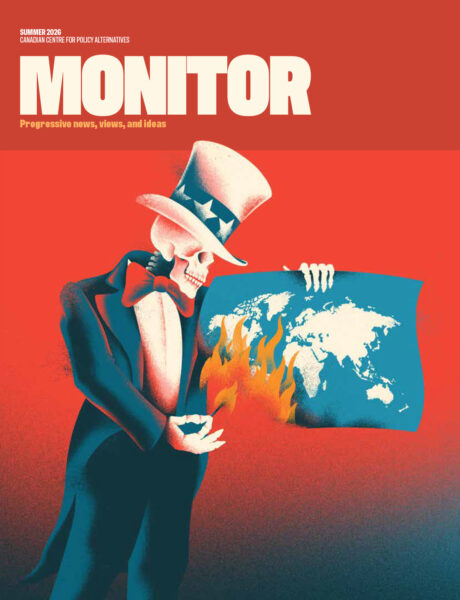
While world leaders are increasingly saying out loud that the postwar liberal world order is dead, the ruling classes in the Global North have an answer for what will come to replace it: fascism. Will they be able to implement their vision?
-
-
-
-
Our Schools/Our Selves
A guide to standing up to book bans and beyond, and how to protect and strengthen public education in Canada
-
-
-
-
- Media Inquiries
- Subscribe
- Legacy Gifts
- About
- Contact
- Donate Now
- Donate Now

Search results for “site/human rights”
-

Tradable Water Rights – Coming to a province near you
In January of this year, the BC government joined Alberta, Saskatchewan and Manitoba to become the fourth province to announce that it is considering creating tradable water rights as a way of curbing use and improving the efficiency of allocation. The announcement came as a vague reference to “water markets”…
-
Budgets more than numbers
The Nova Scotia Department of Finance recently launched an interactive “Back to Balance” website, giving community members an opportunity to try their hands at government budgeting. The site is technically sophisticated and informative. Users can move sliders to adjust the levels of various taxes and expenditures, and pop-up bubbles provide…
-
Fast Facts: Meeting the housing needs of Aboriginal people moving to Winnipeg
Winnipeg is home to Canada’s largest Aboriginal population. Aboriginal people, however, are among the most likely to experience homelessness and are also over-represented in housing that is unaffordable, overcrowded or in poor condition. Finding housing has become a wall preventing many Aboriginal people from successfully making Winnipeg home. Moving to…
-
Youth Voices: Harper’s Crime Strategy
Closing the Doors on Youth On November 12th, 2010, the federal government announced an investment of $45 million to increase the number of beds in Manitoba jails. Steven Harper’s Conservative government has made it well known that getting tough on crime is a top priority. While there is evidence that…
-
Tough on crime will likely lead to more crime, bigger deficit: report
OTTAWA – The Harper governmentís tough on crime agenda will likely increase the incidence of crime and the deficit, says a new report released today by the Canadian Centre for Policy Alternatives (CCPA). The report, by CCPA Research Associate Paula Mallea, analyses the financial and human costs of the tough…
-
The Fear Factor
Stephen Harper’s “Tough on Crime” Agenda Download 982.08 KB 58 pages According to Statistics Canada, crime rates have been trending down for over 20 years. This includes the violent crime rate. Yet the Harper government continues to insist that there is an epidemic of crime, and that Canadians should be…
-

Half of BC workers lack access to “standard jobs” and 37% are in precarious employment, groundbreaking survey finds
CLICK HERE TO VIEW THE FULL REPORT VANCOUVER – A study released today by the Understanding Precarity in BC partnership reveals a polarized labour market in which precarious work is far more pervasive than many assume and includes much more than “gig work.” The pilot BC Precarity Survey is the…
-
A windfall for BC’s five biggest forest companies?
Shortly before the May election, the provincial government withdrew legislation that could have handed de facto control of publicly owned forestlands to a handful of forest companies. The contentious sections of the bill were dropped amid a swelling chorus of questions about why such a gift would be bestowed without…
-
December 2004: Waste Not, Want Not
One of our most precious resources flushed down the drain Nearly a century ago, when Dr. F. H. King visited China, Japan and Korea, he found that the “fertilizer” used by their farmers to produce bountiful crops was human excrement. In his 1911 book about Asian agriculture, Farmers of Forty…
-
Time to move beyond the debate on assisted suicide
The long smouldering debate on physician-assisted suicide (PAS) flared up early this summer when on June 5 the Quebec National Assembly passed Bill 52, An Act respecting end-of-life care. The legislation gives patients in some situations the possibility of requesting medical aid in dying, widely considered a euphemism for euthanasia.…
-

Exploitable and deportable by design: Why migrant workers’ housing is harmful to their health
Canada’s treatment of migrant workers is drawing international scrutiny after UN investigator Tomoya Obokata warned that its Temporary Foreign Worker Program “serves as a breeding ground for contemporary forms of slavery, as it institutionalizes asymmetries of power that favour employers and prevent workers from exercising their rights.” Migrants, activists, and…
-
October 2004: Nortel Implicated in Disastrous Liquidation of Columbia’s Telecom
Nortel Networks, Canada’s largest high-tech corporation, has helped bring about the liquidation of TELECOM, Colombia’s biggest telecommunications company, and the likely privatization of its successor. Brampton-based Nortel has assets of U.S.$15.8 billion, 37,000 employees and a presence in 150 countries. Plummeting global demand for telecommunications equipment and poor management have…