


Share
Canadians like to see ourselves as defenders of democracy, human rights, and the rule of law, at home and internationally. Yet recent foreign policy decisions suggest a very different reality.
Ottawa is pursuing trade, investment, and security agreements that privilege corporate access and geopolitical leverage, even when doing so aligns Canada with governments implicated in repression, environmental harm, or grave humanitarian crises. The prime minister has described this approach as “principled and pragmatic,” as “values-based realism.”
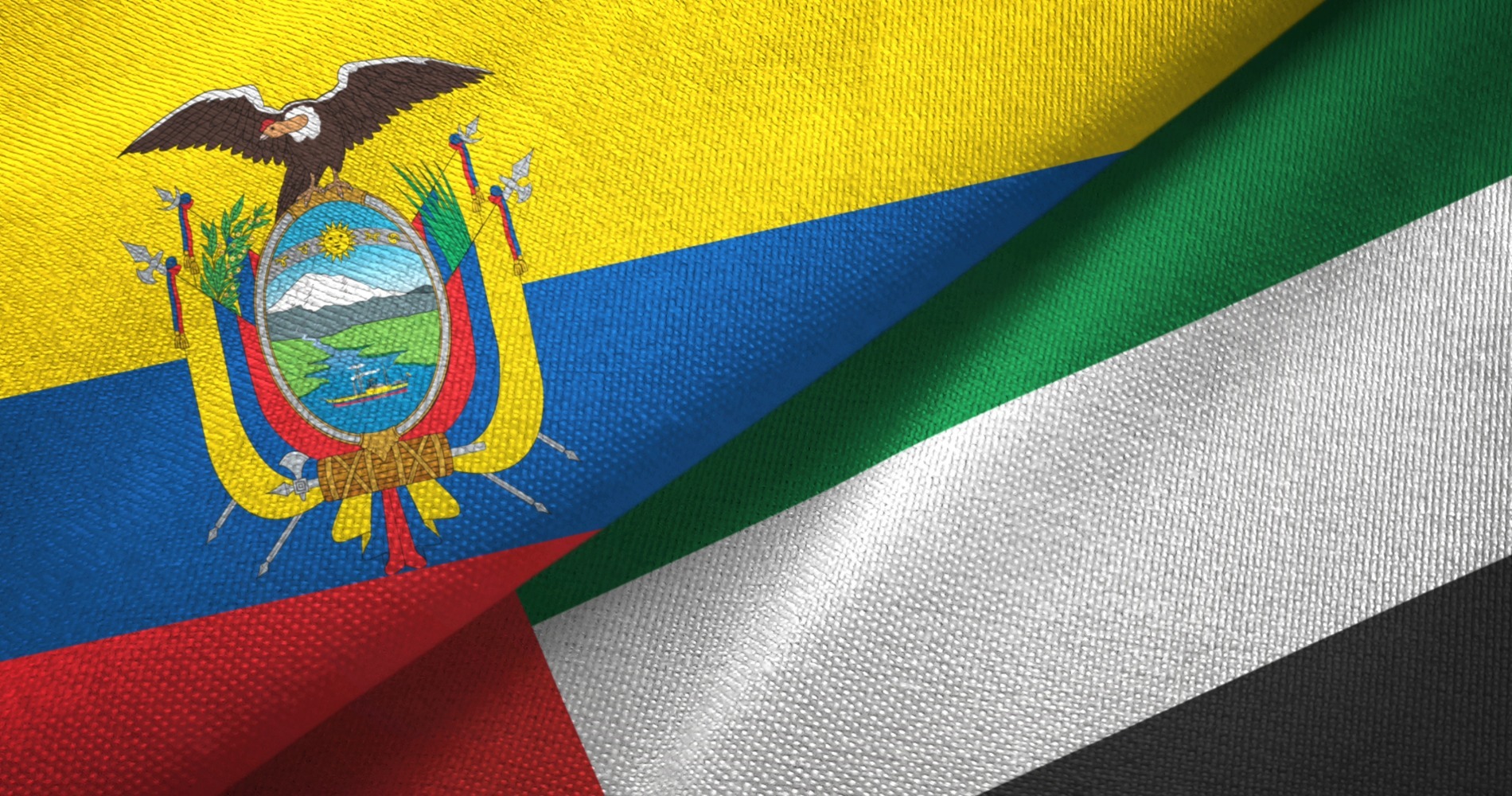
The question Canadians should be asking is simple but uncomfortable: what values are we actually exporting? Consider Canada’s newly signed free trade and investment deals agreements with Ecuador and the United Arab Emirates (UAE).
UAE: Partnering with human rights abusers
Canada signed a Foreign Investment Promotion and Protection Agreement (FIPA) with the UAE in November 2025. This was complemented on July 24 with a rapidly negotiated Canada-UAE Comprehensive Economic Partnership Agreement (CEPA). Prime Minister Mark Carney framed these agreements as a gateway to “billions in bilateral investment,” particularly in critical minerals, energy, infrastructure, AI, and ports.
The message was that Canada is positioning itself as open for business—and, more importantly, for investment, no matter where the money is coming from. But the UAE is hardly a neutral or benign partner. It has a documented record of suppressing dissent, restricting free expression, and exploiting migrant labour. It is also expanding fossil fuel production at a time when climate urgency demands the opposite.
More troubling still is the UAE’s role in the war in Sudan—one of the world’s worst humanitarian catastrophes. Since April 2023, Sudan has been devastated by mass displacement, famine, and widespread violence, much of it perpetrated by the paramilitary Rapid Support Forces (RSF).
The RSF has been accused of ethnic cleansing and atrocities, particularly in West Darfur. Sudan brought proceedings against the UAE at the International Court of Justice in 2025, alleging that Emirati financial and logistical support had helped sustain the group’s campaign of violence (the proceedings were rejected on jurisdictional grounds). Investigative reporting has shown that the RSF controls gold-rich territory and that much of Sudan’s gold flows through UAE markets, providing a critical revenue stream that prolongs the conflict.
Against this backdrop, Canada’s decision to deepen investment ties with the UAE raises serious questions about complicity and accountability.
Ecuador: Attacking the constitution
The same can be said for Canada’s recent free trade agreement (FTA) with Ecuador, also signed last Friday.
The Trudeau government formally launched free trade talks with Ecuador in April 2024 (though exploratory discussions started in late 2022), while Ecuador’s democratic and human rights situation deteriorated sharply. The government has only become more authoritarian and heavy-handed since then.
Under current President Daniel Noboa, the government has relied extensively on militarization to suppress protests and dissent. Human Rights Watch and Amnesty International have documented extrajudicial killings, arbitrary arrests, ill-treatment of detainees, and enforced disappearances linked to sweeping states of emergency that suspend fundamental rights.
Ecuador’s government has used its security strategy to advance mining projects owned and operated by Canadian companies. In Cotopaxi province, communities opposing projects such as La Plata and Curipamba–El Domo have faced violent dispersals, criminalization, and state repression. At least 29 environmental and human rights defenders have been targeted with criminal proceedings, often resulting in convictions and harsh fines for peaceful protest that effectively recast community defenders as alleged “terrorists.”
In Azuay province, Canadian mining company Dundee Precious Metals has brought criminal charges against community leaders following a peaceful cleanup “minga” (a traditional communal work gathering) in the páramo, a unique ecosystem in the highlands. These actions followed setbacks for the company, including the revocation of its environmental license and a complaint with the Ontario Securities Commission regarding undisclosed project risks.
Public resistance has been widespread. Tens of thousands of Ecuadorians have mobilized to defend water, land, and Indigenous rights, particularly in Cuenca and across Azuay, where communities oppose mining in highland páramos that supply critical water sources. Human rights organizations have raised alarm over the state’s repression of social protest, including freezing activists’ bank accounts, and targeting civil society and Indigenous leaders. UN experts have called on Ecuador to protect Indigenous rights, peaceful assembly, and due process—cornerstones of democratic governance.
Yet Canada’s trade strategy with Ecuador, far from showing “values-based realism,” will lock in investor privileges precisely as democratic safeguards erode. Negotiated despite strong opposition from Indigenous nations, environmental defenders, and civil society groups, the FTA threatens to deepen socio-environmental conflict by strengthening corporate leverage while communities face repression and weakened rule of law.
Even more concerning, Canada’s agreement undermines the clearly expressed democratic will of Ecuadorians themselves in at least two ways.
First, the FTA contains an investor-state arbitration process that grants foreign investors the right to bypass Ecuadorian courts and sue the State before international tribunals—a mechanism Ecuador’s Constitution explicitly prohibits.
That prohibition was the result of a long struggle. By 2008, investors had sued Ecuador more than a dozen times under various investment treaties, draining public finances and limiting regulatory space.
The years that followed vindicated that caution. In 2012, a tribunal ordered Ecuador to pay U.S. oil company Occidental Petroleum roughly USD 2.3 billion, including interest, after the state terminated its concession for breach of contract. The award amounted to 59 per cent of Ecuador’s education budget and 135 per cent of its healthcare budget. These experiences led Ecuador to audit and terminate all its investment treaties by 2017.
Second, the agreement overrides a ban that Ecuadorians have since reaffirmed twice at the ballot box. Successive governments—from Lenín Moreno to Guillermo Lasso and now Daniel Noboa—have attempted to reintroduce international arbitration into Ecuadorian law. Voters have refused them each time.
In April 2024, 65 per cent voted against removing the constitutional ban. In November 2025, nearly 62 per cent rejected a proposal to draft a new constitution, widely seen as a backdoor attempt to reinstate international arbitration and roll back protections for Nature (“Pachamama”) and collective well-being (“Buen Vivir”). Extractive companies openly describe those protections as “obstacles to foreign investments.” Two referendums in less than two years, two decisive “no” votes.
The message could not be clearer. Yet Canada’s FTA cynically re-embeds precisely the system Ecuadorians have repeatedly rejected, allowing corporations to challenge public interest laws before private tribunals made up of trade lawyers moonlighting as arbitrators. In doing so, Canada risks aligning itself not with democratic sovereignty or environmental justice, but with predatory corporate interests—at a time when many countries around the world, including within the EU, are rethinking or abandoning these regimes altogether.
What “values?”
Taken together, these agreements with Ecuador and the UAE reveal a troubling trajectory. Rather than standing apart as a principled actor, Canada is deepening ties with states whose legal systems and human rights records are deeply flawed, prioritizing resource extraction, corporate access, and security cooperation with minimal or inadequate public debate. Where the Canadian state once spoke of people and the planet, it now answers to capital.
Is Canada truly acting in defence of democracy, human rights, and the rule of law, or is it prioritizing short-term profit and geopolitical advantage? If the latter, how can the government possibly say its foreign policy is principled or “values-based?” When Canada consistently partners with repression, environmental destruction, and the erosion of sovereignty, Canadians must ask whose values policymakers are advancing, and at what cost.
About the author
Ladan Mehranvar
Ladan Mehranvar is a lawyer, advisor, and legal researcher. Her work centers on the international legal frameworks governing foreign investment and their consequences for sustainable development.

