

Share
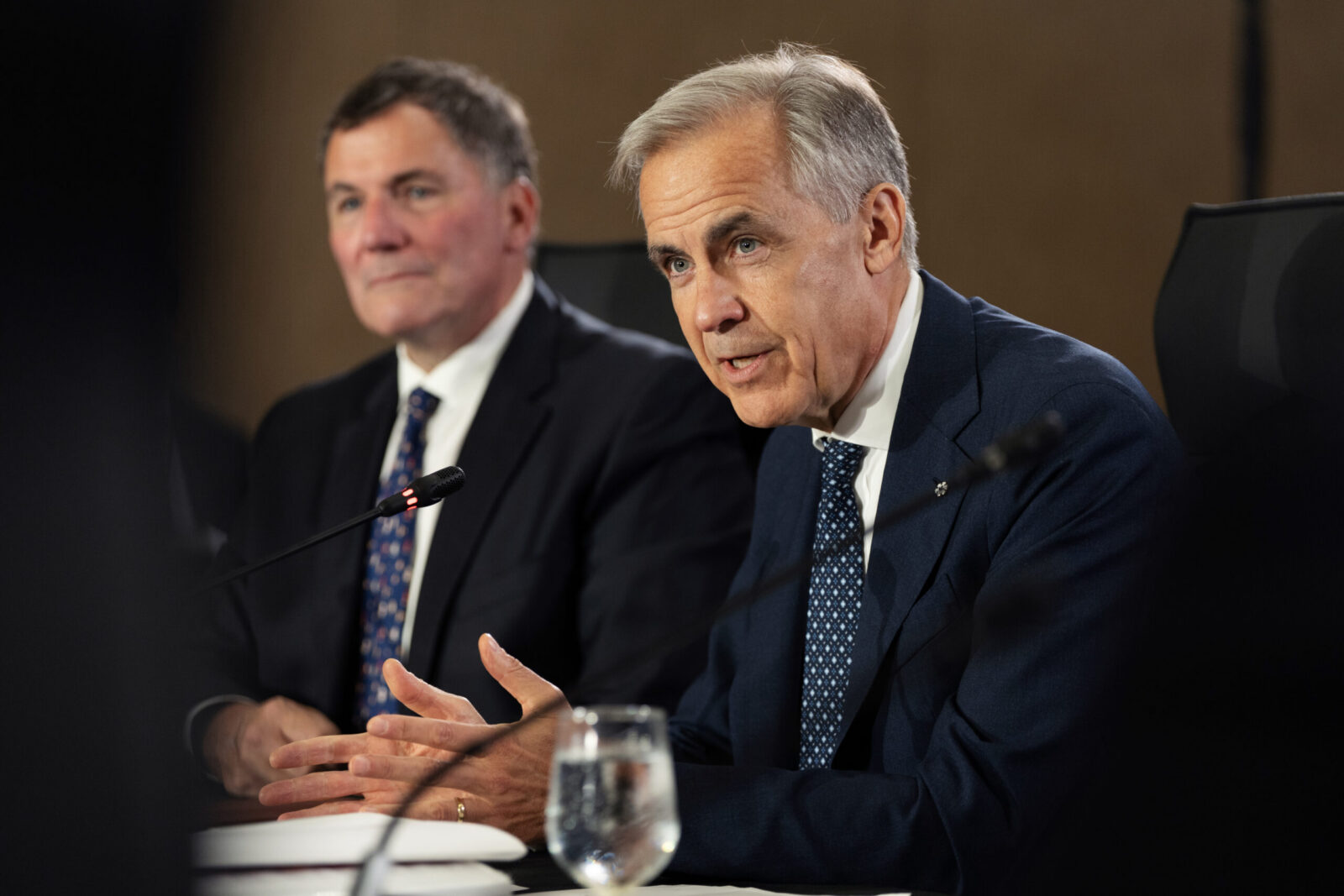
The tectonic plates of North American commerce bulged last weekend when Prime Minister Mark Carney walked his negotiating team away from the U.S. trade table and back to Canada. With a deal rumored to be close, the terms of such a deal, as leaked via the media, pointed to a capitulation. The feds appeared to be testing the line that a deal was better than feeling the brunt of new tariffs that were about to be implemented.
The bully, once he’s got your lunch money, isn’t going to stop coming back for more. Any trade peace from the U.S., in the remainder of the Trump administration or whatever follows, would have been highly uncertain. Canada would inevitably be back to another negotiating table making further concessions to avert another round of tariffs a year from now.
Thankfully, with a broad mandate from Canadians for an “elbows up” approach, and apparent agitation by at least a few premiers, Carney stood firm against U.S. pressure tactics. We review what comes next: the new section 338 tariffs of 50 per cent; Canadian retaliation against the new tariffs; and the need for deeper industrial and trade policies to pivot the Canadian economy away from the U.S. But first, a look at the bad deal on the table.
The deal, rejected
The draft text at the time negotiations collapsed will not likely be released. The centrepiece of the deal would have seen Canada drop its retaliation against American tariffs—removal of U.S. liquor from the shelves of most provinces, bans on government procurement from U.S. companies and tariffs on some American imports—in exchange for reduced but not eliminated sectoral tariffs in steel, aluminum and automotive.
In steel, Canada would have disarmed, lowering its retaliatory tariffs on U.S. steel to zero while the United States applied a 25 per cent tariff on all Canadian imports up to a low tonnage quota, above which the tariff popped back up to 50 per cent. In other words, a very, very lopsided arrangement that maintained a terrible investment environment.
In automotive, the U.S. tariff on finished vehicles would have been reduced to 15 per cent, down from 25 per cent, but only for cars, not trucks, with the value of U.S.-origin parts exempted from the tariff. Unifor, the union representing Canadian autoworkers, warned that any effective tariff rate higher than four or five per cent creates a permanent incentive for U.S. and international auto manufacturers to leave Canada.
Prime Minister Carney also flagged language that would have prohibited Canada from entering into other trade deals and that would restrict language and culture protections. Other sources report Canada was asked to change how it regulates dairy imports, concede ground on cultural policy and digital sovereignty, buy more U.S. armaments and give the American buyers the right of first refusal on Canadian critical mineral production.
What comes next?
The deal, as reported, might have bought Canada time to strengthen our east-west linkages and engage in focused industrial policies that strengthen Canadian supply chains and diversify trade relationships. Yet, by locking Canada even further into the U.S. orbit, we may easily have lost interest in doing this hard work. And the concessions would have locked in a weakened Canadian position that deviates from what we signed under CUSMA.
A top priority is worker and business support for sectors threatened by Trump’s new Section 338 tariffs on a wide range of manufactured goods. Many companies have claimed they will go out of business if they can’t sell into the United States. COVID-level worker subsidies and temporary layoff programs are in order, along with tailored shifts to Employment Insurance (to make it simpler to access) and more resources to the government workers who facilitate the program.
Carney’s day-after speech emphasized dollar-for-dollar retaliation to protect the Canadian sectors affected by the Section 338 tariffs of 50 per cent. In a number of these areas, there should be good opportunities to transition Canadian exports to the domestic market. The new retaliatory measures will be announced shortly and will take effect after Labour Day.
However, tariffs increase costs for Canadian households and businesses, so the key should be targeted retaliation in strategic areas, not achieving some dollar target. This is particularly important for tariffs on imported intermediate or capital goods. There may be Canadian substitutes for inputs currently sourced in the United States. More proactive supply chain information-gathering and match-making is needed to retool the Canadian economy and boost domestic capacity to service the Canadian market.
Production lost to exports may be useful to businesses elsewhere in Canada, but distance and transportation costs are substantial (not alleged internal trade barriers, as some have argued). The government should urgently find ways to lower freight and trucking costs, through the introduction of public competition if necessary. The government’s recent freight subsidies for moving heavy steel products between provinces are a step in the right direction but too hands-off a strategy for encouraging domestic use of domestic industrial inputs and diversifying the kinds of steel products we make here.
In addition, just as removing alcohol from U.S. shelves hit a nerve in key producing locations, an overlay of strategic geography, with the U.S. mid-terms in sight, might focus some of the tariff pain in areas where there is strong Trump support. A number of key Republican border states, such North Dakota and Montana, send the vast majority of their exports to Canada, and for a large majority of U.S. states (36 out of 50), Canada is their top export destination.
Defence procurement is another area where non-tariff measures could be effective. Dropping Canada’s proposed purchase of U.S.-made F-35s makes double sense, as it would be foolish to create an even deeper reliance on American hardware, software and long-term maintenance.
Canada should also not be shy about putting major resource sectors on the table, including oil and gas, electricity and potash. These areas have been carefully shielded from U.S. tariff actions and a Canadian export tax would lead to almost full pass-through into higher costs for Americans. Unfortunately, some of those costs would also be passed on to Canadian importers. For example, we buy about $20 billion worth of refined petroleum (fuels, but also condensate to ease the flow of heavy Alberta crude through pipelines) and tens of billions in chemical products from U.S. sources each year.
An export tax should be designed carefully with the purpose of encouraging more domestic production of these goods in Canada. Paired with an import substitution strategy, an export tax would complement longer-term economic and employment goals and make Canada less reliant on the U.S. market.
Mining is also, er, critical. Rather than give the U.S. a first right of refusal over Canadian critical minerals development and exports, Canada needs to deepen its domestic capacity and, importantly, figure out what minerals we believe to be critical to our economic future—and how to develop and upgrade them sustainably, with full social licence. Crown corporations may be more appropriate to this task than private mining, with public spending directed to internal rather than export-based trade infrastructure.
Another big, unanswered question is how this non-pre-deal relates to the ongoing CUSMA review or parallel U.S.-Mexico trade talks. Trump told the media Friday afternoon that talks with Mexico would restart after a deal is reached with Canada, while Mexico’s economy minister said he expected a similar agreement to be reached with the Americans. With the Canadian talks in limbo after Carney’s walk-out, could a door have opened to trinational conversations about some of the bigger picture items, including the CUSMA review?
The CUSMA review, which may be postponed for a while, was to cover some technical (e.g., minimum North American content requirements for tariff-free automotive trade) and some very political demands from the United States, such as alignment with Trump’s investment screening and export restrictions for Chinese companies, alignment on artificial intelligence regulation and “critical” minerals, and common external tariffs. Canada and Mexico are stronger together in any circumstance.
The vision thing
We can thank Donald Trump for one thing: he has brought Canadians together, from coast to coast and on the left and right. That energy needs to be funnelled into forging a better, unified Canada. Not just boosting the throughput of resources but building an economy that leverages those resources to strengthen the foundation of Canada’s economic life.
Canada may still be considering a leap of faith back into Fortress North America, as proposed by the Ontario government and large parts of the business community. Read between the lines of the prime minister’s Saturday announcement and the issue seems to be more with the lopsidedness of the deal on offer than with the content of renewed cooperation.
Carney has, on several occasions, welcomed closer Canada-U.S. energy, security and military ties, including the participation in lavish military procurement and exercises like the Golden Dome. The delayed introduction of dollar-for-dollar retaliatory tariffs suggests the prime minister is open to concluding such a deal in the next week or so, prior to Labour Day.
Canada is now on a high wire act without a net. And while there are legitimate fears about falling, Canadians need to remember that our country has the resources, infrastructure and know-how to use this moment and come out stronger on the other side.
About the authors

Stuart Trew
Stuart serves as director of the CCPA’s Trade and Investment Research Project (TIRP), which pools the expertise of academic, labour and non-governmental organization researchers to understand the impacts of trade and investment treaties and policy on the Canadian economy, public services, human rights and international relations.

Marc Lee
Marc Lee is a Senior Economist with the Canadian Centre for Policy Alternatives. Marc joined the CCPA’s British Columbia office in 1998, and is one of Canada’s leading progressive commentators on economic and environmental policy issues. From 2009 to 2015, Marc led the CCPA’s Climate Justice Project (CJP), which published a wide range of research on fair and effective approaches to climate action through integrating principles of social justice. Marc continues to write about climate and energy policy, strategies for affordable housing, federal and provincial budgets and macroeconomics. Marc has an MA in Economics from Simon Fraser University and a BA in Economics from the University of Western Ontario. Marc is a past chair of the Progressive Economics Forum, a national network of heterodox economists. He also served as a Visiting Professor at Simon Fraser University’s School of Public Policy in 2024 to 2025.