




Share
While America has long been styled the ‘land of opportunity’, Canadians similarly like to think of ourselves as a just and fair society with equality of opportunity. This ‘Canadian Promise’ is a bedrock of Canadian identity, heralded by leaders from all sides of the political spectrum. But it is becoming harder to believe.
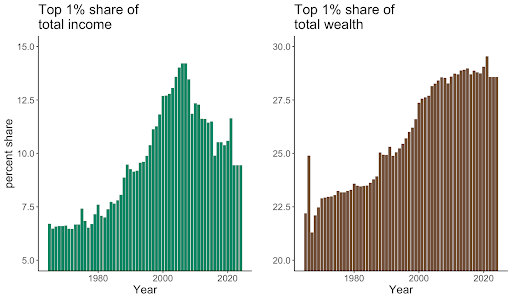
Over the past three or four decades, Canada has seen skyrocketing inequality, coupled with a growing ‘stickiness’ in wealth and opportunity across generations. A 2021 report published by Statistics Canada found that later in life, earnings have come to depend more and more on parental income.
This ‘rich get richer’ dynamic can intensify disparities across generations and amplify the importance of being born into the right circumstances; quite the opposite of a meritocracy.
Canada’s inequality of opportunity extends beyond just income and career prospects. Access to top positions in industry, politics, and other prestigious fields also remain largely closed off to those lucky enough to have the right identity and background, which in Canada has historically favoured white men.
The sort of disparities that we see in Canada today don’t happen by accident; they are the result of systemic forces that play out across generations.
My colleagues and I at Societal Dynamics (SoDy)—the ‘historical policy lab’—together with our partners at the Seshat Databank, have explored hundreds of historical and contemporary societies from all parts of the world. In too many cases, we find stark inequalities and social disparities akin to what Canada is experiencing today, often with disastrous consequences like civil warfare or even societal collapse.
We call this process the wealth pump; the institutions, rules, and structures of society that allow the lion’s share of wealth and prestigious positions to flow into the hands of a small minority of the population.
This often starts small: a few lucky individuals get hold of coveted positions in business, government, and other fields. This gains them social prestige and, typically, substantial wealth. These individuals can then afford the best schools and tutors for their children, who inherit not only their parents’ material resources but also family connections and insider cultural knowledge about how to succeed (often called ‘hidden curricula’).
As long as the wealth pump keeps flowing, these advantages accrue one generation after the next until a relatively small initial gap in success becomes a huge chasm in life outcomes. Unfortunately, Canada’s wealth pump has been gushing for decades—since at least the early 1980s.
If not a meritocracy, what are we?
A true meritocracy, where opportunity and prosperity are blind to identity, wouldn’t exhibit the disparities we see across age, race, sex and gender, and other aspects of social status and identity.
So what kind of system does Canada have? One where opportunities are shrinking and quality of life is diminishing for a large segment of the population, while the means to secure life success and fulfillment are largely passed on intergenerationally.
Perhaps ‘inheritocracy’ is the appropriate label.
Housing offers a clear illustration of this. Owning a home not only provides stable, long-term shelter, it has also traditionally been a key mechanism of upward social mobility. As housing prices have risen in recent years, though, this opportunity has disappeared for large numbers of people.
Even renting is becoming increasingly challenging. This is felt acutely by the younger generations. Property values among homeowners was recently shown to be significantly tied to parents’ home values especially in urban areas, highlighting the pull of intergenerational wealth in securing valuable housing.
One exception to this is found in our universities. Canada has one of the best public post-secondary education systems in the world. Many of our top schools have been making small, but notable, gains in diversity and inclusion in student representation.
Yet the wealth pump undermines the impact of post-secondary education on life success. Having a degree from a prestigious program is not the guaranteed path to upward social mobility that it once was.
One 2025 report notably found that 41.2 per cent of bachelor’s degree holders are “underemployed,” meaning they work in roles that typically do not require a degree, while another found a growing mismatch between rising graduation rates and a shrinking number of vacancies in degree-requiring jobs.
These trends make it both more important and more challenging to be among the lucky few able to grab hold of one of these rare spots, because the risk of not having them on life quality keeps getting more pronounced. The wealth pump churns along.
Restoring the Canadian promise
Problems as deep, systemic, and long-lived as these offer no easy fix. Still, many solutions have been offered to address these challenges, including from the pages of this magazine (see, notably, the Monitor’s 2023 special issue on ‘Canada’s Inequality Problem’).
Policies like (re)introducing progressive taxes on capital gains, on ultra-high household wealth, on large intergenerational transfers through inheritance or gifts, and on high-end corporate earnings can help break the cycle. Such fiscal measures can be made even more effective if introduced alongside efforts to reinvigorate collective bargaining procedures and strengthen policies around fair and inclusive hiring practices.
The revenue gained from such reforms can help level the playing field for securing high quality of life through, for example, affordable housing initiatives, public health care, and education reform to close the gap between the students we produce and the (lack of) secure jobs available to them.
One thing, though, is clear: without shutting down Canada’s wealth pump—the engine that drives so much of the dynamics discussed here—little progress can be made. The Canadian Promise is fading. Reversing the spiraling inequality we have allowed to accumulate over the last two generations is the only chance we have to even approach “a system where individuals succeed based on their abilities, efforts, and achievements—not their background or social status”.