



Share
“We believe our province can compete with any jurisdiction on Earth,” Alberta Premier Danielle Smith recently said, reacting to Meta’s plans for a $13 billion data centre north of Edmonton. “Alberta is well on the way to becoming a central player at the heart of the AI revolution.”
Smith is far from alone in pursuing AI investments. At every level of government, politicians are scrambling to attract the favour of tech oligarchs. Over $2 trillion has been invested in AI already.
A productivity tool that drafts form letters or writes code is not the kind of thing that attracts trillions in investment. That, and the resulting political power, comes from a story about millions of jobs replaced by AI agents.
The oligarchs are keenly aware that their power depends on entrenching the narrative that keeps the money flowing. The story depends on a few key elements: AI is inevitable, if you don’t embrace it you’ll be left behind, and it is the most powerful way to solve our biggest problems.
Where is civil society?
The story is a rallying flag for billionaires to coordinate a world-historic power grab. The concentration of control they are projecting is scarcely comprehensible. Even with just a story and some impressive tech, they have the money to buy a lot of narrative power—and suppress alternative ways of understanding the situation.
Media coverage reinforces the AI industry narrative. Even when there is criticism, it happens against the backdrop of an inevitability that smuggles in corporate power.
The dominant voices are government officials, policy experts, and occasionally academics. Public opinion appears occasionally, mediated by pollsters. When community groups or civil society appear at all, it is at the margins.
And that’s unfortunate: civil society is our best hope for a compelling and grounded alternative to the dominant AI narrative.
Editorial decisions to the side, civil society has largely not been able to create a narrative that can punch through. Non-profits, unions, foundations, and researchers are not immune to the flood of money and its disorganizing effects.
Since lots of civil society orgs (or individual employees) use AI, many feel like they can’t criticize the companies that create it. This muddying is hyper-amplified by the enormous funding for promotion of AI. The federal government alone allocated $174 million to AI adoption initiatives, including funding for non-profits. Tens of millions more have flowed through AI leadership training, with Microsoft and Google as major players.
Universities are swimming in funding infused with the inevitability narrative. In the U.S., three of the biggest university donations from industry total $1 billion, a sum that seems large until you realize that it is one one-hundredth of one per cent of the capital the industry plans to spend on data centres alone. Universities in Canada are opening the doors to corporate donations and massive private gifts for AI training.
Trade unions are also not immune. Union members’ workplace experiences with AI range from helpful tech to dystopian surveillance. And even here, the big tech money is pouring in. One fund is partnering with teachers’ unions to train educators in AI, and building trades have a similar partnership with Microsoft.
Despite these obstacles, NGOs, unions and academia have produced some excellent critical work. But how can they elevate it to actually impact the debate about AI—and public policy?
Strategy for civil society
Faced with an extremely powerful industry that is broadcasting its narrative on every available channel, civil society will have to be disciplined to get an alternative message through.
The first step must be to address the pernicious influence of the industry. It’s probably not possible to get everyone to stop accepting government and industry “AI literacy” money. The important thing is to create spaces that are explicitly critical of the power of the tech oligarchs.
One such space is the emerging Civil Society Hub for Tech Justice, a network of academics, unions and non-profit leaders that came together after the Civil Society Summit on the AI Industry in Montreal in May 2026. But one place to have a conversation that doesn’t get derailed isn’t enough. To develop common messages and strategies, we need critical working groups, caucuses and even secret meetings—at conferences, within boards, and in workplaces.
Once we carve out the space to discuss deeply, we will still disagree on a lot. There will be debates about technology, acceptable types of AI, and environmental and social impacts. Many will not be resolved.
And because we’re famously in silos, everyone is obligated to represent their issue as the primary frame. Journalists facing intellectual property theft and the destruction of their industry are not likely to find a common top-line message with parents working on the mental health effects of large language models, community members fighting a data centre, or advocates working to curb digitally enabled gendered violence.
A civil society should focus on shared narrative infrastructure. In the same way that the AI industry narrative comes back to “this is inevitable, get on board or get left behind,” civil society narratives can reinforce our understanding of an unprecedented concentration of money and power in the hands of a few tech oligarchs.
A narrative infrastructure strategy allows us to connect to a common source and weave in other struggles without losing control of our own messages.
A public sector union might say “the government is trying to replace workers with malfunctioning chatbots, because they’re under pressure from an industry that is spending billions to convince us to send our tax dollars to corporate headquarters instead of our neighbours and fellow citizens.”
An environmental activist might say “this data centre will create pollution equivalent to adding six million new fossil-fuel-burning cars to our roads, and the industry is wielding its enormous power to get the government to subsidize it—and the reason they have that power is because they have promised investors they are going to replace millions of workers.”
If every civil society actor commits to highlighting the same causes and weaving a tiny part of the web between related issues, it will create a story that has a real chance to break through.
Narrative infrastructure
AI has become the banner under which billionaires are coordinating an unprecedented accumulation of power, and civil society can only respond effectively if it learns to connect its struggles rather than fight them separately.
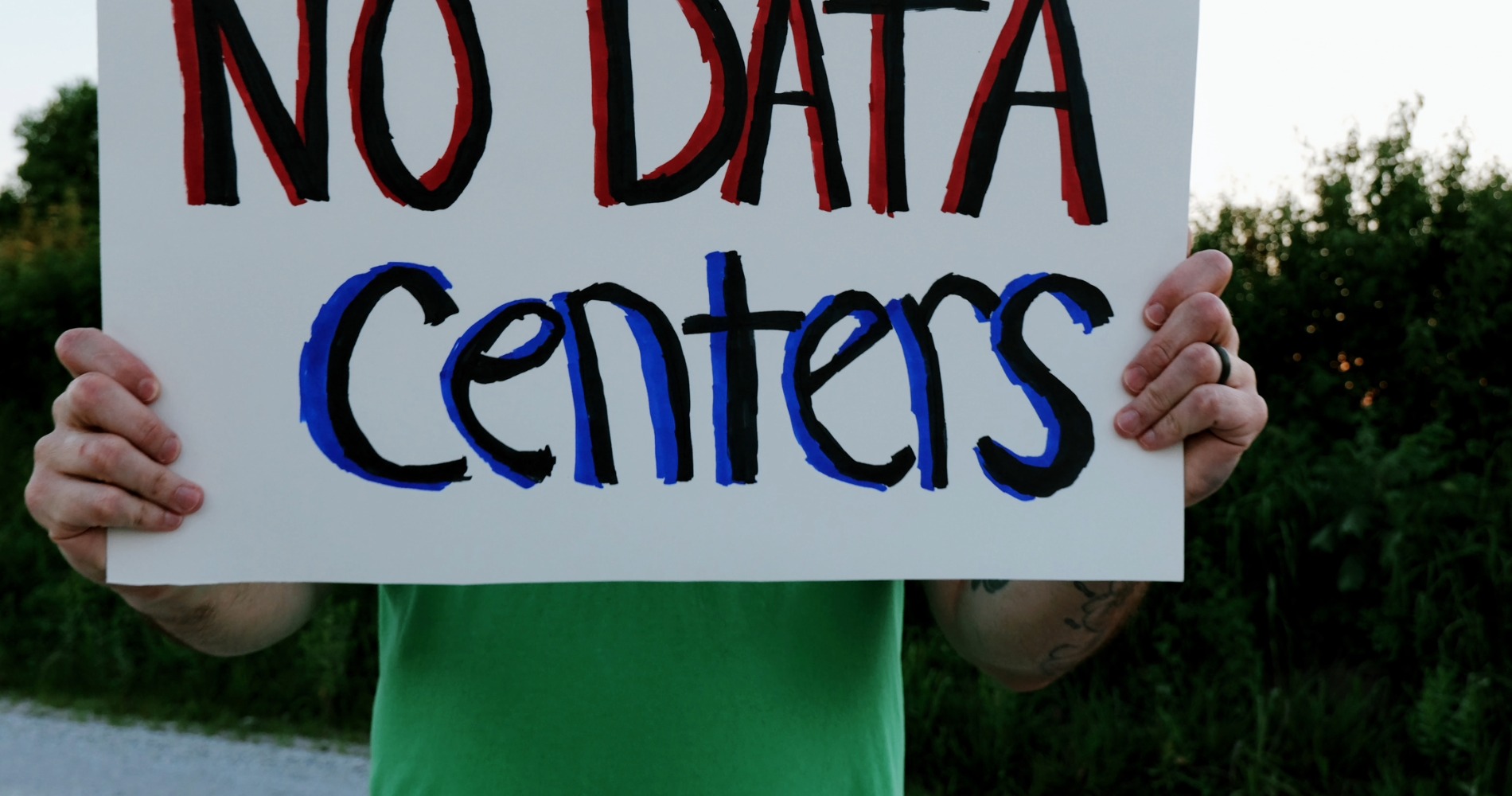
The AI backlash is well underway, and data centres and AI-everywhere is encountering resistance that is as fierce as it is instinctual and inchoate. The way that the narratives around data centres develop is, by default, mediated through algorithms. Civil society is uniquely positioned to mediate narrative development through something a bit more conscious.
Weaving our struggles together while telling a recognizable origin story for the ills of the AI industry will be key for adding depth to popular analysis, empowering the emerging resistance, and anchoring a new wave of activism in material realities and values of wide-reaching solidarity.
About the author
Dru Oja Jay
Dru Oja Jay is the executive director of the Council of Canadians. He co-organized the Civil Society Summit on the AI Industry in May 2026.