




By the numbers summary
- By 9:23 a.m. on January 2 Canada’s 100 highest-paid CEOs had already made what the average worker will make all year.
-
CEOs are enjoying another year of smashed records:
- Highest paid CEO in Canadian history: $205.5 million for Shopify’s CEO.
- Highest average pay for the top 100 Canadian CEOs: $16.2 million.
- Highest “minimum wage” for a CEO to get on the highest-paid list: $7.2 million.
- Biggest gap between CEO pay and average workers’ pay: 248 times.
-
Since 2020, CEO pay is up by 49 per cent and workers’ pay is up by 15 per cent. Compare that to the cost of living:
- Beef is up by 39 per cent, chicken is up by 27 per cent, bacon is up by 29 per cent, and pasta is up by 47 per cent.
- Rent is up by 26 per cent, home ownership is up by 29 per cent, utilities are up 23 per cent.
-
Corporate profits now exceed $600 billion a year, well above pre-pandemic levels:
- CEO pay now comprises of 84 per cent bonuses—bonuses that are based on corporate profits.
Soaring to even greater heights
The average pay of the 100 highest -paid CEOs in Canada soared to a new record in 2024 of $16.2 million. This bested the previous record, which was set in 2022, of $14.9 million for the highest-paid S&P/TSX composite CEOs.
CEO pay can be strongly influenced by extreme pay packages for those at the very top of the list. The highest-paid CEO in 2024 became the highest-paid CEO in Canadian history, making $205.5 million—for Shopify’s CEO. Over the 19 years that the CCPA has been tracking CEO compensation, we’ve never recorded a single year compensation package that high. The former highest-paid CEO was Valeant Pharmaceuticals’ CEO in 2015, who was paid $182.9 million.
The “minimum wage” required to get on the top 100 list also hit an all-time high in 2024, at $7.2 million—beating the previous record of $6.9 million from 2023.
For context, today’s highest-paid CEOs are paid more than double what they were paid in the late 2000s. CEOs used to be able to make it on the highest-paid 100 list by making a “meagre” $3 million. Now it takes over $7 million. The average workers’ wages have only gone up by half that proportion over the same period.
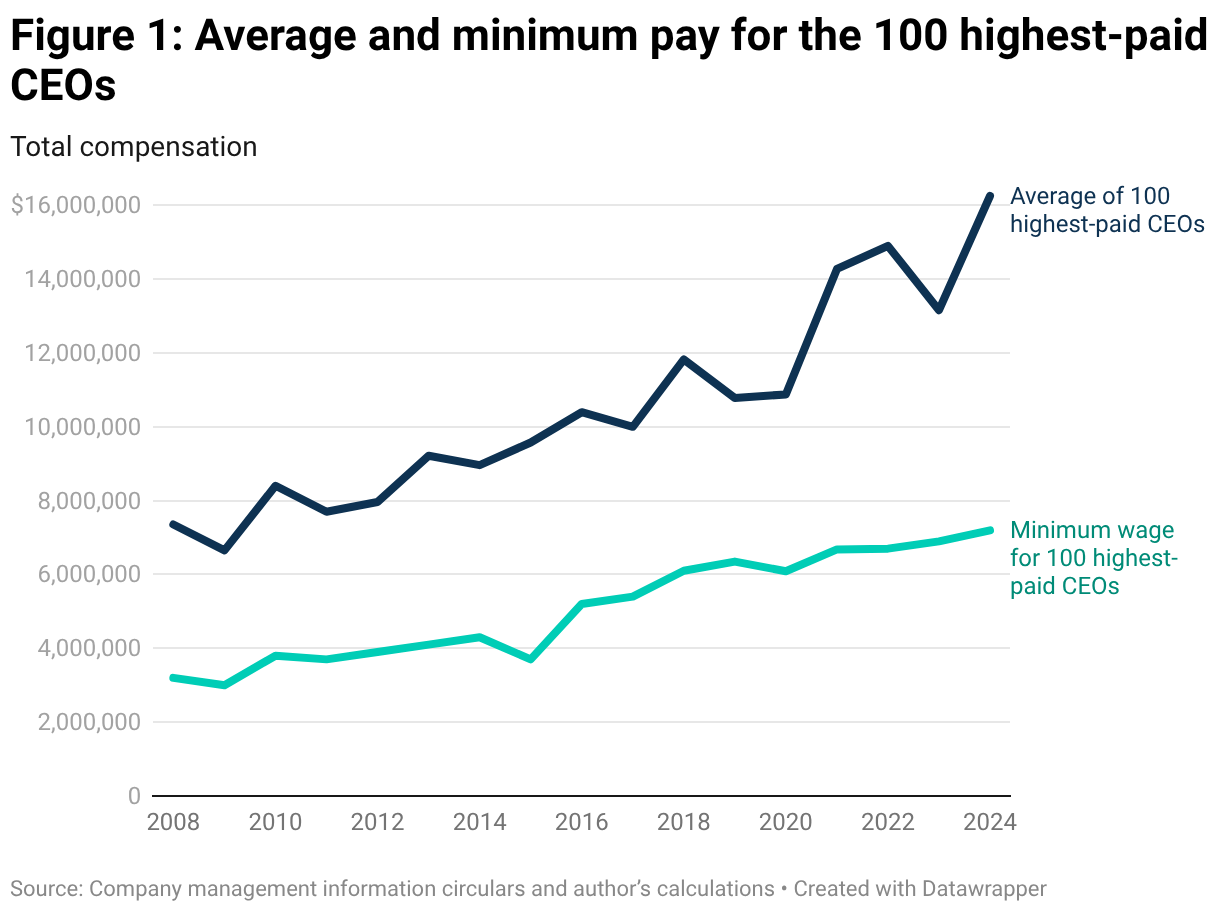
Average workers’ wages and CEO wages do go up over time, often to keep up with rising prices. Seeing new pay highs year after year isn’t nearly as concerning as the widening ratio of CEO pay to average workers’ pay: it hit a new all-time high. Canada’s 100 highest-paid CEOs now make, on average, 248 times more than the average worker in Canada. This beat the previous record of 246 times set in 2022.
In 2024, the average worker took home $65,548, which is up by almost $3,000 from the previous year. By comparison, average highest-paid CEO compensation went up by $3 million since the previous year—widening the ratio of CEO pay to average worker pay.
It’s challenging to represent massive disparities like a CEO making 248 times more than the average worker. Sometimes representing this in terms of time can help: the highest-paid CEOs made $7,812 an hour in 2024, equivalent to making $130 every minute of every working day.
If we assume both average workers and CEOs get paid vacation, then it takes just over eight hours on the first weekday of the New Year for Canada’s highest-paid CEOs to make what the average worker will make all year: $65,548. By 9:23 a.m. on January 2, the highest-paid CEOs already make what will take the average worker to make all year.

If we look back in time, CEOs made around 170 times more than the average worker in 2008. In the late 1990s, the ratio was 104 times.1Mackenzie, Hugh, The Great CEO Pay Race: Over before it begins, Canadian Centre for Policy Alternatives, December 2007, page 6. The data is somewhat less certain in the 1980s, as the gaps were much smaller and weren’t tracked in as much detail, but it was likely in the 40 to 50 times range.
CEOs have always been paid more than the average worker, but the gap has grown five times larger over the past four decades.
Inflation is easy to absorb, with a $5 million raise
Affordability is on everyone’s mind, thanks to the explosion in prices starting in 2021. The cost of everything has shot up, making it harder for Canadians to afford the basics. This certainly means squeezed family budgets, but it also means much worse consequences—like record-high demand for food banks2Food Banks Canada, HungerCount 2025: Food Banks as a Lifeline: Canada’s New Normal, Food Banks Canada, 2025, https://foodbankscanada.ca/hunger-in-canada/hungercount/. and unhoused populations camping out in parks with no affordable places to live.
In 2020, just before inflation reared its head, average worker pay stood at $57,024. As of 2024, it had increased to $65,548—a 15 per cent hike ($8,500) over those four years. Over the same period, the highest-paid CEO average compensation rose from $10.9 million to $16.2 million—a 49 per cent pay spike ($5.2 million) over those same four years.
The average price of goods and services that Canadians buy went up by 18 per cent between January 2020 and January 2025.3Statistics Canada, Table 18-10-0004-01 Consumer Price Index, monthly, not seasonally adjusted, January 2020 to January 2025, https://www150.statcan.gc.ca/t1/tbl1/en/cv!recreate.action?pid=1810000401&selectedNodeIds=2D3,2D7,2D8,2D11,2D25,2D28,2D81,2D84,2D91,2D92,2D184,2D316,2D330,2D368&checkedLevels=0D1&refPeriods=20200101,20250101&dimensionLayouts=layout2,layout2,layout3&vectorDisplay=false. Since workers’ pay went up by only 15 per cent over that period, it means that workers took an effective three per cent pay cut. Their pay went up, but the prices on everything they buy went up faster, so they ended up worse off by the end of 2024.
Over that same period, the cost of food in grocery stores went up by 22 per cent, well more than the 15 per cent pay raise the average worker got. Price spikes were worse for some more specific food items: the price of pasta went up by 47 per cent, just shy of the 49 per cent increase in CEO pay over this period. The price of beef went up by 39 per cent and eggs are 35 per cent more expensive than they were in 2020. These prices rose twice as fast as average worker pay, although still less than the CEOs’ pay increases. Bacon and chicken prices both rose by just under 30 per cent, or double the raises received by the average worker.

The biggest expense for Canadians—housing—has become more expensive as well. Not by as much as food, but they are a much bigger part of a household’s budget, so smaller increases have a bigger dollar impact. Often people believe food bank utilization is due to high food prices. They don’t help, but it’s usually high housing costs that make workers prioritize paying rent over buying food and, therefore, end up at a food bank at month’s end.
For the third of Canadians who rent, having wages go up by 15 per cent and rent go up by 26 per cent is going to put real pressure on any budget. CEOs, who probably aren’t renting, saw their compensation go up twice as high as rent. That luxury suite is just getting cheaper.
As interest rates rose, it also squeezed homeowners as their costs—mostly mortgage interest payments—rose by 29 per cent since 2020. The raise for the average worker over that period was only half that amount. In addition to basic housing costs, the cost of utilities jumped by 23 per cent, further squeezing household budgets. For CEOs whose pay rose by 49 per cent since 2020, covering these increased costs would not be a burden.

CEO pay bonused to the moon
CEO compensation isn’t like regular workers’ pay. Average Canadian workers receive a wage or a salary and that is their compensation. If they’re lucky, they might receive a pension or some sort of RRSP matching. But a wage or salary is how average workers are paid, with only a small proportion of workers who are paid mostly in bonuses, like sales commissions, for example.
CEOs are paid almost entirely in bonuses. In 2024, 84.3 per cent of CEO compensation was based on bonuses, a record-high proportion. These bonuses are called things like “performance-based pay” or “variable pay”, although that is a bit of a misnomer because these bonuses only go up and rarely down, as we’ll see.
The actual salaries that the highest-paid CEOs receive have been falling, in inflation-adjusted terms, since 2017. They now stand at roughly the same place as they did in 2009 and 2010. It isn’t uncommon for CEOs to take a salary of one dollar since this isn’t where the money is made anyway—it’s all on the bonuses side.

The reason why CEO pay is rising is higher bonuses, not higher salaries. The bonuses span three broad categories of compensation: cash bonuses, getting paid in shares (instead of money) and stock options. These types of pay are called “performance based” in that you get them if the company or the executive meets certain goals, like a particular share price or revenue growth or the completion of a particular project.
Hypothetically, if you don’t meet your goals, you don’t get the bonus, but that’s not how it usually works in the real world. COVID-19 was a great example of this in action because it was an event that hit all sectors of corporate Canada. The second and third quarters of 2020 were terrible for corporate profits. As a result, many bonus-based goals were missed.
You’d think this would mean no bonuses in corporate Canada, but you’d be wrong. Half of the CEOs on the 100 highest paid list that year either just changed their goals, after the fact, to exclude those quarters in some way, or they received government bailouts—or both. It’s a game of when things are bad it’s not the CEO’s fault, so they get their bonus anyway and if things go well, it’s all the CEO’s doing and it ends in a huge pay day. Therefore, these bonuses aren’t at risk in a meaningful way, they are one-way bonuses only: up.
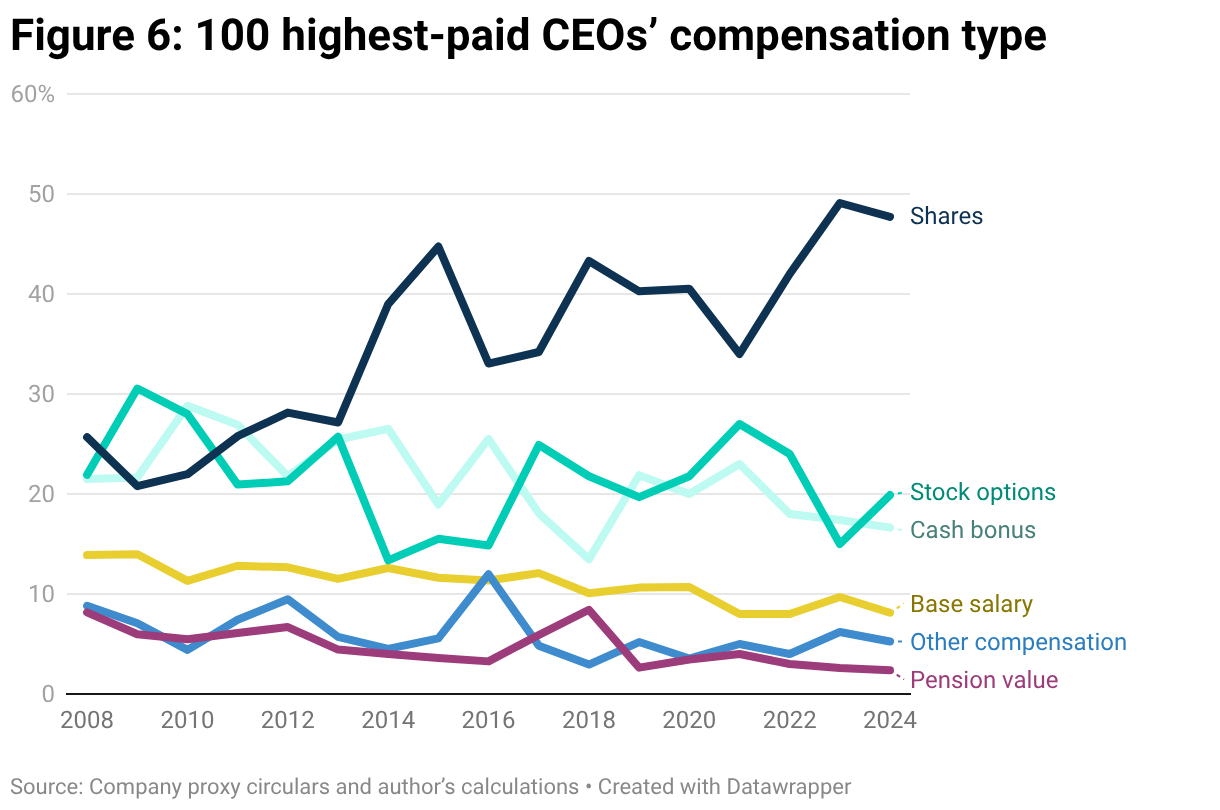
Even the form of bonuses has changed over time, to reduce the risk of CEOs getting nothing when the stock price falls. Stock options, for example, have given way to the direct awarding of stocks.
If a stock price declines too much, the stock option will be worth nothing, even if a CEO hits the milestones he needs to (and I do mean “he”, as we’ll see below). To extract the value from a stock option, CEOs must put the money up to buy the stock at the pre-set sweetheart price, although usually only for a few days before selling it again for a profit.
The direct award of shares instead of stock options further de-risks the CEO. Even if the share price declines, the shares are still worth plenty (as long as they don’t decline to zero). Also, a CEO doesn’t have to come up with the cash to buy the stock, it is directly awarded. The stock option deduction, a tax loophole that allowed CEOs to pay half the tax on stock option profits, was limited in 2021, further reducing its attractiveness.
Direct cash bonuses, as a proportion of overall pay, have been on a downward trajectory. The value of these don’t change with stock price, they are generally tied to performance in some way. There is a premise that a CEO’s interests should be “aligned” with those of shareholders, meaning CEOs do what boosts share price above all else. This has led to more share awards, rather than cash bonuses, over the past decades in Canada.
Inflation dollars go somewhere: record profits and CEO pay
It’s been a great couple of years for Canadian corporate profits. Prior to the pandemic, corporations were bringing in roughly $400 billion a year in pre-tax profits. After the pandemic, this jumped to a new level—$600 billion. In 2024, it stood at $630 billion. The present level isn’t quite as high as in 2022, when inflation was at its peak and profits hit $668 billion.
It’s worth remembering that the extra dollars Canadians are paying for higher prices goes somewhere: corporate profits.
Those corporate profits and their derivatives, like revenues and share prices, are the basis for CEO bonuses. While 2024 was the last full year of corporate profit data, the first three quarters of 2025 were the best so far in Canadian history—despite tariffs and a negative second quarter of GDP growth.
The amount that companies retain of their revenue after they’ve paid their expenses, their net pre-tax profit margins, tell a similar story. The margins in 2024 were not quite as high as in 2021 or 2022, when inflation was roaring, but they were still far higher than at anytime before the pandemic.

Inflation continues to be the gift that keeps on giving for the corporate sector and, by extension, the CEOs whose bonuses are tied to their profits.
Five per cent of highest-paid CEOs are now women
This year, a “shocking” five of the 100 highest-paid CEOs in Canada are women. This is the highest number we’ve ever seen. In previous years, the count has, at most, been four women.
Although the general Canadian labour market hit 40 per cent of women in 1980 and is now at 47 per cent of women in 2024,4Statistics Canada, Table 14-10-0327-01 Labour force characteristics by gender and detailed age group, annual, (https://www150.statcan.gc.ca/t1/tbl1/en/cv!recreate.action?pid=1410032701&selectedNodeIds=2D3,4D1&checkedLevels=0D1,2D1,2D2&refPeriods=19760101,20240101&dimensionLayouts=layout2,layout2,layout3,layout3,layout2&vectorDisplay=false). Canadian CEOs finally comprised five per cent of women in 2024. It is baby steps to gender equality on Bay Street.
This year, the number of women in the 100 highest-paid CEO list has managed to tie the number of men named “Scott”, at five apiece and, in a first, the number women on this list beat the number of men named “John”, which there are only four.
Unfortunately, the highest-paid female CEOs still get paid only 73 per cent of what their male counterparts got paid.
Solutions
In 2024, the federal government proposed perhaps what would have been one of the most expensive tax changes for CEOs in decades: a higher capital gains inclusion rate. Profits made from selling capital, like company shares, would be taxed slightly more like regular wages, but would still receive a substantial rebate. This would only have applied for those making more than $250,000 in profits from stocks in a single year. This would certainly have included CEOs. They end up as massive shareholder in their companies due to being paid in shares. Selling those shares at a profit generally yields substantial capital gains and would have resulted in higher taxes for CEOs.
Unfortunately, this tax change was not implemented. Misperceptions about the potential overlap on this tax change into other areas, like the sale of a family cottage or of a small business, killed the proposal.
Fortunately, another proposed change—taxing stock options with profits over $250,000 like working income—was implemented in 2021. Previously, being paid in stock options also came with a 50 per cent off coupon on your taxes. This was eliminated in 2021 for those making over $250,000 on stock options, in a given year. Those making less than that threshold still receive their tax-off coupon, but this sort of measure would have resulted in CEOs paying tax slightly more like wage earners.
Millionaire’s tax
Despite some wins and some losses on the road to fairer CEO compensation, other possibilities are still available. Perhaps the most appealing of which is a millionaire’s tax, where anyone making over a million dollars would pay a slightly higher tax rate on every dollar over that millionaire mark. This would apply to all the CEOs on our list: they all made, at minimum, $7.2 million. It would have no impact on anyone who didn’t bring in a million dollars a year.
Tax rates on Canada’s richest are close to all-time lows. In the 1950s and 1960s, the top marginal combined income tax rates on the highest-paid workers were just below 80 per cent.5See Figure 2 Lars Osberg, How Much Income Tax Could Canada’s Top 1% Pay?, Canadian Centre for Policy Alternatives, October 2015, (https://www.policyalternatives.ca/wp-content/uploads/attachments/How_Much_Tax_Could_Canadas_Top_1_Pay.pdf ). Today, combined federal and provincial top marginal income tax rates are closer to 50 per cent, depending on the province, with Quebec and Ontario slightly above and Alberta slightly below.
The basis of Canada’s progressive income tax system is simple: if we need extra income to pay for critical services like health care, it’s best to draw from those for whom an extra dollar doesn’t hold the same value. For a family living in poverty, a dollar is worth far more than for someone making $16.2 million a year. In the past, those at the very top were required to pay a lot more towards the public services that we all enjoy. In the 1950s and 1960s, income inequality was also much lower.
Wealth tax
Fairer taxation of capital gains was meant to target people like CEOs who are regularly going to make profits of over $250,000 on stock trades in a year. Capital gains are a well-established part of the income tax system; the 2024 proposal would have simply changed one of the rates involved in calculating the taxes owed on them. While the wealthiest are far more likely to profit from more than $250,000 a year in stock trades, changing the tax rate on capital gains isn’t a wealth tax.
There is a much more direct mechanism to impact wealth taxation: create a wealth tax. A wealth tax should apply only to the very wealthy: those with at least $10 million in net assets. If we do so, the rate can be quite low, amounting to only a few percentage points. Setting a wealth tax for those with assets worth more than $10 million, at one per cent a year, and rising to three per cent a year for those with over $100 million in assets could raise over $20 billion a year.6Parliamentary Budget Officer, Implementing annual wealth tax, Parliamentary Budget Office, April 19, 2025, (https://www.pbo-dpb.ca/en/epc-estimates–estimations-cpe/45/EL-45-1023246-P). That’s enough to fully fund both our national child care plan and eliminate wait times in emergency rooms.
There is no reasonable need for a single person to have $10 million, much less $100 million, in net worth. The returns on wealth that size are generally much more than one to three per cent a year, meaning Canada’s wealthy would keep getting wealthier, just not quite as quickly. A wealth tax asks the wealthiest for a slightly lower rate of return (but still let’s them get even richer) so everyone else can have the basics.
As noted above, most CEO compensation is now paid in shares, not cash. As a result, they end up becoming huge shareholders in their companies. Combine that with them making $16 million a year vs the average worker, at $65,500 a year, and income inequality results in even bigger wealth inequality.
We can, and should, be taking action on income and wealth inequality in Canada. There has been halting progress on this file. It’s time to take more concrete steps.
Methodology
Data for this report is compiled from the companies’ disclosure of pay for their Named Executive Officers (NEO) in proxy circulars or management information circulars. There were 222 companies on the S&P/TSX composite index as of June 2024, although only 212 companies published circulars and pay disclosures. Proxy circulars from those 212 companies were reviewed, with the highest-paid CEOs included in the top 100 list.
The report considers CEOs of the overall company but also includes the CEOs of subsidiaries who are NEOs. It may also include executive chairs, a position that oversees the CEO. It will also include retired CEOs who are NEOs. The list does not include chief operating or chief financial officers, of which there are many who would otherwise have made the top 100 list.
In some cases, CEOs might work for two different companies on the S&P/TSX composite. If one of those companies holds a controlling stake in the other, then the consolidated pay across both companies is used. If a CEO has moved to a different company, then the entries remain separated.
The dataset starts in 2008. Prior to that, stock options were often valued at exercise, not at award (as they were in 2008 and afterwards). As such, direct comparison of CEO pay prior to 2008 might just as easily reflect the difference in valuation and timing of stock options as any underlying change in compensation.
Companies often report executive pay in U.S. dollars. In these cases, amounts are converted into Canadian dollars at a rate of 1.3698, as per the Bank of Canada’s average annual exchange rates in 2024.7Bank of Canada, Annual Exchange rates, 2024, https://www.bankofcanada.ca/rates/exchange/annual-average-exchange-rates/. Annual worker pay is obtained from the Survey of Employment Payroll and Hours weekly average industrial aggregate wage, including overtime.8Statistics Canada, Table 14-10-0204-01 Average weekly earnings by industry, annual. This figure is multiplied by 52 weeks to obtain an average annual worker’s wage. Unless otherwise specified if the report refers to workers’ wages, this is what it is referring to.
The conversion of CEO pay to a daily figure assumes 260 working days in a year (i.e. 52 weeks × five days). This assumes that CEOs and workers have paid statutory holidays, as required by law. Hours are derived assuming an eight-hour day running from 9 a.m. to 5 p.m.

Acknowledgements
The author would like to thank Erin McIntosh for her work in data compilation for this report.
About the author

David Macdonald
David joined the CCPA as its Senior Ottawa Economist in 2011, although he has been a long time contributor as a research associate. Since 2008, he has coordinated the Alternative Federal Budget, which takes a fresh look at the federal budget from a progressive perspective. David has also written on a variety of topics, from child care to income inequality to federal fiscal policy. He is a regular media commentator on national policy issues, often speaking to the CBC, Globe and Mail, Toronto Star and Canadian Press. David received his BA from the University of Windsor and his MA from the University of Guelph, both in Philosophy. Follow David on Bluesky at @davidmaccdn.bsky.social

