
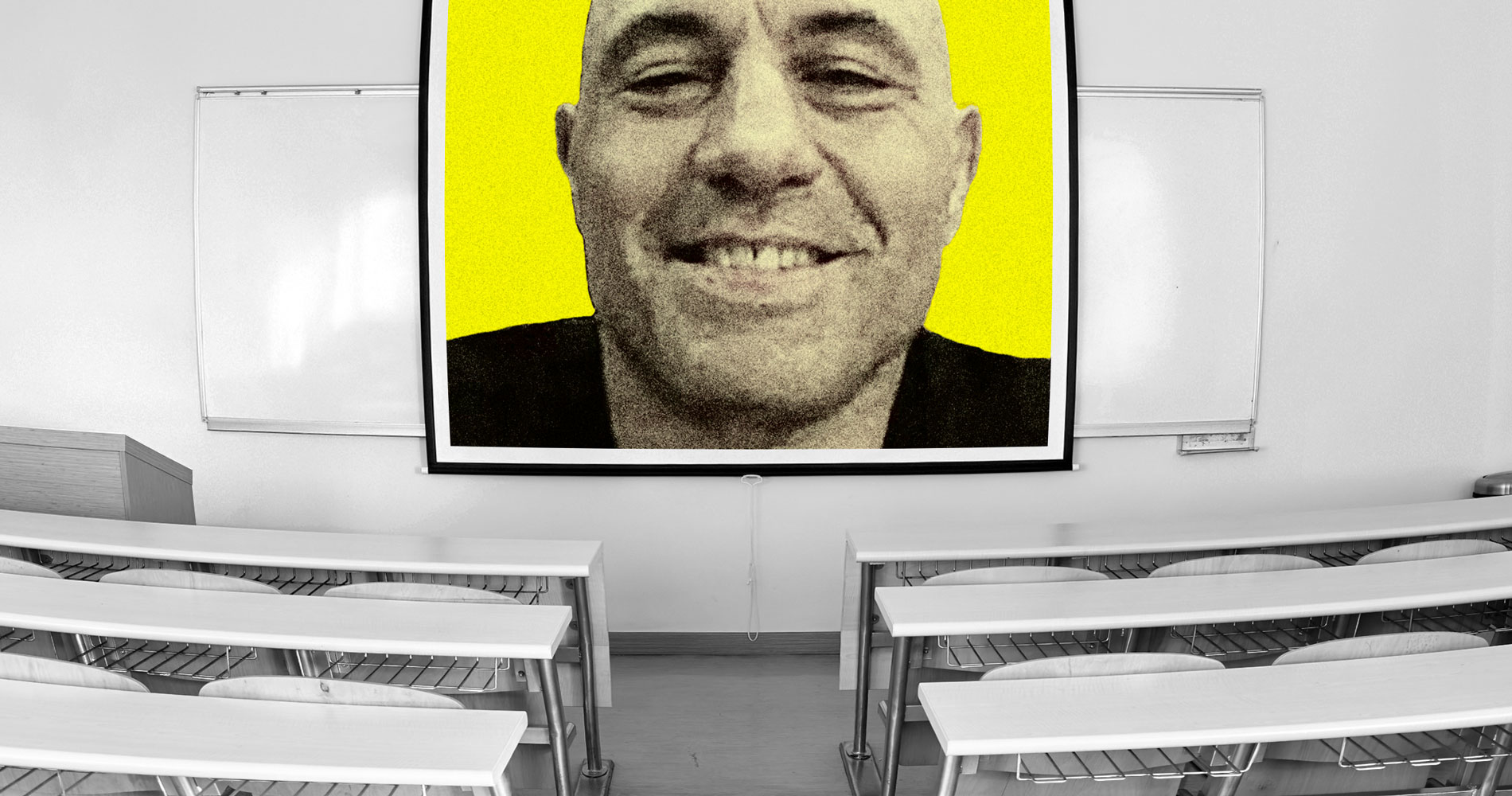
Long before I devoted my professional life to academic research and teaching, I grew up during the nascent years of reality competition television. Survivor, American Idol, Who Wants to be a Millionaire—these shows often dominated ’90s schoolyard discourse.
One of the key formulaic variables in these shows was the host. My first memory of one of these figureheads was an enthusiastic, engaging figure with jet-black hair and a particular penchant for sharing in each contestant’s emotional experience, even if that required calmly explaining that a metal claw would be dumping 3,000 scorpions onto their restrained body. In that instance, Joe Rogan, host of Fear Factor, coached the contestants through the process, urging them to “Relax, calm down” and instructing the competitors to “find their happy place” as scorpions engulfed their ersatz graves.
In that moment, as the claw descended upon screaming contestants, I did not consider the extent to which Joe Rogan would remain a relevant public figure decades later. But, remarkably, this man “played a key role in US elections” when his invitation for Vice President and presidential hopeful Kamala Harris to join his famed podcast was declined.
How did a figure like this develop a following where his wishes and hopes determine scheduled campaign stops, or alternatively, hotly debated omissions when left ignored? The immense reach of Rogan and his many acolytes and imitators was built, painstakingly, through networks of mostly-male listeners, many of whom share a love of an industry, pastime, and activity of particular interest to my students: sport. Exceptionally prominent creators such as Rogan have used sport to preach sermons that harmonize elegantly with the psalms of the resurgent parental rights movement.
For both the parental rights movement and creators like Rogan in what has been labeled the ‘Manosphere’, the enemies are clear: ‘woke,’ ‘SJWs,’ ‘snowflakes,’ ‘DEI,’ and trans-women athletes all threaten societal institutions, including sport, and listener communities are formed in opposition to these perceived threats. As the parental rights movement seeks to preserve ‘tradition’ through aggressively targeting inclusion efforts in schools and legislatures, a network of content creators have used sport to foster proscriptive notions of acceptable masculine responses to a changing world.
Despite their often stated sport-facing political agnosticism, these voices are responsible for shaping the way that many young males explore and understand: public health, masculinity, and politics, moulding them in the images of their content creators.
Consuming content: sports with a side of social commentary
The classrooms of my university are filled with some of the most talented, ambitious, and thoughtful devotees of sport from across North America. I am immensely privileged to have the opportunity to teach them, and I consistently endeavour to understand their sporting tastes to better appreciate how they consume and contribute to the sport industry.
In recent years, while the NHL and NFL remain near the top of the list, Mixed Martial Arts, and its largest platform the Ultimate Fighting Championship, has worked its way into the top tier for many students, both as viewers and aspiring employees. And the UFC is synonymous with two individuals in a way that is uncommon for most sports: CEO and President Dana White and ringside commentator, podcast magnate, and former Fear Factor host, Joe Rogan. As a result, the former figurehead who once cheered on reality game show contestants in my youth now plays a formative role in my classroom.
Before they arrive at my university, many of my students have already consumed sports from childhood. But beyond actually watching games or matches, this content takes many diverse forms, including podcasts, streamers, TikTokers, and Instagram accounts. These broadcasts are a distant relative of sports talk radio or even the panel-style broadcasts popularized through cable television. Such programming provides fans with the opportunity for endless coverage of their favourite sport, without the strictures of traditional media. But if someone were to question how so many young sport fans can digest endless chatter, the answer lies in the form these outputs ultimately take.
When it comes to sports talk, content creators have found that sport pairs nicely with a broad array of seemingly random takes and topics. Although innumerable podcasts and YouTube videos break down the minutiae of every play from any given game, many sport podcasts are far more akin to lifestyle podcasts that cover sport.
The result is that sport new media is frequently co-opted as a forum for a particular ideology: one that often promotes exclusionary, elitist, and extremist views that have come to define the toxic landscape of the manosphere.
For example, Ryen Russillo, a football and basketball podcaster, offers “Life Advice” as a segment of his weekly show, which features friendship queries, parenting tips, and dating advice, among many other topics. Former NFL Quarterback Cam Newton offers dating advice on his “Funky Friday” episodes of his “4th and 1” Podcast, including, in one episode, the realities and risks of dating sexually promiscuous women.
It’s not just dating advice, either; young sports fans, who have long ingested this programming, are developing a political consciousness that, in some prominent sport podcasts, view Diversity, Equity, and Inclusion as a “sheep costume the wolf wears,” fears the dangers of socialized medicine, and argues that “the trans-woman movement is actually anti-woman.”
The anti-trans discourse is often mirrored in contemporary manifestations of the parental rights movement, including: the prominent parental rights group the Alliance Defending Freedom’s 2019 anti-trans women in sport lawsuit, Donald Trump advocating for a ban on transgendered athletes in women’s sport, and the 2024 enacted by the Government of Alberta, which “would emphasize fairness, safety and inclusion as core principles of sport in Alberta” by forcing sport organizations to develop eligibility criteria delineated by biological sex. Exceptionally prominent creators like Rogan have preached barring trans women from women’s sport.
Joe Rogan’s American listeners, roughly 80% of which are male and 51% aged 18-34, preferred Trump to Harris 54% to 26% in the 2024 election. After welcoming then Vice Presidential nominee, J.D. Vance, and Trump onto the show, these numbers are likely not surprising.
Rogan also dabbles in Canadian politics as well, declaring in 2022 that: “Canada’s Communist… They’re f*cked… And then during the pandemic, I’m like, ‘oh, you’re a f*cking dictator’ Oh, you don’t like criticism. You’re trying to shut down criticism by saying that all your critics are misogynists and racists… Yeah, he’s gross.”
Underscoring the direct line between sport and political coverage, this same episode explored how trans women’s participation in sport and “woke ideology” posed existential threats to women’s sport. Also discussed were beauty standards and optimal Subway sandwich juiciness.
The effect of Rogan’s shows is dizzying: episodes are often over three hours long and the topics are expansive, shapeless, and conversational, providing a smokescreen of unserious deniability for anyone seeking to clip: after all, it was just one small part and it wasn’t meant to be serious.
This format has been imitated, diluted, and disseminated globally, to varying levels of success for those attempting to emulate Rogan’s journey from reality television to political tastemaker.
In Canada, many versions of sport-themed podcasts, complete with their own political discourse, are now common. This home-grown industry is in addition to the growing dominance of American content creators—it was estimated that Rogan alone had three million Canadian listeners per month in 2020.
In their own way, Canadian-made podcasts, like the “Slangin’ the Bizkit” podcast, with nearly 10,000 YouTube subscribers, offer a smaller-scale example of Rogan’s formula, but are no less virulent. Whether commenting that the Dallas Cowboy cheerleaders are to be praised for their lack of DEI hires or “fat chicks,” or revealing a practice of the “hot lap,” where players are celebrated for having unprotected sex the night before, “Slangin’” promotes openly misogynistic narratives.
However, by intermixing pernicious rhetoric with seemingly apolitical sport coverage, such as interviews with former NHL players, they create the false impression that sports are intrinsically intertwined with an especially corrosive perspective: sugar laced with arsenic.
Conclusion
Young Canadian men, a group well-represented in the demographics of my classrooms, are still early in their political journeys. When we first meet, many of them have not yet had the opportunity to vote in an election. There is time and opportunity for them to decide, but I see the early polling results in the stickers on many laptops and the hats on some heads.
Sport talk, like sport itself, merchandizes well and these classrooms represent battleground ridings for the next generations of our voting body. In the last election, men aged 18-34 voted Conservative: nearly 20% more than the party that nearly won a majority government. This counter-cultural impulse towards conservatism is not surprising to those of us who research sport and see the sizable gains the right has made in appealing to this demographic through sport.
While I (and I believe most of my young, male students) hold that sport and sport studies are instead at their best when they are humanist, adaptive, and reflective of our evolving world, we ignore the snarling, furious politicization of sports through new media channels at our own peril.
So, rather than relinquish sports as a tool of right-wing ideology and accept Rogan’s advice from Fear Factor to “relax, calm down,” perhaps it is time for those of us who love and study sport to stand up and leave the scorpions behind.