
Last May, CCPA’s detailed analysis of the Ontario budget argued that it failed to address years-long funding shortfalls, leaving the province vulnerable to the economic storm on the horizon.
Earlier today, the Ontario government released its fall economic update. Whereas we hoped for a course correction from a budget that delivered little, the new document shows a government that is staying the course, insisting on inaction. Amid economic uncertainty, job losses and widespread food and housing insecurity, the document touts “nearly $12 billion in cost savings for businesses” and actions aimed at “unleashing our economy.”
We have seen this film before.
At a time when Ontarians need a firm government with the courage to raise revenue and spend it on concrete programs and services that make life better, the government of the day asks us to sit tight and wait for the market to do its magic.
We are told that costly supports for big businesses will make housing more secure, food more affordable, education more accessible, and other much-needed public services more available. But that never happens. And it won’t this time.
Regretfully, the real message the fall economic statement delivers is that there is no help on the way for Ontario families and communities.
Program spending remains little changed despite economic uncertainty and social hardship
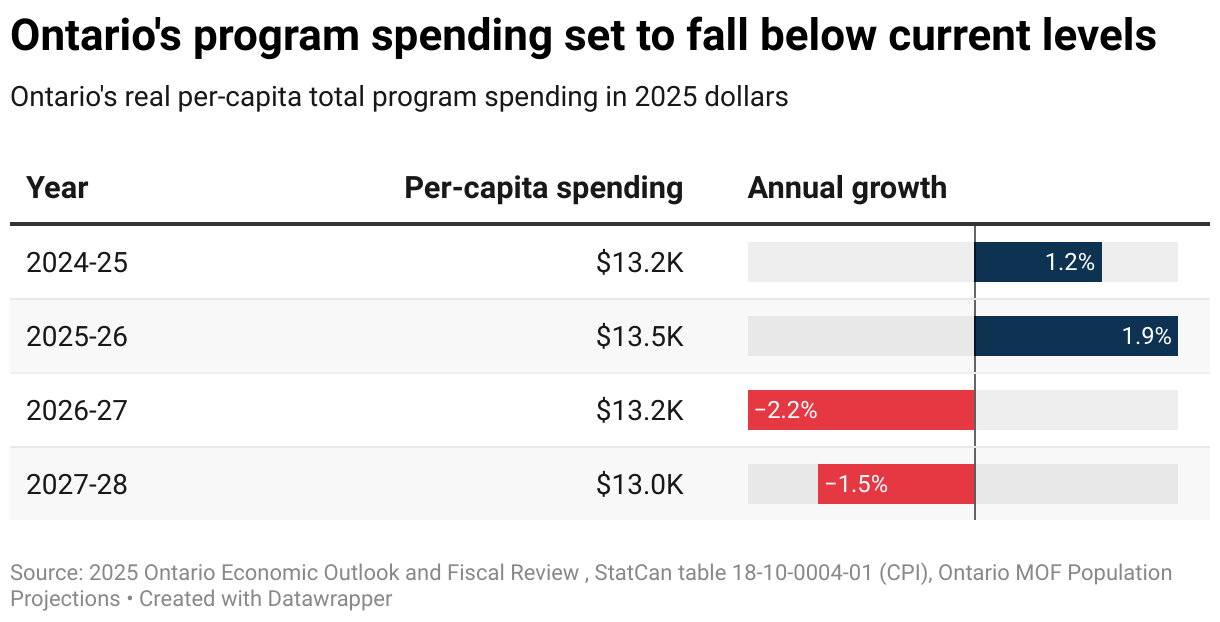
Chart 1 clearly tells the story of a government that is not even trying. Taking inflation into account, the province’s real program spending is set to decline by $228 per person (in 2025 dollars) by 2027-28.
In turn, Table 2 shows what is happening in each key program area, which isn’t much unless we count the stashing away of money.
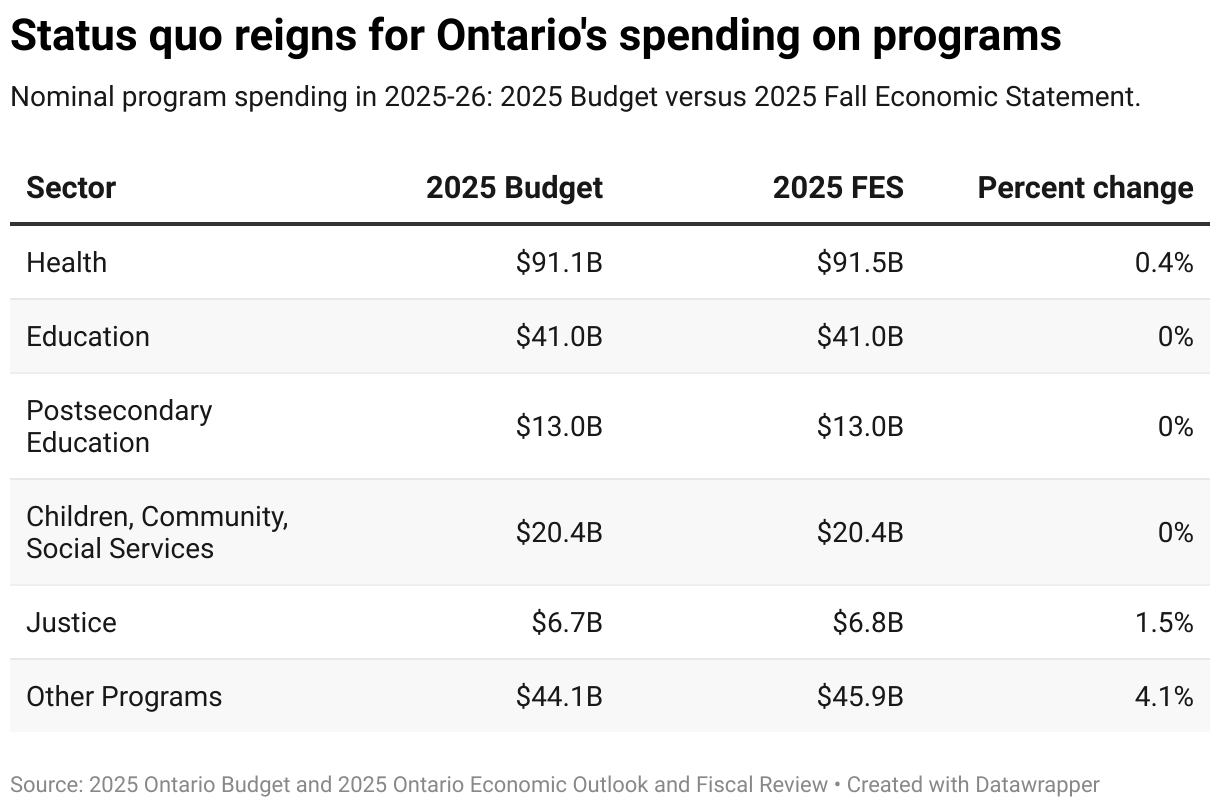
Health care spending in the 2025-26 fiscal year is increasing by $400 million, a small 0.4 per cent increase, bringing total spending to $91.5 billion. While that figure may seem large, it is important to remember that Ontario has the lowest per capita spending in hospitals in Canada and the second-lowest per capita spending on overall health sector funding.
Where the money goes is also a problem.
A CCPA study published last May found that, over the past 10 years, Ontario public hospitals paid for-profit agencies $9.2 billion for services. Over this period, the (real) per capita cost of services delivered through private agencies increased by 98 per cent, while the spending on staffing employed in public hospitals increased by a mere six per cent.
Education funding remains unchanged. One of our analyses shows that since the 2018-19 school year, school boards have been shortchanged by $6.3 billion. This is as good a time as any to reduce class size, adequately fund special education, and address the ever-growing school repair backlog. The government is not moving on any of this.
Post-secondary education is not getting any help either. Decades of underfunding made colleges and universities across the country heavily reliant on international student fees. With the new federal government cap on international students, their finances collapsed, leading to program closures and widespread job losses.
The education sector lost 13,600 jobs between September 2024 and September 2025. A closer look at payroll data shows these losses are mainly in the post-secondary sector. While President Donald Trump’s policies and ongoing threats have harmed many Ontario industries, especially auto (assembly and parts) and steel production, the education sector is shedding jobs at breakneck speed. The chronic underfunding of colleges and universities means that instead of helping to absorb shocks in other parts of the economy, post-secondary institutions are adding to the economic headache.
The children, community and social services sector is also not getting any new money. That is despite widespread food insecurity, growing encampments in cities across the province, and social assistance rates that sentence recipients to deep poverty.
In 2025, food insecurity reached record-high levels, with food bank visits surging to 763,756, a staggering 3.7 per cent increase from the previous year. As a CCPA analysis has highlighted, food insecurity is particularly alarming among children, who now account for 30 per cent of all food bank visits, showcasing the state of vulnerability of Ontario’s youngest residents. Yet no new decisive action on this front, in the spring budget, and now in the economic outlook.
There are only two program areas where funding did increase.
The first is the justice sector. It is receiving $100 million more than previously forecast—that’s a 1.5 per cent increase from the 2025 budget and a 13.3 per cent increase from the 2023-24 budget.
While not named as a new expense in the economic update document, the hiring of new sheriffs to execute the fast-tracked evictions proposed in Bill 60 is likely one of the initiatives that will further inflate the justice budget.
Finally, the Government of Ontario is continuing its now standard practice of stashing money away in contingency funds hidden inside the other programs envelope. This catch-all area is getting $1.8 billion more than what was previously allocated in the 2025 budget. About 85 per cent of that amount is a top-up of the contingency fund, which is now $4.5 billion.
The CCPA has closely monitored and actively condemned this practice. Responsible fiscal plans require some contingency funds, but these excessive amounts are unjustifiable—especially during an economic crisis. In practice, they are simply political cards hidden under the sleeve—room to manoeuvre, to enact populist measures when needed, as the government did with the $200 cheques it sent families during the last election campaign.
On housing, the major announcement is the expected HST exemption for first-time homebuyers, which, the documents states, could save buyers up to $80,000. The estimated cost of the measure is $35 million for this year, with a steep increase to $245 million in the 2027-28 fiscal year. In addition to standing in sharp contrast to Bill 60 and its direct attack on tenants’ rights—a share of whom are prospective first-time homebuyers—this sort of costly measure impacts the government’s capacity to fund other programs and services.
Ontario’s revenue continues to get worse
In our 2025 budget analysis, we showed that total own-source revenue would decrease by 2.6 per cent in real terms between 2024-25 and 2027-28. Chart 2 shows the updated calculation. While the revenue decline dropped to 1.2 per cent compared to the budget, Ontario will still have less revenue in 2027-28 than it has today.
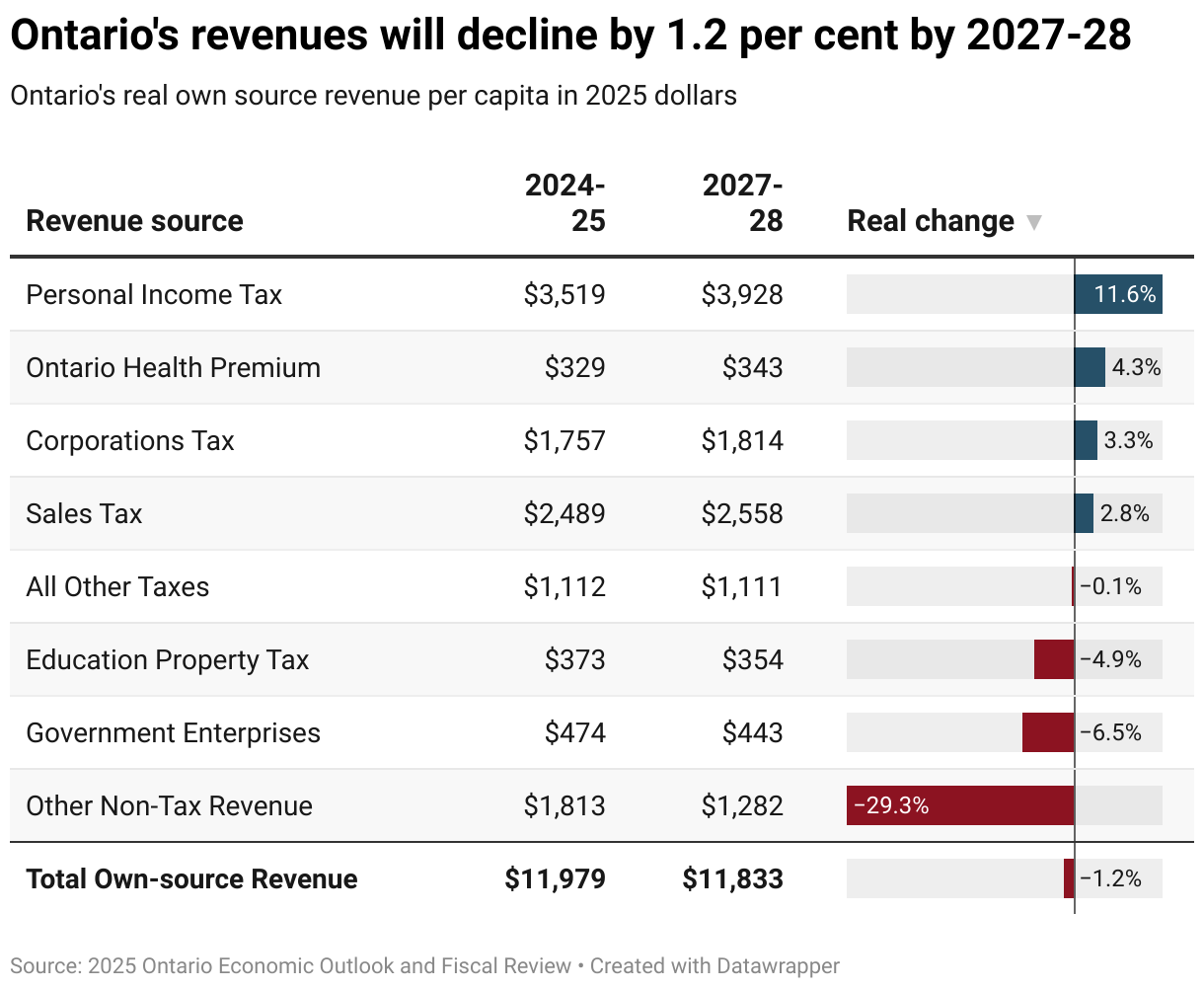
It’s hard to overstate how disconcerting this chart is. With all the uncertainty and risks ahead, the Ontario government is willingly walking into a scenario where it will have fewer, not more, resources to invest in the province and its people.
We are not making the investments we need today. We are not creating the conditions to make those investments tomorrow, either.
The Ontario government is simply coasting.