

In this year’s fall economic statement, the Ontario government repeatedly stated its intention to protect the province’s economy and people “for decades to come.” Talk is cheap. The document didn’t include any new and substantial investment, as discussed in the CCPA same-day analysis.
Notably, the provincial government once again actively neglected education, despite the various crises in the sector.
It’s no secret that Ontario’s colleges and universities are in trouble. After decades of relying on international student fees to balance their books, they have been hard hit by the federal caps on the number of international students they can admit each year. Instead of restoring public funding to where it once was, making post-secondary training affordable, the government of the day has opted to do nothing.
The cracks in the elementary and secondary education systems are also becoming wider. Since 2018, the province has shortchanged school boards by $6.3 billion in funding, forcing schools to constantly ration existing resources. Close to 40 per cent of all schools are in a state of disrepair. Special education continues to be woefully underfunded through a funding formula that ignores actual needs on the ground.
Sadly, that’s not all. Another, less visible, and equally disconcerting crisis is brewing on the back burner.
The elementary and secondary teaching workforce is aging—fairly quickly, and not because of general workforce trends. There is no research available to explain why this is happening, and, more importantly, no plan in place to avert a major and widespread teacher shortage.
The facts we know
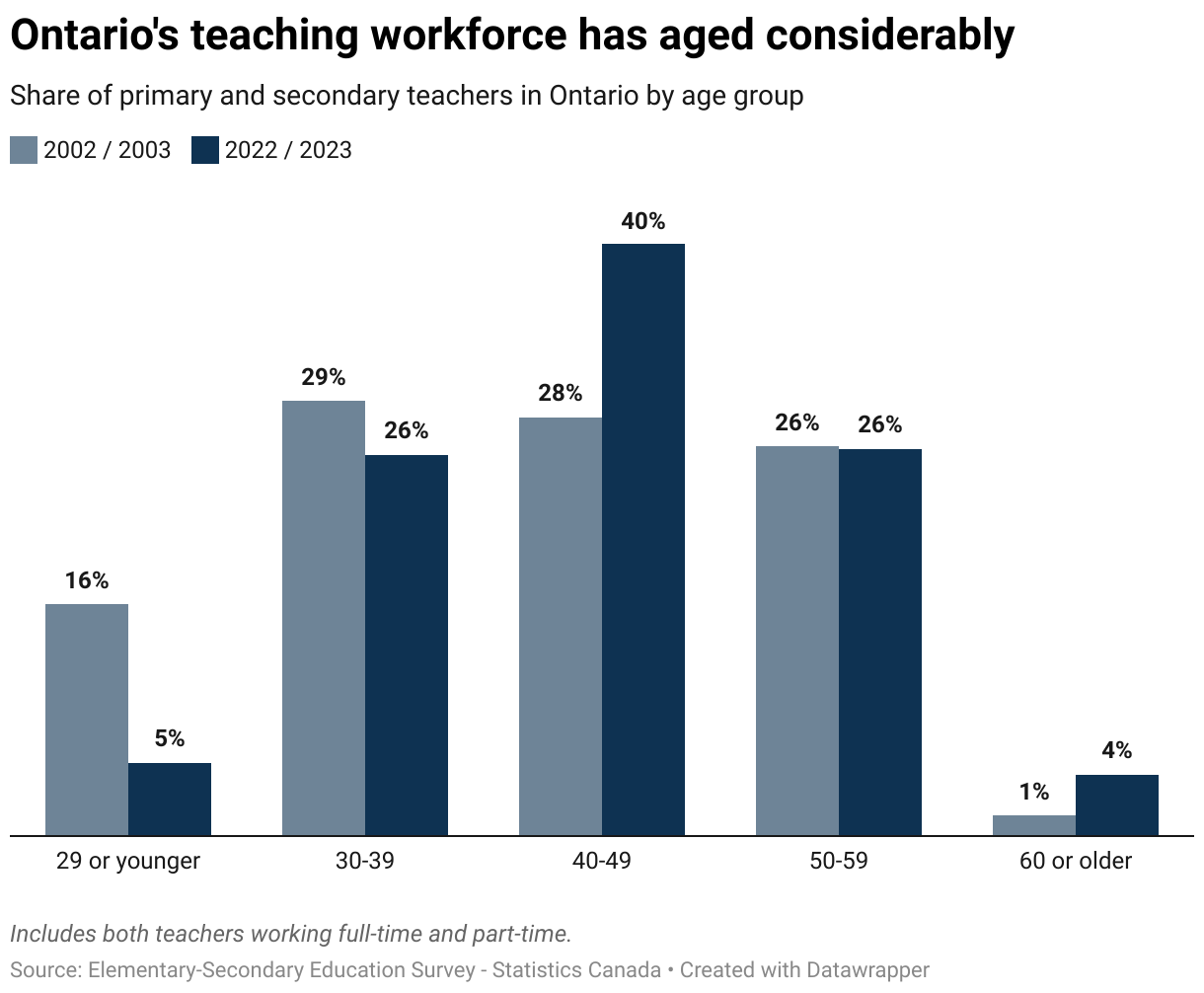
In the 2002-03 school year, 15.5 per cent of Ontario teachers were in their 20s. Fast forward 20 years, and that share dropped to 4.9 per cent. The share of teachers in their 30s also dropped: from 29.1 per cent to 25.5 per cent. In turn, teachers in their 40s make up nearly 40 per cent of the active teaching workforce in the province, whereas previously, they accounted for 28 per cent. The share of teachers 60 and older increased threefold over the past 20 years.
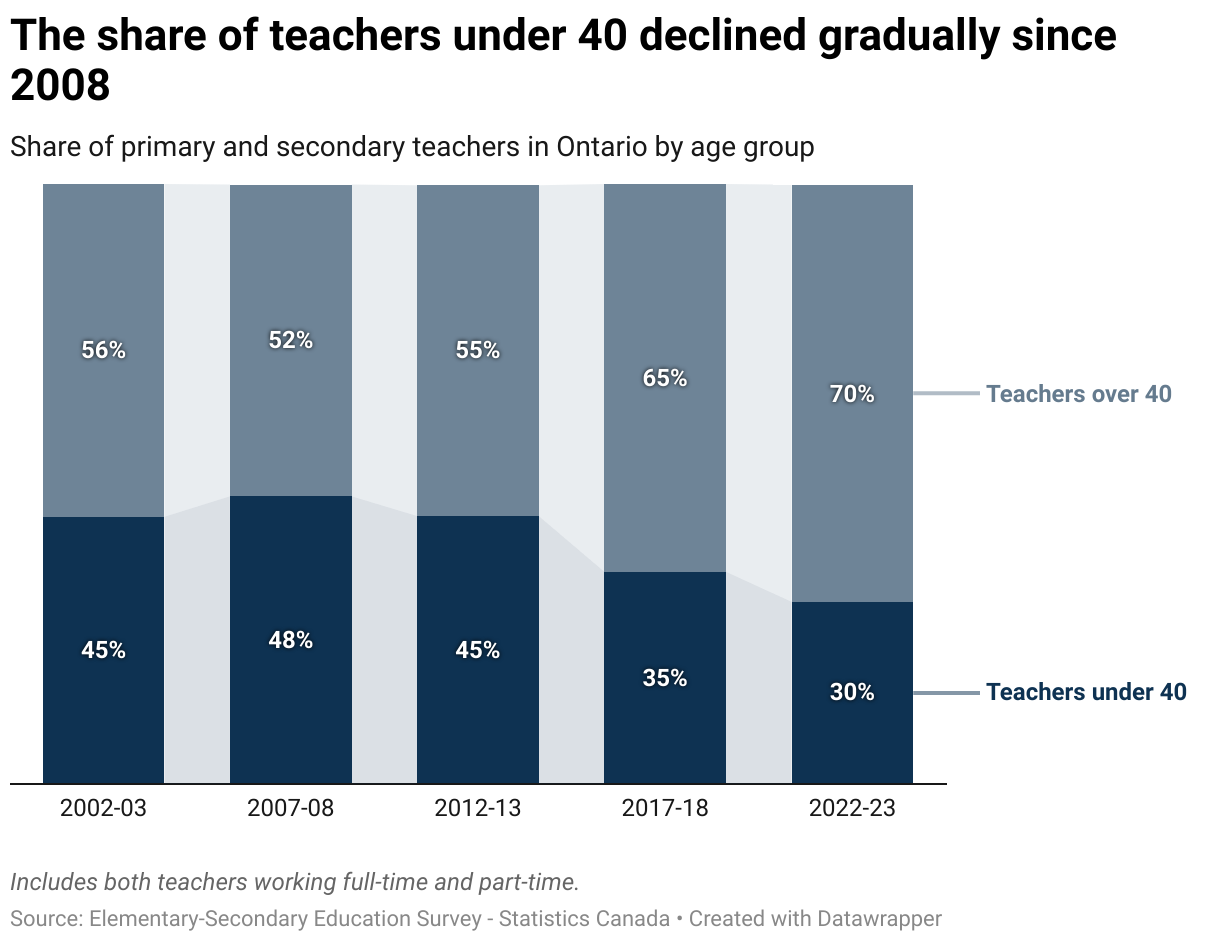
Simply put, 20 years ago, 45 per cent of teachers in Ontario were under 40, but now only 30 per cent are. Teachers aged 40 and over now comprise 70 per cent of the teaching workforce.
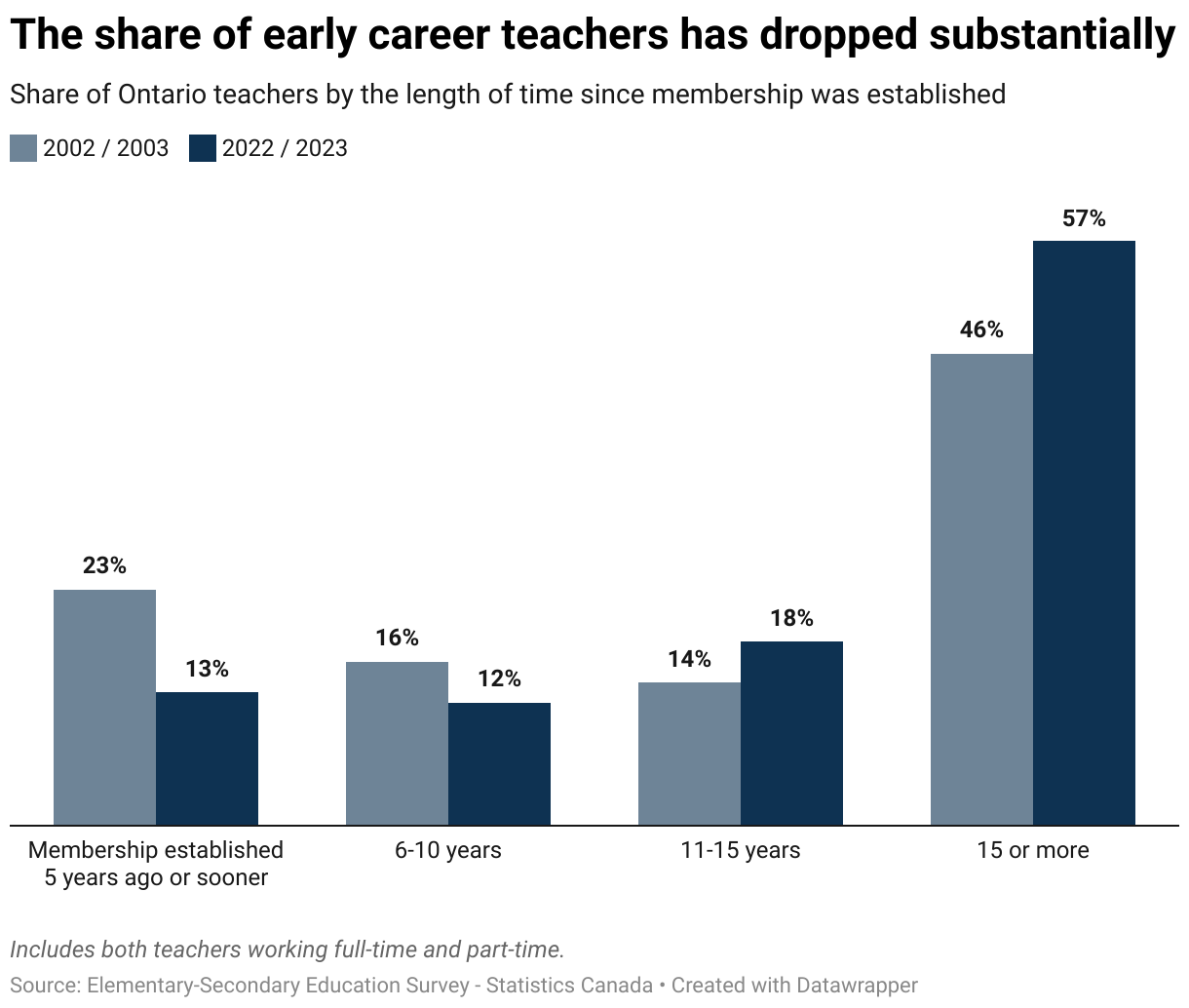
The average number of years of service has also increased in the past 20 years, similar to the age composition. In 2003, 46 per cent of teachers were veterans who had been registered with the Ontario College of Teachers for 15 years or more; 30 per cent had between six and 15 years of service; and nearly one in four had been an active teacher in Ontario for less than five years. Fast forward 20 years, and only 13 per cent of active teachers have been in the profession for less than five years, whereas the share of veterans increased to 57 per cent.
A workforce with a diverse age composition is always a strength. In teaching, where internships and mentorship are key parts of training, experienced educators play a crucial role in ensuring new entrants develop to their full professional potential. The main problem with an older workforce is that too many workers may retire at once, drastically reducing on-the-ground experience and possibly leading to a teachers’ shortage.
The causes we don’t fully understand
Currently, there is no good explanation for why this is happening.
Broader workforce trends don’t explain why the share of younger teachers dropped so sharply. Over the past 20 years, the proportion of Ontario workers aged 60 and over has increased, but the share of workers under 40 has only decreased by two percentage points, compared to a 15 percentage-point decline in the teaching workforce.
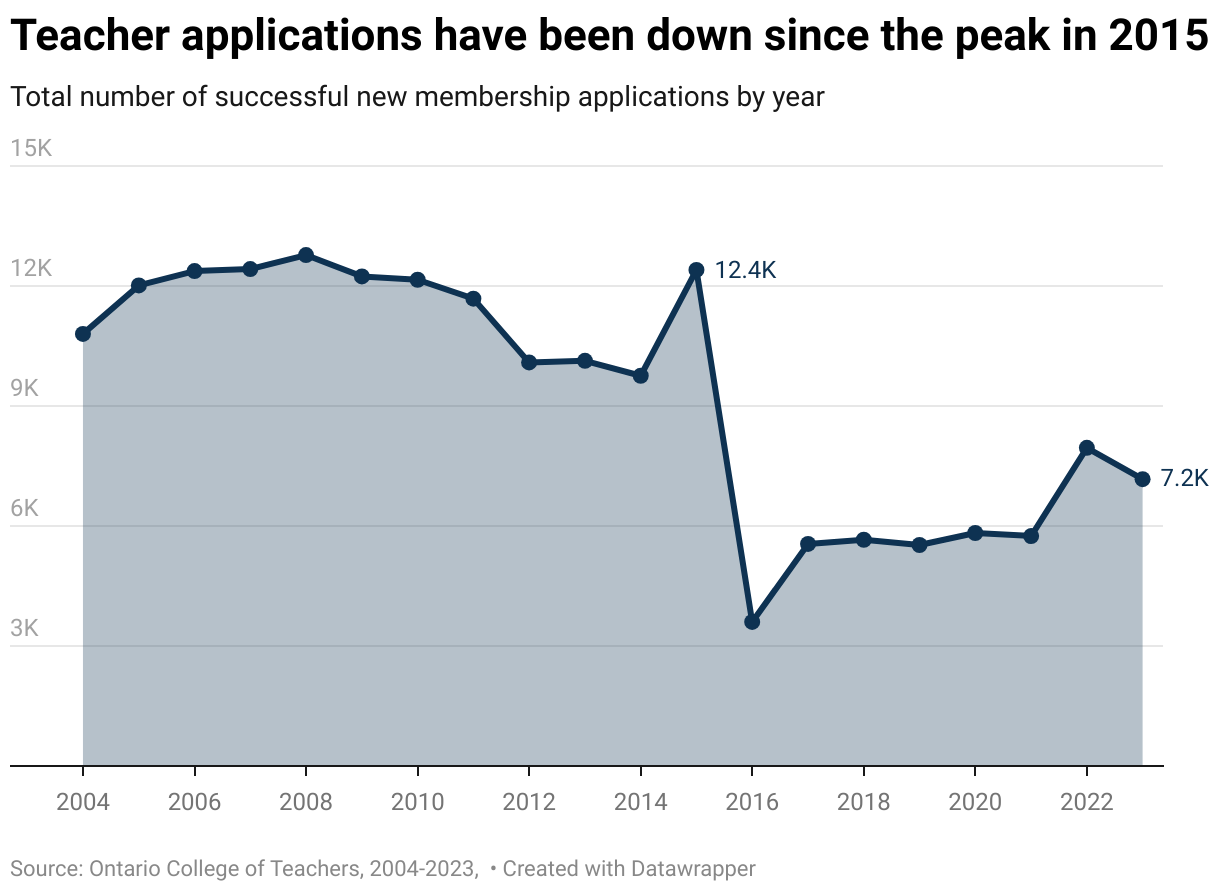
One possible and commonly offered explanation is the change in the length of the teacher training program, from one to two years, which took place in 2015. The number of applications to the Ontario Teacher College—a required step to become a certified teacher in Ontario—dropped significantly after the change and never fully recovered.
That is a part of the story, but not the whole story.
The additional year of teacher training may have dissuaded some undergraduate students from choosing this career path, but this is not the only factor, especially given that a larger share of Ontarians is pursuing graduate degrees.
The number of master’s degrees, the education level equivalent to a teaching degree, awarded in Ontario increased by 37 per cent between 2015 and 2022. The share of the population aged 25 to 34 with a master’s or doctoral degree rose from 11 to 16 per cent since 2015. People in Ontario are studying more, not less, but fewer are choosing teaching as a career.
The other possible explanation is that deteriorating working conditions are making the teaching profession less appealing.
Teachers have reported that, since the COVID-19 pandemic, students have displayed less respect for educators and less willingness to follow instructions. There is evidence of increasing rates of violence against educators in Ontario schools. We also hear that larger class sizes and a lack of support for students with special education needs make teaching exceptionally taxing. Finally, the rise of the “parental rights” movement has added stress on teachers, who are pressured by parents who oppose the public school curriculum and basic human rights.
Although those factors must be part of the story, they are not the whole story, either. At this point, there is no research linking what current teachers experience to students’ decisions to enter the profession.
Meanwhile, teacher shortages are becoming a common occurrence.
According to a People for Education survey, a quarter of Ontario’s schools experience teacher shortages every day. The government knows it. Briefing notes prepared for the new Ministry of Education in 2024 clearly stated that a teacher shortage existed, and would get much worse by 2027.
Where do we go from here?
From a research perspective, it is critical to understand what is discouraging more people from choosing teaching as a career in Ontario. Equally important, we need a better understanding of what is leading some people to leave the profession, either after a few years of practice or for early retirement.
The Ontario Teacher Federation estimates that 48,000 certified teachers are not currently working in the province’s education system. We need to know why they quit.
At this point, administrative data is scattered, statistical data is partial, and qualitative evidence is anecdotal. A comprehensive research effort would combine all three types of data within a robust methodological framework.
From a government perspective, we need a recruitment plan. It is not necessary to understand the “why” to act on it. Improving working conditions, properly funding schools, and refraining from attacking workers’ rights would go a long way to make teaching a desirable career choice again.
It’s impossible to protect Ontario’s economy while neglecting education. Workers are the backbone of a strong economy. And child care centres, schools, colleges, and universities are where people—young and old—go to learn, grow, and pick up a trade.
Generations of Ontario politicians understood the crucial role public education plays in economic development; even Conservatives like John Robarts did so. But this government appears to have skipped that class.