


Share
The big picture
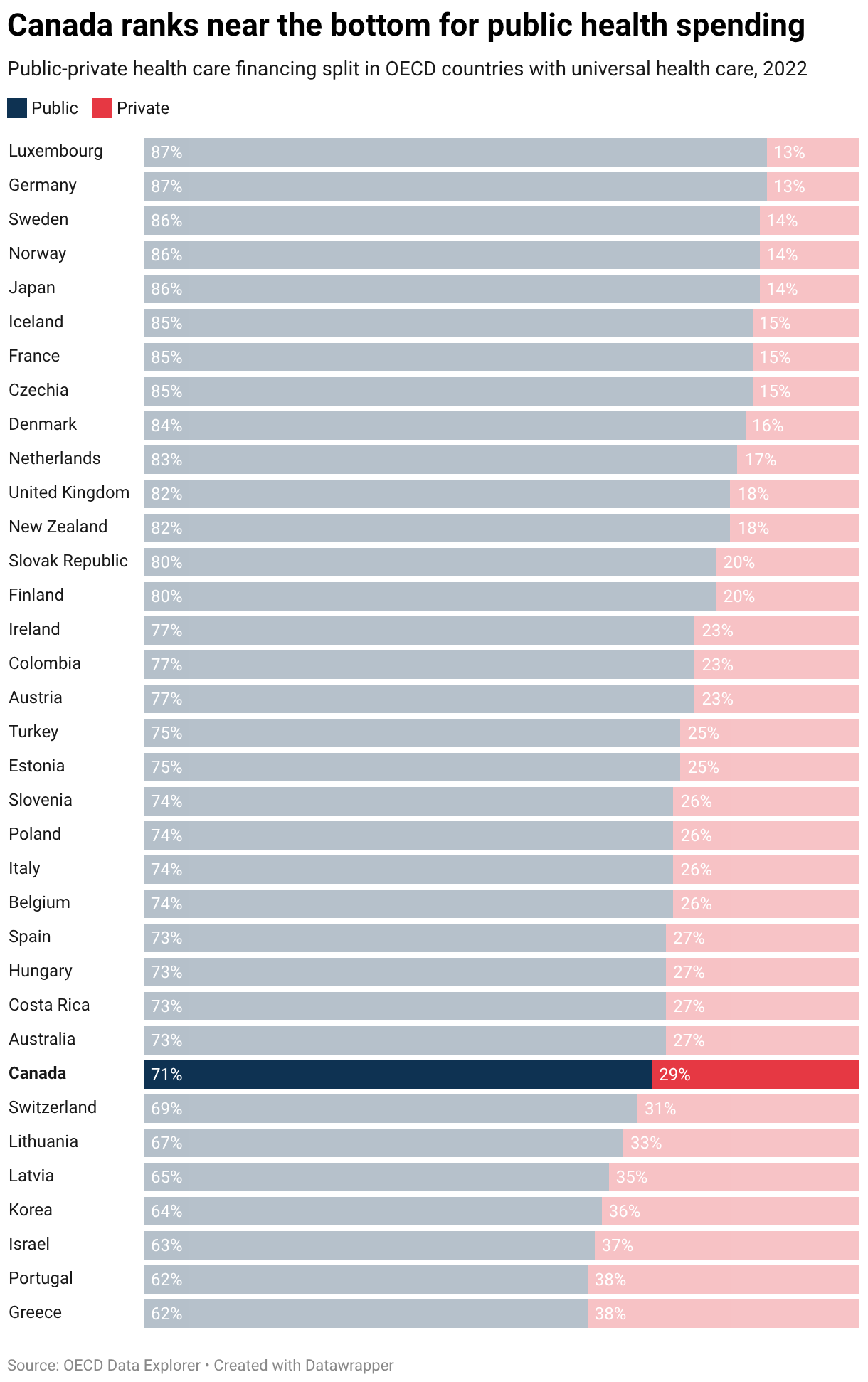
- Canada ranks near the bottom of OECD countries—28 out of 35—for its relatively low share of public health care spending compared to the private share of total health care spending
- Private health care spending grew nearly twice as fast as public spending in Canada, per person, from 2021 to 2023 (8.1 per cent vs. 4.3 per cent)
- Most private spending is on only a few things, with more than three-quarters of private health care spending (out-of-pocket and private insurance) going towards non-physician professionals, drugs, and long-term care
- Private spending has been growing especially fast in a handful of areas, with private spending on home and community care, non-physician professionals, and physicians growing fastest over the past three years (2021-23)
- Nova Scotia ($3,015), Alberta ($2,852), and Ontario ($2,852) had the highest per person private health care spending in the country
- Ontario ($5,425), New Brunswick ($5,685), and Alberta ($5,870) had the lowest per person provincial health care spending
- Saskatchewan and the Maritime provinces lead the country in private long-term care spending on a per person basis
Canada ranks near the bottom
Canada ranks near the bottom of OECD countries for share of public spending on health care
Canada ranks 28 out of 35 OECD countries for its lower share of public spending on health care, behind 27 other countries with universal health care systems. In the United Kingdom, New Zealand, and most of western Europe, public spending—rather than private out-of-pocket and insurance spending—comprises a greater share of total health care expenditure. In Germany, Sweden, Norway, and the United Kingdom more than 80 per cent of spending is public. In Canada, 71 per cent of spending was public and 29 per cent was private in 2022.
Private health spending growing fast
Private health care spending grew at almost twice the speed as public spending
Over the last three years of available data (2021-23), per person private health care spending outpaced public spending in Canada. At 8.1 per cent, private spending growth was almost double that of public spending growth of 4.3 per cent. Despite provincial (public) per person spending ($5,868) remaining greater than private spending ($2,602), the fact that private spending is growing faster than public spending is cause for concern.

Most private spending is on only a few things
Most private health care spending is on non-physician professionals, drugs, and long-term care
Seventy-seven per cent of private health care spending was on non-physician professionals (32 per cent), drugs (30 per cent), and long-term care (15 per cent) in Canada in 2023.
This is not surprising considering these services are not universally publicly insured under the Canada Health Act and the federal government has abandoned national pharmacare. Private spending in these areas shows us the gaps in Canadian medicare that need to be addressed.

Across health care sectors, the average private per person spending was greatest in home and community care (17 per cent), on non-physician professionals (13 per cent), and on physicians (10 per cent) over the last three years.

Which provinces are doing worst?
Nova Scotia, Alberta, and Ontario have the highest private health care spending…
Nova Scotia ($3,015), Alberta ($2,852), and Ontario ($2,852) had the highest per person private health care spending in the country, and above the Canadian average of $2,602.
…while Ontario, New Brunswick, and Alberta have the lowest provincial health care spending
Ontario ($5,425), New Brunswick ($5,685), and Alberta ($5,870) had the lowest per person provincial health care spending in 2023. The Canadian average for per person provincial health care spending was $5,868 in 2023.
Ontario and Alberta are among the provinces most rapidly advancing the privatization of public health care services, including surgeries, diagnostic imaging, and seniors’ care. If the public system is left to deteriorate by inadequate provincial funding (federal transfers are included here), this provides corporate profit-taking opportunities for private-pay health care services and publicly funded outsourcing.

What are provinces seeing private money spent on?
B.C., Alberta, and Ontario spend the most on private-pay non-physician professionals
B.C. ($1,024), Alberta ($975), and Ontario ($869) lead the country in per person private spending on non-physician professionals, including physiotherapists, dentists, and psychologists. Many of these health professionals are not part of the public health care system in most provinces, meaning that people must pay out-of-pocket or with private insurance to access these providers.
We know that many of these health care providers are necessary for prevention and managing chronic diseases, yet the very low provincial spending on these professionals relative to private spending shows that these professionals are only accessible to those who can pay for them, despite their importance.
Quebec has the highest per person provincial spending on non-physician providers, which speaks to the superior public coverage for dental care, eye care, and some other allied health professional services.

Saskatchewan and the Maritimes lead the country in private long-term care spending
Private long-term care spending demonstrates that too many people pay out of pocket for this necessary health care.
Saskatchewan ($631), Nova Scotia ($620), New Brunswick ($558), and P.E.I. ($513) lead the country in private per person long-term care spending—significantly higher than the Canadian average of $386 per person.
Private long-term care spending comes from private-pay long-term care and residents in publicly funded long-term care paying for accommodation fees and other expenses that are not publicly covered.

About the author

Andrew Longhurst
Andrew Longhurst is a senior researcher and political economist, with a focus on health policy, at the Canadian Centre for Policy Alternatives. He holds an MA from Simon Fraser University where he is a PhD candidate. He is the author of over 45 publications on public finance, health services, and the care economy.

