



Share
Summary
Over the past 50 years, women in Canada have made substantial gains in employment and earnings, supported by greater participation in full-time work, higher education levels, and movement into professional and unionized jobs. Despite this progress, major gender inequalities persist. Women—especially mothers of young children, caregivers, women with fewer years of formal schooling, and those facing overlapping forms of discrimination—remain concentrated in lower-paid occupations rooted in traditional gender roles. Persistent occupational segregation is a key contributor to Canada’s large gender pay gap and to rising inequality among women themselves. The employment recovery from the COVID-19 pandemic opened the door to change for some female workers, but as this study finds, not for Canada’s largely female and racialized low-waged workforce.
Did the pandemic disrupt the nature of women’s work?
The pandemic significantly disrupted the labour market, triggering very large job losses and equally large employment gains, all in a comparatively short period of time. Between 2019 and 2024, women saw major job growth in specialized middle-management, professional occupations in business and in education, and in administrative and financial supervisory roles—the four occupations together accounting for more than half of all employment gains for women. The number of working in the care economy, especially in health, education and community services, also increased. These gains were smaller than those recorded in professional and managerial occupations, but health care, education and social service industries remain the largest employer of women. By contrast, the number of women working in sales, clerical and administrative occupations fell sharply. These jobs still employ almost one million women; indeed, of the top 10 “sub-major group” occupations, six involve sales, service and administrative occupations—occupations that typically pay between $17 to $23 per hour. But these occupations now represent a smaller share of the female workforce, part of the long-term transformation of white-collar work, a trend which has accelerated in the aftermath of the pandemic. Meanwhile, there was no change in women’s representation in traditionally male-dominated trades, production and transport roles.
Gender segregation: Where are we now?
There has been a decrease in the share of women and men working in highly concentrated female occupations, those where over 80 per cent of the workers are female. But if we look at all occupations where women represent more than 60 per cent of all workers, the proportion of women working in these fields is up, from 45.2 per cent in 2019 to 49.9 per cent in 2024, a total increase of 779,800 jobs. Men’s representation in these female-majority occupations grew as well, from 12.1 per cent to 15.1 per cent (or 446,100 jobs). These trends speak to the ongoing shift in the occupational composition within all industries, from routine to non-routine jobs, boosting the numbers engaged in several traditionally female occupations in business, administration, education and health care.
Have current employment trends narrowed the gender pay gap?
The pandemic and post-pandemic job shifts led many women to move into better-paying occupations, but these gains did nothing to narrow the overall gender pay gap. Although women’s average wages increased between 2019 and 2024, high inflation wiped out most early progress, and by 2024 women still earned just 87 cents for every dollar earned by men—the same as in 2019. Wage growth was strongest for women who entered or advanced in high-paying fields such as management, finance and applied sciences, yet men’s wage gains in these same occupations were often larger, widening pay gaps at the top, especially in senior management. At the same time, women in the care economy—teachers, nurses, and community service workers—saw real wage declines, in part due to wage caps and long-standing undervaluation of care work. And there has also been little movement in wages among those engaged in low-paid work. In 2024, 34.8 per cent of women worked in low-waged occupations, effectively unchanged from 2019 (35.2 per cent). The upshot is that women now make up a larger share of workers in the highest paid occupations (33.2 per cent to 35 per cent) and in the lowest-paid occupations (52 per cent to 54.7 per cent). This study provides evidence that the patterns of female employment are not only tracking, but now influencing, the broader trends of polarization.
Missed opportunity
The pandemic and its aftermath represented a rare chance to reshape Canada’s labour market and reduce long-standing gender inequalities, but that opportunity was largely missed. While some women moved into higher-paid professional roles, the crisis did little to change the unequal division of paid and unpaid labour, improve wages and working conditions among low-waged, precarious workers, or substantially reduce occupational segregation. Instead, high costs of living, uncertain job markets, and the rapid spread of AI are generating increased insecurity among marginalized workers. As AI begins transforming not only routine jobs but also professional and technical roles, the risk of widening inequality is growing in the absence of meaningful regulation and worker-centred supports to navigate the transition. Government action is needed now to strengthen workers’ rights and protections for precarious workers, improve pay equity and pay transparency laws, expand the availability of high-quality public services, including education and care, and modernize social protections in service of a more inclusive, gender-just labour market.
The widening gap: Gender segregation and job polarization in the post-pandemic labour market
The COVID-19 pandemic represented a profound economic disruption. The pandemic wiped out 35 years of women’s economic gains in two short months. Women’s employment started to rebound in late 2020, buoyed by a surge in consumer demand and high levels of immigration, even as large numbers of older workers left the labour market. As the employment recovery peaked in 2022, the percentage of employed women aged 25 to 54 years reached an all-time high of 81.4 per cent.1The employment rate of men aged 25 to 54 years hit 88.1 per cent, its highest level since the early 1980s. A sizable group of women—including many from marginalized communities—were able to pivot from retail and other hard-hit industries into professional service jobs and the care economy.2Katherine Scott, Work in progress: Women in Canada’s changing post-pandemic labour market, Canadian Centre for Policy Alternatives, p. 43, 2024.
The nature of work has been slowing shifting over several decades in response to increased globalization and the offshoring of manufacturing, as well as the adoption of automation and information technologies, now including generative AI. The share of jobs involving routine tasks in production, craft, repair and operative occupations as well as sales, clerical and administrative support, has declined, while the share of jobs involving non-routine and/or cognitive tasks in managerial, professional and technical occupations and service occupations has increased.3Kristyn Frank, Zhe Yang and Marc Frenette, The changing nature of work in Canada amid recent advances in automation technology, Analytical Studies Branch Research Paper Series, Statistics Canada, Catalogue no. 11F0019M448, 2021. See also: Marc Frenette and Kristyn Frank, Automation and job transformation in Canada: Who’s at risk? Analytical Studies Branch Research Paper Series, Statistics Canada, Catalogue, no. 11F0019M448, 2020. The pandemic appears to have accelerated these trends as workers sought out better paid, more secure and safer employment, while employers, for their part, ramped up to meet changing market demand, including new investment in technology and automation.4Marc Frenette, “The changing nature of work since the onset of the COVID-19 pandemic,” Statistics Canada, Economic and Social Reports, Catalogue no. 36-28-0001, p. 1., 2023. And Marc Frenette, “The changing nature of work in Canada: 1987 to 2024,” Statistics Canada, Economic and Social Reports, Catalogue no. 36-28-0001, 2025. See also: Marc Frenette and Kristyn Frank, Automation and job transformation in Canada: Who’s at risk? Statistics Canada, Analytical Studies Branch Research Paper Series, Catalogue no. 11F0019M448, 2020.
This brief explores the changing occupational structure of the labour market in greater detail, focusing on the experience of women workers through the 2019 to 2024 period.5This research report uses an inclusive definition of women that embraces women, queer women, trans women and gender-diverse people. How did women fare through this period? Did the pandemic and its aftermath disrupt long-established patterns of gender segregation? What can we expect looking forward? Are recent employment gains at risk in the context of the current trade war and expansion of AI in Canadian workplaces?
Deeply entrenched labour market disparities
Over the last 50 years, the gap in employment rates between men and women has narrowed substantially as women moved into the labour market in large numbers. Over this same period, women’s income from employment increased, helping to reduce the gender gap in earnings. Several factors help explain women’s economic progress, including growth in full-time employment, longer job tenure, and higher levels of educational attainment. Many more women now work in higher-paid professional occupations, such as in law and social, community and government services, and in unionized (typically public sector) workplaces, which offer decent wages, employment benefits and job security.6See: David Macdonald, How the public sector is fighting income inequality (And why it’s still not good enough), Canadian Centre for Policy Alternatives, 2024; Nicole Fortin, “Increasing earnings inequality and the gender pay gap in Canada: Prospects for convergence,” Canadian Journal of Economics, 52: 407-440, 2019.; Rachelle Pelletier, Martha Patterson and Melissa Moyser, The gender wage gap in Canada: 1998 to 2018, Statistics Canada, Labour Statistics: Research Papers, Catalogue no. 75-004-M—2019004, 2019.
Yet disparities persist—particularly among mothers with young children and other caregivers, women with fewer years of formal education, and women confronting overlapping sources of discrimination.7See: Marie Drolet and Mandana Mardare Amini, “Intersectional perspective on the Canadian gender wage gap”, Statistics Canada, Studies on Gender and Intersecting Identities, Catalogue no. 45200002, 2023; Sheila Block and Grace Edward Galabuzi, A rising tide does not lift all boats: Ontario’s colour-coded labour market recovery, Canadian Centre for Policy Alternatives, 2023; Tammy Schirle and Moyosoreoluwa Sogaolu, A work in progress: Measuring wage gaps for women and minorities in the Canadian labour market, The C.D. Howe Institute, 2020. It is the product of entrenched systemic biases, the unequal burden of care, and outright discrimination. The gendered division of labour across and within occupations and industries is another manifest source of economic disparity.8See: Francine Blau and Lawrence Kahn, “The gender wage gap: Extent, trends, & explanations,” Journal of Economic Literature, 55 (3): 789-865, 2017. Despite almost equal rates of labour force participation, women (and other marginalized groups) continue to be concentrated in lower-paying occupations and sectors of the economy, work presumed to align with their “natural” or “traditional” abilities and interests.9See: Emma Quinn, et al., “Men and women at work in Canada, 1991-2016,” Labour & Industry, 30(4): 401-412, 2020.; Asaf Levanon and David Grusky, “The persistence of extreme gender segregation in the twenty-first century,” American Journal of Sociology,” 122(2): 573-619, 2016; Michelle Budig, Melissa Hodges, and Paula England, “Wages of nurturant and reproductive care workers: Individual and job characteristics, occupational closure, and wage-equalizing institutions,” Social Problems, 66 (2): 294–319, 2019. The comparatively few women who work in “non-traditional” jobs earn more than other women, but they, too, generally earn less than their male peers.10See: Fortin, 2019. 11A 2019 CCPA study found that women in the C-suite earn only 68 cents for every dollar their male colleagues make—an average difference of $950,000 less a year. David Macdonald, The double-pane glass ceiling: The gender pay gap at the top of corporate Canada, Canadian Centre for Policy Alternatives, 2019. In Canada, only three women made the top 100 CEO list in 2023.12There were more CEOs named Scott or Michael than there were women. David Macdonald, Company men: CEO pay in 2023, Canadian Centre for Policy Alternatives, 2025. Canada continues to have one of the largest pay gaps in the OECD.13OECD, Gender wage gap (indicator), 2025.
The segregated character of Canada’s labour market has been markedly resistant to change. In 2021, the majority of women (54 per cent) were employed in just 20 occupations, all involving the “5 Cs”: caring, clerical, catering, cashiering and cleaning. This is only a slightly smaller share than in 1987, when 59 per cent of women were employed in these same occupations. By contrast, just 19 per cent of men were employed in “female” occupations in 2021, compared to a similarly low 16 per cent in 1987—a three percentage point increase over 34 years.14These figures are based on calculations by Melissa Moyser (2017), updated with the 2021 Census of Population. Population aged 25 to 54 years. Melissa Moyser, “Women and Paid Work,” Women in Canada: A Gender-based Report, Statistics Canada, Catalogue No. 89-503-X, 2017. While women have a strong economic incentive to move into higher-paid “male” occupations, the reverse isn’t the case among men. Men’s limited movement into female-dominated occupations remains a key barrier to any future progress.15See: Megan Moskos, “Why is the gender revolution uneven and stalled? Gender essentialism and men’s movement into ‘women’s work’,” Gender, Work & Organization, 27(4): 527-44, 2020.
Progress in reducing high levels of gender occupational segregation stalled 25 years ago and there’s been limited improvement since. Linda Kaida and Monica Boyd, in their study of women’s work, for example, found that there were only small movements of women out of low-paid, highly female-concentrated occupations, such as clerical work, into higher paid positions in more gender-integrated professional and managerial roles during the 1991-2016 period—a much slower rate of improvement compared to the 1960s, 1970s and 1980s. At the same time, women’s representation in heavily male-dominated occupations, in areas such as repair, construction, or transportation, was virtually unchanged.16Lisa Kaida and Monica Boyd “Revisiting gender occupational segregation trends in Canada: 1991-2016,” Canadian Review of Sociology, 59(S1): 4-25, 2022. See also: Neil Guppy and Nicole Luongo, “The rise and stall of Canada’s gender-equity revolution,” Canadian Review of Sociology, 52(3), 241-65, 2015. Emma Quinn and her colleagues likewise conclude that there was little change in the segregated character of Canada’s labour market between 1991 and 2016: half of 500 detailed occupational categories were dominated by either men or women (with representation of 75 per cent or greater) at the time of each census over this period of time.17See: Quinn et al., 2020.
These findings are particularly troubling in light of the continuing importance of industry and occupation (and related job characteristics) on the size of the gender pay gap relative to men and other measures of women’s economic security, such as the prevalence of low-waged work. Drolet and Amini (2023) estimate that the combined effect of industry and occupation accounted for over one-third (36.6 per cent) of the gender wage gap in 2022, and an even larger share among Indigenous women (42.8 per cent).18The variables included in Drolet and Amini’s statistical model accounted for 13 per cent of the gender wage gap for all groups, a smaller share than in 2007. 19Pelletier, Patterson and Moyser’s (2019) study of wage gaps found that the industrial distribution of men and women—and, in particular, the larger share of men working in construction, manufacturing and mining, quarrying, and oil and gas extraction—explained the largest portion of the gender wage gap in 2018, accounting for 39.7 per cent. Altogether, the variables included in Pelletier, Patterson and Moyser’s statistical model explained over one-third (36.6 per cent) of the gender wage gap in 2018. The remainder was attributed to unexplained factors, consistent with previous research. This study, and others, highlight the scale of the challenge in making further progress in reducing gender inequality against a backdrop of ongoing labour market polarization, entrenched financial/business interests, lax state oversight and regulation of labour markets across the country,20See Bryan Evans, et al., From Consent to Coercion: The continuing assault on labour, 4th edition. Toronto: University of Toronto Press, 2023. and Canada’s porous welfare state, as so graphically revealed by the COVID-19 pandemic.
These studies reveal, as well, the scale of the opportunity that the pandemic represented to jumpstart Canada’s “stalled gender revolution.” As our findings show, while both men and women experienced significant growth in management, professional and technical occupations over the past five years—pushing up women’s average wage—women continue to be over-represented in the lowest-paying occupations compared to male workers. Indeed, the gap between women in high-paying occupations and those in the lowest-paying occupations appears to be growing, the same dynamic evident among male workers as well.
Did the pandemic disrupt the nature of women’s work?
The pandemic disrupted the labour market, triggering very large job losses and equally large employment gains, all in a comparatively short period of time. One of the most notable changes was the sharp reduction in low-waged service sector employment and the simultaneous increase in several higher-paying industries, such as professional services, finance, educational services and public administration. Women workers have been on the frontlines of these changes—both figuratively and literally—as this study of women’s location in Canada’s occupational hierarchy attests. Just as the pandemic fuelled industrial change, it also accelerated changes to the nature of work and the demand for specific occupations, impacting both the level of gender segregation in the labour market and access to economic security for women on both sides of “good” job vs “bad” job divide.
Marc Frenette’s analysis of long-term occupational trends in the Canadian labour market provides important context for this discussion of women’s employment and occupational segregation.21Marc Frenette, “The changing nature of work in Canada: 1987 to 2024,” Statistics Canada, Economic and Social Reports, Catalogue no. 36-28-0001, 2025. Since the late 1980s, there has been a significant increase in the share of workers engaged in managerial, professional and technical occupations (non-routine, cognitive tasks)—among both men and women. The share of men involved in these occupations rose steadily between 1987 and 2019 and then jumped by 4.6 percentage points between 2019 and 2024, rising from 29.6 per cent to 34.2 per cent. The increase among women working in managerial and professional occupations was equally significant, the proportion of women rising from 23.7 per cent in 1987 to 33.3 per cent in 2019 and then to 39.3 per cent in 2024 (see Figure 1a and 1b).
These trends were accompanied by steep declines in the share of men working in production, craft, repair and operative occupations (routine, manual tasks), and in the share of women working in lower-paid sales, clerical and administrative support occupations (routine, cognitive tasks), reflecting the deep-seated gender divides in the labour market. Back in 1987, almost half of all male workers were engaged in production, craft, repair and operative occupations (47.1 per cent). By 2019, the share of male workers in these occupations had fallen to 37.9 per cent—and by another 2.8 percentage points, to 35.1 per cent in 2024, fuelled by the impact of automation and just-in-time production processes as well as the offshoring of production. (The decline among women in production, craft, repair and operative occupations was much smaller (just 0.5 percentage points between 2019 and 2024) but not surprising, given the comparatively low number of women employed in these jobs.)
The widespread adoption of information technologies also contributed to the transformation and decline of work in sales, clerical and administrative support, largely impacting female workers. Between 1987 and 2024, the share of women working in these occupations dropped by 10 percentage points, from 41.3 per cent to 31.2 per cent. One quarter of these losses (-2.6 percentage points) occurred between 2019 and 2024 as the pandemic upended personal service industries, such as retail and accommodation and food services. The scale of pandemic-related losses was comparatively smaller among men, declining just 0.7 percentage points between 2019 and 2024. Indeed, the overall share of male workers engaged in sales, clerical and administrative support has remained largely unchanged since 1987, rising from 15.7 per cent to 16.7 per cent in 2024.
We see a similar pattern in service occupations (non-routine, manual tasks). The proportion of men engaged in services has edged up slightly over the decades, declining between 2019 and 2022, and then rebounding by 2024. In 2024, one in seven male workers (13.9 per cent) were involved in service occupations, the same as in 1987 (13.7 per cent). The share of women engaged in service occupations since 1987 has been relatively constant too, at roughly one-quarter of all female workers up until 2019. Between 2019 and 2022, women’s share dropped sharply, by 2.8 percentage points, to 23.8 per cent as personal service industries contracted and community services struggled to fill staffing positions even as demand soared. Care economy jobs have bounced back since 2022, notably in education, but women’s losses in personal services have continued, the gains in one group of service occupations offsetting the losses in others.
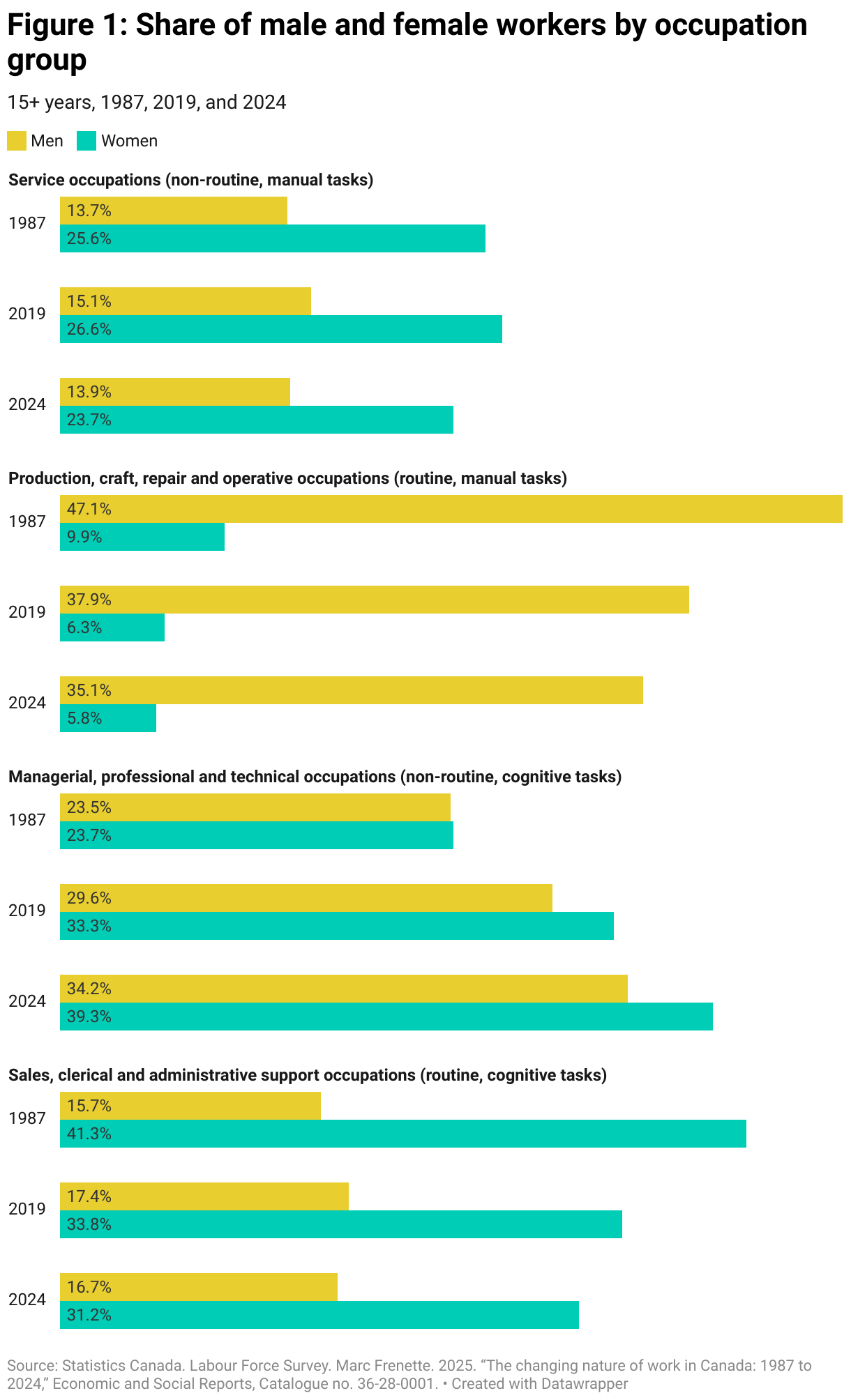
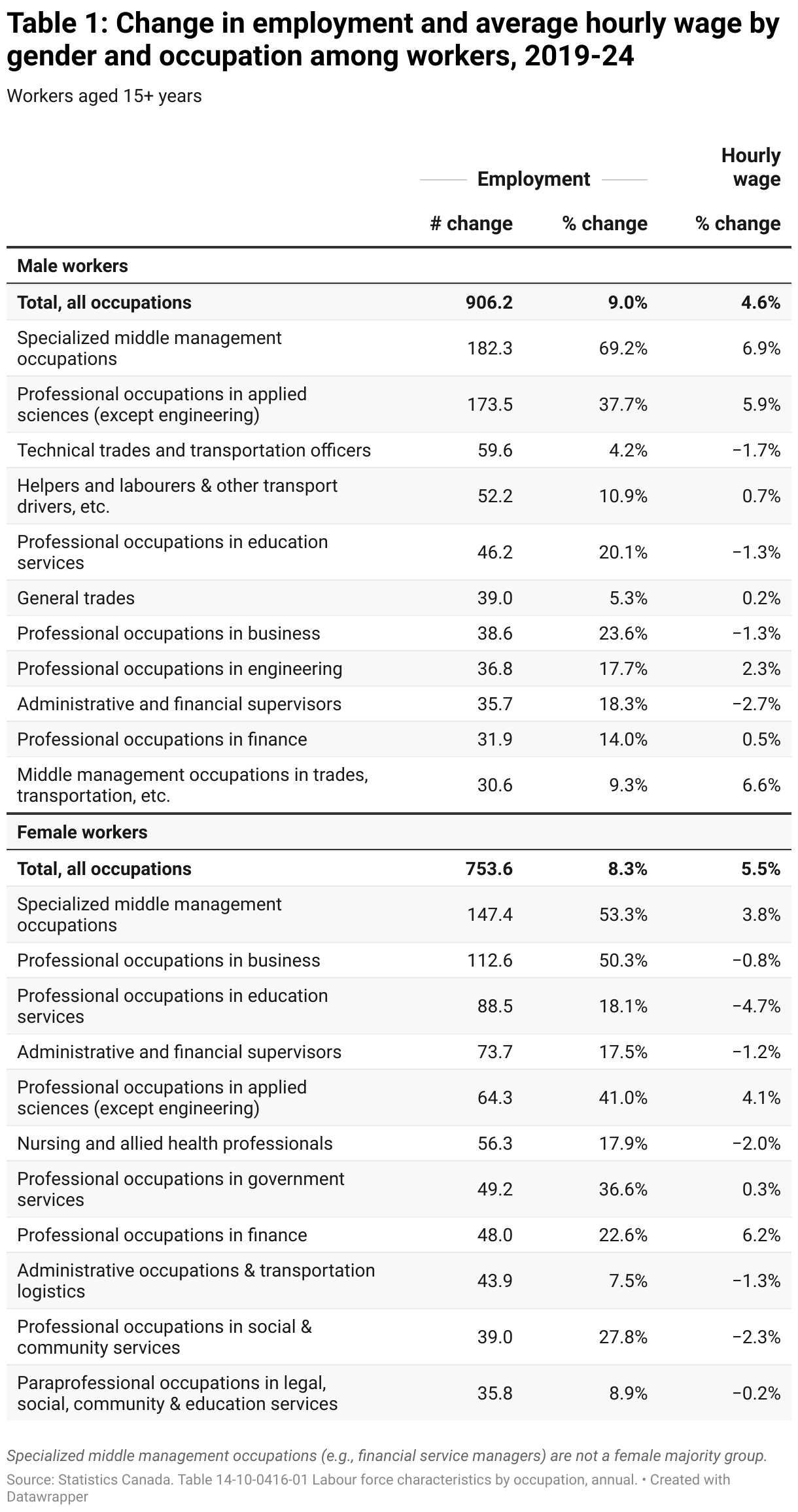
Table 1 provides a more granular look at the changing distribution of occupations in Canada, comparing the top occupations among women in 2019 and 2024, ranked by concentration and count of female workers among the 43 “sub-major group” occupations tracked annually in the Labour Force Survey. Not surprisingly, given the comparatively short time frame, there was little change in the top 10 list of occupations with the highest concentration of female workers between 2019 and 2024. And the top six occupations by female head count were the same too—sales and service occupations took the top two spots of all occupations. But there are a few key changes to note that speak to the ongoing transformation of Canada’s labour market.
First, the expansion of managerial, professional and technical occupations is clearly evident among both male and female workers. The biggest increase among female workers was in the specialized middle-management occupations, an increase of 69.2 per cent (182,300 positions). Women workers also reported large increases professional occupations in business (50.3 per cent), professional occupations in education (18.1 per cent), and administrative and financial supervisors and specialized administrative occupations (17.5 per cent). Together, these four occupations accounted for over half (56 per cent) of all employment growth among female workers between 2019 and 2024. The same four occupations were on the top 10 list of growth occupations among male workers too—but accounted for just one-third (33.4 per cent) of total job growth among male workers.
The increase in women working in professional business occupations pushed up women’s share of employment in that occupational group by 4.7 percentage points, to 62.5 per cent. Women also made inroads in professional finance occupations, reaching 50.2 per cent of all employed. Even though women reported the largest increase in specialized middle-management occupations, their share of these jobs actually fell by 2.5 percentage points, from 51.2 per cent in 2019 to 48.7 per cent in 2024, because growth in these occupations was even larger among their male peers (69.2 per cent or 182,300 jobs)—a point that we will return to below.
Relatedly, while the number of women in middle-management occupations grew, there was a decline in the ranks of senior management. The number of women engaged in these occupations declined by 8.1 per cent between 2019 and 2024, their share of all senior managers and legislators declining by 2.8 percentage points to 29.2 per cent. A recent report from the Prosperity Project, examining data from the FP500 companies, calls out this troubling trend, especially among equity-seeking groups, as well as the decline in the number of women in the leadership pipeline. It concludes that “progress is possible, but it is neither guaranteed nor equitably shared. Some women are rising, but too many are being left behind.”22Prosperity Project, Annual Report Card on Gender Equity and Leadership, 2025.
Secondly, there were increases in the number of women working in care economy occupations, including nursing, social and community services, and paraprofessionals in legal, social, community and education services. But these gains were smaller than those recorded in professional and managerial occupations: just 17.4 per cent of total employment gains between 2019 and 2024. That said, health care, education and social service industries remain the largest employers of women, representing 34.1 per cent of the total female workforce. And a growing number of women now work in health, education, law, community and government service occupations, up 1.8 percentage points over 2019, reaching 30.7 per cent of all female workers in 2024.
Apart from professionals in educational services, care economy occupations did not make the men’s top 10 list of “growth” occupations. But technical trades, helpers, labourers and transport drivers, and general trades occupations did. Together, these occupational groups accounted for 16.6 per cent of total employment growth among men and an even smaller fraction of employment growth among women (1.7 per cent). Indeed, women’s representation in general trades occupations declined between 2019 and 2024. Despite efforts to break down occupational barriers, women’s representation in these traditionally male-dominated fields remains very low, just 7.9 per cent in general trades in construction and maintenance and 12.9 per cent among helpers and labourers and transport drivers in 2024. As Kaida and Boyd (2022) conclude, speaking about change in occupational segregation between 1991 and 2016, “the observed progress is asymmetrical.”23Kaida and Boyd, p. 19, 2022.
There was employment growth, however, in professional occupations in applied sciences (except engineering) among both men and women. The number of men working in this area jumped from 460,000 to 633,000 (37.7 per cent) between 2019 and 2024, while the number of women increased by over 64,000 to 221,000, pushing up women’s share of employment in this occupation by 0.4 percentage points to 25.9 per cent.
Third, the share of workers engaged in sales, clerical and administrative occupations lost a lot of ground. There were fewer women working in these occupations in 2024 than before the pandemic, notably among those working in sales and service support occupations (-8.3 per cent, or 89,900 jobs), sales and service representatives and other customer and personal services occupations (-7.2 per cent, or 55,700 jobs) and administrative and financial support and supply chain logistics occupations (-7.5 per cent, or 44,000 jobs). Among male workers, sales and service support occupations, sales and service representatives, and other customer and personal services occupations also experienced the largest absolute declines, -40,200 jobs and -21,900 jobs, respectively. But these losses, indeed all employment losses between 2019 and 2024, were less than half of the total reported by female workers.
It’s important to note that these changes were not enough to knock sales and service support occupations out of their top spot on the list of women’s occupations—in 2024, almost one million women worked as cashiers, wait staff and cleaners. Indeed, of the top 10 “sub-major group” occupations, six involve sales, service and administrative occupations, such as those in office support and logistics, personal services or real estate—occupations that typically pay between $17 to $23 per hour. But with these losses, women’s representation in some female-majority occupations, such as administrative and financial support, has continued to decline, part of the long-term transformation, in this instance, of white-collar service industries and a key factor contributing to occupational “desegregation” dating back to the 1970s.24Monica Boyd, Change or stability? Sex segregation in Canada’s service economy, Working Paper 92-9. Ottawa: Department of Sociology and Anthropology, Carleton University, 1992; and Nicole Fortin and Michael Huberman, Occupational gender segregation and women’s wages in Canada: An historical perspective. Canadian Public Policy, 28(SP), S11-S39, 2002.
Gender segregation: Where are we now?
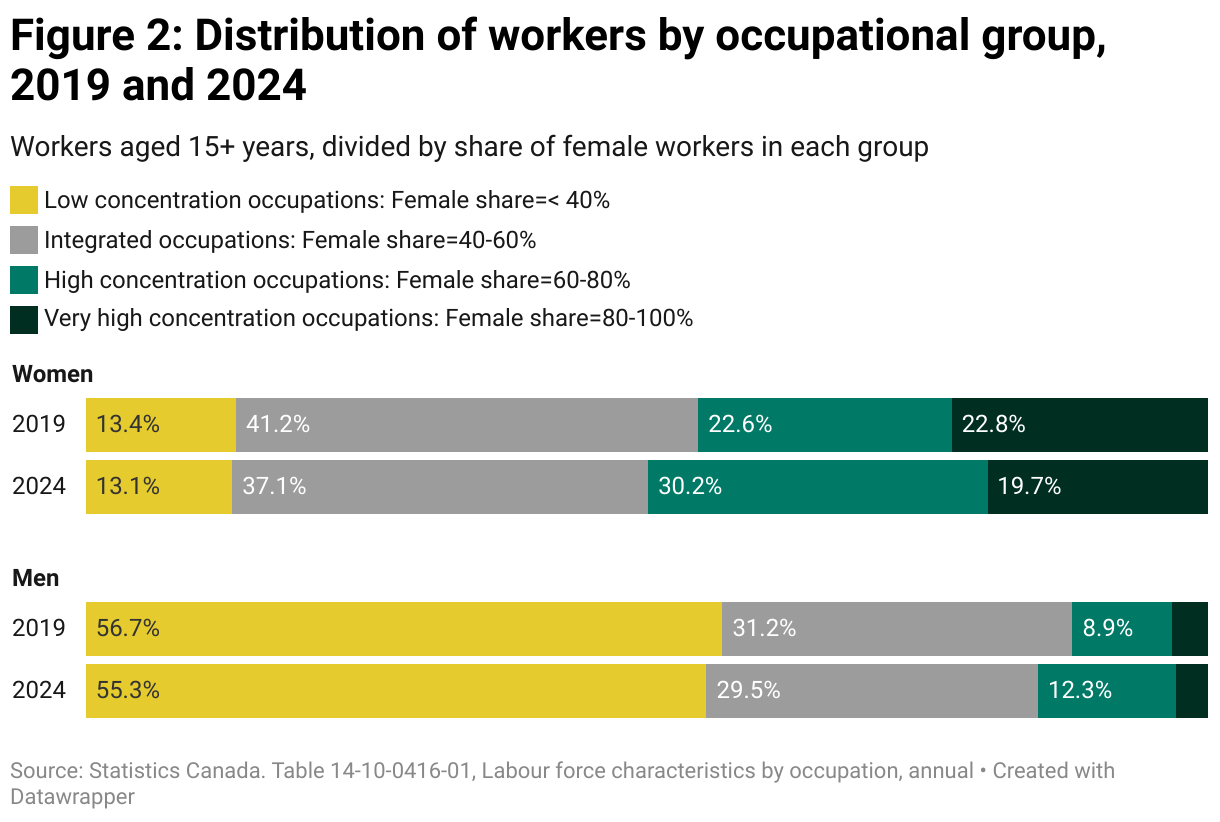
The top 10 most highly concentrated female occupations (where women represent over 80 per cent of workers) were the same in 2019 and 2024, dominated in each year by care economy jobs. But there has been a decline both in the absolute number (-138,400 jobs) and the proportion of women working in these occupations, as shown in Figure 2. In 2019, 22.8 per cent of the female workforce worked in occupations where over 80 per cent of all workers were women. By 2024, the share of women working in these largely female fields had declined by 3.2 percentage points, to 19.7 per cent. The six occupations with the largest share of female workers all experienced decline. The share of women working in nursing, for example, fell by 1.6 percentage points, from 90.1 per cent in 2019 to 88.5 per cent in 2024,25The next five occupations with the highest concentration of female workers also experienced a decline in the level of female representation, including: paraprofessional occupations in legal, social, community and education services (-0.3 ppt), care providers and public protection support occupations (-5.1 ppt), assisting occupations in support of health services (-2.1 ppt), administrative occupations and transportation logistics occupations (-2.7 ppt), and technical occupations in health (-1.4 ppt). even as the overall number of female nurses increased (four times the increase reported by men).
There was also a significant drop in the share of women working in more “integrated” occupations where the concentration of women ranged from 40 to 60 per cent. This group of occupations includes sales and service support occupations, professional occupations in finance and in law, as well as the growing number of workers employed in specialized middle-management occupations. The surge in specialized middle managers between 2019 and 2024 was not enough to offset the even larger job losses among those in sales and service. In 2019, 41.2 per cent of all female workers were employed in these occupations. By 2024, their share had fallen to 37.1 per cent—representing a net loss of 93,800 jobs.
At the same time, there was little change in women’s representation in male-majority occupations such as machine operators, technical occupations in natural sciences and contractors (those where over 60 per cent of workers are male). Their share of total employment edged down by -0.3 percentage points, as male employment gains in these occupations eclipsed those of women at a pace of five to one. In 2024, 13.1 per cent of female workers worked in male-majority occupations compared to 55.3 per cent of male workers. It is interesting to note that, despite the sizable increase in the number of men working in male-majority occupations (+39.6 per cent), the share of the total male workforce working in these fields declined by 1.4 percentage points.
The only occupational group that experienced sizable growth were those where women accounted for 60 to 80 per cent of positions. The share of women involved in these occupations increased by 7.6 percentage points, from 22.6 per cent to 30.2 per cent by 2024, a group that includes well-paid managerial, professional and technical occupations, described above. The expansion of professional occupations in social and community services, professional occupations in business, professional occupations in government services, and administrative and financial support occupations drove almost all of women’s employment growth over the 2019 to 2024 period—and was the largest contributor to men’s employment growth as well, accounting for half (49.3 per cent) of all gains.
Figure 2 illustrates the changes in the distribution of male and female workers by occupational group, arranged by the concentration of female workers. There has been a decrease in the share of women and men working in highly concentrated female occupations, those where over 80 per cent of the workers are female. But if we look at all occupations where women represent more than 60 per cent of all workers, there has been an overall increase in the proportion of women engaged in these fields, from 45.2 per cent in 2019 to 49.9 per cent in 2024, a total increase of 779,800 jobs. Men’s representation in these female-majority fields grew as well, from 12.1 per cent to 15.1 per cent (or 446,100 jobs). These trends speak to the ongoing shift in the occupation composition within all industries, from routine to non-routine jobs, boosting the numbers engaged in several traditionally female occupations fields in business, administration, education and health care.
Wages trends and the gender pay gap
What, then, has been the impact, if any, of current employment trends on women’s earnings? Have women’s employment gains translated into wage gains?
A sizable group of diverse female workers moved up the wage grid in the aftermath of the pandemic, as women took advantage of the surge of job vacancies in higher-paying industries in the tightest labour market in decades. While the average hourly wage among female employees increased substantially between 2019 and 2022, reaching $29.66 an hour, the surge in inflation was such that the real increase was a scant 21 cents. Low-wage workers—and even the women who had moved a step up the income ladder—could be forgiven for thinking that their immediate economic circumstances were not improving. After a decline in the rate of inflation between 2019 and 2020, the annual CPI index jumped by 3.4 per cent in 2021 and by another 6.8 per cent in 2022, significantly outpacing earnings growth among both women and men.
As the rate of inflation eased between 2022 and 2024, falling to 2.4 per cent, average wages picked up. In 2024, women’s average hourly wage reached $32.77 per hour, an increase of 4.7 per cent over 2022 after taking inflation into account. Men’s average wages also rose in lockstep, reaching $37.50 per hour in 2024. With all the ups and downs of the 2019-24 period, however, the gender wage gap moved little. In 2019, women earned 87 cents for each dollar men earned, and the same again in 2024.
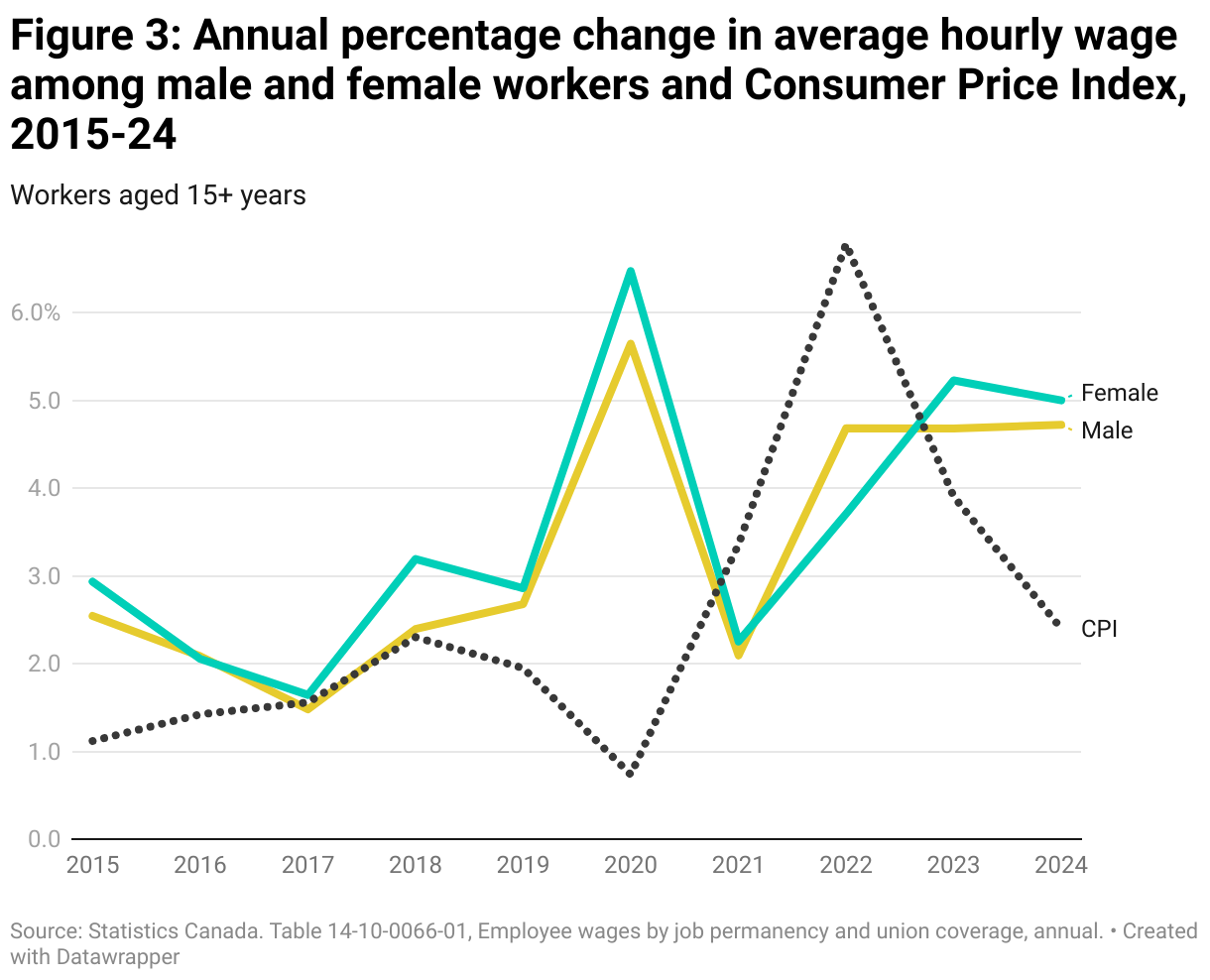
Recent progress in the labour market has not translated into higher income for all women. Rising living costs for shelter and other essentials have been especially devastating for the millions who continue to work in industries hard hit during the pandemic. Many of the lowest-paid jobs eked out only marginal gains over the five years even as employment levels dwindled. The wages of all workers in sales and service occupations increased by a scant 0.4 per cent, while those in administrative and financial support occupations experienced a decline in their real wages of -1.4 per cent. The decline was even larger among female workers in this heavily feminized occupational group, reporting a drop of -2.3 per cent.
The future of precarious, low-waged, front-facing service work is important to consider in this context—and the millions of women who work in these occupations. Personal service employers did not change their business model in response to the pandemic. They remain the lowest-paid sectors in the Canadian economy, with some of the highest rates of part-time work and lowest rates of unionization, illustrating the very low value attached to care and personal service work. They are least likely to have access to employer-provided health insurance and other benefits, more likely to live in unaffordable housing, at great distances from their places of work, and least likely to have reliable access to community services and supports.26Sean Speer, et al., Canada’s New Working Class, Cardus, 2022. These industries may be shrinking in size, but the gap between these low-waged, precarious sectors and the rest of the economy is widening.

Another key trend in the wage data that stands out is the scale of the real wage pay cuts in the care economy. Female educators experienced a real decline in wages of -4.7 per cent between 2019 and 2024, while the wages of female health professionals and professionals in social and community services fell by -2.2 per cent and -2.3 per cent, respectively, over this period. Even as care workers battled the pandemic under terrible and demoralizing working conditions, their wages were eroding in value. In Ontario, for example, the wages of public sector workers, including frontline care economy workers, were capped at one per cent per year throughout the pandemic crisis period, provisions that were repealed after being confirmed as unconstitutional by the courts in 2024.27Liam Casey and Allison Jones, “Ontario to repeal wage-cap law after Appeal Court rules Ford government’s Bill 124 unconstitutional,” CBC News, February 12, 2024.
The cost-of-living crisis in 2022 set the stage for a series of high-profile strikes as workers fought to make up for years of real wage losses.28See Ryan Romard, Public sector workers are leading a big uptick in strikes in Canada, Canadian Centre for Policy Alternatives, 2023. In Ontario, more than 55,000 education workers walked off the job in late 2022 as the provincial government attempted to impose a contract, passing legislation that would prohibit strike action by the Canadian Union of Public Employees, invoking the constitution’s notwithstanding clause to shield the law from a court challenge. The government agreed to repeal the bill in the face of staunch public opposition and the threat of a general strike. This, and other important settlements29In 2023, four Quebec union federations came together in a “Common Front” coordinating several walkouts and a general six-day strike involving around 420,000 workers, including teachers and nurses. Lia Lévesque, “We’re not bluffing about a full strike in January, common front tells Quebec,” The Gazette, December 20, 2023. in the public and private and public sectors, helped push up average wages between 2022 and 2024,30Adam King, How did Canadian workers and unions fare in 2023? The Maple, January 3, 2024, 2023. but, as these data show, care economy workers continue to lag.
The wage growth posted between 2019 and 2024 has been almost exclusively driven by gains among a specific group of workers in management, natural and applied sciences and business and finance. In 2024, women working specialized middle management, applied sciences (except engineering) and finance posted real wage increases over 2019 levels of 3.8 per cent, 4.1 per cent and 6.2 per cent, respectively. These three sectors together represented over one-third (34.5 per cent) of women’s total employment gains. Women working as professionals in law, a smaller number, also recorded wage gains of 5.8 per cent between 2019 and 2024. In 2024, all of these occupations commanded wages above the average hourly wage of all female workers ($32.77 per hour).
It is important to note that in the two highest paid occupational groups—management and natural and applied sciences—men’s wage gains outpaced women’s. For instance, the average hourly wage of men in specialized management occupations increased by 6.9 per cent between 2019 and 2024, after taking inflation into account—almost twice the rate of women (3.8 per cent). The difference in wage growth among men and women in senior management was even higher: 16.2 per cent versus 0.8 per cent. Male workers also did better in the natural and applied sciences (4.4 per cent versus 2.8 per cent). Even as women increased their presence in selected high-waged occupations, men maintained their advantage, as reflected in the widening of the wage gap in specialized middle management (89 per cent to 86.4 per cent) and natural and applied sciences (89.1 per cent to 87.7 per cent). The wage gap in senior management widened by an astonishing 11.2 percentage points over the five years (84.6 per cent falling to 73.4 per cent)31The gap was even wider looking at median hourly wages between 2019 and 2024. Female senior manager lost ground over this period (-3.7 per cent) while men’s wages rose (+12.9 per cent), the gender wage gap widening by 13 percentage points. because of the skyrocketing pay packets of the wealthiest CEOs.
This study provides additional evidence of continuing job polarization in the larger economy. It shows the patterns of female employment are not only tracking, but now influencing, the broader trends of polarization. Long-term shifts in the demand for work, from production to services, as well as the distribution of male and female workers across occupations, have opened up opportunities for women—and improved financial security for some, including women from historically marginalized groups.32Katherine Scott, Still struggling: Racialized workers in the post-pandemic labour market, Canadian Centre for Policy Alternatives, 2025. The changing demand in the labour market has helped to reduce vertical gender segregation in white-collar employment as women have pivoted from female-dominated clerical occupations impacted by emergent information technologies into more gender-integrated professional and managerial occupations that pay a better wage.
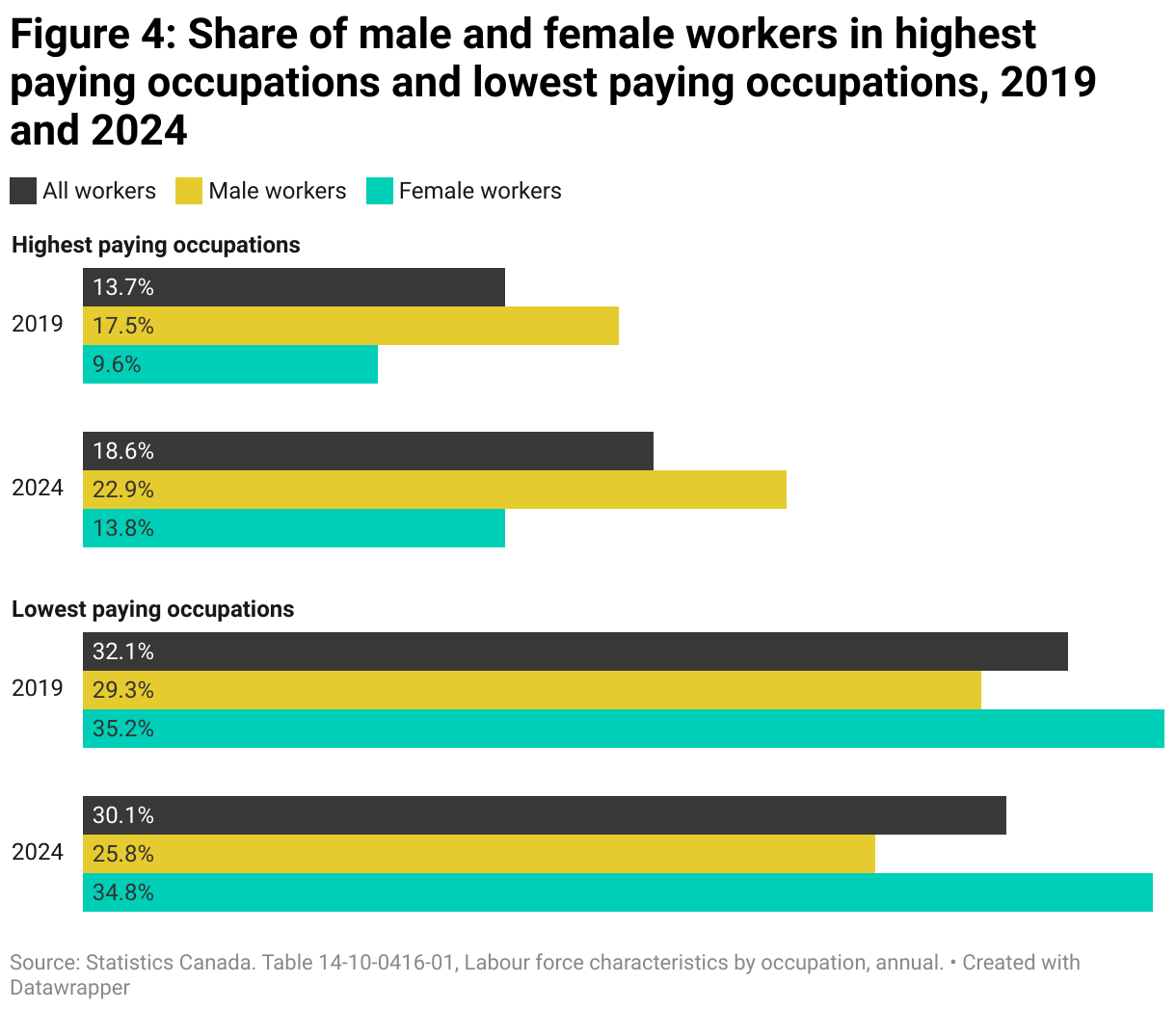
As Figure 4 shows, the proportion of female workers employed in the 10 top-paying occupations increased by 4.2 percentage points between 2019 and 2024, from 9.6 per cent to 13.8 per cent. Higher-waged women now comprise a larger segment of the total female workforce, roughly one in seven workers. At the same time, there has been no movement among the many more women at the bottom of the earnings ladder.33There are 2.5 times as many female workers in the bottom lowest-paid occupations compared to those in the highest paid occupations. In 2024, 34.8 per cent of women worked in low-waged occupations, which was effectively unchanged from 2019 (35.2 per cent). Thus, while there was some movement at the top of the income scale in the aftermath of the pandemic, millions of women remain stuck in low-waged sectors, hugely vulnerable to the economic uncertainties of the current moment.
There was an even larger jump in the number of male workers moving into the top-paying occupations between 2019 and 2024 compared to female workers. The share of male employees working in the highest-paid occupations increased by 5.5 percentage points over this period, from 17.5 per cent to 22.9 per cent. But, unlike their female counterparts, the proportion of men working in the lowest-paid occupations declined from 29.3 per cent to 25.8 per cent over this period. The upshot is that women now make up a larger share of workers in the top group (33.2 per cent to 35 per cent) and in the bottom group (52 per cent to 54.7 per cent). These data speak to the size of the gender disparities that continue to exist and the scale of the challenge in the pursuit of economic justice.
The issue of gender segregation between and within occupational groups demands further attention—especially with a view to understanding the varied experiences of different groups of women. Single measures, such as the employment rate or gender wage gap, hide a diversity of experience across key demographics, such as age, educational attainment and family status, as well as by Indigenous status, immigration status, racialized status or disability status. For example, as Drolet and Amini (2023) find, Canadian-born women typically face smaller gender wage gaps compared to Indigenous and immigrant women. Improvements in human capital and changes within and between industry and occupation are important factors explaining gender wage differentials and changes over time, but their impact varies considerably between different groups. As they conclude, understanding gender differences “requires analysis from a number of different perspectives.”34Drolet and Amini, p. 27, 2023.
Unpacking the ways in which sources of discrimination intersect and interact must remain a priority. There are well-established hierarchies within the labour market, characterized by gender disparities, as well as by race, immigration and ability. We see Canadian-born women, for example, being replaced by immigrant, and often racialized, women in the most devalued care and personal service work, such as custodial and food service roles.35See: Kjersti Misje Østbakken, Julia Orupabo and Marjan Nadim, “The hierarchy of care work: how immigrants influence the gender-segregated labor market,” Social Politics, Vol 30, No. 3, 2022; Evelyn Glenn, Signs, Vol. 18, No. 1, 1992. Women’s persistently high representation in low-waged occupations, as this study finds, certainly suggests that the mechanisms that reproduce economic disadvantage for women have not been dislodged or disrupted by the pandemic.36These mechanisms include, for example, the negative wage penalty attached to motherhood and other workers with care responsibilities; gendered and racialized norms, biases and stereotypes around competence, leadership and likeability; lack of access to attendant care, accessible transportation or other accommodations; and the inequitable treatment of foreign credentials and related work experience. The post-pandemic job recovery represented an opportunity to bridge the gender divide in the labour market. While the changing demand for labour—for non-routine, cognitive skills, in particular—has provided a runway to boost women’s representation in higher paid sectors of the economy, it has likewise continued to fuel job polarization within and between occupations and industries.
Conclusion: Missed opportunity
A decade ago, researchers and advocates were discussing whether the “gender revolution” had stalled and what was needed to reinvigorate the push for substantive change.37See: Paula England, “The gender revolution uneven and stalled,” Gender & Society, 24(2): 149-166, 2010; Neil Guppy and Nicole Luongo, “The rise and stall of Canada’s gender-equity revolution,” Canadian Review of Sociology, 52(3): 241–65, 2015. This question has taken on even greater urgency in the aftermath of the COVID-19 pandemic crisis period—against a backdrop of significant population growth, population aging, job polarization and the reorganization of work. The pandemic triggered a shake up of the labour market. It opened the door to higher incomes for a group of female workers, but it did not transform the deeply gendered division of paid and unpaid labour between men and women at home,38Sylvia Fuller, et. al., “Gender Divisions of Domestic Labour During the COVID-19 Pandemic in Canada: Did Increases in Father Involvement Persist Through Later Stages?” Canadian Review of Sociology, November 4, 2025. nor did it improve the working conditions of low-waged, precarious workers.39Katherine Scott, Unequal pandemic, unequal recovery. Canadian Centre for Policy Alternatives, 2024; Katherine Scott, Work in progress: Women in Canada’s changing post-pandemic labour market, Canadian Centre for Policy Alternatives, 2024. Temporary improvements brought in during the pandemic, including paid sick leave, wage top-ups and investments in training, have long since expired.40For a comparison of the treatment of low-wage and self-employed workers during the pandemic in eight countries, see: Ellen MacEachen, et al., “Laws, Policies, and Collective Agreements Protecting Low-wage and Digital Platform Workers During the COVID-19 Pandemic,” New Solutions, Vol. 32, No. 3, 2022.
Female workers and other low-waged, precarious workers have been on an economic roller coaster for the last five years, hit hard by recurring public health closures, the exponential increase in unpaid labour, and then the surge in the cost-of-living in 2022 which ratcheted up financial pressures on households.41Weimin Wang, “High Inflation in 2022 in Canada: Demand–pull or supply–push?” Statistics Canada, Economic and Social Reports, Catalogue no. 36-28-0001, 2024. Low-waged workers now confront greater uncertainty as the economy contracts in the face of the American trade war. Labour market growth has slowed in 2025 and unemployment has started to climb in export industries, impacting not only workers in steel, autos and lumber, but millions more in related service sectors.42Guy Gellatly and Carter McCormack, Recent developments in the Canadian economy: Fall 2025, Statistics Canada, Economic and Social Reports, Catalogue no. 36-28-0001, 2025. Young workers, students and recent graduates are bearing the greatest burden as companies scale back new hires and offer more part-time work, part of a trend that started to accelerate in 2024.43Kevin Carmichael, “Canada’s young workers are getting crushed”, The Logic, August 9, 2025. The large pullback in employment in sales and service occupations, and in industries such as retail and accommodation and food services, is an important part of the current picture for all low-waged households.
So, too, is the rapid evolution of AI technologies and advanced robotics—and their impacts on labour markets. The use of AI is now well advanced across the economy in manufacturing, health care, management, customer services, and construction, to name a few. Unlike past technology waves that targeted routine manual tasks, AI extends into cognitive work—analyzing data, recognizing patterns, and drawing conclusions. This puts even high-waged managerial, professional and technical occupations at risk of change, challenging long-held assumptions about their immunity to automation. Medhi and Morissette (2024) estimate that six in 10 workers are already working in roles that are highly exposed to AI, half of whom (roughly 4.2 million) work in jobs like journalism, programming or medical technology that may be wholly transformed and replaced.44Tahsin Mehdi and René Morissette, “Experimental Estimates of Potential Artificial Intelligence Occupational Exposure in Canada,” Statistics Canada, Economic and Social Reports, Catalogue no. 36-28-0001, 2024. In today’s labour market, heightened risk of job loss to automation is redefining what it means to be precarious.
It remains to be seen how the take up of AI in the world of work will play out. Al holds out great potential to enhance human capabilities, but the risks to human rights and health and safety are considerable,45Sofia Gomez Tamayo and Andrea Petrelli, Work Transformed: The Promise and Peril of Artificial Intelligence, ILO Research Brief, 2025. as the integration of AI proceeds with few legislative or regulatory guardrails in Canada.46Blair Attard-Frost, The Death of Canada’s Artificial Intelligence and Data Act: What Happened, and What’s Next for AI Regulation in Canada?, Montreal AI Ethics Institute, 2025. To date, Canadian business have been comparatively slow to implement AI technologies, lagging other G7 countries, but that is changing. Statistics Canada recently reported that 12.2 per cent of firms reported using AI in production and services in the second quarter of 2025, doubling in the space of a year, and a larger share (14.5 per cent) was planning to use AI in the next 12 months.47Valerie Bryan, Shivani Sood and Chris Johnston, Analysis on expected use of artificial intelligence by businesses in Canada, third quarter of 2025, Statistics Canada, Analysis in Brief, Catalogue no. no. 11621M, 2025. As the adoption of AI proceeds, its impact on workers will depend on their ability to access the tools, training, and infrastructure needed to adapt and to mobilize collectively to make their voices heard. As Tamayo and Petrelli (2025) argue, “[w]ithout targeted investment in education and reskilling—especially for those in low-income and marginalized communities—there is a risk that the augmentation gap will widen existing inequalities.”48Tamayo and Petrelli, 2025, p. 5.
The risk of widening inequalities is especially high among women who, compared to men, are both more likely to be engaged in roles with high automation potential (e.g., administration, logistics, data analysis) and those that offer substantial opportunities for job enhancement and upskilling if available and effectively leveraged (e.g., research, care, teaching).49Pawel Gmyrek, et.al., Generative AI and jobs: A refined global index of occupational exposure, ILO Working Paper 140, International Labour Organization, 2025. Post-pandemic labour market changes in the occupational composition of the labour force, as documented here, have served to raise the stakes higher. As the AI juggernaut unfolds, will highly AI-exposed low-waged, marginalized workers have access to the resources needed to weather the storm? There is a great likelihood that the skills needed in an AI world will be fundamentally different from the skills needed today to secure a decent living.
This question is just as pressing for other vulnerable workers in the care economy and personal service occupations, including the growing ranks of gig workers staffing long-term care homes, tutoring students and taking care of the company books. How will the uptake of AI in its various forms influence the distribution of male and female workers across occupations and industries? What strategies are needed to prepare workers to navigate workplace change and to actively mitigate negative impacts—including the risk of widening inequalities not only between men and women, but across other cleavages in the labour market as well? As importantly, what systemic safeguards are necessary to protect the rights of workers and to help level the playing field in pursuit of decent jobs and a living wage?
Occupational segregation remains a critical barrier to women’s economic equality and well-being. It has been remarkably stable over many decades, despite rising levels of education and employment among women. Female workers have reduced their overrepresentation in clerical jobs and have made significant inroads in professional and technical occupations. Male workers have also expanded their representation in professional and technical occupations as their numbers in manufacturing and production jobs have steadily declined, all of which is working to reduce the level of occupational segregation in the labour market. But it is still the case that women continue to populate low-waged work in much greater numbers than men do. As an extensive body of research has found, women’s work tends to be more poorly paid in female-majority sectors precisely because the majority of workers are female; women’s work simply isn’t valued as highly as men’s.50See: Asaf Levanon, Paula England and Paul Allison “Occupational feminization and pay: Assessing causal dynamics using 1950-2000 U.S. census data,” Social Forces, 88(2): 865-891, 2009. The work done by marginalized women workers is valued even less, concentrated as they are in the most precarious and difficult jobs.51See: Melissa Hodges, Melissa, “Intersections on the Class Escalator: Gender, Race, and Occupational Segregation in Paid Care Work,” Social Forum, 35: 24-49, 2020; Kjersti Misje Østbakken, Julia Orupabo and Marjan Nadim, “The Hierarchy of Care Work: How Immigrants Influence the Gender-Segregated Labor Market,” Social Politics, 30(3): 818-843, 2023.
Governments have a critical role to play in service of a more resilient and inclusive labour market and gender-just future—one where occupational segregation and earnings polarization do not limit women’s economic opportunities and financial security. The COVID-19 crisis illustrated both the shortcomings of existing policies and institutions and what’s possible with strong public leadership. The current moment demands public leadership to contain and reverse growing economic disparities in the labour market, which are at risk of widening further as the toll from the U.S. trade war mounts and the unregulated roll-out of AI proceeds. Governments should be working to facilitate and uphold the rights of all workers to decent work, to unionize, to bargain collectively and seek redress when their rights are not upheld. They should be working to bring wage rates into alignment with the actual cost of living, expanding access to labour protections for non-standard, precarious and temporary workers, and strengthening pay equity and pay transparency laws. They should be prioritizing investments in the care economy, enhancing the wages of essential care workers and improving their crushing working conditions. They should be working to modernize and strengthen existing social protections for workers and the education and training systems needed to navigate Canada’s polarized labour market, leveling the playing field for women and all marginalized workers. The pandemic recovery was a missed opportunity. The time for action is now.
Appendix: Average hourly wage by gender and occupation, 2024

Acknowledgements
Special thanks to my colleagues at the CCPA and the external reviewers who kindly provided invaluable advice. My thanks as well to Trish Hennessy, Tim Scarth and the CCPA comms team who have transformed this report with their tremendous talents, at once making it more engaging and extending its reach and impact.
About the author

Katherine Scott
Katherine serves as the director for the CCPA’s gender equality and public policy work. She has worked in the community sector as a researcher, writer and advocate over the past 20 years, writing on a range of issues from social policy to inequality to funding for nonprofits.