



Share
Summary
Five years into the Canada-Wide Early Learning and Child Care (CWELCC) program, this report analyzes the shifting landscape of licensed child care fees across 35 major Canadian cities, comparing 2026 data against the 2019 pre-program baseline.
There has been progress: Costs are lower now, but most child care fees in Canada are not at $10 a day. Six jurisdictions have committed to $10 a day as a set or maximum fee: Newfoundland and Labrador, Prince Edward Island, Manitoba, Saskatchewan, and Nunavut. Quebec’s low daily fee of $9.65 predated the CWELCC. An additional three provinces have set fees, but higher than $10 a day. The remaining four jurisdictions have a different fee at every provider.
Those jurisdictions without $10-a-day set fees argue that when you include their low-income subsidies, they have average fees of $10 a day.
Child care fees in key cities
Infant child care fees
Infant fees in 11 of the 35 cities in this study are now $10 a day, including in St. John’s, Charlottetown, Winnipeg, Regina, Saskatoon, and Iqaluit (they are $9.65 a day in Quebec cities of Gatineau, Laval, Longueuil, Montreal and Quebec City). Infant fees in Lethbridge, Calgary and Edmonton are $15 a day, they’re $19 a day in Saint John, Moncton and Fredericton, $22 a day in all Ontario cities, and $23 a day in Halifax. B.C. cities are the laggards, where infant fees range from $28 a day in Kelowna to $52 a day in Richmond.
Preschool-age fees
As with infant spaces, most parents in the cities included in this report are not paying $10 a day for a preschool-age child care space. Some are: parents with preschool-age children in Quebec pay the set fee of $9.65 a day in 2026 in Gatineau, Laval, Longueuil, Montreal and Quebec City. In Charlottetown, St. John’s, Winnipeg, Saskatoon, Regina, and Iqaluit, parents pay $10 a day for a preschool-age space. Preschool-age child care fees are $15 a day in Edmonton and Calgary, $16 a day in Saint John, Moncton and Fredericton, and $22 a day in Ontario’s big cities and market-fee-based Halifax. Again, B.C. is the laggard: median preschool-age fees range from $24 to $42 a day in Kelowna and Richmond, respectively.
Substantial savings
By far the largest monthly savings for parents of infants have been in Toronto, where parents are saving more than $1,800 a month compared to the adjusted-for-inflation fees they would have been without the CWELCC. Parents in the suburban cities around Toronto (Mississauga, Richmond Hill, Brampton, Vaughan, Markham and Oakville) are also saving $1,300 to $1,500 a month for infant care. Ontario fees were so high pre-CWELCC, lowering and regularizing them yielded more savings in Ontario than other provinces that had kept fees in check up to 2019.
Iqaluit parents with infants are saving $1,374 compared to what infant care would have cost without CWELCC. In most other cities Canada-wide, parents are saving $500 to $1,000 a month on infant spaces due to CWELCC.
When it comes to cities in British Columbia, parents now pay the highest fees in the country for infant spaces. Despite that, they are still saving money compared to what they would have been paying without the CWELCC, although their savings are much smaller than elsewhere in Canada, with parents of infants in B.C. cities saving $300 to $500 a month.
British Columbia and Nova Scotia retain market fees, where each provider has a different fee structure. This has led to the most complex systems for parents and the highest fees. Micro data from B.C. illustrates that for-profit centres charge consistently more than non-profits and that B.C. parents are paying a wide variety of fees, some of which are $10 a day but most are many several times higher.
The next stage of building Canada’s child care system requires a long-term plan for achieving the commitments made by the federal government in 2021. In June 2026, the federal government increased its CWELCC funding by a third, worth $5.4 billion over two years. The first round of CWELCC funding has been federal, now it’s time for all provinces and territories to step up too.
Building a child care system that works for all—families, women, children and the economy—will require further stable funding, comprehensive policy and long-term planning to deliver on the promise of affordable, accessible, high-quality child care for all.
Introduction
The creation of the Canada-Wide Early Learning and Child Care (CWELCC) program changed the game on what Canadian parents pay for child care. In the 2021 federal budget, the Trudeau government announced the historic $10-a-day plan, which would be backed by substantial multi-year federal funding. Between 2021 and 2022, all provinces and territories agreed—with some variation in enthusiasm—to work with the federal government to transform Canada’s child care market into an early learning and child care system.1“Early Learning and Child Care Agreements”, Government of Canada, https://www.canada.ca/en/early-learning-child-care-agreement/agreements-provinces-territories.html.
The new program applied to licensed child care in centres and regulated family child care homes serving children aged six and under; it could be full-day or part-day, centres and licensed family child care, including children attending kindergarten who require part-day before- and after-school care. The federal government and provinces/territories agreed it would be based on a set of common principles: affordability, accessibility, quality and inclusivity. It was envisioned and designed as a program “for all”—that is, universal.
At the very beginning, the federal government set out two specific goals for affordability: first, an initial reduction of parent fees by 50 per cent in the first year, and a second goal of reducing all parent fees to an average of $10 a day, per child, by 2026. All jurisdictions agreed to specific five-year numerical targets for expanding licensed child care, to be “primarily” in the not-for-profit and public sectors. Other key goals, such as improving wages and working conditions for the child care workforce, ensuring high quality, and strengthening inclusivity were identified but left relatively unspecified.
The introduction of CWELCC came at a time when child care fees across Canada had been increasing steadily, often at rates well above inflation.2See for instance: David Macdonald and Martha Friendly, Developmental Milestones: Child care fees in Canada’s big cities 2018, Canadian Centre for Policy Alternatives, February 2019. At the end of the five-year period of the initial round of CWELCC agreements, which ended March 31, 2026, parent fees and fee structures have changed markedly across the country. Although most fees are not at $10 a day (as we shall see), they are substantially lower than they were before CWELCC. And, importantly, some key attitudes and ideas about early learning and child care have changed, as support for publicly funded child care as essential social and economic infrastructure has broadened.
Many parents who have accessed a reduced fee space report that it has been “life-changing”, enabling them to return to work, pursue an education, improve their financial stability, and reduce household stress.
Of course, lower fees are only part of the major change that CWELCC has brought to child care provision. Other elements include a significant expansion of spaces (although not yet enough), and improved, more regularized wages for early childhood educators (although not yet adequate nor comprehensive). Both pillars of a child care system, they are less visible to parents but are equally important building blocks in the development of a sustainable and equitable early learning and child care system.
This year’s fee report examines the median fees in 35 major cities in Canada. It examines “base” fees, not considering the additional or supplemental fees that have become increasingly common in some provinces. Thus, some centres charge for lunches, for joining a waiting list, or using extended hours. In previous years, we have examined the prevalence of these additional fees,3Macdonald, D., & Friendly, M., The Price is Not Right (yet): $10-a-day child care falling short of target, Canadian Centre for Policy Alternatives, ( https://www.policyalternatives.ca/news-research/the-price-is-not-right-yet-10-a-day-child-care-falling-short-of-target/ ). but didn’t do so this year.
Additionally, most provinces and territories further subsidize fees beyond the base fees reported here for eligible low-income families. These income-contingent fee subsidies are not examined here. A more fulsome analysis of income-contingent fee subsidies both before and after CWELCC is sufficiently complicated to merit its own analysis.
The price differentiation based on age (infants, toddler and preschool-age categories) is much less common now than it was pre-CWELCC, so this report presents only infant and preschool-age fees.
Beyond many important achievements over the five years of CWELCC, one of the most striking findings is about what has not happened with regard to affordability in the last year: those jurisdictions that had market fees in 2025 still do; those that hadn’t brought down fees to $10 a day by 2025 still haven’t; those jurisdictions that had age-differentiated fees still use them. In addition, the important issue of affordability for low-income families has not changed by 2026, with Alberta4On April 1st, 2025, Alberta ended its Child Care Subsidy Program. See “Early Learning and Child Care ‘What’s Changing’ Fact Sheet For Preschools,” Government of Alberta, 2025, https://open.alberta.ca/dataset/9bce7fbd-7d52-40d2-84d0-cdfd36668b9a/resource/91125452-78b9-4676-814c-3eec79b30b58/download/jet-early-learning-child-care-whats-changing-preschools-2025.pdf. and Saskatchewan5In January 2024, Saskatchewan cancelled the Child Care Subsidy but allowed low-income eligible parents to use the Saskatchewan Employment Supplement, which had been in place for some years to cover employment-related costs, such as transportation, and would now include child care fees: Government of Saskatchewan, “The Saskatchewan Employment Incentive is now Open for Applications,” January 25, 2024, https://www.saskatchewan.ca/government/news-and-media/2024/january/25/the-saskatchewan-employment-incentive-is-open-for-applications. having cancelled their low-income fee subsidy schemes.
In our 2025 report, we noted that as parent fees had been significantly reduced, regularized and stabilized due to CWELCC’s influence, it was likely to be the last in this series of reports. Since publication of the 2025 fee report, however, the political climate regarding continued enhancement of child care has shifted, with additional ongoing federal funding uncertain and some provinces putting forward the idea of returning to more complex pre-CWELCC approaches, such as including higher, income-tested fees for middle-income parents.6Katie DeRosa, “B.C. premier says ‘significant decision’ coming from Ottawa on $10-a-day child care,” CBC News, January 20, 2026, https://www.cbc.ca/news/canada/british-columbia/bc-ottawa-10-dollar-a-day-childcare-decision-eby-9.7053715.
Significant changes to parent fees
One of the most significant achievements of CWELCC has been the transformation of how licensed child care is financed. Prior to CWELCC, the cost of licensed child care was borne primarily by parents through parent fees. Today, operating funding provided by federal and provincial/territorial governments has replaced a substantial portion of parent-fee revenue, making child care considerably more affordable for most families. Before CWELCC:
- Almost all parent fees were significantly higher than they are today, and were regularly increasing above the rate of inflation;
- Only four provinces had fees set by the government (which were at different levels, as they are today). The set fee provinces were Newfoundland and Labrador, P.E.I., Quebec, and Manitoba;
- Fees were much more differentiated based on age, with different fees for infants, toddler and preschoolers in almost all jurisdictions. Fees were highest for infants and lowest for preschool-age children.
During its first five years, CWELCC brought about three fundamental changes to parent fees:
- Parent fees in jurisdictions both with, and without, set fees are markedly lower, although in some jurisdictions they are still characterized by high-market fees with limited government intervention, as they were pre-CWELCC;
- Provinces and territories have almost all implemented set fees across the board. The with the exceptions are Nova Scotia, British Columbia,7British Columbia has some spaces at $10 a day, a set fee, but these are a small minority of spaces in all the cities we examined. Vancouver comes closest, with just under half of its spaces at $10 a day. the Yukon and the Northwest Territories, which still primarily use marketized fees that are set by, and are different across, licensed providers—although the annual increases in fees and what new fees can be are limited by governments;
- Age-differentiated fees are now the exception, not the norm, with almost all provinces and territories opting for a common fee across all age groups. Of the provinces and territories with set fees, only New Brunswick retains different fees for different ages.
As we noted back in 2023, set parent fees greatly simplify the system for parents, providing administrative transparency and simplicity. Parents no longer have to ask every licensed centre or family child care provider what their fees are because they are identical, leaving parents to focus on choosing the program that best meets their child’s and family’s needs.
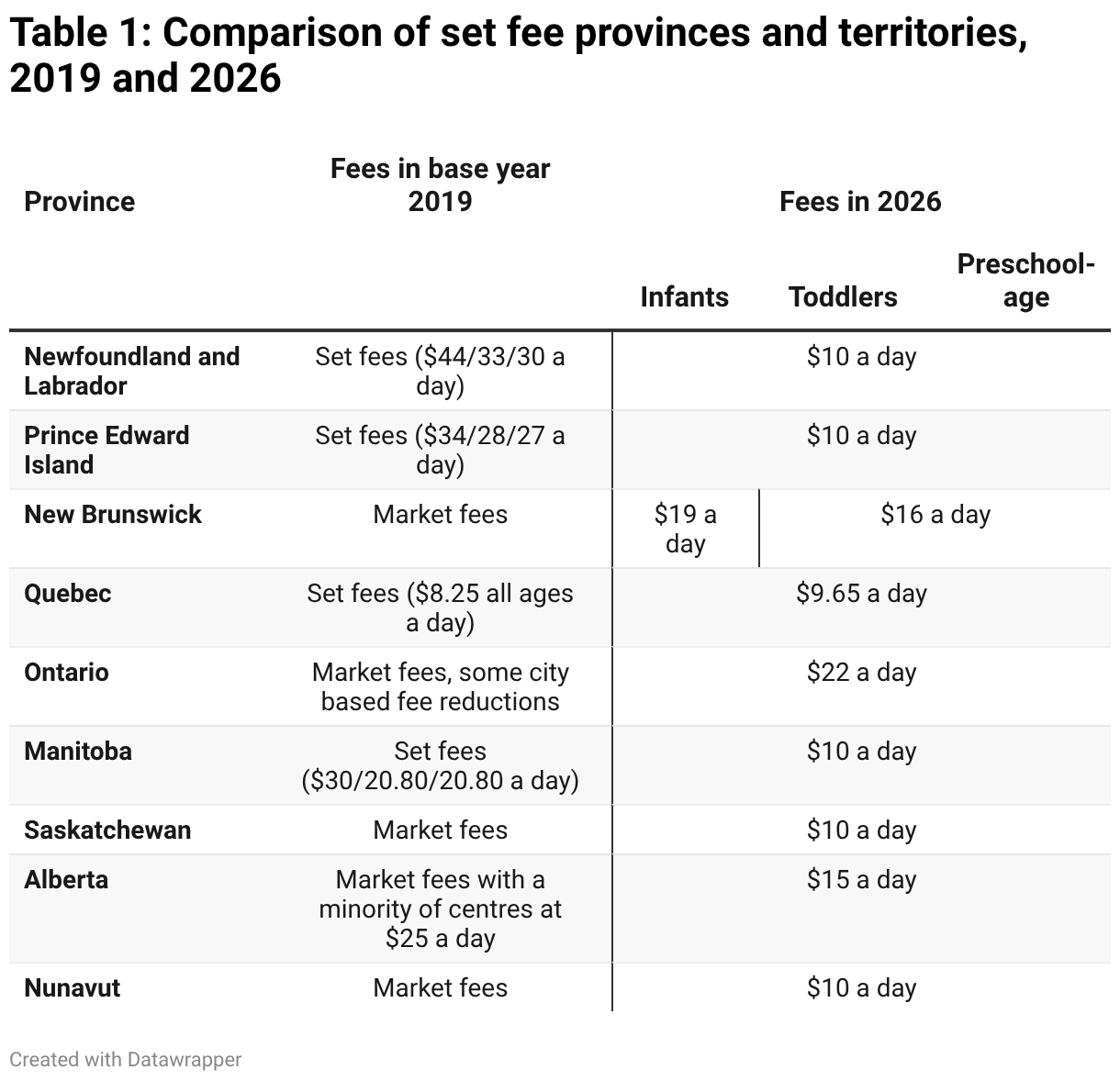
As Table 1 shows, four provinces and territories still retain aspects of market fees. This means that centres and regulated family child care providers (or their agency, in agency-model jurisdictions) set their own fees, which are offset by “fee reduction” schemes that transfer public funds to service providers. Thus, although each provincial or territorial government is the main contributor to covering the service provider’s cost of providing child care, it is the government’s contribution that is set, with the fee “at the gate” established by the service provider (albeit with some controls by the provincial or territorial government). For parents, this is a much less transparent, more complex system: parents may not be able to predict what their fees will be and could end up paying very different amounts, depending on where they manage to find an available space in conditions of short supply.
These fee reduction schemes are quite complex, as Table 2 shows, with the government contribution sometimes varying based on children’s age and by service type (family child care versus a centre), as is the case in British Columbia. Additionally, the province or territory may allow fees to increase over time, as in B.C., which allows a three per cent increase, with some exceptions, while others are locked in, as in Nova Scotia, and as Ontario’s fees were before the set fee was introduced. To further complicate matters, while most spaces in these four jurisdictions remain attached to market fees in some way, British Columbia has two fee-reduction systems. The first, in essence, pays a part of the pre-existing market fee. The second system of family child care homes and centres charge $10 a day but they are a small minority of the spaces.
As Table 2 shows, the market-fee provinces are much more complex to understand or navigate, with fees varying—sometimes substantially—from provider to provider even within one city.

This complexity acts as an access barrier for lower-income families who find it hard to navigate even generous income-subsidy programs.8Laudine Carbuccia et al., “A Randomized Controlled Trial on the Effect of Administrative Burden and Information Costs on Social Inequalities in Early Childcare Access in France,” Nature Human Behaviour 10, no. 1 (January 2026): 64, https://doi.org/10.1038/s41562-025-02293-4.
Apart from the level of fees, provinces and territories can be categorized into four categories based on their fee complexity, as Table 3 shows. Eight of the provinces and territories charge the same fee in every centre and regulated home that is part of CWELCC, no matter the age group (as long as it is for children aged six and younger). This is the simplest system for parents to understand: the fee is the same everywhere.
New Brunswick has provincially set fees but they vary both by age and region, making them more complex than the other set-fee provinces.
In British Columbia, a small minority of its licensed child care provision is in $10-a-day full-time spaces and $7 a day for part-time spaces, no matter the child’s age. Thus, this part of its system is easy to understand, while the majority of its licensed provision is made up of centres and family child care with different fees by service providers that vary further by age group. This part of the B.C. system fits into the “most complex” category in Table 3, where the fees may be different at every service provider, and are usually also different by age.
The most complex category includes the Northwest Territories, Yukon and Nova Scotia, where all providers charge different fees and those fees also differ by age within a centre.
It is noteworthy that this “most complex” category was the norm in almost all of Canada before the introduction of CWELCC.

As noted above, not all spaces are part of the CWELCC system. Some provinces have large minorities outside of the system, although always well under 50 per cent of spaces. Figure 1 outlines the proportion of spaces outside CWELCC that can charge whatever the market will bear. The proportion of non-set fee spaces is the largest in Quebec, at 20 per cent.

Has CWELCC achieved $10-a-day child care?
The most publicly visible goal of the CWELCC program was to reduce fees so parents were paying $10 a day per child. But the wording in the initial announcement and all subsequent accords was quite specifically an “average of $10 a day”.9See, for instance, “Canada-Alberta Canada-Wide Early Learning and Child Care Agreement,” Section 1.0, Government of Canada and Government of Alberta, https://www.canada.ca/en/early-learning-child-care-agreement/agreements-provinces-territories/alberta-canada-wide-2021.html. Six provinces and territories made the policy choice to make a commitment to $10 a day per child as a cap, or maximum fee. In those places, all parents now pay $10 a day. These jurisdictions include Newfoundland and Labrador, Prince Edward Island, Manitoba, Saskatchewan, and Nunavut. Quebec’s low daily fee of $9.65 in 2026 predated CWELCC.10Quebec had adopted fees much lower than $10 a day long before CWELCC. The province is not governed by CWELCC, and although it has adopted annual indexation to inflation, its fees remain lower than $10 a day.
Two other provinces—Ontario and Alberta—also use a set maximum fee of $22 a day in Ontario and $15 a day in Alberta. Ontario also describes its fees as “on average” $19 a day, factoring in its fee subsidies, but non-subsidized parents all pay $22 a day.
In practice, two other factors determine how much parents pay. The first is the fee subsidy systems that cover some or all of the cost of parent fees for eligible low-income families, a practice that dates from the Canada Assistance Plan, although several provinces have since discontinued their low-income subsidy systems: Quebec did so in September 1997 when it began to fund child care operationally, with a parent fee originally of $5 a day.11Pierre Fortin, Luc Godbout, and Suzie St-Cerny, “Lessons from Quebec’s Universal Low-Fee Childcare Programme,” Progressive Review 19, no. 2 (August 2012), https://www.ippr.org/articles/lessons-from-quebecs-universal-low-fee-childcare-programme. Saskatchewan and Alberta discontinued their fee subsidy systems much more recently, following the introduction of CWELCC. This may make all the difference for low-income families—especially those with more than one child, for whom even a set fee of $10 or $15 a day is an insurmountable barrier to accessing licensed child care, if they are, for instance, taking training or seeking employment. This report is not examining parent fee subsidies in further detail.
A second cost factor to keep in mind are “additional” or “supplemental” parent fees, which haven’t been heavily researched, although our 2025 fee report provided some preliminary information on additional fees.12David Macdonald, The Price Is Not Right (Yet): $10-a-Day Child Care Falling Short of Target, Canadian Centre for Policy Alternatives, 2025, https://www.policyalternatives.ca/news-research/the-price-is-not-right-yet-10-a-day-child-care-falling-short-of-target/. This report examines only “base” fees and excludes the additional add-ons that are becoming increasingly common in some provinces, where service providers may charge meal fees (some quite high), fees for non-standard hours, wait list fees, and others.
The remainder of this report examines parent fees in selected big cities across Canada in more detail.
Infant fees in 2026
The infant category generally includes children aged 18 months to two years and younger, although this differs somewhat by province/territory. It is the youngest age group and is the most expensive in a market system because it requires the highest staff-to-child ratios. Infant care is the least common type of full-time care, due, in large part, to higher staffing costs.13See Table 1 of Martha Friendly et al., Early Childhood Education and Care in Canada 2024/2025, Childcare Resource and Research Unit, 2026, https://childcarecanada.org/publications/ecec-canada/26/02/early-childhood-education-and-care-canada-2024-2025. So for parents looking for child care for an infant—typically to return to work following parental leave—it is generally very hard to find, no matter the fee.
As noted, the CWELCC program now means that there are indeed parents in many of Canada’s big cities who are paying $10 a day, or less, for an infant space. This is happening in all the Quebec cities included in this report, where the 2026 infant fee is slightly less at $9.65 a day. These include: Gatineau, Laval, Longueuil, Montreal and Quebec City. Quebec parents are joined by parents in the east coast cities of St. John’s and Charlottetown, and parents of children in the Prairie cities of Winnipeg, Regina and Saskatoon—all of which offer infant spaces for $10 a day. Parents in the far-North capital of Iqaluit also enjoy $10-a-day care for infants.
For 11 of the 35 cities included in this report, $10-a-day care for infants is already a reality. For the remainder—both those with set fees and those with market-based fees—it is not.
The Alberta cities of Lethbridge, Calgary and Edmonton provide infant child care at a set fee of $15 a day, while roughly $20 a day is the most common daily fee for infants with fees in 16 cities close to this value. This is the case in the New Brunswick cities of Saint John, Moncton and Fredericton, where parents are paying $19 a day. Parents in all the Ontario cities now pay $22 a day for a CWELCC infant space.
Halifax (and Nova Scotia generally), along with the B.C. cities, are stuck between the old world of market fees and the new world of set fees. We see this reflected in Figure 2, where these market-fee systems retain the highest fees in Canada. Halifax has a median fee of $23 a day for infants.
B.C. cities are the laggards on reduced fees: infant fees range from $28 a day in Kelowna to $52 a day in Richmond, a suburb of Vancouver.

Preschool-age fees in 2026
There is often a toddler age category that falls between the infant and preschool-age categories in most jurisdictions. However, as fees have been simplified, this category has much less differentiation than it used to, even if it still has specific licensing requirements. We’ve excluded the toddler category from the fees comparison as a result.
Preschool-age is for children who are soon to enter public school and comprises roughly age three to four or five years, depending on availability of four-year-old and five-year-old kindergarten in that province or territory. In a market system, service providers usually charge lower fees for preschool-age children than infants because fewer staff per child are required. Preschool-age spaces are the most common type of space, so are much easier for parents to find than infant spaces.
As with infant spaces, most parents in the cities included in this report are not paying $10 a day for a preschool-age space. Some are: parents with preschool-age children in Quebec pay the set fee of $9.65 a day in 2026 in Gatineau, Laval, Longueuil, Montreal and Quebec City. In the Atlantic Canada cities of Charlottetown and St. John’s, parents pay $10 a day for a preschool-age space. The Prairie cities of Winnipeg, Saskatoon and Regina also have preschool-age fees of $10 a day, and in the far-North, Iqaluit parents also pay $10 a day for a preschool-age space.
In the Alberta cities of Lethbridge, Edmonton and Calgary, parents pay 50 per cent more than the $10-a-day target, or $15 a day for a preschool-aged child. Parents in the New Brunswick cities of Saint John, Moncton and Fredericton (where fees vary by the child’s age) pay $16 a day for preschool-age. Parents pay $22 a day for a preschool-age space in Ontario’s big cities and market-fee-based Halifax.
Finally, in British Columbia, median fees range from $24 to $42 a day in Kelowna and Richmond, respectively. Despite the small minority of $10-a-day centres, market fees persist in B.C. cities, with new centres opening at higher fees, and fees are creeping up to erode the provincial fee reductions, which haven’t changed in value since December 2022.

Substantial savings for parents
In previous reports in this series on parent child care fees, comparisons have used 2019 fees (CWELCC’s baseline year) and compared them to current fees. But this underestimates the savings for parents. Between 2019 and 2026, Canada-wide prices overall rose by 24 per cent.14Statistics Canada, Table 18-10-0004-01 https://www150.statcan.gc.ca/t1/tbl1/en/cv!recreate.action?pid=1810000401&selectedNodeIds=2D2&checkedLevels=0D1&refPeriods=20190401,20260401&dimensionLayouts=layout2,layout2,layout3&vectorDisplay=false, April 2019 to April 2026. In our reports before 2019, we observed that child care fees were rising faster than inflation. Thus, in this analysis, 2019 will be our comparison year for 2026 fees, but adjusted for general inflation over that period, not the higher-fee inflation child care fees were seeing prior to 2019. Therefore, the parent savings displayed in Figures 3 and 4 are likely conservative estimates.
Parents’ savings for infant care since CWELCC are much larger than for older children. Most of the cities included in 2019 had market fee systems in place, so their infant fees were much higher. Since most cities have now moved to one set fee across age groups, parents’ biggest saving has been for infant child care.
By far the largest monthly savings for parents of infants have been in Toronto, where parents are saving more than $1,800 a month compared to the adjusted-for-inflation fees they would have been paying without the CWELCC funds. Parents in the suburban cities around Toronto (Mississauga, Richmond Hill, Brampton, Vaughan, Markham and Oakville) are also saving $1,300 to $1,500 a month for infant care.
One might be tempted to conclude that CWELCC was “more successful” in Ontario in lowering fees, given these savings. But another interpretation would be that fees were so high pre-CWELCC, lowering and regularizing them yielded more savings in Ontario than other provinces that had kept fees in check up to 2019.
Iqaluit parents with infants are saving $1,374 compared to what infant care would have cost without CWELCC. For most other cities Canada-wide, parents are saving $500 to $1,000 a month on infant spaces due to CWELCC.
When it comes to cities in British Columbia, parents now pay the highest fees in the country for infant spaces. Despite that, they are still saving money compared to what they would have been paying without CWELCC, although their savings are much smaller than elsewhere in Canada, with parents of infants in B.C. cities saving $300 to $500 a month.
In Quebec—which has the longest experience with set fees, an operational funding formula and parent fees that are annually adjusted for inflation. There are essentially no savings for parents compared to pre-CWELCC, but fees are $9.65 a day in 2026, the lowest in Canada.

Parents’ savings for preschool-age child care are smaller than for infants, although still sizable. The savings are smaller because fees for preschool-age child care were lower in 2019 than infant fees in market and non-market systems. Thus, the move to more administrative simplicity by setting common fees across all age groups means somewhat lower savings for these parents.
Again, using 2026 fees adjusted for inflation, the biggest saving in preschool-age fees was in Calgary, where parents are saving over $1,300 a month as a result of CWELCC. Iqaluit is similar, with parents saving just under $1,300 a month for a preschool-age space. Toronto and its suburbs in Ontario show monthly savings due to CWELCC of $900 to $1,000 a month for a preschool-age space.
Savings from CWELCC of $400 to $800 a month for preschool age children are evident in many big cities.
Some of the smallest savings for parents are again in B.C. cities, particularly Richmond, where parents are saving only $264 a month compared to what they would have been without CWELCC (or CCRFI which is the provincial fee reduction program). In 2019, Winnipeg already had low set fees, which varied by age group at that time, so parents saved $335 a month there.
There were almost no savings for 2026 Quebec parents compared to those in 2019. Quebec had a common fee across age groups in 2019, and now annually adjusts its parent fees for inflation: preschool age-fees, like infant fees, are $9.65 a day in 2026.

These data and analyses show that most parents who are able to access a CWELCC-funded child care space are saving a substantial amount compared to pre-CWELCC parents, especially when inflation is taken into account. Before CWELCC, fees could differ in every centre and licensed family child home. Only four provinces had set fees in 2019 (although at different levels). Today, there are only four provinces and territories that do not have set fees. Additionally, in 2019, fees were much more differentiated based on age, maximizing the complexity.
Overall, when making the comparison between 2019 pre-CWELCC and 2026 parent fees, and adjusting for inflation, British Columbia and Nova Scotia—both maintaining market fee systems—have delivered the least savings for parents. Thus, it is worth examining these stalwarts of the old market system in more detail.
In many cities, as noted above, parents are paying considerably more than $10 a day. Six provinces and territories have decided that $10 a day shouldn’t be an average, it should be a maximum. If all the other provinces and territories followed suit, parents would see particularly large benefits in some cities.
For parents in Richmond, B.C., the move to a maximum of $10 a day for an infant space would save parents over $900 a month—the most of any city, given the high fees. Vancouver parents would save $648 a month with $10 a day fees, and parents in Burnaby and Surrey would save in the $500-a-month range for an infant spot. Halifax parents would save $282 a month for an infant space. Ontario parents would save $260 a month if $10-a-day fees were used instead of the $22 a day fees now paid. Parents in Alberta and Nova Scotia would see savings of $100 to $200 a month, respectively, if those provinces moved to $10 a day for infants.

The remainder of the cities in our study are already at or below $10 a day and so aren’t included.
Market fees and marketization persist
Both British Columbia and Nova Scotia retain market fees, although both provincial governments manage elements of parent fees, so service providers have somewhat less flexibility than they did before CWELCC. However, in both provinces, each centre and licensed family child care home may have different fees than its neighbour, so parents are paying quite a range of fees besides the medians reported above. The two provinces have different child care landscapes and have used different policy approaches since CWELCC began in 2021.
In British Columbia, parent fees have been rising, as the underlying fees increase but the provincial flat fee reduction—the value of which was set out in 2022—does not. The flat-rate reduction to fees in British Columbia has been the same since December 2022, but the underlying fees (the fees “at the gate”) have been rising at a regulated rate of three per cent a year (or more with specialized approval). With this approach, unless the dollar amount paid by the province increases over time, it is parents who cover the gap, so parents end up paying higher net fees.
We have already noted that fees are on the rise in B.C. cities and vary considerably from one provider to another. New spaces that have come online since 2021 have maximum fees set by region, although these can be negotiated higher in special cases. In addition, fees as shown in Table 4, apply only to new centres; family child care has a different fee schedule. These maximum fees are set at the 80th percentile of fees for children18 month or younger and the 75th percentile for all other age groups.
The net result of new spaces coming online is to raise the median of fees for parents. These new space maximum fees are higher than 80 per cent of the other fees (for 18 months and younger), (the definition of 80th percentile, as opposed to coming in at the middle, or the 50th percentile). Over time, this will put further upward pressure on fees. Overall, it means that understanding and dealing with parent fees is quite complex and not transparent for B.C. parents.

Centres and family child care homes in British Columbia’s growing, but still small, $10-a-day ChildCareBC sites charge all parents $10 a day per child for full day (or $7 a day for part-day care). There are 12,400 full-time, non-school age $10-a-day spaces in B.C.,15CCPA Childcare Licensing and Accessibility by Region (CLAR) database for full time, non-school age spaces in British Columbia, Q3 2025. representing 12 per cent of those space types. Parents lucky enough to get a space there benefit from the much lower, more transparent child care fee. These programs are not distributed equitably across cities: 45 per cent of Vancouver’s preschool-age spaces cost $10 a day while 18 per cent of Kelowna’s and 10 per cent or less of the in Richmond and Surrey centre spaces are at $10 a day. Some regions, like Fraser Valley, have only three per cent of their spaces at $10 a day.16“Unequal Fees”, 10aDay.ca, July 2025, https://www.10aday.ca/unfair_fees. This has to do, in part, with Vancouver’s much larger proportion of service providers that are not-for-profit, which are more likely to receive the $10-a-day designation.
Figure 7 shows the distribution of the range of fees for preschool-age spaces across selected B.C. cities. It is derived from ranking all B.C. spaces from lowest to highest fee and creating benchmarks of 10 per cent from the lowest price, 25 per cent from the lowest price, and so on.
Figure 7 shows that Vancouver has the lowest fees for the most parents, with the bottom 45 per cent of preschool-age spaces costing parents $10 a day. Vancouver, is, however, a tale of two extremes, which also has some of the highest-priced spaces. In Vancouver, 25 per cent of families are still paying more than $46 per day for a full-time preschool age space. The top five per cent of spaces cost parents more than $69 a day.
Kelowna has the lowest median preschool-age fee, at $24 a day, despite its proportionately few $10-a-day spaces. Much of the middle of its fee spectrum is between $20 and $30 a day, while even Kelowna’s top five per cent of fees are far lower compared to the other cities, at $38 a day.
Surrey and Richmond have slightly less than 10 per cent of preschool-age spaces cost $10 a day, leading to few affordable options for parents. At the other end, Surrey’s highest fees aren’t as high as Vancouver’s or Richmond’s, which top out at $59 a day for the top five per cent of fees.
Richmond ties Vancouver at having the highest median fees among the B.C. cities, as noted above. This is, in part, because it has relatively few $10-a-day spaces. However, even above that point, fees are higher than elsewhere across most of the fee distribution. In Richmond, 25 per cent of parents are paying at least $57 per day. Overall, for most parents in Richmond, fees are much higher than in other large cities in B.C. no matter where they are in the fee distribution.

The impact of centre ownership on fees: The B.C. illustration
British Columbia’s fee data provides a good demonstration of the relationship between ownership and parent fees. The reports in this series have historically found, pre- and post-CWELCC, that ownership is correlated with parent fees; the average fees at for-profit centres in a city are almost always more expensive than those for not-for-profits.17See, for instance, Figure 23 of David Macdonald and Martha Friendly, Sounding the Alarm: COVID-19’s impact on Canada’s precarious child care sector, Canadian Centre for Policy Alternatives, March 2021, https://www.policyalternatives.ca/news-research/sounding-the-alarm/.
In this section, we group not-for-profit corporations, charities, public (municipal, school board and post-secondary) child care as “not-for-profit” and all privately owned and for-profit corporations as “for-profit”. Family child care homes are not included in this analysis.
As Figure 8 shows, at every point in the fee distribution, not-for-profits charge lower fees in all cities. The difference is most dramatic in Vancouver, where at almost every point in the figure, for-profit centres are charging at least $30 more a day than not-for-profits. In part, this is linked to the relatively higher proportion of $10-a-day spaces in Vancouver, with more than half of the not-for-profit spaces in the city being at $10-a-day sites. While Vancouver also has some of the highest fees of any of the cities, those very high fees are being driven by for-profit providers. It is noteworthy that long-term local planning policy in Vancouver has driven the city’s ownership pattern. Since Vancouver has twice as many not-for-profit spaces as for-profit ones, the lower fees can thus be accessed by more parents.
In both Burnaby and Richmond, we find that for-profit spaces cost parents substantially more—between $20 a day and $40 a day. The difference is particularly stark at the high end in Burnaby: not-for-profit spaces top out at $42 a day whereas for-profit spaces go up to $80 a day. Unlike Vancouver, Burnaby and Richmond both have far more for-profit spaces than not-for-profit ones, so parents are much more likely to face the at least $20-a-day for-profit burden.
The ownership differences are less stark in Kelowna, with both ownership types charging fees in the $20 -$30 a day range. Nevertheless, not-for-profits are still less costly for parents at every point.
If we were to compare the B.C. graphs to similar distribution graphs in Ontario or Alberta—other big provinces that now have set fees—there would be no ownership differences; there would be a straight line, at $22 a day for Ontario and $15 a day for Alberta.

It is worth considering that if British Columbia moves to a set-fee model for all aged five and under child care provision—not only for a small minority—the starting fee differences between for-profits and not-for-profits will create significant funding pressures. The provincial government will have to cover the extra for-profit cost burden if those spaces are to remain part of CWELCC.
The expansion in spaces over the CWELCC period has been overwhelmingly for-profit.18Davd Macdonald, The Last Mile: Provincial child care expansion at the five-year deadline, Canadian Centre for Policy Alternatives, July 2026, https://www.policyalternatives.ca/news-research/the-last-mile-provincial-child-care-expansion-at-the-five-year-deadline/.
Similar cost pressures also exist in other provinces that have moved to set fees, like Ontario and Alberta, although in a less visible way. Those pressures have moved behind the scenes as for-profit providers lobby governments for higher payments and the ability to charge more to maintain these for-profit cost burdens on parents.
Nova Scotia
Another illustration of a market-model for parent fees comes from Nova Scotia, with a post-CWELCC approach different from B.C.’s.
While the underlying fees are permitted to rise in British Columbia, fees for most service providers participating in Nova Scotia’s CWELCC system (which is most of the licensed child care) are quite managed. Service providers who became part of CWELCC in 2021 had their fees frozen at that time, and (like B.C.’s) the provincial flat rate fee reduction offsets for those fees have also remained unchanged since then. However, new spaces must enter the system at the set fees outlined in Table 5, although permission can be granted to charge more than those maximums. This fee schedule is complicated because the fees vary both by region and by a child’s age. In addition, there is a small minority of centres in Nova Scotia that are not part of the CWELCC system that are allowed to charge whatever the market will bear.

The Nova Scotia government points out that the average child care fee is $12.13 a day, including all low-income subsidy spaces and school age spaces (which is the next age group up from the preschool-age category and is the lowest fee).19Hansard, Committee on Public Accounts, Nova Scotia House of Assembly, June 3, 2026, https://www.google.com/url?q=https://nslegislature.ca/sites/default/files/pdfs/committees/pa/pa_20260603.pdf?1381&sa=D&source=docs&ust=1782226204528621&usg=AOvVaw1QMNXi9xkGxE-5HT3awkPc . However, by examining the median in the city of Halifax, we can see what the fee is for the range of middle-class families with children in each age group, rather than averaging out differences.
Nova Scotia and British Columbia are both caught between the old market fees and the newer publicly funded set fees, with the result that their cities are not only the most expensive in the country, but are also the most complicated for parents to navigate, with different fees for every provider (albeit still lower than they would have been without CWELCC).
As we have pointed out, moving away from market fees, and towards provincially set fees, as most provinces and territories have now done, is an important first step. This needs to be accompanied by policy guard rails aimed at controlling the cost pressures driven by for-profit providers that have been used to charging higher fees without constraint of their margins.
Policy implications
The child care transfers to provinces and territories were identified in the spring economic statement at just over $8 billion a year for at least the next four years, through to 2030-31.20See Table A1.9, “Canada Strong for All: Spring Economic Update 2026,” Government of Canada, April 2026, https://budget.canada.ca/update-miseajour/2026/report-rapport/anx1-en.html#a19:~:text=Table%20A1.9%0AThe%20Expense%20Outlook. However, in June 2026, this was boosted by an additional $5.4 billion over two years—a boost of one third, a significant change in federal funding—at least for the next two years. This brings the federal investment up to $11 billion in each of 2026-27 and 2027-28.21Employment and Social Development Canada, “Minister of Jobs and Families announces new funding to maintain affordable early learning and child care in Canada,” Government of Canada, June 19, 2026, https://www.canada.ca/en/employment-social-development/news/2026/06/minister-of-jobs-and-families-announces-new-funding-to-maintain-affordable-early-learning-and-child-care-in-canada.html. This major increase in funding—if it is continued after the next two years—could provide an opportunity to tackle the issues identified in this analysis.
The announcement of new federal child care investments is an encouraging signal, as convincing research continues to accumulate showing that publicly funded child care done right yields strong economic and fiscal returns. Recent analyses show22Jim Stanford, Powering Growth: Economic benefits from Canada’s $10-per-day early learning and child care program, the Centre for Future Work, November, 2024, https://centreforfuturework.ca/wp-content/uploads/2024/11/Child-Care-Economic-Benefits-Nov2024-FINAL.pdf. 23Micheal Baker, Jonathan Gruber and Kevin Milligan, Investing in Mothers? The long-run impact of a universal child care program on maternal work and income, March 2026, https://sites.google.com/view/kevin-milligan/home/research/bgm-childcare3. that public investments in affordable child care can readily pay for themselves, particularly by increasing the labour force participation of mothers, who then pay taxes and contribute to economic growth. Thus, the ongoing and new child care investments are a key part of fiscally responsible economic strategy—an investment in social infrastructure, not merely an expenditure.
Parents can see that while child care fees have fallen, they are far from $10 a day in many places. Moreover, while there are more spaces, the reduced fees mean that parents’ demand has risen, and wait lists abound. Complex rules and systems create barriers for parents. Low-income parents are often left out due to policies that restrict their access to child care. Child care availability continues to be hampered by lack of capital funding and too few qualified educators to ensure that child care spaces can function. While CWELCC included evidence-based commitments to “primarily” not-for-profit expansion, the lion’s share of expansion under CWELCC’s public funding has been for-profit.
There is yet much work to be done, as this paper’s analysis outlines. Without modification to the basic approach, these trends will continue. The next stage of building Canada’s child care system requires a long-term plan for achieving the commitments made by the federal government in 2021 and in the new federal legislation, as well as more focused, evidence-based planning and implementation by provincial and territorial governments. While the first round of CWELCC funding has been federal, the vision was that provincial/territorial spending would represent 50 per cent of funding. There should also be a continued focus on reducing child care fees at least to the promised $10 a day, but as a maximum, not as a more problematic “average” fee.
While there have been many major successes in building Canadian child care’s first system, there was never an expectation that the program would be complete in five years. Building a child care system that works for all—families, women, children and the economy—will require further stable funding, comprehensive policy and long-term planning to deliver on the promise of affordable, accessible, high-quality child care for all.
About this report
This report, part of the Canadian Centre for Policy Alternatives’ (CCPA) annual child care fee series, documents those changes over time, comparing fees before and after CWELCC while examining the different approaches jurisdictions have taken to improving affordability, and the implications for the future.
The CCPA fee report series is the sole Canada-wide data source of regularly collected and analyzed data on parent fees for regulated child care services. Beginning with the first survey in 2014, CCPA has annually reported on fees in child care centres and regulated family child care homes in Canada’s large cities, tracking parent fees across Canada and over time. One strength of the CCPA’s fee reports has been that the data have been collected using a consistent method, so year-to-year and city-to-city comparisons are possible.
The project was initiated to provide and analyze comparable, consistent data on the fees that parents are required to pay for licensed child care across Canada because it was not available from other sources. Working from provincial/territorial lists of licensed child care programs, the CCPA initially used a telephone survey to collect fee data from centres and regulated family child care providers in Canada’s largest cities. The survey grew from the initial 20 cities to 35 cities distributed across all provinces and territories.
The reports consider child care fees from the perspective of service providers and the fees they charge; they do not provide data on what parents say they pay for child care. Median fees have been used for making comparisons. These medians are weighted by spaces, so a centre with more spaces gets more weight than a centre or family child care home with fewer spaces. A median is less impacted by extreme fees than is a weighted average. The median is the point at which half of all spaces are more expensive and half are less expensive. In provinces and territories with set fees, the median is the set fee as long as at least half the spaces in the city are part of the set fee system. Note that although in cities in Quebec a substantial proportion of spaces is not part of the fee system, it never represents half of the spaces. Similarly in Ontario, although the proportion not part of the reduced fee system is much smaller than in Quebec. The number of spaces outside CWELCC is growing with the overall size of the child care system, but they’re always substantially less than half the spaces.
In most years, a small number of additional questions and analyses of interest were added to the report. We have asked questions about centre wait lists, wait list fees, and about not-for-profit and for-profit ownership. As the number of provinces/territories using fees set by government (with parent fee revenue replaced by operating funding to programs), has grown, the market fee child care services found in all jurisdictions (those not covered by the set provincial fee/territorial fee) were separately analyzed. In 2015, a separate analysis was included to examine out-of-pocket fees that lower-income families eligible for fee subsidies are asked to pay on top of government subsidies. In 2017, service providers in rural communities in Ontario and Alberta were surveyed to answer the question: “Are child care fees in rural communities lower than in larger cities?” Because expanding the supply of regulated child care has become a pressing issue on the child care policy agenda, in the 2023 survey we asked service providers a question designed to ascertain their capacity to expand: “Can you enroll an additional child in the next week?”
Acknowledgements
The authors would like to thank the following readers for their valuable insight on an earlier version of the paper: Morna Ballantyne, Jane Beach, Ariane Hotte, Molly McCracken, Susan Prentice, Christine Saulnier, Eric Swanson, Ricardo Tranjan.
About the authors
David Macdonald
David joined the CCPA as its Senior Ottawa Economist in 2011, although he has been a long time contributor as a research associate. Since 2008, he has coordinated the Alternative Federal Budget, which takes a fresh look at the federal budget from a progressive perspective. David has also written on a variety of topics, from child care to income inequality to federal fiscal policy. He is a regular media commentator on national policy issues, often speaking to the CBC, Globe and Mail, Toronto Star and Canadian Press. David received his BA from the University of Windsor and his MA from the University of Guelph, both in Philosophy. Follow David on Bluesky at @davidmaccdn.bsky.social
Martha Friendly
Martha Friendly is the founder and executive director of the Childcare Resource and Research Unit and a research associate at the Canadian Centre for Policy Alternatives.

