
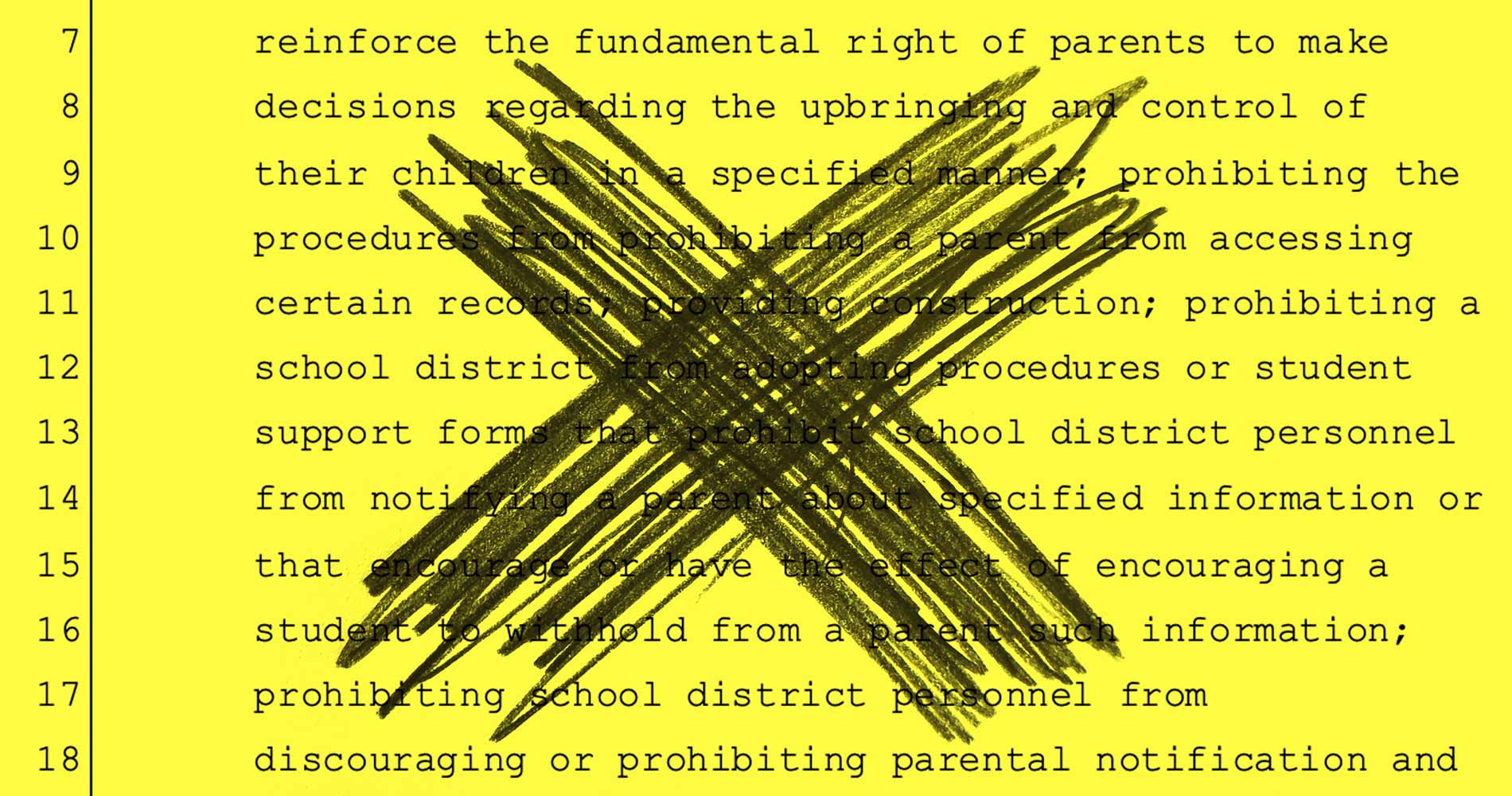
Across the globe, governments are passing anti-LGBTQ+ curriculum laws that curtail queer and gender-inclusive education initiatives, prohibit trans students’ inclusion in sports, and require the use of bathrooms according to sex assigned at birth. Tying these policies together is a common rhetorical theme of “parental rights” that seeks to secure the authority of parents in a child’s upbringing and to ensure “fairness” in school activities.
In North America, one of the first bills to use this rhetoric was Florida’s 2022 Parental Rights in Education Act (PREA). The contents of the bill provide that parents must be allowed to make decisions regarding a child’s mental and physical well-being at school, be notified of any social or health-related changes, and that classroom instruction on gender and sexual identity be age-appropriate.1Parental Rights in Education Act, Florida Stat. § 1001.42 (2022), https://www.flsenate.gov/Session/Bill/2022/1557/BillText/er/PDF.
While the advent of legislation such as Florida’s PREA comes at a time of increasing anti-gender movements worldwide,2Judith Butler. 2024. Who’s Afraid of Gender? Toronto: Alfred A. Knopf Canada. the shift to “parental rights” framing differs from recent opposition models used by anti-LGBTQ+ rights activists. Whereas previous efforts to block LGBTQ+ rights expansions saw discursive frames of religion, morality, and disgust, this new model uses the parental rights frame to weaponize neutrality,3Shannon Moore, and Kevin Lopuck. 2025. “Discursive Decoys: The Legitimation of Homophobia and Transphobia, Educational Neutrality, and Teacher Deprofessionalization in Mainstream Media’s Coverage of the ‘Parental Rights’ Movement in Manitoba.” Canadian Journal of Education/Revue Canadienne de l’éducation. obscuring the overt homophobia and transphobia inherent to parental rights bills.4Cris Mayo. 2021. “Distractions and Defractions: Using Parental Rights to Fight Against the Educational Rights of Transgender, Nonbinary, and Gender Diverse Students.” Educational Policy 35 (2): 368–82. Moreover, by circumventing a discussion of LGBTQ+ rights, the framework reifies cisheteronormativity as the best model for a child’s welfare and upbringing.5Catherine J. Nash, and Kath Browne. 2021. “Resisting the Mainstreaming of LGBT Equalities in Canadian and British Schools: Sex Education and Trans School Friends.” Environment and Planning C: Politics and Space 39 (1): 75.
Despite the shift in framing, the current strategy of deploying parental rights is not new—it is a continuation of preceding oppositional strategies. More specifically, the parental rights debate uses fear and security to achieve institutional change while sanitizing discourses of disgust and moral outrage. Emotion discourse analysis (EDA) helps uncover the emotional discourses of PREA policy debates and demonstrates how the emotional discourses of Florida policymakers share discursive continuity with previous conservative opposition to LGBTQ+ rights.
Emotions and institutions
Institutions are important to understand in politics because they are the formal and informal rules, organizations, and structures that influence political behavior, policy processes, and decision-making capabilities.6Vivien Lowndes, and Mark Roberts. 2013. Why Institutions Matter: The New Institutionalism in Political Science. Houndmills, Basingstoke, Hampshire: Palgrave Macmillan. Often viewed as neutral and rational, an emerging literature in policy studies highlights how institutions are constituted and influenced by emotions through how they build support for policy ideas and legitimacy for policy actions,7Anna Durnova. 2015. “Lost in Translation: Expressing Emotions in Policy Deliberation.” In Handbook of Critical Policy Studies, edited by Frank Fischer, Douglas Torgerson, Anna Durnova, and Michael Orsini, 222–38. mobilise resistance and advocacy,8Michael Orsini, and Sarah M. Wiebe. 2014. “Between Hope and Fear: Comparing the Emotional Landscapes of the Autism Movement in Canada and the United States” in Comparing Canada: Methods and Perspectives on Canadian Politics, ed. Martin Papillon, Luc Turgeon, Jennifer Wallner, and Stephen White (Vancouver: UBC Press, 2014) 147-167. frame and shape policy content,9Stephanie Paterson. 2021. “Emotional Labour: Exploring Emotional Policy Discourses of Pregnancy and Childbirth in Ontario, Canada.” Public Policy and Administration 36 (2): 252–72. shape policy processes,10Rosie Anderson. 2016. “The Sentimental Civil Servant.” In Emotional States: Sites and Spaces of Affective Governance, edited by Eleanor Jupp, Jessica Pykett, and Fiona Smith, 85–98. Routledge. and re/produce social relations within policy contexts.11Stephanie Paterson, and Lindsay and Larios. 2021. “Emotional Problems: Policymaking and Empathy through the Lens of Transnational Motherhood.” Critical Policy Studies 15 (3): 273–91.
To investigate the emotions inherent to policy debates surrounding the PREA, I used EDA. The method is concerned with interpreting language to analyze its emotional potential and contextualizing these sentiments within the broader social, institutional, and political environment.12Simon Koschut. 2023 “Emotion Discourse Analysis,” in Routledge Handbook of Foreign Policy Analysis Methods, ed. Patrick A. Mello and Falk Ostermann (New York: Routledge), 168–184.
To conduct this analysis, I gathered transcripts from all legislative debates, press conferences, social media posts, and committee hearings on the bill from the policymakers who supported it. What this analysis reveals is that, through the use of emotional discourses to inform policy responses, the PREA changed the institutional structuring of Florida education laws to one that is less inclusive and accepting of LGBTQ+ students and families.
Opposition to LGBTQ+ rights advancement
There exists a long history of LGBTQ+ opposition in the United States based on frames of disgust and morality. Using the HIV/AIDS epidemic as a catalyst to assume more influence, anti-LGBTQ+ activists framed queer people as “deviants” and “undeserving” to restrict research funding for HIV/AIDS research. The Save Our Children Campaign, founded in Florida by Anita Bryant, sought to prevent the employment of openly LGBTQ+ people in publicly funded school systems due to fear of moral corruption.
Curricular laws often referred to as “no promo homo” laws gained traction in the 1980s and 1990s citing the risk to public health if same-sex attraction was promoted in classes through mandated curriculum or sexual education. The “Don’t Ask Don’t Tell” policy of the Clinton administration restricted LGBTQ+ service members from coming out due to the perceived corrupting effects on military readiness and troop morale. Opposition to reversing sodomy laws and expanding marriage rights to same-sex partners in the 2000s and 2010s used the morality-based language of traditional gender roles and family values to support anti-LGBTQ+ ballot initiatives and court battles.
With Florida passing the PREA in 2022, the fight over LGBTQ+ policies seemed to take a turn by focusing on rights-based arguments instead of feelings of morality and disgust. However, using EDA reveals that emotions such as disgust and moral outrage still play a part in this debate alongside discourses of fear and security.
Discourses of fear and security
Of the emotional discourses discovered in the collected transcripts, fear and security were the most prevalent. While similar in their usage, they evoke different meanings.
In the debate over parental rights, fear constructs and legitimises policy ideas and solutions. It cements the fact that parents need to be afraid of the current state of education in Florida and allows policymakers to make the case that the state needs to adopt the bill to prevent indoctrination from reaching children. For example, in a press conference, Governor DeSantis stated, “We will make sure that parents can send their kids to school to get an education, not an indoctrination.” Fear was also used to construct and legitimize the idea that the state was encroaching on the rights of parents through gender ideology.
During floor debates State Representative Fernandez-Barquin claimed “In states like California, and in our totalitarian neighbour to the North, Canada, they are terminating parental rights because the parents refuse to affirm a child’s gender orientation,” and State Senator Baxley stated, “I’m always very anxious when it looks like we’re moving away from educating and beginning to socially engineer people as to how they’re supposed to think, feel, and do. I don’t want to wait till we’re like Russia where you have to go to a thought improvement school”. Narratives of indoctrination, government overreach, and gender ideology painted the picture that parental rights were on the precipice of collapse in the state and children were in danger. This frame provokes a response in the public that this bill is necessary to protect both parents and children in Florida.
While fear was dominant in political communication, it was not used in isolation. Supporters of the bill also used the narrative of security in their emotional appeals.
Security is a consequence of fear, but is tempered by hope and the promise of protection. In the debate over the PREA, security presented itself as a need to protect parents and their children from indoctrination, as evidenced by Governor DeSantis tweeting, “…keep indoctrination out and put parents in charge of their children’s futures”. In order to protect against these fears produced by “gender ideology”, policymakers framed the bill as one that would take care of Florida families and empower parents to take charge and protect their children.
Consider, for example, State Representative Elizabeth Fetterhoff who stated in a news release, “Parents, who are their children’s first teachers, should always have a voice and decision making rights in the education of their children.” Here, narratives of security prioritize the importance of parents in a child’s upbringing, distancing the role of the state and teachers in a child’s upbringing. Similarly, State Representative Tom Leek tweeted, “…give our school system back to the parents.” Whereas emotional appeals to fear were used to explain the necessity of the bill, emotional appeals to security were used to promise hope and empowerment to Florida parents.
Emotionalizing security was an effective discursive strategy because it preemptively shut down interventions from opponents of the bill. The security discourse is premised on a binary relation, such that opposition to security was constituted as “anti-security” and therefore not persuasive. Working in tandem with fear, discourses of security convinced the public of the need for drastic changes to education standards. These uses of security point to further policy legitimization on behalf of supporters of the bill, but underneath this legitimization lay dormant frames in conservative opposition—disgust and moral outrage.
Discourses of disgust and moral outrage
Disgust and moral outrage informed the passing of Florida’s PREA during floor debates and committee hearings amongst policymakers. They were used to call into question queerness and gender diversity in the name of protecting the innocence of children. For example, State Senator Baxley stated, “Why is everybody now all about coming out when you’re in school?… I know parents are very concerned about the departure of the core belief systems and values.”
Despite increasing rights and attitudes towards the LGBTQ+ community, these emotions of disgust and moral outrage are still seen to inform policies through beliefs of what queerness or gender diversity are. Take for example how State Senator Garcia believes, “…gay is not a permanent thing,” or how State Senator Burgess advocated for the need to “Protect children’s innocence a little longer.” By espousing these beliefs of impermanence or corruption, policymakers reaffirm emotional appeals of disgust and moral outrage seen in previous opposition movements against LGBTQ+ rights.
Unlike the discourses of fear and security, disgust and moral outrage are hidden from the wider public audience. Instead of appearing in communication directly to the public, for instance, through social media posts or press conferences, these emotional discourses appear in the more formal institutional settings of legislative debates.
In past opposition movements, disgust and moral outrage were useful frames to create, legitimise, and persuade others of socially conservative policy initiatives opposed to LGBTQ+ rights. Now, with increased acceptance of said rights, these discourses are not as useful for legitimization and persuasion, but they remain useful in policy creation. When the bill was being presented to the public, only fear and security were invoked in its favour through discourses of legal—that is, neutral—rights. This demonstrates an awareness among policymakers that disgust and moral outrage are not as salient as they once were in wider public forums. As a result, these emotions remain largely hidden from political debate, yet remain central to the creation of the bill.
This sanitization of disgust and moral outrage demonstrates how the parental rights framework repackages past oppositional strategies to hide inherent homophobia and transphobia through more neutral and legal rights-based discourses based on fear and security.
Conclusion
Through the sanitization of emotional appeals based on disgust and moral outrage, policies based on anti-gender rhetoric and beliefs have seen increasing successes. Canada is no stranger to the strategies used in Florida to pass the PREA with the Alberta and Saskatchewan Legislatures passing similar parental rights bills. Attuning to how these bills are discursively framed using emotions can provide useful analysis as to why the parental rights debate has been so successful for social conservative forces despite steady increases in LGBTQ+ rights and acceptance over the past several decades.
References
Anderson, Rosie. 2016. “The Sentimental Civil Servant.” In Emotional States: Sites and Spaces of Affective Governance, edited by Eleanor Jupp, Jessica Pykett, and Fiona Smith, 85–98. Routledge.
Butler, Judith. 2024. Who’s Afraid of Gender? Toronto: Alfred A. Knopf Canada.
Durnova, Anna. 2015. “Lost in Translation: Expressing Emotions in Policy Deliberation.” In Handbook of Critical Policy Studies, edited by Frank Fischer, Douglas Torgerson, Anna Durnova, and Michael Orsini, 222–38.
Simon Koschut. 2023 “Emotion Discourse Analysis,” in Routledge Handbook of Foreign Policy Analysis Methods, ed. Patrick A. Mello and Falk Ostermann (New York: Routledge), 168–184.
Lowndes, Vivien, and Mark Roberts. 2013. Why Institutions Matter: The New Institutionalism in Political Science. Houndmills, Basingstoke, Hampshire: Palgrave Macmillan.
Mayo, Cris. 2021. “Distractions and Defractions: Using Parental Rights to Fight Against the Educational Rights of Transgender, Nonbinary, and Gender Diverse Students.” Educational Policy 35 (2): 368–82.
Moore, Shannon, and Kevin Lopuck. 2025. “Discursive Decoys: The Legitimation of Homophobia and Transphobia, Educational Neutrality, and Teacher Deprofessionalization in Mainstream Media’s Coverage of the ‘Parental Rights’ Movement in Manitoba.” Canadian Journal of Education/Revue Canadienne de l’éducation.
Nash, Catherine J, and Kath Browne. 2021. “Resisting the Mainstreaming of LGBT Equalities in Canadian and British Schools: Sex Education and Trans School Friends.” Environment and Planning C: Politics and Space 39 (1): 74–93.
Orsini, Michael, and Sarah M. Wiebe. 2014. “Between Hope and Fear: Comparing the Emotional Landscapes of the Autism Movement in Canada and the United States” in Comparing Canada: Methods and Perspectives on Canadian Politics, ed. Martin Papillon, Luc Turgeon, Jennifer Wallner, and Stephen White (Vancouver: UBC Press, 2014) 147-167.
Parental Rights in Education Act, Florida Stat. § 1001.42. 2022. https://www.flsenate.gov/Session/Bill/2022/1557/BillText/er/PDF
Paterson, Stephanie. 2021. “Emotional Labour: Exploring Emotional Policy Discourses of Pregnancy and Childbirth in Ontario, Canada.” Public Policy and Administration 36 (2): 252–72.
Paterson, Stephanie, and Lindsay and Larios. 2021. “Emotional Problems: Policymaking and Empathy through the Lens of Transnational Motherhood.” Critical Policy Studies 15 (3): 273–91.